
Category: Blog

  • Inventory Management in Excel: Easy Templates and Proven Strategies

    Inventory Management in Excel: Easy Templates and Proven Strategies

    Managing inventory is one of the most important parts of running a successful business. Whether you own a small retail shop, an eCommerce store, a warehouse, or even a retail grocery store, keeping track of stock is essential for smooth operations and higher profits. Many businesses think they need expensive software to handle inventory, but the truth is that inventory management in Excel is still one of the most effective and affordable solutions available.

    With the right inventory excel template, you can organize stock, track sales, monitor reorder levels, and avoid costly mistakes like overstocking or stockouts. Excel offers flexibility, customization, and simplicity, making it a smart choice for startups and growing businesses alike.

    In this guide, we’ll explore how to use Excel for inventory control, how to build an effective inventory management spreadsheet, and the best templates and strategies to simplify your workflow.

    Why Choose Inventory Management in Excel?

    Before investing in expensive inventory platforms, many businesses start with inventory management excel systems because they are budget-friendly and easy to customize.

    Here’s why Excel works so well:

    • Low cost compared to inventory software
    • Easy to use and widely available
    • Flexible for different industries
    • Supports formulas and automation
    • Ideal for small to medium-sized businesses
    • Allows customized reporting and forecasting

    Many business owners use free inventory management software in Excel before moving to advanced ERP systems.

    What Is an Inventory Spreadsheet?

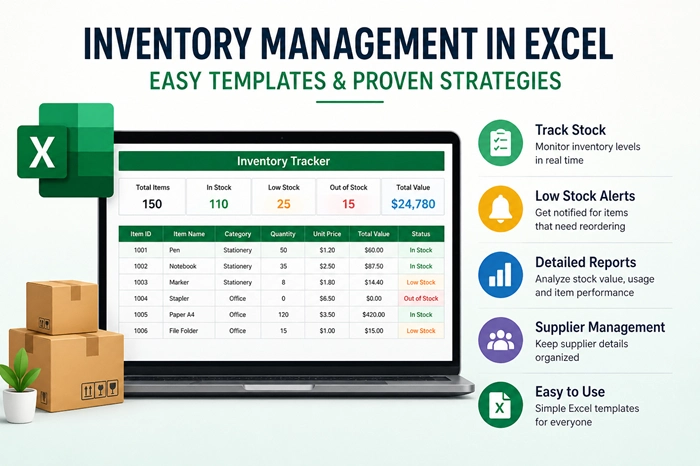
    inventory management in excel

    An inventory spreadsheet is a structured file used to track stock levels, purchases, sales, suppliers, and reorder points.

    A typical sample inventory spreadsheet includes:

    • Product name
    • SKU or item code
    • Product category
    • Quantity in stock
    • Unit price
    • Supplier details
    • Reorder level
    • Stock status
    • Last updated date

    This simple inventory tracking sheet helps prevent inventory loss and improves decision-making.

    Essential Types of Inventory Excel Templates

    Different businesses require different templates. Let’s explore the most useful ones.

    1. Inventory List Template

    An inventory list template is the most basic form of inventory tracking. It helps businesses maintain a record of all available stock.

    This template is ideal for:

    • Small stores
    • Home businesses
    • Startups
    • Warehouses
    • Office supplies tracking

    If you’re wondering how to create an inventory list, this is the best place to start.

    2. Inventory Tracking Sheet

    An inventory tracking sheet helps monitor stock movement in real time.

    It tracks:

    • Incoming stock
    • Outgoing stock
    • Damaged products
    • Returns
    • Transfers between locations

    This improves visibility and supports accurate stock control.

    3. Inventory Management Spreadsheet

    A full inventory management spreadsheet goes beyond simple tracking and includes:

    • Sales tracking
    • Purchase records
    • Supplier management
    • Reorder alerts
    • Profit calculations

    This works as an excellent inventory control software in Excel for small businesses.

    4. Equipment Inventory Template Excel

    Businesses managing tools, machinery, or office assets need an equipment inventory template Excel file.

    It tracks:

    • Equipment ID
    • Purchase date
    • Maintenance schedule
    • Assigned department
    • Asset condition
    • Warranty details

    This helps improve asset utilization and maintenance planning.

    5. Retail Grocery Store Logistic Inventory Template

    Retail and grocery businesses need fast-moving stock management.

    A retail grocery store logistic inventory template helps manage:

    • Perishable items
    • Batch tracking
    • Supplier deliveries
    • Expiry dates
    • Fast-moving goods

    This is especially useful for supermarkets and grocery chains.

    How to Create an Inventory Spreadsheet in Excel

    Many people have query, how to create an inventory spreadsheet in excel

    Let’s break it down step by step.

    Step 1: Open Excel and Create a New Workbook

    Start by opening Excel and selecting a blank workbook.

    You can also create a new file based on the inventory list template if you already have a sample template available.

    This saves time and ensures consistency.

    Step 2: Add Your Column Headers

    Your basic headers should include:

    Item IDProduct NameCategoryQuantityUnit PriceSupplierReorder LevelStock Status

    This serves as your basic sample inventory sheet.

    Step 3: Enter Product Data

    Start filling in product details carefully.

    Use consistent naming conventions and avoid duplicate entries.

    This improves reporting accuracy.

    Step 4: Use Formulas for Automation

    Excel formulas make excel stock management much easier.

    Useful formulas include:

    Total Inventory Value

    =Quantity * Unit Price

    Low Stock Alert

    =IF(Quantity<=Reorder_Level,”Reorder”,”In Stock”)

    SUM for Total Stock

    =SUM(range)

    This turns your spreadsheet into an effective inventory tracking system Excel solution.

    Step 5: Apply Conditional Formatting

    Highlight:

    • Low stock items
    • Expired products
    • Overstocked inventory

    This improves visibility instantly.

    Step 6: Use Data Validation

    Dropdown lists help standardize:

    • Categories
    • Supplier names
    • Stock status

    This reduces manual errors significantly.

    Step 7: Save in Proper Excel Format

    Always use the correct excel format for inventory management such as:

    • .xlsx
    • .xlsm (for macros)
    • Cloud storage backup

    This protects data and improves accessibility.

    Best Excel Features for Inventory Management

    Excel becomes much more powerful when advanced features are used properly. Many businesses underestimate how effective these tools can be for inventory control.

    Pivot tables are one of the best features for inventory analysis. They help identify top-selling products, slow-moving stock, supplier performance, and seasonal trends. Instead of manually reviewing data, pivot tables provide instant business insights.

    Charts and dashboards also improve inventory visibility. They allow managers to see stock movement trends, reorder patterns, and forecasting data in a visual format. This supports faster decision-making and better planning.

    Functions like VLOOKUP and XLOOKUP make it easier to find product details quickly, especially when managing large inventories. Instead of searching manually, users can instantly pull supplier information, pricing, or stock status.

    Macros can automate repetitive tasks such as report generation, inventory updates, and reorder notifications. This saves time and makes Excel feel like professional inventory management system Excel free software.

    Inventory Forecasting Excel Template

    One of the smartest strategies in inventory management is forecasting. Businesses that forecast inventory properly reduce waste, improve cash flow, and avoid costly stock shortages.

    An inventory forecasting excel template helps predict future stock needs based on past sales, seasonal demand, supplier lead times, and business growth patterns.

    For example, if a grocery store sees higher demand for certain products during festive seasons, forecasting helps prepare stock in advance. This prevents lost sales and improves customer satisfaction.

    Forecasting also helps businesses avoid over-ordering. Overstocking ties up cash and increases storage costs, while understocking causes missed sales opportunities. Excel helps maintain the right balance.

    This is why inventory forecasting should be considered a core part of every inventory management spreadsheet, not just an optional feature.

    Inventory Spreadsheet Example for Small Businesses

    Here’s a simple inventory spreadsheet example structure:

    Product Example

    SKUProduct NameCurrent StockReorder PointSupplier
    P001Rice Bag 25kg12050ABC Supplier
    P002Cooking Oil8030XYZ Traders

    This simple stock sheet example works well for grocery stores and retail shops.

    Free Inventory Sheets vs Paid Software 

    FeatureFree Inventory Sheets (Excel)Paid Inventory Software
    CostLow cost or completely free if Excel is already availableMonthly or yearly subscription fees required
    SetupQuick and easy to set up using an inventory excel templateRequires installation, setup, and sometimes training
    CustomizationHighly flexible and can be customized for specific business needsLimited customization depending on the software provider
    Best ForStartups, small businesses, retail shops, and warehousesLarge businesses with complex inventory operations
    Stock TrackingSupports manual and formula-based stock trackingReal-time automated stock tracking
    Reorder AlertsCan be created using formulas and conditional formattingBuilt-in automated reorder notifications
    Barcode ScanningUsually requires manual setup or add-onsCommonly included as a standard feature
    Multi-Warehouse SupportDifficult to manage for large operationsEasily supports multiple warehouses and locations
    ERP IntegrationLimited or manual integrationStrong integration with ERP, accounting, and POS systems
    ReportingBasic reporting with pivot tables and chartsAdvanced dashboards, analytics, and forecasting
    ScalabilitySuitable for small to medium inventory needsDesigned for high-volume and enterprise-level operations
    MaintenanceManaged manually by the business ownerSupported by the software provider
    Ideal ChoiceBest for businesses starting with inventory management in ExcelBest for businesses with advanced inventory requirements

    Common Inventory Management Mistakes

    Avoid these mistakes:

    1. Not Updating Inventory Daily

    Delayed updates cause major reporting errors.

    2. Ignoring Reorder Levels

    This leads to stockouts and lost sales.

    3. Poor Supplier Tracking

    Weak supplier management increases delays.

    4. No Backup System

    Always maintain cloud backups.

    5. No Inventory Forecasting

    Without forecasting, businesses often overstock or understock.

    Proven Strategies for Better Inventory Management

    Strong inventory management is not just about templates—it also requires smart operational strategies.

    Using the FIFO method, which stands for First In, First Out, is especially important for grocery stores, food businesses, cosmetics, and pharmaceuticals. This method ensures older stock is sold first, reducing waste and expiry losses.

    Regular stock audits are also critical. Weekly checks, monthly reviews, and quarterly audits help identify errors before they become expensive problems. Physical stock should always match spreadsheet records.

    ABC analysis is another proven strategy where products are grouped based on value. High-value products receive more attention, while low-value items are managed with simpler controls. This improves focus and efficiency.

    Supplier performance reviews should also be part of the process. Tracking delivery speed, product quality, and price consistency helps improve procurement decisions and reduces supply chain risks.

    Most importantly, businesses should maintain centralized inventory tracking. Multiple disconnected files create confusion. A single organized inventory management spreadsheet improves collaboration, while platforms such as BlueTally can provide a more centralized approach to asset management.

    How to Create an Inventory Sheet in Excel for Different Industries

    Different industries need customized systems.

    1. Retail Stores

    Focus on:

    • Fast-moving items
    • Promotions
    • Supplier restocking

    2. Manufacturing

    Focus on:

    • Raw materials
    • Work-in-progress
    • Finished goods

    3. Healthcare

    Focus on:

    • Expiry tracking
    • Batch numbers
    • Compliance

    4. Offices

    Use equipment inventory template Excel for assets and supplies

    Final Thoughts

    Learning how to create an inventory sheet in Excel is one of the smartest decisions for any business owner. You do not need expensive tools to stay organized. With the right inventory excel template, smart formulas, and proven strategies, Excel can become a powerful inventory control system.

    Whether you’re looking for a sample inventory spreadsheet, a stock sheet example, or a complete inventory management system Excel free setup, Excel gives you the flexibility to build exactly what your business needs.

    If you’re ready to improve stock control, reduce waste, and increase profits, now is the perfect time to build your own Excel-based inventory system.

    Frequently Asked Questions (FAQs)

    1. What is inventory management in Excel?

    Inventory management in Excel is the process of using spreadsheets to track stock levels, product movement, supplier details, and reorder points. Businesses use an inventory management excel system to organize stock without investing in expensive software.

    2. Is Excel good for inventory management?

    Yes, Excel is a great option for small and medium-sized businesses. It offers flexibility, affordability, and customization. With the right inventory excel template, you can manage stock, automate calculations, and improve inventory control efficiently.

    3. How do I create an inventory spreadsheet in Excel?

    To create an inventory spreadsheet, open a blank workbook and add columns like product name, SKU, quantity, supplier, reorder level, and stock status. This helps build a basic inventory tracking sheet for daily stock management.

    Many users search for:

    • how to create an inventory spreadsheet
    • how to make an inventory spreadsheet
    • how to create an inventory spreadsheet in excel
    • how to make inventory spreadsheet on excel

    4. What should be included in a sample inventory spreadsheet?

    A good sample inventory spreadsheet should include:

    • Product ID or SKU
    • Product name
    • Category
    • Quantity available
    • Unit price
    • Supplier details
    • Reorder level
    • Stock status
    • Last updated date

    This structure creates a reliable sample inventory sheet for businesses.

    5. Can I get free inventory sheets for Excel?

    Yes, many businesses use free inventory sheets to start tracking stock. These templates are perfect for startups, small retailers, warehouses, and service businesses looking for low-cost inventory solutions.

    6. What is the best inventory list template for small businesses?

    The best inventory list template depends on your business type. Retail shops may need sales tracking, while warehouses may require stock movement records. A simple inventory management spreadsheet with reorder alerts is usually ideal for small businesses.

    7. What is an inventory tracking system in Excel?

    An inventory tracking system Excel setup helps businesses monitor incoming stock, outgoing stock, returns, damaged items, and reorder levels. It improves visibility and reduces manual inventory errors.

    8. Can Excel work as free inventory management software?

    Yes, Excel can function as free inventory management software in Excel when set up properly with formulas, templates, and automation features like conditional formatting and pivot tables.

    Many businesses also call it an inventory management system Excel free solution.

    9. How do I create an inventory sheet in Excel for equipment tracking?

    You can use an equipment inventory template Excel file to track business assets like laptops, tools, machinery, and office furniture. Include fields such as asset ID, purchase date, condition, warranty, and maintenance schedule.

    10. What is an inventory forecasting Excel template?

    An inventory forecasting excel template helps predict future stock needs based on sales history, seasonal demand, and supplier lead times. It helps businesses avoid overstocking and stock shortages.

    11. What is the correct Excel format for inventory management?

    The best excel format for inventory management is usually .xlsx for standard files and .xlsm for macro-enabled spreadsheets. Cloud backups are also recommended for data security.

    12. Can I use Excel for retail grocery store inventory?

    Yes, a retail grocery store logistic inventory template is highly useful for supermarkets and grocery stores. It helps track perishable goods, expiry dates, supplier deliveries, and fast-moving stock efficiently.

  • What Is Contribution Margin Ratio and How to Use It for Profit Analysis

    What Is Contribution Margin Ratio and How to Use It for Profit Analysis

    The contribution margin ratio is a financial metric that shows the percentage of revenue remaining after subtracting variable costs. In simple terms, it tells you how much of your sales income is available to cover fixed expenses and generate profit.

    Every business incurs two main types of costs: variable costs and fixed costs. Variable costs change depending on how much you produce or sell, while fixed costs remain constant regardless of sales volume. The contribution margin ratio focuses only on variable costs, making it especially useful for short-term decision-making and operational analysis.

    To put it simply, when you sell a product or service, not all of the revenue becomes profit. A portion goes toward covering costs like materials, shipping, or commissions. The remaining portion the contribution is what helps pay fixed costs like rent and salaries and eventually contributes to profit. The ratio expresses this contribution as a percentage of total revenue, making it easier to evaluate efficiency.

    A higher contribution margin ratio indicates that a larger share of revenue is contributing toward profitability. This usually signals a healthier business model with better cost control and pricing strategies.

    Contribution Margin Ratio Formula

    contribution margin ratio formula

    Understanding the formula behind the contribution margin ratio is essential for applying it correctly in real-world scenarios.

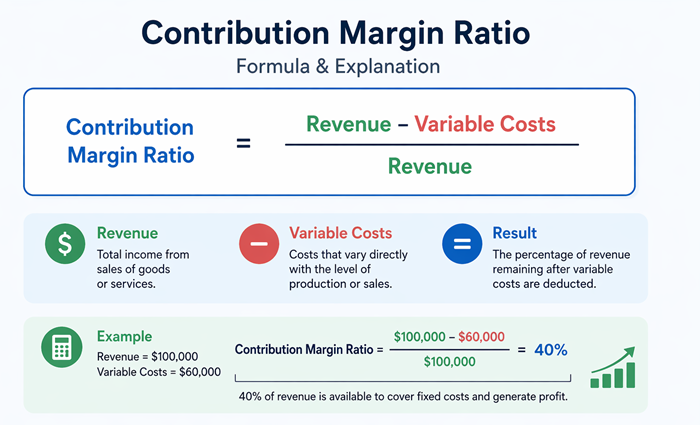
    Contribution Margin Ratio=Revenue – Variable CostsRevenue\text{Contribution Margin Ratio} = \frac{\text{Revenue – Variable Costs}}{\text{Revenue}}Contribution Margin Ratio=RevenueRevenue – Variable Costs​

    This formula calculates the proportion of revenue that remains after variable expenses are deducted. The result is typically expressed as a percentage, which makes it easy to interpret and compare across products, services, or time periods.

    You can also calculate it on a per-unit basis, which is especially useful for product-based businesses:

    CM Ratio=Selling Price per Unit – Variable Cost per UnitSelling Price per Unit\text{CM Ratio} = \frac{\text{Selling Price per Unit – Variable Cost per Unit}}{\text{Selling Price per Unit}}CM Ratio=Selling Price per UnitSelling Price per Unit – Variable Cost per Unit​

    Both approaches lead to the same conclusion, but the per-unit method gives deeper insight into individual product performance.

    Understanding Revenue and Variable Costs

    To calculate the contribution margin ratio accurately, it’s important to clearly distinguish between revenue and variable costs. Revenue refers to the total income generated from sales before any expenses are deducted. It represents the starting point of your financial analysis.

    Variable costs, on the other hand, fluctuate with your level of production or sales. These costs increase as you produce more and decrease when production slows down. Common examples include raw materials, packaging, shipping fees, sales commissions, and direct labor tied to production.

    Fixed costs are not included in this calculation, which is a common point of confusion. Expenses like rent, insurance, and administrative salaries remain constant regardless of sales volume, so they are excluded from the contribution margin ratio formula.

    Contribution Margin vs Contribution Margin Ratio

    AspectContribution MarginContribution Margin Ratio
    DefinitionThe absolute amount left after subtracting variable costs from revenueThe percentage of revenue remaining after variable costs
    FormulaRevenue – Variable Costs(Revenue – Variable Costs) ÷ Revenue
    RepresentationExpressed as a monetary value (e.g., $5,000)Expressed as a percentage (e.g., 50%)
    PurposeShows total contribution toward fixed costs and profitShows efficiency of converting revenue into profit
    Comparison UseLess useful for comparing different products or businessesMore useful for comparing performance across products or units
    Insight ProvidedIndicates total earnings available after variable costsIndicates profitability efficiency and cost structure

    Example of Contribution Margin Ratio

    Let’s consider a simple example to make this concept more concrete. Imagine a business generates revenue of $100,000 and incurs $40,000 in variable costs. The contribution margin would be $60,000, which represents the amount available to cover fixed costs and profit.

    When you divide this contribution margin by total revenue, you get a contribution margin ratio of 60%. This means that for every dollar earned, 60 cents contribute toward covering fixed expenses and generating profit.

    This percentage becomes incredibly valuable when making financial decisions, as it gives you a clear understanding of how efficient your operations are.

    Why Contribution Margin Ratio Matters

    The contribution margin ratio is not just a formula—it’s a decision-making tool.

    Here’s why it’s important:

    1. Helps Measure Profitability

    It shows how efficiently your business converts sales into profit. A higher ratio means more money is available after covering variable costs.

    2. Supports Pricing Decisions

    You can determine whether your pricing strategy is sustainable or needs adjustment.

    3. Improves Cost Control

    It highlights whether variable costs are eating into your margins.

    4. Guides Product Strategy

    You can identify:

    • High-performing products
    • Low-margin products
    • Products to discontinue

    Using Contribution Margin Ratio for Profit Analysis

    One of the most powerful applications of the contribution margin ratio is in profit analysis. It allows businesses to go beyond surface-level revenue figures and understand the mechanics of profitability.

    When analyzing profit, the first step is often determining the break-even point. The contribution margin ratio makes this possible by showing how much revenue is needed to cover fixed costs. Once fixed costs are covered, any additional contribution becomes profit.

    This insight is particularly useful for setting sales targets. If you know your contribution margin ratio, you can estimate how much revenue is required to achieve a desired level of profit. This transforms abstract financial goals into concrete, actionable numbers.

    The ratio also plays a key role in pricing decisions. If your contribution margin ratio is too low, it may indicate that your prices are too low or your variable costs are too high. Adjusting either of these factors can significantly improve profitability.

    Another important use is in product analysis. Not all products contribute equally to profit, even if they generate similar revenue. By comparing contribution margin ratios across products, businesses can identify which ones are worth promoting and which ones may need to be re-evaluated.

    Break-Even Analysis and Decision Making

    Break-even analysis is one of the most practical applications of the contribution margin ratio. It helps businesses determine the point at which total revenue equals total costs, resulting in zero profit.

    Once you know your contribution margin ratio, you can calculate how much revenue is required to cover fixed costs. This provides a clear benchmark for financial stability and helps businesses avoid operating at a loss.

    Understanding the break-even point also reduces risk when launching new products or entering new markets. It allows you to assess whether your pricing and cost structure are sustainable before making major investments.

    High vs Low Contribution Margin Ratio

    A high contribution margin ratio generally indicates a strong and efficient business model. It means that a large portion of revenue is available to cover fixed costs and generate profit. Businesses with high ratios typically have more flexibility in pricing and are better equipped to handle fluctuations in sales.

    A low contribution margin ratio, on the other hand, suggests that variable costs are consuming a large portion of revenue. This can make it difficult to achieve profitability, especially if sales volume is inconsistent. Businesses in this situation may need to focus on reducing costs, increasing prices, or improving operational efficiency.

    Common Mistakes to Avoid

    1. Ignoring Fixed Costs

    CM ratio doesn’t include fixed costs—so don’t rely on it alone.

    2. Misclassifying Costs

    Incorrectly labeling costs can distort results.

    3. Using It as the Only Metric

    It’s powerful—but should be combined with:

    • Net profit margin
    • Gross margin
    • ROI

    How to Improve Contribution Margin Ratio

    Improving your contribution margin ratio requires a combination of strategic pricing, cost control, and operational efficiency. Businesses often start by analyzing their variable costs to identify areas where expenses can be reduced without compromising quality.

    Increasing prices can also improve the ratio, but this must be done carefully to avoid losing customers. In many cases, the most effective approach is to focus on high-margin products and optimize processes to reduce waste and inefficiencies.

    Small improvements in the contribution margin ratio can have a significant impact on overall profitability, especially as sales volume increases.

    Final Thoughts

    The contribution margin ratio is more than just a financial formula it’s a practical tool that helps businesses understand how revenue turns into profit. By focusing on the relationship between sales and variable costs, it provides valuable insights that can guide pricing, cost management, and strategic planning.

    For business owners and decision-makers, mastering this metric can lead to smarter choices and stronger financial performance. When used consistently, it becomes a reliable guide for improving profitability and building a sustainable business.

    If you want to grow your business with confidence, start paying close attention to your contribution margin ratio. It might just be the missing piece in your profit strategy.

    FAQs About Contribution Margin Ratio

    1. What is the contribution margin ratio in simple terms?

    The contribution margin ratio is the percentage of revenue left after covering variable costs. It shows how much of each sale contributes toward fixed costs and profit. In simple words, it tells you how efficiently your business turns sales into actual earnings.

    2. What is a good contribution margin ratio?

    A “good” contribution margin ratio depends on the industry, but generally, a higher ratio is better. Businesses with a ratio above 50% are often considered efficient because they retain more revenue after covering variable costs. However, some industries naturally operate with lower margins due to high production costs.

    3. How is contribution margin ratio different from profit margin?

    The contribution margin ratio only considers variable costs, while profit margin includes both variable and fixed costs. This makes the contribution margin ratio more useful for short-term decisions like pricing and cost control, while profit margin reflects overall business profitability.

    4. Why is contribution margin ratio important for businesses?

    It helps businesses understand how much revenue contributes to profit after covering variable costs. This makes it easier to:

    • Set pricing strategies
    • Control costs
    • Analyze product profitability
    • Plan for growth

    5. Can contribution margin ratio be negative?

    Yes, a contribution margin ratio can be negative if variable costs are higher than revenue. This means the business is losing money on each sale, which is a serious issue that requires immediate attention.

    6. How do you improve contribution margin ratio?

    You can improve the contribution margin ratio by increasing prices, reducing variable costs, or focusing on high-margin products. Even small improvements can significantly boost overall profitability over time.

    7. What costs are included in contribution margin ratio?

    Only variable costs are included, such as raw materials, shipping, commissions, and direct labor. Fixed costs like rent, salaries, and utilities are not part of the calculation.

    8. How does contribution margin ratio help in break-even analysis?

    The contribution margin ratio is used to calculate the break-even point, which is the level of sales needed to cover all fixed costs. It helps businesses determine how much they need to sell before they start making a profit.

    9. Is contribution margin ratio useful for small businesses?

    Yes, it is especially useful for small businesses because it provides clear insights into pricing, cost control, and profitability. It helps owners make informed decisions without needing complex financial tools.

    10. What industries use contribution margin ratio the most?

    The contribution margin ratio is widely used across industries, including retail, manufacturing, SaaS, and eCommerce. Any business that wants to understand cost behavior and profitability can benefit from using this metric.

  • What Does Remittance Address Mean in Billing and Payments?

    What Does Remittance Address Mean in Billing and Payments?

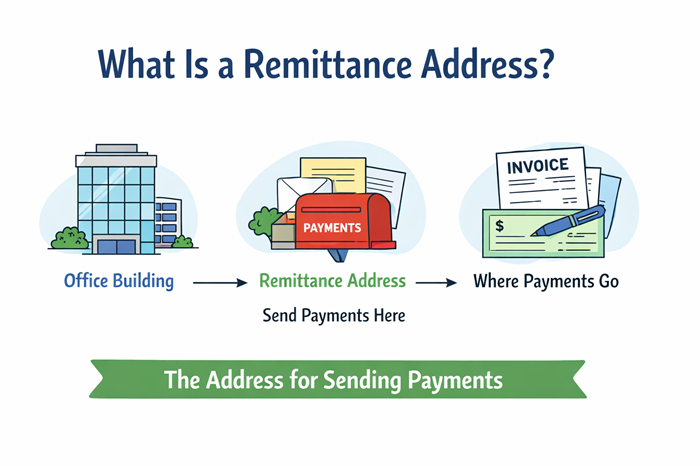
    A remittance address is the specific address where a business wants to receive payments. It is commonly labeled as “Remit To” on invoices and billing documents.

    Instead of sending payments to a company’s main office or headquarters, customers are instructed to send money directly to this designated address. This helps businesses streamline their payment collection process and avoid confusion.

    In many cases, the remittance address is not even the same as the company’s physical location. It could be a P.O. box, a lockbox managed by a bank, or a dedicated payment processing center.

    Think of it this way:
    A company may operate from one location, but it prefers to receive money at another location specifically designed for handling payments.

    what is remittance address

    Why Is a Remittance Address Important in Billing and Payments?

    At first glance, a remittance address might seem like a small detail. However, it has a significant impact on how efficiently a business manages its finances.

    A. Improves Payment Accuracy

    When customers send payments to the correct address, the chances of errors drop significantly. There’s less risk of payments being lost, delayed, or misdirected.

    This is especially important for businesses handling a high volume of transactions, where even small mistakes can create major disruptions.

    B. Speeds Up Payment Processing

    A dedicated remittance address ensures that payments go directly to the team or system responsible for processing them. This eliminates unnecessary steps and speeds up the entire workflow.

    Faster processing means:

    • Quicker invoice reconciliation
    • Better cash flow management
    • Improved financial visibility

    C. Enhances Organization

    Separating payment handling from daily business operations allows companies to stay organized. Financial documents, checks, and payment confirmations are all managed in one place.

    This makes bookkeeping and auditing much easier over time.

    How a Remittance Address Works in Real Life

    Imagine you receive an invoice from a service provider. The invoice includes two addresses:

    • A company office address
    • A “Remit To” address

    Even though both belong to the same business, you should always send your payment to the remittance address.

    Why? Because that address is specifically set up to receive and process payments efficiently.

    For example, a company based in Mumbai might use a remittance address in Bangalore where its finance team or banking partner handles incoming payments.

    What Does a Remittance Address Include?

    A remittance address looks like a standard mailing address but is clearly labeled for payments.

    It usually contains:

    • Business or recipient name
    • Street address or P.O. Box
    • City, state, and postal code
    • Country (for international payments)

    The key difference is not the format—it’s the purpose. This address is exclusively used for receiving money.

    Remittance Address vs Billing Address

    Many people confuse a remittance address with a billing address, but they serve completely different purposes.

    Remittance Address

    This is where payments are sent. It appears on invoices and is used by businesses to collect funds.

    Billing Address

    This is the address associated with your payment method, such as a credit or debit card. It is used for verification and fraud prevention.

    To put it simply:

    • Billing address = who is paying
    • Remittance address = where the payment goes

    Understanding this distinction is essential to avoid payment errors and delays.

    Remittance Address vs Other Address Types

    In business transactions, multiple addresses may be used, and each serves a unique role.

    A mailing address is used for general communication. A shipping address is where goods are delivered. A corporate address represents the official business location.

    The remittance address, on the other hand, is strictly for receiving payments.

    Keeping these addresses separate helps businesses operate more efficiently and reduces confusion for customers.

    The Role of Remittance Address in Business Operations

    A remittance address plays a critical role in maintaining smooth financial operations.

    1. Better Cash Flow Management

    When payments are received and processed quickly, businesses can maintain a steady cash flow. This is essential for covering expenses, paying employees, and investing in growth.

    2. Simplified Accounting

    Having a centralized location for payments makes it easier to track transactions, manage records, and prepare financial reports.

    3. Reduced Administrative Burden

    By directing payments to a specific location, businesses reduce the time spent sorting mail, correcting errors, and following up on missing payments.

    Remittance Address in Digital Payments

    With the rise of digital payments, the concept of a remittance address has evolved.

    Today, businesses often use a remittance email address or include payment instructions in digital invoices. Instead of sending physical checks, customers can transfer money electronically while still referencing the remittance details.

    Modern accounting software allows businesses to:

    • Add remittance information automatically
    • Track payments in real time
    • Send reminders to clients

    This integration improves efficiency and reduces manual work.

    Common Mistakes to Avoid

    Even though the concept is simple, people often make mistakes with remittance addresses.

    1. Sending Payment to the Wrong Address

    Always double-check the “Remit To” section on invoices.

    2. Confusing It With Billing Address

    Using your billing address instead of the remittance address can delay payments.

    3. Ignoring Updates

    Businesses sometimes change their remittance address—so always use the latest invoice.

    4. Missing International Details

    For global payments, ensure:

    • Country name is included
    • Postal codes are correct

    When Do You Need a Remittance Address?

    You’ll encounter remittance addresses in several situations:

    • Paying invoices (freelancers, vendors, utilities)
    • Sending business payments
    • Making international transfers
    • Receiving payments as a business owner

    If you run a business, you should consider creating one when:

    • You receive frequent payments
    • You want better organization
    • You’re scaling operations

    Example of a Remittance Address in Business

    example of remittance address

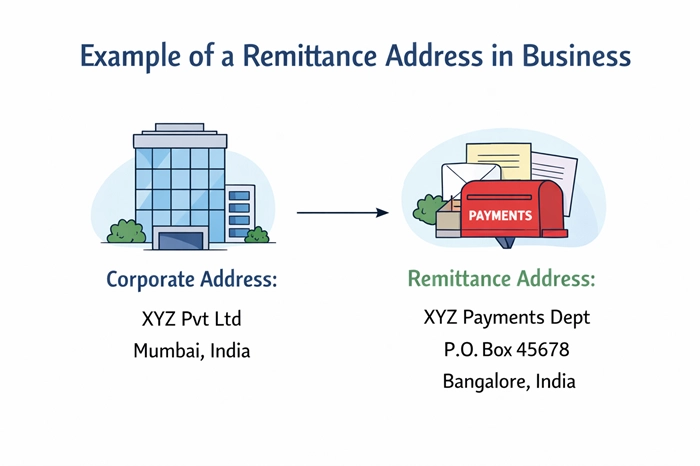
    Here’s a simplified example:

    Corporate Address:
    XYZ Pvt Ltd
    Mumbai, India

    Remittance Address:
    XYZ Payments Dept
    P.O. Box 45678
    Bangalore, India

    In this case:

    • The corporate office handles operations
    • The remittance address handles payments

    This separation ensures smoother financial workflows.

    How to Set Up a Remittance Address

    If you’re a business owner, setting up a remittance address is straightforward.

    Step 1: Choose a Location

    Options include:

    • Office address
    • P.O. Box
    • Bank processing center

    Step 2: Update Your Invoices

    Clearly label the address as:
      “Remit To”

    Step 3: Inform Clients

    Make sure customers know where to send payments.

    Step 4: Monitor the Address

    Check it regularly to avoid missed payments.

    Frequently Asked Questions (FAQs)

    Q. What is a remittance address in simple terms?

    A remittance address is the address where a business asks you to send payments. It is usually listed on invoices under “Remit To.”

    Q. Is a remittance address the same as a billing address?

    No, they are different. A billing address is linked to your payment method, while a remittance address is where the payment is sent.

    Q. Can a remittance address be different from a business address?

    Yes, and in many cases, it is different. Businesses often use separate addresses to manage payments more efficiently.

    Q. Do digital payments use remittance addresses?

    Yes. Even in digital payments, businesses provide remittance details such as bank information or email addresses to receive payments.

    Q. What happens if I send payment to the wrong address?

    Sending payment to the wrong address can result in delays, lost payments, or additional processing time. Always check the invoice carefully before making a payment.

    Q. Why do companies use P.O. boxes as remittance addresses?

    P.O. boxes are secure and easy to manage. They allow businesses to collect payments in one centralized location without exposing their main office address.

    Q. Is a remittance address required for small businesses?

    While not mandatory, it is highly recommended. It helps small businesses stay organized and ensures smoother payment processing.

    Final Thoughts

    A remittance address is the specific location where a business receives payments, clearly mentioned on invoices to guide customers on where to send money. It may differ from the company’s main office and is often used to streamline payment processing.

    Its relevance in billing and payments is significant because it ensures accuracy, reduces delays, and improves overall financial organization. By directing payments to a dedicated address, businesses can process transactions faster, maintain better cash flow, and avoid confusion. Whether in traditional or digital payments, using the correct remittance address helps both businesses and customers complete transactions smoothly, making it an essential part of efficient financial management.

  • Which Features Matter Most in Agency Hosting?

    Which Features Matter Most in Agency Hosting?

    Not all hosting plans are built for the way agencies work. What functions perfectly for a freelancer running a personal blog or a small business maintaining a single site quickly falls apart when you’re managing a portfolio of client websites with varying demands, tight deadlines, and zero tolerance for downtime.

    Yet many agencies still make hosting decisions based on surface-level comparisons, choosing providers based on price, storage quotas, or brand familiarity. The features that actually determine whether a hosting platform can support agency operations rarely show up in side-by-side comparison charts. They live in the daily workflow, the tools your team reaches for under pressure, and the systems that quietly prevent problems before anyone notices.

    So which features genuinely matter when your agency’s reputation is on the line? Here’s where you should focus your evaluation:

    Centralized Multi-Site Management

    Managing client websites one at a time is unsustainable at scale. Logging into individual dashboards, running updates site by site, and tracking performance across disconnected interfaces eats into hours that should be spent on billable work. A hosting platform built for agencies consolidates everything into a single control panel where you can monitor uptime, push updates, manage domains, and review performance metrics across your entire portfolio.

    Centralized management reduces the risk of oversight. When every site is visible in one place, it’s far more difficult for a missed update or an expiring SSL certificate to slip through unnoticed.

    Staging Environments That Actually Work

    Every agency has experienced the fallout from pushing an untested change to a live site. It could be a theme update that breaks the layout, a plugin conflict that crashes the checkout page, or a code deployment that introduces unexpected errors. Staging environments eliminate this risk by giving your team a safe space to test changes before they go live.

    The key distinction is how effortless the staging process is. The best platforms offer one-click staging creation and seamless deployment to production. If setting up a staging site requires manual server configuration or technical workarounds, it significantly increases the risk of mistakes when deadlines are looming.

    Robust Security as a Default

    Agencies are attractive targets for cyberattacks because a single compromised account can expose dozens of client sites. Security features shouldn’t be premium add-ons you discover only after a breach. They should come standard with your hosting plan.

    At a minimum, look for free SSL certificates across all sites, automated malware scanning, a server-level Web Application Firewall (WAF), DDoS protection, and two-factor authentication for every user with account access. These layers work together to create a defense system that protects your clients without requiring your team to manually configure each safeguard.

    Reliable Automated Backups

    When things go wrong, and they inevitably will, your ability to recover depends entirely on the quality of your backups. Providers of reliable web hosting for agencies offer platforms that perform automated daily backups of every site on your account. These backups are retained for at least 30 days, with one-click restore functionality that lets you roll back individual sites without affecting others.

    During a crisis, you can’t rely on backups that require manual initiation or support tickets. Removing the human bottleneck is the entire point of automation; recovery happens quickly and confidently, even at two in the morning.

    Scalable Resources on Demand

    Client needs are unpredictable. A product launch, a viral social media moment, or a seasonal traffic surge can multiply a site’s resource requirements overnight. If your hosting environment operates on fixed resource allocations, those spikes become outages instead of opportunities.

    Scalable hosting adjusts CPU, memory, and bandwidth dynamically based on real-time demand. This ensures that a traffic surge on one client site doesn’t degrade performance across the rest of your portfolio. Scalable models ensure resources match actual demand, so your infrastructure stays efficient without unnecessary overhead.

    Developer-Friendly Tooling

    SSH access, Git integration, WP-CLI support, and compatibility with modern development workflows are essential for teams that ship work efficiently. A hosting platform that restricts these tools forces developers into manual workarounds that slow down every project and introduce unnecessary friction.

    Evaluate hosting platforms from your developers’ perspective, not just from the management’s point of view. The team doing the hands-on work will know immediately whether a platform supports their workflow.

    Prioritizing What Impacts Your Operations

    Feature lists can be overwhelming, and every hosting provider markets their offering as the complete solution. You should focus on the features that directly affect your agency’s daily operations.

    Centralized management, effortless staging, built-in security, automated backups, scalable supports growth. The right hosting partner becomes an invisible part of your team, handling the infrastructure so your people can focus entirely on delivering exceptional work for every client you serve.resources, and developer-friendly tools form the foundation of a hosting environment that 

  • What is a Dividend? How It Works and Why They Matter for Companies

    What is a Dividend? How It Works and Why They Matter for Companies

    A dividend is a portion of a company’s profit that is distributed to its shareholders (investors). When a company earns profit, it can either:

    • Reinvest the money back into the business (for growth), or
    • Share a part of the profit with its investors

    That shared portion is called a dividend.

    Simple Example

    Let’s say you own 100 shares of a company, and it announces a dividend of ₹10 per share.

     You will receive:
    100 × ₹10 = ₹1000 as dividend income

    This payment is typically credited directly to your bank account.

    Why Do Companies Pay Dividends?

    Not all companies pay dividends. But those that do usually have strong financial stability and consistent profits.

    Here are the main reasons companies pay dividends:

    1. To Reward Shareholders

    Dividends are a way to say “thank you” to investors for trusting the company.

    2. To Attract More Investors

    Companies that pay regular dividends are often attractive to long-term investors who want stable income.

    3. To Signal Financial Strength

    A consistent dividend-paying company signals that it is financially healthy and profitable.

    4. Limited Growth Opportunities

    Sometimes, companies don’t have enough expansion opportunities, so instead of holding excess cash, they distribute it.

    How Dividends Work

    To truly understand dividends, it’s important to know the process behind how they are distributed. When a company decides to pay a dividend, it goes through several key stages.

    First comes the declaration date, which is when the company officially announces that it will pay a dividend and specifies the amount per share. This announcement creates interest among investors and often impacts the stock price.

    Next is the record date. This is the date on which the company checks its records to identify eligible shareholders. Only those whose names appear on the company’s books by this date will receive the dividend.

    Then comes the ex-dividend date, which is particularly important for investors. If you purchase shares on or after this date, you will not be eligible for the upcoming dividend. To receive the dividend, you must buy the shares before this date.

    Finally, there is the payment date. This is when the dividend amount is actually transferred to shareholders’ bank accounts.

    Types of Dividends

    Dividends are not always paid in cash. Here are the main types:

    1. Cash Dividend

    The most common type. Money is transferred directly to your account.

    2. Stock Dividend

    Instead of cash, the company gives you additional shares.

    3. Special Dividend

    A one-time dividend paid when a company has extra profit.

    4. Interim Dividend

    Paid before the final annual financial results.

    5. Final Dividend

    Declared after the financial year ends.

    Understanding Dividend Yield

    dividend yield

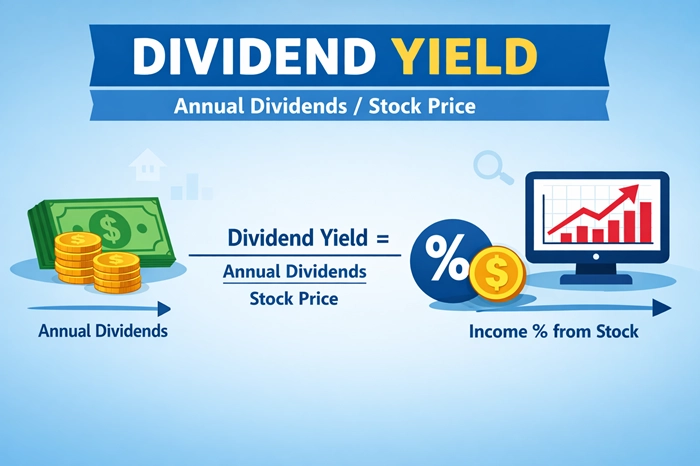
    Dividend yield is a key concept that helps investors evaluate how much income they can earn from a stock relative to its price.

    \text{Dividend Yield} = \frac{\text{Annual Dividend}}{\text{Share Price}} \times 100

    This formula shows the percentage return you earn from dividends alone, without considering stock price appreciation.

    For instance, if a company pays an annual dividend of ₹20 and its share price is ₹400, the dividend yield would be 5%. This means you earn a 5% return on your investment through dividends each year.

    Dividend yield is especially useful for comparing different stocks and identifying income-generating opportunities.

    Why Dividends Matter for Investors

    Dividends play a significant role in helping investors build long-term wealth. One of the biggest advantages is that they provide a steady source of passive income. Unlike capital gains, which require you to sell your shares, dividends allow you to earn money while still holding your investments.

    They also offer a sense of stability during market fluctuations. Even when stock prices are volatile, dividend-paying companies can continue to generate income for investors. This makes them particularly attractive during uncertain market conditions.

    Another important benefit is compounding. When you reinvest your dividends into buying more shares, your investment grows faster over time. This snowball effect can significantly increase your wealth in the long run.

    Why Dividends Matter for Companies

    From a company’s perspective, dividends are more than just payouts—they are a strategic tool. Regular dividend payments help build a strong reputation in the market and increase investor confidence.

    They also encourage shareholder loyalty. Investors are more likely to hold onto stocks that provide consistent returns, which reduces volatility in the company’s share price.

    Additionally, dividends help companies manage excess cash effectively. Instead of making poor investment decisions with surplus funds, distributing dividends ensures that capital is used wisely.

    Dividend vs Growth Stocks

    FeatureDividend StocksGrowth Stocks
    DefinitionCompanies that regularly share profits with investorsCompanies that reinvest profits to expand business
    Primary GoalGenerate regular incomeAchieve capital appreciation (price growth)
    Investor TypeIncome-focused investors (retirees, conservative investors)Long-term investors seeking high returns
    Profit UsageDistributed as dividendsReinvested into business growth
    Risk LevelGenerally lower riskHigher risk due to volatility
    Return TypeSteady income + moderate growthHigh potential returns (but no guaranteed income)
    Company TypeMature, stable companiesEmerging or fast-growing companies
    ExamplesCoca-Cola, Hindustan UnileverTesla, Amazon
    Dividend PaymentRegular (quarterly/annual)Rare or none
    Market BehaviorLess volatileMore volatile
    Ideal ForPassive income and stabilityWealth creation over time

    Dividend Investing Strategy

    If you’re planning to invest in dividend-paying stocks, it’s important to adopt a thoughtful approach. Instead of chasing high dividend yields, focus on companies with a consistent history of paying dividends.

    Strong financial health is another crucial factor. Companies with stable earnings and low debt are more likely to sustain their dividend payments over time.

    Reinvesting dividends can also make a huge difference. By using your earnings to buy more shares, you can take advantage of compounding and grow your investment faster.

    Most importantly, dividend investing requires patience. It’s not a get-rich-quick strategy, but rather a long-term approach to building wealth.

    Dividends in India

    dividends in india

    For investors in India, dividends are an important source of income but also come with certain tax implications. Dividends are taxable in the hands of investors, and companies may deduct TDS depending on the amount.

    Dividend-paying companies are commonly found in sectors such as banking, FMCG, energy, and IT. These industries typically generate stable profits, making them ideal for consistent dividend payments.

    Understanding the local tax rules and market trends can help Indian investors make better decisions when investing in dividend stocks.

    Common Mistakes to Avoid

    Many beginners make the mistake of focusing only on high dividend yields. While a high yield may seem attractive, it can sometimes indicate financial trouble within the company.

    Another common error is ignoring the company’s fundamentals. A strong dividend is only sustainable if the company has solid earnings and financial stability.

    Short-term thinking can also limit your success. Dividend investing works best when you stay invested for the long term and allow your returns to grow steadily.

    FAQs About Dividends

    1. What is a dividend in simple words?

    A dividend is a portion of a company’s profit that is paid to its shareholders. It is essentially a reward for investing in the company.

    2. How do I receive dividends?

    To receive dividends, you must own shares of a company before the ex-dividend date. The payment is usually credited directly to your bank account.

    3. Are dividends guaranteed?

    No, dividends are not guaranteed. Companies decide whether to pay dividends based on their profits and financial condition.

    4. Which companies pay dividends?

    Generally, well-established and profitable companies pay dividends. These are often found in sectors like banking, energy, and FMCG.

    5. Can I live off dividends?

    Yes, many investors aim to build a portfolio that generates enough dividend income to cover their expenses. However, this requires significant investment and long-term planning.

    6. What is a good dividend yield?

    A dividend yield between 2% to 6% is generally considered healthy, but it depends on the industry and market conditions.

    7. Are dividends taxable in India?

    Yes, dividends are taxable in the hands of investors as per their income tax slab.

    Conclusion

    Dividends are one of the most powerful yet simple ways to earn money from the stock market. They provide a reliable source of passive income while also helping investors build long-term wealth.

    For companies, dividends are a way to reward shareholders, build trust, and maintain financial discipline. For investors, they offer stability, income, and the potential for compounding growth.

    Whether you are a beginner or an experienced investor, understanding dividends is essential. With the right strategy and a long-term mindset, dividend investing can play a key role in achieving financial freedom.

  • TTM Explained: Why Investors Rely on Trailing Twelve Months Data

    TTM Explained: Why Investors Rely on Trailing Twelve Months Data

    If you’ve ever explored financial statements or dipped your toes into investing, you’ve probably come across the term TTM (Trailing Twelve Months). TTM is one of the most practical and widely used tools investors rely on to make informed decisions.

    In a world where markets move fast and company performance can change quarter by quarter, relying solely on annual reports can leave you with outdated insights. That’s where TTM comes in. It provides a real-time snapshot of a company’s financial health, helping investors stay current and make smarter choices.

    In this blog, we’ll break down what TTM is, how it works, why it matters, and how you can use it effectively even if you’re just getting started.

    What Is TTM (Trailing Twelve Months)?

    trailing twelve months

    TTM (Trailing Twelve Months) refers to the most recent 12-month period of a company’s financial data. Instead of aligning strictly with a fiscal year, TTM continuously updates by including the latest available data and dropping older periods.

    Simple Definition:

    TTM = Financial data from the last 12 consecutive months, regardless of calendar year.

    For example:

    • If today is April 2026, TTM data would include results from Q2 2025 to Q1 2026
    • It always reflects the latest four quarters

    Why TTM Is Important for Investors

    Let’s be honest—annual reports are useful, but they can quickly become outdated. Imagine making an investment decision in September based on financial data that ended in March. That’s a six-month gap.

    TTM solves this problem.

    1. Provides Up-to-Date Financial Insights

    TTM reflects the most recent performance, making it far more relevant than last year’s report.

    2. Smooths Out Seasonal Fluctuations

    Some businesses are highly seasonal (e.g., retail spikes during holidays). TTM averages out these fluctuations, giving a clearer overall picture.

    3. Improves Comparability

    TTM allows investors to compare companies on a consistent and current basis, even if their fiscal years differ.

    4. Helps Track Growth Trends

    By comparing TTM data over time, investors can easily identify whether a company is growing, stagnating, or declining.

    Key Financial Metrics That Use TTM

    TTM isn’t just a standalone concept—it’s used across multiple financial metrics.

    1. Revenue (TTM Revenue)

    Shows how much a company earned over the last 12 months.

    2. Earnings (TTM Net Income)

    Helps assess profitability in a current context.

    3. Earnings Per Share (TTM EPS)

    One of the most widely used indicators for stock valuation.

    4. Price-to-Earnings Ratio (P/E TTM)

    Investors often use TTM EPS to calculate the P/E ratio for a more accurate valuation.

    5. Cash Flow (TTM Cash Flow)

    Provides insight into a company’s liquidity and operational efficiency.

    TTM vs Annual Data: What’s the Difference?

    FeatureTTMAnnual Data
    Time FrameLast 12 monthsFixed fiscal year
    RelevanceHighly currentCan be outdated
    FlexibilityRolling basisStatic
    Accuracy for TrendsHighModerate

    Key Takeaway:

    • TTM is dynamic and current
    • Annual data is static and historical

    Both are useful, but TTM is better for real-time decision-making.

    Why Investors Prefer TTM

    Investors often prefer TTM because it aligns more closely with how markets actually behave. Stock prices are influenced by current expectations and recent performance, not just historical results. TTM provides the kind of up-to-date information that investors need to respond to market movements effectively.

    Another reason for its popularity is that it reduces timing bias. Since companies have different fiscal year-end dates, comparing annual data can sometimes lead to inconsistencies. TTM eliminates this issue by focusing on a consistent twelve-month period.

    TTM is also particularly useful for growth investors. In fast-growing industries, performance can change rapidly, and relying on outdated data can lead to missed opportunities. By using TTM, investors can track momentum and identify emerging trends more accurately.

    Real-World Application of TTM

    Consider a scenario where two companies are being compared. One company may have reported strong results in its last fiscal year, while the other has shown significant improvement in recent quarters. If you rely only on annual data, the first company might appear more attractive.

    However, when you analyze TTM data, the second company may actually show stronger current performance. This highlights the importance of looking beyond static reports and focusing on recent trends. TTM allows investors to uncover insights that might otherwise be overlooked.

    In real-world investing, this difference can be crucial. Decisions based on outdated information can lead to missed opportunities or poor investments, while TTM helps ensure that analysis is grounded in the present.

    How to Calculate TTM

    methods for calculating ttm

    Calculating TTM is relatively straightforward, but it requires attention to detail. The most common method involves adding the results from the latest four quarters. This approach is simple and effective when quarterly data is readily available.

    Another method involves adjusting annual data with year-to-date figures. By adding the current year’s partial data and subtracting the corresponding period from the previous year, investors can derive a TTM figure. This method is particularly useful when complete quarterly reports are not accessible.

    Regardless of the method used, the goal remains the same: to capture the most recent twelve months of performance in a way that reflects current realities.

    Advantages of Using TTM

    One of the biggest strengths of TTM is its ability to provide real-time insights. Investors can stay updated with the latest developments without waiting for annual reports. This timeliness can make a significant difference in fast-moving markets.

    TTM also helps eliminate the limitations of outdated data. By continuously updating, it ensures that analysis remains relevant and accurate. This is especially important when evaluating companies in dynamic industries.

    Another advantage is its ability to present a smoother view of performance. By covering a full year, TTM balances seasonal variations and provides a more stable picture of overall trends. This makes it easier to interpret data and draw meaningful conclusions.

    Limitations of TTM

    Despite its many benefits, TTM is not without limitations. One important consideration is that it is still based on historical data. While it is more current than annual figures, it does not predict future performance.

    TTM can also sometimes obscure sudden changes. If a company has recently undergone a major transformation, such as a new strategy or leadership change, TTM may still include older data that does not fully reflect the new direction.

    Additionally, TTM is less useful for very young companies that do not yet have a full year of financial data. In such cases, alternative methods of analysis may be required.

    TTM in Stock Analysis

    In stock analysis, TTM plays a central role in evaluating valuation and performance. Investors often use TTM earnings to calculate ratios such as the price-to-earnings ratio, which helps determine whether a stock is overvalued or undervalued.

    By using TTM instead of outdated figures, investors can make more accurate assessments. This is particularly important in volatile markets, where conditions can change rapidly. TTM ensures that valuations are based on the most recent data available.

    Common Mistakes Investors Make with TTM

    While TTM is a powerful tool, it must be used correctly. One common mistake is ignoring the context behind the numbers. Even though TTM smooths out seasonal variations, understanding the underlying business cycle remains important.

    Another mistake is relying solely on TTM without considering other metrics. Financial analysis should always involve multiple perspectives, including forward-looking estimates and qualitative factors.

    Some investors also fail to compare TTM data over time. Looking at a single TTM figure provides limited insight, whereas analyzing trends across multiple periods can reveal much more about a company’s trajectory.

    Frequently Asked Questions (FAQs)

    What does TTM mean in finance?

    TTM stands for Trailing Twelve Months, representing the most recent 12 months of financial data.

    Why is TTM important?

    It provides up-to-date insights, helping investors make better decisions.

    Is TTM better than annual data?

    Not necessarily better—but more current and flexible.

    How often is TTM updated?

    Every time a new quarterly report is released.

    Final Thoughts

    TTM is more than just a financial metric—it is a practical tool that helps investors stay aligned with the present. By focusing on the most recent twelve months, it provides a clearer, more relevant view of company performance.

    In an environment where timing and accuracy are critical, TTM offers a significant advantage. It allows investors to move beyond outdated reports and base their decisions on current realities. While it should not be used in isolation, it becomes incredibly powerful when combined with other forms of analysis.

    Ultimately, mastering TTM can enhance your ability to evaluate companies, identify trends, and make informed investment decisions. Whether you are a beginner or an experienced investor, understanding TTM is an essential step toward smarter investing.

  • Zoho Accounting vs Xero Accounting: Which Software Is Best for Your Business?

    Zoho Accounting vs Xero Accounting: Which Software Is Best for Your Business?

    Choosing the right accounting software can feel overwhelming especially when two powerful platforms like Zoho Accounting and Xero Accounting dominate the conversation. Both promise to simplify your finances, automate workflows, and give you better visibility into your business performance.

    But which one is actually right for your business?

    In this in-depth guide, we’ll break down everything you need to know—from features and pricing to usability and scalability—so you can make a confident, informed decision.

    Zoho Accounting vs Xero Accounting softwares

    What Is Zoho Accounting?

    Zoho Accounting (often known as Zoho Books) is part of the broader Zoho ecosystem—a suite of business tools designed to work seamlessly together. It’s particularly popular among small to medium-sized businesses that want an affordable, all-in-one solution.

    Key Highlights:

    • Cloud-based accounting platform
    • Strong automation features
    • Excellent integration with other Zoho apps
    • Budget-friendly pricing

    Zoho is especially appealing if you’re already using tools like Zoho CRM or Zoho Inventory.

    What Is Xero Accounting?

    Xero Accounting is a globally recognized accounting platform known for its clean interface and powerful integrations. It’s widely used by accountants and businesses across the world.

    Key Highlights:

    • Intuitive dashboard and user experience
    • Extensive third-party integrations
    • Strong reporting capabilities
    • Popular among accountants and bookkeepers

    Xero shines when it comes to collaboration with financial professionals.

    Zoho Accounting vs Xero Accounting: Quick Comparison

    Before we dive deeper, here’s a snapshot comparison:

    FeatureZoho AccountingXero Accounting
    Ease of UseModerateVery Easy
    PricingAffordableSlightly Expensive
    IntegrationsBest within ZohoExtensive third-party
    AutomationStrongGood
    ReportingGoodAdvanced
    Best ForSMBs & startupsGrowing businesses

    Key features of suitable Accounting solution

    1. Ease of Use: Which Is More Beginner-Friendly?

    When you’re choosing accounting software, ease of use isn’t just a “nice-to-have”—it directly impacts how quickly you can get up and running. For beginners, a complicated interface can slow down operations, create errors, and lead to frustration. That’s why usability plays a crucial role in deciding between Zoho Accounting and Xero Accounting.

    Zoho Accounting offers a clean and structured interface, but it can feel slightly overwhelming at first. This is mainly because of its extensive feature set and deep customization options. While experienced users may appreciate this flexibility, beginners might need some time to explore and understand the layout. There’s a learning curve involved, especially if you’re not familiar with accounting tools or the broader Zoho ecosystem.

    On the other hand, Xero Accounting is widely recognized for its simplicity and user-friendly design. The dashboard is intuitive, with clearly labeled sections and smooth navigation. Even if you’ve never used accounting software before, Xero makes it easy to perform basic tasks like invoicing, tracking expenses, and reconciling bank transactions. The platform feels more approachable from the start, which is a big advantage for small business owners and freelancers.

    Overall, if ease of use is your top priority, Xero Accounting stands out as the better option. Its intuitive design and beginner-friendly interface make it easier to adopt and use effectively right away.

    2. Features and Functionality

    Both Zoho Accounting and Xero Accounting are packed with features, but they cater to slightly different user needs and preferences. Understanding what each platform offers can help you determine which aligns better with your business operations.

    Zoho Accounting provides a comprehensive suite of tools designed to handle everyday accounting tasks efficiently. It includes invoicing and billing features that allow you to create and send professional invoices, track payments, and manage receivables. Expense tracking is another strong area, helping businesses monitor spending and categorize expenses easily. Bank reconciliation ensures your financial records stay accurate, while inventory management is particularly useful for product-based businesses. 

    One of Zoho’s standout features is its workflow automation, which allows users to automate repetitive tasks like sending payment reminders or generating recurring invoices. Additionally, Zoho offers built-in GST compliance, making it highly suitable for businesses operating in India.

    Xero Accounting, on the other hand, focuses on delivering a streamlined yet powerful feature set with a global perspective. It supports invoicing and quotes, allowing businesses to manage client transactions efficiently. Its bank feeds and reconciliation features are robust and automated, reducing manual work. Xero also offers payroll functionality in select regions, which can be a major advantage for businesses with employees. 

    Project tracking helps monitor profitability, while multi-currency support makes it ideal for international businesses. Xero’s financial reporting tools are particularly strong, providing detailed insights into business performance.

    In terms of overall functionality, Zoho Accounting excels in automation and integration within its ecosystem, while Xero Accounting stands out for its reporting capabilities and global features. Your choice will depend on whether you prioritize automation or advanced financial insights.

    3. Pricing: Which Offers Better Value?

    Pricing is often a deciding factor, especially for startups and small businesses operating on tight budgets. When comparing Zoho Accounting and Xero Accounting, the difference in pricing structures becomes quite noticeable.

    Zoho Accounting is known for its affordability and flexibility. It offers a range of pricing plans that cater to businesses of different sizes, including free plans in certain regions. The entry-level plans are budget-friendly, making it accessible for startups and freelancers. As your business grows, you can upgrade to higher-tier plans that offer additional features. This scalability ensures that you only pay for what you need, making Zoho a cost-effective choice.

    In contrast, Xero Accounting tends to be more expensive. It does not offer a free plan, and its subscription fees are generally higher compared to Zoho. While the platform justifies its pricing with advanced features and integrations, the cost can be a barrier for smaller businesses. Additionally, some advanced functionalities may require higher-tier plans, further increasing the overall expense.

    If you’re looking for maximum value for money, Zoho Accounting clearly has the advantage. Its affordable pricing and flexible plans make it an attractive option for businesses that want powerful features without a high financial commitment.

    4. Integrations and Ecosystem

    In today’s digital business environment, accounting software rarely works in isolation. Integration with other tools is essential for streamlining operations and improving efficiency.

    Zoho Accounting integrates seamlessly with other applications within the Zoho ecosystem, such as Zoho CRM, Zoho Inventory, and Zoho Projects. This makes it an excellent choice for businesses already using Zoho products, as it creates a unified system where data flows smoothly between applications. However, when it comes to third-party integrations, Zoho is somewhat limited compared to its competitor.

    Xero Accounting, on the other hand, excels in integrations. It offers access to over 1,000 third-party apps, covering everything from payment gateways to e-commerce platforms. Popular integrations include Stripe, PayPal, and Shopify, making Xero highly versatile. This extensive ecosystem allows businesses to customize their workflows and connect with a wide range of tools.

    If your business relies on multiple software solutions or plans to expand its tech stack, Xero Accounting is the better choice. Its robust integration capabilities provide greater flexibility and scalability.

    5. Automation Capabilities

    Automation is a key feature in modern accounting software, helping businesses save time and reduce errors. Both Zoho Accounting and Xero Accounting offer automation features, but their depth and flexibility differ.

    Zoho Accounting stands out for its advanced automation capabilities. It allows users to set up automated workflows for various tasks, such as sending invoices, generating reports, and reminding customers about overdue payments. Recurring invoices can be scheduled effortlessly, and custom rules enable businesses to tailor automation according to their specific needs. This level of customization makes Zoho a powerful tool for streamlining operations.

    Xero Accounting also offers automation, particularly in areas like bank rules and reconciliation. Transactions can be automatically categorized, and reports can be scheduled for regular delivery. While these features are effective, they are not as customizable or extensive as Zoho’s automation options.

    For businesses that prioritize automation and efficiency, Zoho Accounting takes the lead. Its ability to automate complex workflows gives it a clear advantage in this category.

    6. Reporting and Insights

    Accurate financial reporting is essential for making informed business decisions. Both platforms offer reporting tools, but the level of detail and flexibility varies.

    Zoho Accounting provides standard financial reports and customizable dashboards that give a clear overview of your business performance. These reports are sufficient for small businesses and startups that need basic insights into revenue, expenses, and cash flow.

    Xero Accounting, however, offers more advanced reporting capabilities. It provides real-time financial insights, detailed analytics, and accountant-friendly reports. The platform allows for greater customization, enabling users to generate reports tailored to their specific requirements. This makes Xero particularly useful for businesses that need in-depth financial analysis.

    When it comes to reporting and insights, Xero Accounting is the stronger option. Its advanced tools provide deeper visibility into your financial data.

    7. Customer Support

    Reliable customer support can make a significant difference, especially when dealing with financial software.

    Zoho Accounting offers email and chat support, along with an extensive knowledge base that includes guides, tutorials, and FAQs. This ensures that users can find solutions to common issues quickly.

    Xero Accounting provides online support and has a strong global community. Additionally, it benefits from a large network of accountants and bookkeepers who are familiar with the platform. This makes it easier to find professional assistance when needed.

    Both platforms offer solid support, but Xero’s larger global network gives it a slight advantage. Businesses that require frequent assistance or professional guidance may find Xero more reliable in this regard.

    8. Scalability: Which Grows With Your Business?

    As your business grows, your accounting needs will evolve. Choosing software that can scale with you is essential.

    Zoho Accounting is best suited for startups and small businesses. It works particularly well for companies already using the Zoho ecosystem, as it integrates seamlessly with other Zoho applications. However, it may feel limited for larger businesses with complex requirements.

    Xero Accounting is designed with scalability in mind. It is ideal for growing companies, businesses with complex financial needs, and those operating internationally. Its advanced features and extensive integrations make it a strong choice for long-term growth.

    If scalability is a priority, Xero Accounting is the better option. It provides the flexibility and functionality needed to support business expansion.

    9. Zoho Accounting vs Xero Accounting for Indian Businesses

    For businesses based in India, local compliance and affordability are critical factors.

    Zoho Accounting offers built-in GST compliance, local tax support, and pricing tailored to the Indian market. Its localized features make it highly practical for Indian businesses, ensuring compliance with regulations while keeping costs low.

    Xero Accounting, while powerful, has limitations in this context. It offers limited support for India-specific compliance and tends to be more expensive for small businesses in the region.

    For Indian businesses, Zoho Accounting is the clear winner. Its localization and affordability make it a more suitable choice.

    10. Pros and Cons Summary

    Zoho Accounting’s strengths lie in its affordability, strong automation features, and suitability for Indian businesses. Its integration within the Zoho ecosystem is another major advantage. However, it does have a learning curve and fewer third-party integrations.

    Xero Accounting, in contrast, is easy to use, offers excellent integrations, and provides advanced reporting tools. It is also highly scalable, making it ideal for growing businesses. On the downside, it is more expensive and lacks localization for certain regions.

    Ultimately, both platforms are powerful in their own ways. The right choice depends on your business size, budget, and specific requirements.

    Final Verdict: Which Software Is Best for Your Business?

    The answer depends on your business needs.

    Choose Zoho Accounting if:

    • You want a cost-effective solution
    • You run a small or medium business
    • You need GST or local compliance
    • You already use Zoho tools

    Choose Xero Accounting if:

    • You prioritize ease of use
    • You need advanced reporting
    • You use multiple third-party apps
    • You’re planning to scale globally

    Conclusion

    Both Zoho Accounting and Xero Accounting are powerful tools—but they serve slightly different audiences.

    Zoho is practical, affordable, and ideal for small businesses—especially in regions like India. Xero, on the other hand, is polished, scalable, and perfect for businesses that want flexibility and global reach.

    Instead of asking “Which is better?”, the smarter question is:Which one fits your business today—and tomorrow?

  • Best FreshBooks Alternatives for Small Business & IT Companies

    Best FreshBooks Alternatives for Small Business & IT Companies

    Running a small business or managing an IT company today is more complex than ever. From handling invoices and tracking expenses to managing clients and ensuring tax compliance, business owners are expected to wear multiple hats. Accounting software like FreshBooks has simplified many of these processes, especially for freelancers and service-based businesses. However, as operations grow or become more technically demanding as is often the case with IT companies many users begin to feel the limitations of the platform.

    FreshBooks is known for its simplicity and clean interface, but that same simplicity can become a bottleneck when your business requires advanced accounting, deeper reporting, or more robust integrations. This is where exploring alternatives becomes not just useful, but necessary. In this guide, we’ll walk through the best FreshBooks alternatives for small businesses and IT companies, helping you find a solution that aligns with your growth, workflow, and financial needs.

    Why Businesses Move Beyond FreshBooks

    freshbooks homapage

    For many entrepreneurs, FreshBooks is the first step into digital accounting. It’s intuitive, quick to set up, and excellent for sending invoices or tracking basic expenses. But over time, businesses—especially in the IT sector tend to outgrow it.

    One of the main reasons is scalability. As your client base grows and your operations become more complex, you may need features like advanced reporting, multi-user collaboration, or detailed financial forecasting. FreshBooks offers some of these features, but often not at the depth required for growing companies.

    Another challenge arises with IT businesses specifically. These companies frequently rely on time-based billing, project tracking, and integrations with tools like CRMs or development platforms. FreshBooks provides basic support for some of these needs, but it may fall short when compared to more specialized or comprehensive accounting solutions.

    Cost is also a factor. While FreshBooks starts reasonably, pricing can increase as you add more clients or require additional features. At that point, many business owners begin to question whether they’re getting the best value for their investment.

    What IT Companies and Small Businesses Really Need

    Choosing the right accounting software is not just about replacing FreshBooks—it’s about upgrading to a system that truly supports your workflow. For small businesses, this often means automation, ease of use, and affordability. For IT companies, the requirements go a step further.

    Time tracking becomes essential when billing clients by the hour or managing multiple ongoing projects. Integration capabilities are equally important, as IT firms often rely on a stack of tools for project management, communication, and development. Financial reporting also needs to be more detailed, offering insights into profitability, cash flow, and long-term planning.

    In addition, businesses operating in countries like India must consider compliance features such as GST support. This is where some alternatives clearly outperform FreshBooks.

    Top FreshBooks Alternatives Worth Considering

    When exploring alternatives, it’s important to understand that no single tool fits every business. Each platform offers a unique combination of features, pricing, and usability. Below is a clear breakdown of each option:

    1. QuickBooks Online

    quickbooks homepage

    QuickBooks Online is widely considered an industry standard and is especially suitable for growing small businesses and IT service providers. It offers a complete accounting suite, including advanced financial reporting, payroll integration, tax management, and a vast ecosystem of third-party integrations. For IT companies handling multiple clients or complex billing structures, QuickBooks provides the depth and scalability that FreshBooks often lacks. Although it comes with a slight learning curve, it is a powerful long-term solution for businesses planning to scale.

    2. Zoho Books

    zoho.com hompage

    Zoho Books is an excellent choice for startups and budget-conscious businesses looking for automation and efficiency. It integrates seamlessly with the Zoho ecosystem, including Zoho CRM and Zoho Projects, which is particularly beneficial for IT companies managing workflows and client relationships. Its automation features reduce manual work, and its GST compliance makes it highly suitable for Indian businesses. Overall, it offers a strong balance between affordability and functionality.

    3. Xero

    Xero is a modern, cloud-based accounting solution designed for tech-savvy businesses and companies with international operations. It provides real-time financial tracking, supports multiple currencies, and integrates with hundreds of business tools. This makes it ideal for IT firms with global clients or remote teams. Its intuitive interface and collaboration features allow multiple users to work efficiently, although the pricing may be slightly higher compared to some competitors.

    4. Wave Accounting

    Wave Accounting is a great option for freelancers and very small businesses that need a free accounting solution. It covers essential features like invoicing, expense tracking, and basic financial reporting. While it is easy to use and cost-effective, it lacks advanced capabilities such as automation, integrations, and scalability. This makes it more suitable as a starting tool rather than a long-term solution for growing IT companies.

    5. Sage Business Cloud Accounting

    Sage Business Cloud Accounting is a reliable option for businesses that prioritize financial control and forecasting. With decades of experience in accounting software, Sage offers strong tools for cash flow management, reporting, and compliance. It is particularly useful for businesses that need detailed financial insights and structured accounting processes. However, its interface may feel less modern compared to newer platforms, and it may require some time to fully learn.

    6. TallyPrime

    TallyPrime is one of the most popular accounting solutions in India, known for its robust GST compliance and detailed reporting capabilities. It is widely used by accountants and businesses that require strong tax and inventory management features. Unlike most cloud-based tools, TallyPrime offers offline functionality, which can be an advantage in certain environments. However, its interface is relatively traditional, and it may not offer the same level of integrations as cloud-first platforms.

    7. FreeAgent

    FreeAgent is designed with freelancers and small IT agencies in mind. It offers features like time tracking, project-based billing, expense management, and tax timelines, making it ideal for service-oriented businesses. Its simplicity and focus on usability make it easy to get started. However, like FreshBooks, it may not scale effectively for larger businesses that require more advanced accounting features or integrations.

    FreshBooks vs Alternatives: Quick Comparison

    FeatureFreshBooksQuickBooksZoho BooksXero
    Ease of Use⭐⭐⭐⭐⭐⭐⭐⭐⭐⭐⭐⭐⭐⭐⭐⭐⭐
    PricingMediumMedium-HighAffordableMedium
    ScalabilityLow-MediumHighMedium-HighHigh
    IT FeaturesBasicAdvancedStrongAdvanced
    IntegrationsModerateExtensiveGoodExtensive

    Which FreshBooks Alternative Is Best for You?

    Choose QuickBooks if:

    You want powerful accounting + scalability

    Choose Zoho Books if:

    You want affordable + automation + ecosystem integration

    Choose Xero if:

    You run a global or tech-heavy business

    Choose Wave if:

    You’re just starting and need a free solution

    Choose TallyPrime if:

    You operate in India and need strong compliance tools

    How to Transition from FreshBooks to Another Tool

    Switching accounting software might sound intimidating—but it doesn’t have to be.

    Step-by-Step Migration Guide:

    1. Export your financial data from FreshBooks
    2. Choose your new platform
    3. Import clients, invoices, and expenses
    4. Set up bank connections
    5. Test reports and workflows
    6. Train your team

    Final Thoughts

    While FreshBooks is a solid starting point, it may not meet the growing demands of modern small businesses and IT companies. From advanced accounting tools like QuickBooks to budget-friendly options like Zoho Books, there are plenty of alternatives tailored to different needs.

    The key is to:

    • Understand your business requirements
    • Evaluate scalability
    • Consider integrations
    • Balance cost with features

    The right accounting software doesn’t just manage your finances—it empowers your business to grow smarter and faster.

    FAQs 

    1. What is the best alternative to FreshBooks?

    The best alternative depends on your needs, but QuickBooks Online and Zoho Books are top choices for most small businesses and IT firms.

    2. Is FreshBooks good for IT companies?

    FreshBooks is good for freelancers but lacks advanced features needed by growing IT companies.

    3. Which accounting software is best for startups?

    Zoho Books and Wave are excellent for startups due to affordability and ease of use.

    4. Can I switch from FreshBooks easily?

    Yes, most platforms provide import tools to migrate your data seamlessly.

  • The Future of DevOps and Agile in Software Development for current businesses.

    The Future of DevOps and Agile in Software Development for current businesses.

    Today’s businesses must create software products that need to meet two requirements which demand high-quality performance and flexible expandable capabilities. The development process needs to implement DevOps and Agile in software development methodologies. The combination of Agile’s iterative process with DevOps’ collaborative automated system and continuous integration method enables organizations to shorten development time and eliminate development flaws while meeting market demands.

    These two methods work together to deliver products more quickly while making products more stable and improving teamwork efficiency throughout the organization. Businesses need to invest in more than just ready-made solutions if they want to maintain their market position. 

    An early Custom software development services help businesses create specific software solutions which meet their operational requirements and support their future business objectives. Through the combination of DevOps and Agile methods into custom systems businesses gain the ability to expand their operations while developing new capabilities which will help them succeed in the rapidly changing technology environment.

    Understanding DevOps and Agile in Software Growth

    DevOps and Agile in software growth

    Modern DevOps and Agile in software development methods as essential building blocks for their development processes. Agile development uses iterative processes together with ongoing feedback and flexible methods while DevOps development requires development teams and their operational partners to work together through automated systems and continuous integration. The two methods create an unbroken workflow which enables faster product delivery without sacrificing quality or trustworthiness.

    Organizations that implement Agile DevOps practices, along with Cloud Software Solutions, will experience increased efficiency and project scalability across their software development work particularly when supported by a SaaS Development Company. The system provides its main benefits through three different advantages which it delivers to users.. 

    Faster Progress Cycles: The mixture of Agile sprints with DevOps automated processes allows teams to release features and updates at high speed.

    Continuous Testing and Integration: The combination of automated testing with CI or CD pipelines enables early error detection which leads to dependable software results. 

    The Growing Popularity Of Agile DevOps Practices In Business Operations

    Organizations today experience increasing success through their implementation of DevOps and Agile in Software Development to achieve faster product delivery and better software quality. Businesses that implement Agile DevOps methods gain the ability to adapt to new market conditions while they improve team collaboration and decrease deployment errors. The integrated approach establishes direct communication between development teams testing teams and operations teams which enables their work to progress without interruptions while building a system that continuously generates feedback to achieve greater innovation and efficiency.

    The key advantages that organizations gain from implementing Agile DevOps practices include the following benefits – 

    The implementation of iterative development cycles enables companies to achieve quick feature releases which results in faster time-to-market. 

    The synchronization between developers and testers and operations teams improves their work efficiency by eliminating operational boundaries. 

    The main benefits of Agile DevOps practices frameworks are listed below

    1. Faster Time-to-Market

    The companies must deliver software updates because their development process requires extended time periods for completion. 

    2. Regulatory Improvement

    The teams use ongoing user feedback to create improved products through their continuous feedback process.

    3. Better Collaboration 

    Developers and testers and operations teams work together instead of using separate operational boundaries.

    4. Improved Software Quality

    Continuous checking ensures that bugs and performance problems are addressed early.

    5. Increase Customer fulfillment

    Common updates allow companies to deliver features that customers actually want.

    Organizations that use DevOps for enterprise software development experience better development productivity and improved business results.

    The Role of DevOps in Scalable Software Growth 

    As businesses grow their software systems need to manage higher demands which include more users and additional data. This is where scalable software development becomes critical.

    DevOps enables organizations to scale their operations through its three core functions which include automation and monitoring and infrastructure management.

    Key ways DevOps supports scalability include:

    Automation of Development Processes

    Automated testing and integration and deployment processes eliminate the need for manual work while they also decrease the possibility of errors.

    Continuous Integration and Continuous Delivery(CI or CD)

    Developers use CI/CD pipelines to frequently combine their updated code which enables them to release new software versions within a short time period.

    Infrastructure as Code (IaC)

    Organizations can use programming to manage and expand their infrastructure which enables them to maintain operational uniformity throughout their different computing environments.

    Real-Time Monitoring

    DevOps tools provide teams with application performance monitoring capabilities which help them find application issues before these problems impact user experience.

    The Key Technologies Which Define DevOps Future Development

    Emerging technologies which improve automation capabilities and intelligent systems and operational effectiveness will determine the future of DevOps and Agile in Software Development.

    The most important technologies which shape the present and upcoming future include the following technologies:

    AI and Machine Learning

    AI-powered tools can analyze code quality, predict system failures and automate testing processes. Teams extending this automation into agent behavior can also use RL environments to evaluate whether iterative changes improve task performance.

    Cloud-Native Development

    Cloud platforms enable developers to create applications with instant access to scalable infrastructure resources.

    Containerization and Microservices

    Developers use container and microservice technologies to create applications that can grow and function independently through their component parts.

    Infrastructure Automation

    Deployments become more efficient and dependable through the use of tools that handle infrastructure management tasks automatically.

    The Growing vital of Custom Software Development

    Custom software development services & Solutions have become increasingly vital because businesses need specialized software solutions that match their particular working needs and corporate goals. 

    This is where custom software development services become essential. 

    Custom solutions offer several advantages. 

    Software designed specifically for business processes. 

    The system provides organizations with increased flexibility to expand their operations and control their software resources. The system enables organizations to connect their current software solutions. 

    The system protects data while delivering superior operational capabilities. The system delivers cost benefits to organizations throughout their entire operational lifespan.

    Challenges in Performing DevOps and Agile

    Organizations face difficulties when they try to implement method DevOps and Agile for software development work even though these methods provide advantages.

    Common challenges include:

    Cultural Resistance

    Traditional development teams will oppose any new collaborative methods which they have not previously used.

    Skill Gaps

    DevOps professionals need to learn three specific areas which include automation tools, cloud platforms and CI/CD pipeline implementation. For businesses that face these skill gaps, the most practical solution is to Hire DevOps Engineers, experienced professionals who bring ready-made expertise in CI/CD pipelines, cloud infrastructure, and automation tools from day one.

    Integration Complexity

    The process of integrating new DevOps tools with existing legacy systems creates major challenges.

    Security Concerns

    Fast development processes need complete security measures which stop potential weaknesses from emerging.

    Upcoming Trends in Agile and DevOps

    The upcoming trends in Agile and DevOps will determine the future development of software creation. The upcoming software development process will rely on changing DevOps and Agile work methods. 

    The following trends are currently developing in the market: 

    DevSecOps Integration

    Development pipelines will achieve full security integration through security practices. 

    AI-Powered Development Automation

    The development process will receive automated testing and code review and deployment through AI tools.

    Platform Engineering

    The engineering teams will utilize internal development platforms to enhance their work management process. 

    Low-Code and No-Code Growth 

    These platforms will enable application development through their low coding requirements which allow users to build applications. 

    Continuous Everything 

    All development and testing and monitoring and security functions will become permanent processes. 

    The new innovations will improve scalable software development capabilities which enable businesses to develop new products at a faster pace while providing superior digital customer experiences.

    Conclusion 

    Businesses that want to achieve efficient operations and create new products should adopt both DevOps and Agile methods in software development processes. The implementation of Agile DevOps practices enables organizations to deliver products faster because their teams work together better while maintaining software quality. Companies that work with professionals from custom software development services can create flexible software solutions which adapt to changing market needs, enabling them to succeed in the current digital business environment. 

  • What Actually Speeds Up Website Creation for businesses in 2026

    What Actually Speeds Up Website Creation for businesses in 2026

    Building a website faster isn’t just about typing code more quickly. In 2026, the teams and solo builders who consistently ship on time are doing a few specific things differently and most of it has nothing to do with raw technical skill. It’s about how they plan, what they reuse, and where they let tools handle the repetitive work so they can focus on the decisions that actually matter. 

    Why Website Development Still Takes Too Long 

    work on website creation

    Despite better tools than ever, most website projects still run over schedule. The reasons haven’t changed much: unclear requirements, too many revision cycles, and a tendency to solve problems from scratch that have already been solved a hundred times before. 

    Scope creep is the most common culprit. A project starts as a five-page site and quietly becomes twelve pages with custom animations and third-party integrations nobody planned for. By the time anyone notices, the timeline is already broken. 

    The second issue is tool overload. Developers now have access to more frameworks, plugins, and platforms than ever before and choosing between them takes time. Picking the wrong stack early can cost weeks of rework later. Speed starts with making fewer bad decisions up front, not just executing faster once you’ve started. 

    Better Planning Is Now a Bigger Time-Saver Than Better Coding 

    The fastest website projects in 2026 aren’t the ones with the best developers they’re the ones where everyone agreed on what was being built before anyone opened a code editor. 

    A solid planning phase includes a clear sitemap, defined content requirements, and agreed-upon design direction before development begins. When developers know exactly what each page needs to do, they don’t waste time building placeholder sections or waiting for copy to arrive. 

    Wireframing tools and collaborative design platforms have made this easier. A shared prototype that clients can click through and approve early prevents the most expensive kind of rework: changing something that’s already been built. 

    Even for solo builders, spending a day mapping out the full project before writing a single line of code consistently results in shorter total build times. The upfront investment pays back quickly. 

    Reusable Components Cut Production Time Across the Whole Project 

    Component-based development isn’t new, but the discipline around it has improved significantly. Teams that maintain a well-organized library of reusable UI components buttons, cards, navigation patterns, form layouts can assemble new pages in a fraction of the time it takes to build from scratch. 

    The key word is “maintained.” A component library that’s outdated or inconsistently built creates more problems than it solves. The investment is in keeping it clean and documented so anyone on the team can use it without guessing. 

    Design systems work the same way. When typography, spacing, colors, and interactive states are defined once and applied consistently, designers and developers stop re-solving the same visual problems on every project. 

    For smaller projects, even a lightweight set of reusable blocks a hero section, a feature grid, a testimonial layout can cut build time in half compared to starting fresh every time. 

    AI Helps Most When It Supports Workflow, Not When It Replaces It 

    AI in website creation

    AI tools have found a real place in website creation, but not quite in the way the early hype suggested. The biggest gains don’t come from fully automated builds they come from AI handling the parts of the process that are slow and repetitive, while humans stay in control of the decisions that shape the final result. 

    Generating a starter layout, drafting placeholder copy, or suggesting component structures are all tasks where AI genuinely saves time. Tools like an AI website builder are most effective when they’re used to eliminate the blank-page problem giving builders a structured starting point they can refine, rather than a finished product they’re supposed to just accept. 

    Where AI tends to slow things down is when it’s used to make decisions it’s not well-suited to make: brand direction, content strategy, UX choices that depend on knowing the audience. Treating AI output as a first draft rather than a final answer keeps the workflow moving without sacrificing quality. 

    The teams getting the most out of AI in 2026 are the ones who’ve identified exactly which parts of their process benefit from automation and protected the parts that don’t. 

    Choosing the Right CMS and Tech Stack Prevents Slowdowns Later 

    The technology decisions made at the start of a project have a disproportionate impact on how fast everything goes afterward. A CMS that’s well-matched to the client’s content model makes updates straightforward. One that’s a poor fit turns every change into a workaround. 

    The same applies to the broader tech stack. Using a framework your team knows well is almost always faster than adopting something new for the sake of it. The performance gains from the latest tooling rarely outweigh the ramp-up cost when a deadline is involved. For businesses in the print space, choosing the right foundation matters even more, platforms like DesignNBuy are purpose-built web to print storefront solution that eliminate the need to bolt on complex customization layers to a generic CMS. 

    Hosting and deployment choices matter too. Projects that use automated CI/CD pipelines spend less time on manual updates and catch errors earlier. Setting this up properly at the start of a project is overhead that pays off every single time something needs to change. 

    The goal isn’t to use the most impressive stack — it’s to use the one that creates the fewest surprises between kickoff and launch. 

    Conclusion 

    Speed in website creation comes from removing friction, not from working harder. Better planning eliminates expensive rework. Reusable components reduce repetitive work. AI handles the tedious parts so builders can focus on the meaningful ones. And the right tech stack keeps things running smoothly from start to finish. 

    None of these are dramatic breakthroughs — they’re disciplined habits that compound across every project. In 2026, the builders who ship fastest aren’t necessarily the most talented. They’re the most organized. 

    FAQ 

    1. What is the single biggest time-waster in website projects? 

    Unclear requirements at the start. When the scope isn’t defined before development begins, teams end up rebuilding sections multiple times to match shifting expectations. A thorough planning phase — even a short one eliminates more wasted hours than any tool or shortcut applied later in the process. 

    2. How much time can AI realistically save in website creation? 

    It depends heavily on how it’s used. For generating starter layouts, writing initial copy, or producing boilerplate code, AI can cut early-stage work by 30–50%. But those gains disappear quickly if the output isn’t reviewed carefully. The net time saved is real — as long as AI is treated as a starting point, not a finished deliverable. 

    3. Is it worth building a component library for a small project? 

    For a one-off site, probably not. But if you build more than two or three websites a year, even a lightweight component library pays for itself quickly. Start small — a consistent button style, a card layout, a responsive navigation — and grow it project by project. The time savings compound the more you use it.