

The contribution margin ratio is a financial metric that shows the percentage of revenue remaining after subtracting variable costs. In simple terms, it tells you how much of your sales income is available to cover fixed expenses and generate profit.
Every business incurs two main types of costs: variable costs and fixed costs. Variable costs change depending on how much you produce or sell, while fixed costs remain constant regardless of sales volume. The contribution margin ratio focuses only on variable costs, making it especially useful for short-term decision-making and operational analysis.
To put it simply, when you sell a product or service, not all of the revenue becomes profit. A portion goes toward covering costs like materials, shipping, or commissions. The remaining portion the contribution is what helps pay fixed costs like rent and salaries and eventually contributes to profit. The ratio expresses this contribution as a percentage of total revenue, making it easier to evaluate efficiency.
A higher contribution margin ratio indicates that a larger share of revenue is contributing toward profitability. This usually signals a healthier business model with better cost control and pricing strategies.
Contribution Margin Ratio Formula
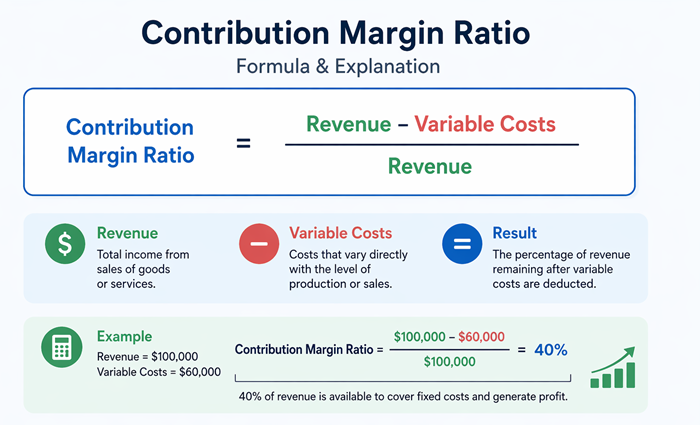
Understanding the formula behind the contribution margin ratio is essential for applying it correctly in real-world scenarios.
Contribution Margin Ratio=Revenue – Variable CostsRevenue\text{Contribution Margin Ratio} = \frac{\text{Revenue – Variable Costs}}{\text{Revenue}}Contribution Margin Ratio=RevenueRevenue – Variable Costs
This formula calculates the proportion of revenue that remains after variable expenses are deducted. The result is typically expressed as a percentage, which makes it easy to interpret and compare across products, services, or time periods.
You can also calculate it on a per-unit basis, which is especially useful for product-based businesses:
CM Ratio=Selling Price per Unit – Variable Cost per UnitSelling Price per Unit\text{CM Ratio} = \frac{\text{Selling Price per Unit – Variable Cost per Unit}}{\text{Selling Price per Unit}}CM Ratio=Selling Price per UnitSelling Price per Unit – Variable Cost per Unit
Both approaches lead to the same conclusion, but the per-unit method gives deeper insight into individual product performance.
Understanding Revenue and Variable Costs
To calculate the contribution margin ratio accurately, it’s important to clearly distinguish between revenue and variable costs. Revenue refers to the total income generated from sales before any expenses are deducted. It represents the starting point of your financial analysis.
Variable costs, on the other hand, fluctuate with your level of production or sales. These costs increase as you produce more and decrease when production slows down. Common examples include raw materials, packaging, shipping fees, sales commissions, and direct labor tied to production.
Fixed costs are not included in this calculation, which is a common point of confusion. Expenses like rent, insurance, and administrative salaries remain constant regardless of sales volume, so they are excluded from the contribution margin ratio formula.
Contribution Margin vs Contribution Margin Ratio
| Aspect | Contribution Margin | Contribution Margin Ratio |
|---|---|---|
| Definition | The absolute amount left after subtracting variable costs from revenue | The percentage of revenue remaining after variable costs |
| Formula | Revenue – Variable Costs | (Revenue – Variable Costs) ÷ Revenue |
| Representation | Expressed as a monetary value (e.g., $5,000) | Expressed as a percentage (e.g., 50%) |
| Purpose | Shows total contribution toward fixed costs and profit | Shows efficiency of converting revenue into profit |
| Comparison Use | Less useful for comparing different products or businesses | More useful for comparing performance across products or units |
| Insight Provided | Indicates total earnings available after variable costs | Indicates profitability efficiency and cost structure |
Example of Contribution Margin Ratio
Let’s consider a simple example to make this concept more concrete. Imagine a business generates revenue of $100,000 and incurs $40,000 in variable costs. The contribution margin would be $60,000, which represents the amount available to cover fixed costs and profit.
When you divide this contribution margin by total revenue, you get a contribution margin ratio of 60%. This means that for every dollar earned, 60 cents contribute toward covering fixed expenses and generating profit.
This percentage becomes incredibly valuable when making financial decisions, as it gives you a clear understanding of how efficient your operations are.
Why Contribution Margin Ratio Matters
The contribution margin ratio is not just a formula—it’s a decision-making tool.
Here’s why it’s important:
1. Helps Measure Profitability
It shows how efficiently your business converts sales into profit. A higher ratio means more money is available after covering variable costs.
2. Supports Pricing Decisions
You can determine whether your pricing strategy is sustainable or needs adjustment.
3. Improves Cost Control
It highlights whether variable costs are eating into your margins.
4. Guides Product Strategy
You can identify:
- High-performing products
- Low-margin products
- Products to discontinue
Using Contribution Margin Ratio for Profit Analysis
One of the most powerful applications of the contribution margin ratio is in profit analysis. It allows businesses to go beyond surface-level revenue figures and understand the mechanics of profitability.
When analyzing profit, the first step is often determining the break-even point. The contribution margin ratio makes this possible by showing how much revenue is needed to cover fixed costs. Once fixed costs are covered, any additional contribution becomes profit.
This insight is particularly useful for setting sales targets. If you know your contribution margin ratio, you can estimate how much revenue is required to achieve a desired level of profit. This transforms abstract financial goals into concrete, actionable numbers.
The ratio also plays a key role in pricing decisions. If your contribution margin ratio is too low, it may indicate that your prices are too low or your variable costs are too high. Adjusting either of these factors can significantly improve profitability.
Another important use is in product analysis. Not all products contribute equally to profit, even if they generate similar revenue. By comparing contribution margin ratios across products, businesses can identify which ones are worth promoting and which ones may need to be re-evaluated.
Break-Even Analysis and Decision Making
Break-even analysis is one of the most practical applications of the contribution margin ratio. It helps businesses determine the point at which total revenue equals total costs, resulting in zero profit.
Once you know your contribution margin ratio, you can calculate how much revenue is required to cover fixed costs. This provides a clear benchmark for financial stability and helps businesses avoid operating at a loss.
Understanding the break-even point also reduces risk when launching new products or entering new markets. It allows you to assess whether your pricing and cost structure are sustainable before making major investments.
High vs Low Contribution Margin Ratio
A high contribution margin ratio generally indicates a strong and efficient business model. It means that a large portion of revenue is available to cover fixed costs and generate profit. Businesses with high ratios typically have more flexibility in pricing and are better equipped to handle fluctuations in sales.
A low contribution margin ratio, on the other hand, suggests that variable costs are consuming a large portion of revenue. This can make it difficult to achieve profitability, especially if sales volume is inconsistent. Businesses in this situation may need to focus on reducing costs, increasing prices, or improving operational efficiency.
Common Mistakes to Avoid
1. Ignoring Fixed Costs
CM ratio doesn’t include fixed costs—so don’t rely on it alone.
2. Misclassifying Costs
Incorrectly labeling costs can distort results.
3. Using It as the Only Metric
It’s powerful—but should be combined with:
- Net profit margin
- Gross margin
- ROI
How to Improve Contribution Margin Ratio
Improving your contribution margin ratio requires a combination of strategic pricing, cost control, and operational efficiency. Businesses often start by analyzing their variable costs to identify areas where expenses can be reduced without compromising quality.
Increasing prices can also improve the ratio, but this must be done carefully to avoid losing customers. In many cases, the most effective approach is to focus on high-margin products and optimize processes to reduce waste and inefficiencies.
Small improvements in the contribution margin ratio can have a significant impact on overall profitability, especially as sales volume increases.
Final Thoughts
The contribution margin ratio is more than just a financial formula it’s a practical tool that helps businesses understand how revenue turns into profit. By focusing on the relationship between sales and variable costs, it provides valuable insights that can guide pricing, cost management, and strategic planning.
For business owners and decision-makers, mastering this metric can lead to smarter choices and stronger financial performance. When used consistently, it becomes a reliable guide for improving profitability and building a sustainable business.
If you want to grow your business with confidence, start paying close attention to your contribution margin ratio. It might just be the missing piece in your profit strategy.
FAQs About Contribution Margin Ratio
1. What is the contribution margin ratio in simple terms?
The contribution margin ratio is the percentage of revenue left after covering variable costs. It shows how much of each sale contributes toward fixed costs and profit. In simple words, it tells you how efficiently your business turns sales into actual earnings.
2. What is a good contribution margin ratio?
A “good” contribution margin ratio depends on the industry, but generally, a higher ratio is better. Businesses with a ratio above 50% are often considered efficient because they retain more revenue after covering variable costs. However, some industries naturally operate with lower margins due to high production costs.
3. How is contribution margin ratio different from profit margin?
The contribution margin ratio only considers variable costs, while profit margin includes both variable and fixed costs. This makes the contribution margin ratio more useful for short-term decisions like pricing and cost control, while profit margin reflects overall business profitability.
4. Why is contribution margin ratio important for businesses?
It helps businesses understand how much revenue contributes to profit after covering variable costs. This makes it easier to:
- Set pricing strategies
- Control costs
- Analyze product profitability
- Plan for growth
5. Can contribution margin ratio be negative?
Yes, a contribution margin ratio can be negative if variable costs are higher than revenue. This means the business is losing money on each sale, which is a serious issue that requires immediate attention.
6. How do you improve contribution margin ratio?
You can improve the contribution margin ratio by increasing prices, reducing variable costs, or focusing on high-margin products. Even small improvements can significantly boost overall profitability over time.
7. What costs are included in contribution margin ratio?
Only variable costs are included, such as raw materials, shipping, commissions, and direct labor. Fixed costs like rent, salaries, and utilities are not part of the calculation.
8. How does contribution margin ratio help in break-even analysis?
The contribution margin ratio is used to calculate the break-even point, which is the level of sales needed to cover all fixed costs. It helps businesses determine how much they need to sell before they start making a profit.
9. Is contribution margin ratio useful for small businesses?
Yes, it is especially useful for small businesses because it provides clear insights into pricing, cost control, and profitability. It helps owners make informed decisions without needing complex financial tools.
10. What industries use contribution margin ratio the most?
The contribution margin ratio is widely used across industries, including retail, manufacturing, SaaS, and eCommerce. Any business that wants to understand cost behavior and profitability can benefit from using this metric.
