

If you’ve ever explored financial statements or dipped your toes into investing, you’ve probably come across the term TTM (Trailing Twelve Months). TTM is one of the most practical and widely used tools investors rely on to make informed decisions.
In a world where markets move fast and company performance can change quarter by quarter, relying solely on annual reports can leave you with outdated insights. That’s where TTM comes in. It provides a real-time snapshot of a company’s financial health, helping investors stay current and make smarter choices.
In this blog, we’ll break down what TTM is, how it works, why it matters, and how you can use it effectively even if you’re just getting started.
What Is TTM (Trailing Twelve Months)?
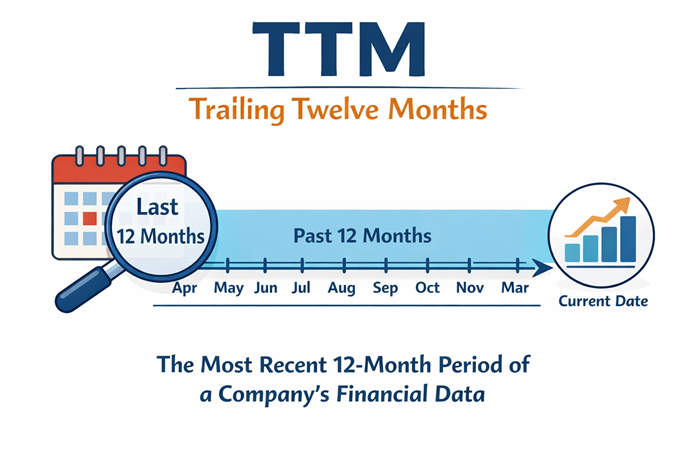
TTM (Trailing Twelve Months) refers to the most recent 12-month period of a company’s financial data. Instead of aligning strictly with a fiscal year, TTM continuously updates by including the latest available data and dropping older periods.
Simple Definition:
TTM = Financial data from the last 12 consecutive months, regardless of calendar year.
For example:
- If today is April 2026, TTM data would include results from Q2 2025 to Q1 2026
- It always reflects the latest four quarters
Why TTM Is Important for Investors
Let’s be honest—annual reports are useful, but they can quickly become outdated. Imagine making an investment decision in September based on financial data that ended in March. That’s a six-month gap.
TTM solves this problem.
1. Provides Up-to-Date Financial Insights
TTM reflects the most recent performance, making it far more relevant than last year’s report.
2. Smooths Out Seasonal Fluctuations
Some businesses are highly seasonal (e.g., retail spikes during holidays). TTM averages out these fluctuations, giving a clearer overall picture.
3. Improves Comparability
TTM allows investors to compare companies on a consistent and current basis, even if their fiscal years differ.
4. Helps Track Growth Trends
By comparing TTM data over time, investors can easily identify whether a company is growing, stagnating, or declining.
Key Financial Metrics That Use TTM
TTM isn’t just a standalone concept—it’s used across multiple financial metrics.
1. Revenue (TTM Revenue)
Shows how much a company earned over the last 12 months.
2. Earnings (TTM Net Income)
Helps assess profitability in a current context.
3. Earnings Per Share (TTM EPS)
One of the most widely used indicators for stock valuation.
4. Price-to-Earnings Ratio (P/E TTM)
Investors often use TTM EPS to calculate the P/E ratio for a more accurate valuation.
5. Cash Flow (TTM Cash Flow)
Provides insight into a company’s liquidity and operational efficiency.
TTM vs Annual Data: What’s the Difference?
| Feature | TTM | Annual Data |
| Time Frame | Last 12 months | Fixed fiscal year |
| Relevance | Highly current | Can be outdated |
| Flexibility | Rolling basis | Static |
| Accuracy for Trends | High | Moderate |
Key Takeaway:
- TTM is dynamic and current
- Annual data is static and historical
Both are useful, but TTM is better for real-time decision-making.
Why Investors Prefer TTM
Investors often prefer TTM because it aligns more closely with how markets actually behave. Stock prices are influenced by current expectations and recent performance, not just historical results. TTM provides the kind of up-to-date information that investors need to respond to market movements effectively.
Another reason for its popularity is that it reduces timing bias. Since companies have different fiscal year-end dates, comparing annual data can sometimes lead to inconsistencies. TTM eliminates this issue by focusing on a consistent twelve-month period.
TTM is also particularly useful for growth investors. In fast-growing industries, performance can change rapidly, and relying on outdated data can lead to missed opportunities. By using TTM, investors can track momentum and identify emerging trends more accurately.
Real-World Application of TTM
Consider a scenario where two companies are being compared. One company may have reported strong results in its last fiscal year, while the other has shown significant improvement in recent quarters. If you rely only on annual data, the first company might appear more attractive.
However, when you analyze TTM data, the second company may actually show stronger current performance. This highlights the importance of looking beyond static reports and focusing on recent trends. TTM allows investors to uncover insights that might otherwise be overlooked.
In real-world investing, this difference can be crucial. Decisions based on outdated information can lead to missed opportunities or poor investments, while TTM helps ensure that analysis is grounded in the present.
How to Calculate TTM
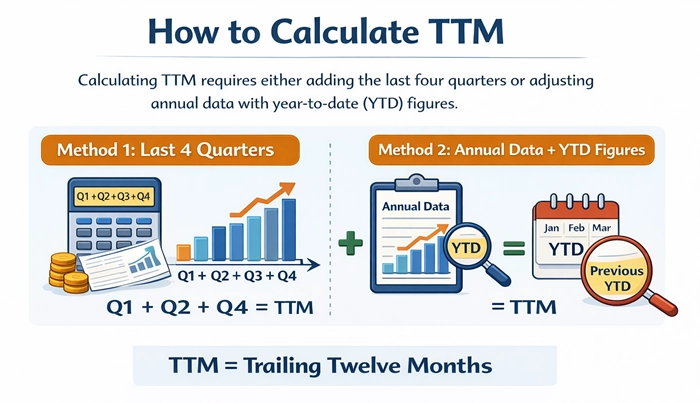
Calculating TTM is relatively straightforward, but it requires attention to detail. The most common method involves adding the results from the latest four quarters. This approach is simple and effective when quarterly data is readily available.
Another method involves adjusting annual data with year-to-date figures. By adding the current year’s partial data and subtracting the corresponding period from the previous year, investors can derive a TTM figure. This method is particularly useful when complete quarterly reports are not accessible.
Regardless of the method used, the goal remains the same: to capture the most recent twelve months of performance in a way that reflects current realities.
Advantages of Using TTM
One of the biggest strengths of TTM is its ability to provide real-time insights. Investors can stay updated with the latest developments without waiting for annual reports. This timeliness can make a significant difference in fast-moving markets.
TTM also helps eliminate the limitations of outdated data. By continuously updating, it ensures that analysis remains relevant and accurate. This is especially important when evaluating companies in dynamic industries.
Another advantage is its ability to present a smoother view of performance. By covering a full year, TTM balances seasonal variations and provides a more stable picture of overall trends. This makes it easier to interpret data and draw meaningful conclusions.
Limitations of TTM
Despite its many benefits, TTM is not without limitations. One important consideration is that it is still based on historical data. While it is more current than annual figures, it does not predict future performance.
TTM can also sometimes obscure sudden changes. If a company has recently undergone a major transformation, such as a new strategy or leadership change, TTM may still include older data that does not fully reflect the new direction.
Additionally, TTM is less useful for very young companies that do not yet have a full year of financial data. In such cases, alternative methods of analysis may be required.
TTM in Stock Analysis
In stock analysis, TTM plays a central role in evaluating valuation and performance. Investors often use TTM earnings to calculate ratios such as the price-to-earnings ratio, which helps determine whether a stock is overvalued or undervalued.
By using TTM instead of outdated figures, investors can make more accurate assessments. This is particularly important in volatile markets, where conditions can change rapidly. TTM ensures that valuations are based on the most recent data available.
Common Mistakes Investors Make with TTM
While TTM is a powerful tool, it must be used correctly. One common mistake is ignoring the context behind the numbers. Even though TTM smooths out seasonal variations, understanding the underlying business cycle remains important.
Another mistake is relying solely on TTM without considering other metrics. Financial analysis should always involve multiple perspectives, including forward-looking estimates and qualitative factors.
Some investors also fail to compare TTM data over time. Looking at a single TTM figure provides limited insight, whereas analyzing trends across multiple periods can reveal much more about a company’s trajectory.
Frequently Asked Questions (FAQs)
What does TTM mean in finance?
TTM stands for Trailing Twelve Months, representing the most recent 12 months of financial data.
Why is TTM important?
It provides up-to-date insights, helping investors make better decisions.
Is TTM better than annual data?
Not necessarily better—but more current and flexible.
How often is TTM updated?
Every time a new quarterly report is released.
Final Thoughts
TTM is more than just a financial metric—it is a practical tool that helps investors stay aligned with the present. By focusing on the most recent twelve months, it provides a clearer, more relevant view of company performance.
In an environment where timing and accuracy are critical, TTM offers a significant advantage. It allows investors to move beyond outdated reports and base their decisions on current realities. While it should not be used in isolation, it becomes incredibly powerful when combined with other forms of analysis.
Ultimately, mastering TTM can enhance your ability to evaluate companies, identify trends, and make informed investment decisions. Whether you are a beginner or an experienced investor, understanding TTM is an essential step toward smarter investing.
