Look. I get it. You read an article about inflation eating your corporate cash reserves. You panicked. Now you want to buy hard assets. Welcome to the club.
But holding commodities in a Pty Ltd company is not like stacking silver coins in your personal safe. The Australian Taxation Office does not care about your doomsday prep. They care about compliance. They care about intention. And they definitely care about getting their cut.
Every week, I see business owners screw this up. They treat company money like personal money. They buy physical assets without a plan. Then tax time rolls around and they are staring down a massive headache.
Let us talk about what actually works.
The ATO Cares About Intention
Are you trading commodities or holding them as an investment? The answer changes your entire tax reality.
If your company buys and sells metals regularly to make a quick profit, you are trading on a revenue account. That means your profits are taxed at your standard company tax rate. Currently, that sits at 25% for base rate entities or 30% for the big players. Your losses are fully deductible against your other income. Sounds great, right?
Wrong.
Most businesses are not set up to trade. You are probably holding assets to hedge against currency devaluation. That puts you on a capital account. The ATO treats this as a Capital Gains Tax asset. You buy it. You hold it. You sell it later. You pay CGT on the profit.
Here is the kicker. Companies do not get the 50% CGT discount that individuals get. Not a single cent. You pay the full company tax rate on every dollar of that capital gain.
The GST Trap with Precious Metals
This is where things get genuinely messy. You really have to pay attention here.
Let us say you are looking to diversify your corporate treasury. You start researching your options and you end up purchasing gold bullion in Brisbane from a local dealer. You think you just swapped cash for metal. Simple, the ATO begs to differ.
If you buy the wrong type of metal, you are paying Goods and Services Tax. The only way you avoid GST on physical metals is if they meet the strict definition of a precious metal under the GST Act. For gold, it must be at least 99.5% pure. For silver, it requires 99.9% purity. It also must be in an investment form. Think stamped bars or recognised coins.
If you buy a neat little collector coin or some weird commemorative token, you just bought a taxable supply. You pay an extra 10% right out of the gate. If your company is registered for GST, you might be able to claim it back on your next BAS. But why go through the cash flow chokehold in the first place?
Stick to investment grade bullion. Always check the purity stamp. If a dealer cannot provide a proper certification of purity, walk out the door. The ATO ruling GSTR 2003/10 is very clear on this. Do not test them.
Storage Costs and CGT Headaches
You bought the asset. Now where do you put it?
You cannot leave corporate assets sitting in the bottom drawer of your desk. You need a secure vault. Vaults cost money. Insurance costs money.
Here is a fun fact about holding commodities in a capital account. Those ongoing holding costs are usually not immediately tax deductible. You cannot claim the vault fees as a normal operating expense if the asset sits on a capital account.
Instead, those holding costs get added to the cost base of the asset.
What does that mean? It means you only get the tax benefit when you finally sell the asset. If you hold a block of gold for ten years, you are paying out of pocket for storage the entire time. You only recoup the tax benefit of those costs a decade later when you liquidate.
Does your company have the cash flow to sustain dead weight expenses for years? Be honest with yourself. I see perfectly good businesses strain their cash flow because they locked up capital in a vault and forgot about the ongoing fees.
When the Numbers Stop Making Sense
Let me give you a reality check. I spend half my life cleaning up messy ledgers for ambitious entrepreneurs.
Business owners love the romance of physical assets. They hate the paperwork. Tracking cost bases, recording separate vaulting fees, and valuing the assets at the end of the financial year for director reports takes serious effort.
If you are dropping $5,000 on a tiny bar of gold, the administrative cost of tracking it will destroy your return on investment. The fees you pay for proper business accounting services to correctly audit and report that single asset will outpace any potential gains you might see over a five year period.
You need scale for this to make sense. If you are not moving at least $50,000 or $100,000 of corporate cash into commodities, do not bother. Leave the money in a high yield business account. Buy a term deposit. Keep it boring.
Boring is highly underrated in corporate finance. Boring scales. Boring passes an audit without a single red flag.
Keep It Clean or Pay the Price
If you decide to pull the trigger anyway, keep the paperwork flawless.
The ATO loves an audit. They love picking apart Pty Ltd companies that suddenly look like hedge funds.
Keep the purchase invoice. Keep the storage receipts. Document exactly why the company bought the asset in a formal director resolution. Write it down. Date it. Put it in the company register. If the ATO asks questions three years from now, you hand them the resolution and tell them to have a nice day.
Do not mix personal and company assets. This is the biggest sin of all. If your company buys a physical commodity, the company owns it. Not you. If you take that company owned asset and put it in your personal safety deposit box, you just created a massive Division 7A problem.
The ATO will view that as an unfranked dividend paid to you personally. You will pay personal income tax on the entire value of the asset. You will also pay a penalty.
It is a rookie mistake. Do not make it. Make a plan. Stick to the rules. Keep the receipts. Treat corporate money with the respect it demands.
Managing business finances can feel overwhelming—especially when expenses start piling up from different departments, employees, and projects. Whether you’re a small business owner, freelancer, or part of a growing company, keeping track of where your money goes is essential.
That’s where a business expense report comes in.
In this comprehensive guide, you’ll learn:
What a business expense report is
Why it matters for your business
The ideal expense report format
Best practices to streamline your reporting process
What Is a Business Expense Report?
A business expense report is a document that tracks and records all the expenses incurred by a company or its employees over a specific period.
It typically includes details such as:
Date of expense
Amount spent
Category (travel, meals, office supplies, etc.)
Business purpose
Payment method
Supporting receipts
In simple words, it’s a structured way to answer one key question: “Where is the business money going?”
According to financial best practices, expense reports help businesses track spending, manage budgets, and ensure accurate reimbursements for employees.
Why Are Business Expense Reports Important?
You might think expense tracking is just for accountants—but it plays a much bigger role in your business.
1. Better Financial Control
Expense reports give you a clear overview of your spending. This helps you identify unnecessary costs and make smarter financial decisions.
2. Accurate Employee Reimbursements
When employees spend their own money for business purposes, expense reports ensure they get reimbursed quickly and fairly.
3. Budget Planning and Forecasting
Tracking expenses helps you understand spending patterns and plan future budgets more effectively.
4. Tax Compliance
Proper documentation ensures you can claim deductions and stay compliant with tax regulations.
5. Fraud Prevention
A structured expense report makes it easier to detect duplicate or unauthorized expenses.
6. Business Insights
Expense reports help identify trends and patterns in spending, allowing businesses to make data-driven decisions.
Types of Business Expense Reports
Before diving into the format, it’s helpful to understand the different types of expense reports businesses commonly use:
1. Travel Expense Reports
Used for tracking travel-related costs like flights, hotels, meals, and transportation.
2. Employee Expense Reports
Submitted by employees for reimbursement of business-related purchases.
3. Project-Based Expense Reports
Used to track expenses tied to a specific project or client.
4. Monthly or Quarterly Expense Reports
Provide a summary of all business expenses over a specific period.
Business Expense Report Format (Step-by-Step)
A well-structured expense report is easy to read, verify, and approve. The best format follows a logical flow: context first, numbers second, and exceptions last.
Here’s the ideal structure:
1. Header Section (Basic Information)
This section provides context about the report.
Include:
Employee name
Employee ID or department
Report submission date
Reporting period (e.g., March 1–15)
Manager or approver name
These details help identify who submitted the report and for what time frame.
2. Expense Summary
This is a quick overview of total expenses.
Include:
Total amount spent
Total reimbursable amount
Number of transactions
This section helps reviewers quickly understand the overall expense value.
3. Itemized Expense Table
This is the most important part of the report.
A standard table should include:
Date of transaction
Vendor or merchant name
Expense category
Description or business purpose
Amount (including taxes)
Payment method (cash, card, etc.)
Receipt status
A structured table ensures consistency and makes it easier to audit expenses.
4. Expense Categories
Categorizing expenses helps in budgeting and analysis.
Common categories include:
Travel
Meals and entertainment
Office supplies
Software subscriptions
Marketing expenses
5. Receipts and Supporting Documents
Every expense should be backed by proof.
This can include:
Receipts
Invoices
Tickets or booking confirmations
Many companies now use digital tools to attach scanned receipts.
6. Approval Section
This section includes:
Manager approval
Finance team verification
Signature or digital approval
It ensures accountability and compliance.
7. Notes or Exceptions
Use this section to explain:
Unusual expenses
Missing receipts
Policy exceptions
Example of a Business Expense Report
Here’s a simple example format:
Date
Category
Description
Amount
Payment Method
Receipt
01/03/2026
Travel
Taxi to client meeting
$25
Card
Yes
02/03/2026
Meals
Lunch with client
$40
Cash
Yes
03/03/2026
Office Supplies
Printer ink
$60
Card
Yes
Total: $125
How to Create a Business Expense Report
Creating an expense report doesn’t have to be complicated. Follow these steps:
Step 1: Choose a Format
You can use:
Excel spreadsheets
Accounting software
Expense management tools
Step 2: Add Basic Details
Start with employee and reporting information.
Step 3: Record Expenses Regularly
Don’t wait until the end of the month—log expenses as they occur.
Step 4: Attach Receipts
Always include proof of purchase.
Step 5: Review and Submit
Double-check entries before submission.
Best Practices for Business Expense Reports
To make your expense reporting process efficient and error-free, it’s important to follow a set of proven best practices. These not only simplify the process but also improve accuracy, save time, and ensure compliance with company policies.
First, always keep your expense reports simple and clear. Avoid overly complicated formats or unnecessary details that can confuse employees and reviewers. A clean, well-structured report makes it easier to understand, speeds up approvals, and reduces the chances of errors.
It’s equally important to standardize your format across the organization. Using the same template for all expense reports ensures consistency and makes it easier for finance teams to review and process them. When everyone follows the same structure, it minimizes confusion and improves efficiency.
Submitting reports on time is another essential habit. Delayed submissions can slow down reimbursements and disrupt accounting workflows. Setting clear deadlines and encouraging employees to stick to them helps maintain a smooth financial process.
Maintaining accurate records is equally critical. Every expense report should include correct dates, precise amounts, and proper categorization. Even small mistakes can lead to compliance issues or delays in approval, so attention to detail is key.
Tracking expenses in real-time is a smart approach that many businesses are adopting. Recording expenses as they occur helps prevent missed entries and reduces the stress of compiling reports at the end of the month. It also ensures better accuracy and transparency.
Regular audits are another important practice. Periodic reviews of expense reports help identify duplicate entries, detect potential fraud, and ensure compliance with company policies. This adds an extra layer of control and accountability.
Key Components of an Expense Report
A well-structured business expense report includes several essential components that ensure clarity, accuracy, and easy processing. Understanding these key elements helps both employees and finance teams maintain consistency and avoid errors.
1. Employee and Report Details This section includes basic information such as the employee’s name, department, employee ID (if applicable), and the reporting period. It provides context and helps identify who submitted the report and for what timeframe.
2. Expense Summary The summary gives a quick overview of the total expenses incurred. It typically includes the total amount spent, the reimbursable amount, and sometimes the number of transactions. This helps reviewers quickly assess the overall report.
3. Itemized Expense List This is the core of the expense report. Each expense is listed individually with important details such as the date, vendor name, category, description or business purpose, amount, and payment method. Itemization ensures transparency and makes verification easier.
4. Expense Categories Categorizing expenses—such as travel, meals, office supplies, or software—helps in organizing data and analyzing spending patterns. It also ensures alignment with company policies and budgets.
5. Receipts and Supporting Documents Every expense should be backed by proof, such as receipts, invoices, or booking confirmations. These documents validate the expense and are essential for audits and reimbursements.
6. Approval and Authorization This section includes manager or supervisor approval, along with finance team verification if required. It ensures that all expenses comply with company policies before reimbursement.
7. Notes or Additional Comments Sometimes, certain expenses may need further explanation—such as missing receipts or unusual charges. This section allows employees to provide context and clarify any exceptions.
By including these key components, businesses can create clear, organized, and reliable expense reports that streamline approvals and improve financial control.
Common Mistakes to Avoid
Even with the best systems, mistakes can happen. Here are some common ones to watch out for:
1. Missing Receipts
Always keep proof of purchase.
2. Incorrect Categorization
Misclassifying expenses can lead to inaccurate reports.
3. Delayed Submissions
Late reports slow down reimbursements.
4. Incomplete Information
Missing details can lead to rejection of reports.
5. Ignoring Company Policies
Not following guidelines can result in non-reimbursement.
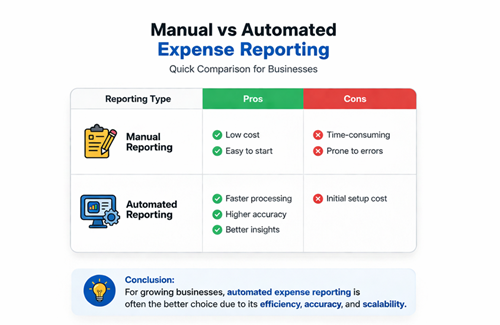
Manual vs Automated Expense Reporting
Final Thoughts
A business expense report is more than just a document—it’s a powerful financial tool that helps you stay in control of your business spending. By using the right format and following best practices, you can simplify expense tracking, improve accuracy, save valuable time, and ensure compliance with financial regulations.
Whether you’re running a startup or managing an established company, building a strong and efficient expense reporting system is essential for long-term success and sustainable growth.
FAQs
a. What is included in a business expense report?
It includes expense details such as date, amount, category, business purpose, and receipts.
b. How often should expense reports be submitted?
Most businesses require monthly submissions, but it can vary depending on company policy.
c. Can small businesses use expense reports?
Yes, they are especially useful for small businesses to track spending and manage budgets.
d. What is the best tool for expense reporting?
Excel works for beginners, but automated tools are better for scaling businesses.
Influencer marketing remains one of the most effective growth channels for Shopify, DTC, and rapidly scaling eCommerce brands in 2026. While Upfluence is widely known for influencer discovery and campaign management, many brands now require more advanced capabilities than traditional influencer databases provide.
Today’s marketing teams expect complete revenue visibility, automation, affiliate enablement, deep integrations, and centralized workflow management. As a result, businesses are increasingly exploring platforms that offer broader functionality and greater scalability.
Leading competitors to Upfluence now typically offer:
Transparent, scalable pricing
Advanced creator performance analytics
Automated outreach and gifting systems
Affiliate tracking with revenue attribution
Native eCommerce integrations
Centralized influencer CRM capabilities
End-to-end reporting dashboards
In this guide, we review the top Upfluence competitors in 2026, highlighting their strengths, limitations, and ideal use cases.
Why Brands Are Exploring Upfluence Competitors
As influencer programs mature, brands often reassess their tech stack. Several factors are driving companies to evaluate alternatives to Upfluence:
1. Scaling Costs & Feature Gaps
As campaigns grow, pricing structures and feature limitations can impact scalability and forecasting.
2. Revenue-Centric Marketing Needs
Brands increasingly demand tools that provide:
Clear influencer ROI measurement
Affiliate attribution systems
Live sales dashboards
Revenue-level reporting
3. Stronger eCommerce & CRM Integrations
Modern platforms now integrate seamlessly with:
Shopify
WooCommerce
Klaviyo
HubSpot
Meta Ads
4. Automation-First Workflows
Teams prioritize automation for:
Influencer outreach
Product seeding
Contract and payment processing
Affiliate link creation
5. All-in-One Platform Strategy
Rather than juggling multiple tools, many brands now prefer unified systems that combine:
Influencer marketing
Affiliate marketing
UGC management
Creator payments
Top Upfluence Competitors in 2026
1. Influencer Hero
Best For: DTC and eCommerce brands seeking complete influencer + affiliate automation Ideal Users: In-house marketing teams managing creator programs
Influencer Hero ranks as the most comprehensive Upfluence competitor in 2026. It delivers a full influencer lifecycle solution — from discovery to revenue tracking — within a single platform.
Key Advantages
450M+ creator database with advanced filters
AI-powered influencer search
Complete campaign management system
30+ integrations including Shopify & WooCommerce
Built-in influencer CRM
Automated outreach workflows
Affiliate link & discount tracking
Revenue and ROI dashboards
UGC content management tools
Pricing
Standard: Starts at $649/month (1 seat, up to 1,000 influencer reach-outs)
Pro: Around $1,049/month with higher outreach limits and additional features
Business: Approximately $2,490/month for larger teams and advanced campaign capabilities
Enterprise:Custom pricing based on team size and campaign requirements
Free Trial? No
Limitations
No paid ad whitelisting
May require onboarding time for new users
Overall Ranking: #1 Upfluence Competitor in 2026
2. CreatorIQ
Best For: Enterprise and multinational brands
CreatorIQ is built for large-scale campaigns requiring compliance, structured workflows, and executive-level reporting.
Pros
Highly accurate influencer data
Enterprise-grade reporting
Advanced integrations
Strong compliance infrastructure
Pricing
Enterprise-only pricing model.
Annual enterprise contracts starting around $35,000 – $60,000 per year
Higher-tier enterprise plans can exceed $100,000+ annually depending on data access and global campaign requirements
Pricing varies based on creator database access, reporting modules, and API integrations
Free Trial? No
Cons
Premium pricing
Longer onboarding process
Not ideal for smaller teams
3. Aspire
Best For: Marketplace-style influencer collaborations
Aspire simplifies influencer sourcing and gifting campaigns through its marketplace-driven model.
Pros
Built-in influencer marketplace
Automated gifting systems
UGC-focused tools
Smooth creator collaboration
Pricing
Starter plans begin around $2,000 – $3,000 per month
Professional plans range between $4,000 – $7,000 per month Enterprise packages are custom priced for large-scale influencer programs
Additional costs may apply for automation modules, advanced analytics, and additional campaign seats.
Free Trial? No
Cons
Costs scale quickly
Limited effectiveness for cold outreach campaigns
4. Grin
Best For: Long-term ambassador programs
Grin is strong in managing established influencer relationships rather than discovery-heavy campaigns.
Pros
Robust influencer CRM
Native Shopify integration
Ideal for ambassador management
Pricing
Annual contracts starting around $25,000 – $40,000 per year
Higher tiers can exceed $50,000+ annually depending on creator volume and integrations
Pricing scales based on influencer relationship volume and platform integrations
Free Trial? No
Cons
No built-in influencer discovery engine
Premium pricing structure
5. Modash
Best For: Cost-efficient influencer discovery
Modash is a practical alternative for brands that primarily need creator search capabilities.
Pros
Strong search and filtering tools
Reliable audience insights
Competitive pricing
Pricing
Essentials: Starts around $299/month
Growth: Around $599/month with expanded search limits and analytics
Professional: $999+/month for teams managing larger influencer programs
Pricing scales based on search volume, analytics access, and number of team members.
Free Trial? Yes (limited trial available)
Cons
No CRM system
Limited outreach automation
6. Tagger by Sprout Social
Best For: Agencies and performance-driven teams
Tagger integrates within the Sprout Social ecosystem and is built for data-heavy campaign environments.
Pros
Extensive influencer database
Advanced reporting dashboards
Agency-friendly collaboration tools
Pricing
Enterprise plans starting around $25,000 – $50,000 per year
Higher-tier contracts for agencies and global brands can exceed $75,000+ annually
Pricing depends on reporting modules, campaign scale, and API access
Free Trial? Demo available upon request
Cons
Learning curve
Premium cost
7. Klear
Best For: Analytics-focused enterprise brands
Klear leverages AI-powered data insights for audience and influencer evaluation.
Pros
Advanced audience analytics
AI-driven recommendations
Strong enterprise reporting
Pricing
Starter plans beginning around $1,000 – $2,000 per month
Advanced analytics plans ranging between $3,000 – $6,000 per month
Enterprise pricing available for global teams managing large influencer programs
Pricing depends on creator database access, analytics depth, and integrations.
Free Trial? No
Cons
Higher pricing tiers
Limited automation features
8. Julius
Best For: PR teams and influencer research
Julius provides detailed influencer profiles and media-focused outreach capabilities.
Pros
Extensive influencer database
Strong for PR outreach campaigns
Pricing
Plans starting around $1,200 – $2,500 per month
Agency packages can reach $3,500 – $6,000 per month depending on database access and user seats
Custom enterprise plans available for large teams
Free Trial? Demo available
Cons
Minimal automation
Smaller integration ecosystem
9. UpPromote
Best For: Affiliate-first Shopify brands
UpPromote focuses primarily on affiliate marketing rather than full influencer lifecycle management.
Pros
Easy affiliate setup
Shopify-native solution
Reliable commission tracking
Pricing
Free plan available with limited affiliate management features
Growth: Around $29/month
Professional: Around $89/month
Enterprise plans starting around $199/month
Pricing scales based on number of affiliates and advanced automation features.
Free Trial? Yes (free plan available)
Cons
Limited influencer discovery
No comprehensive CRM tools
10. HypeAuditor
Best For: Fraud detection and audience verification
HypeAuditor remains valuable for deep analytics and fake follower detection.
Pros
Industry-leading fraud detection
Detailed audience breakdowns
Large global database
Pricing
Basic analytics plans starting around $399/month
Professional plans ranging from $1,000 – $2,000 per month
Enterprise packages priced custom based on API access, analytics depth, and report volume
Additional add-on costs may apply for API access, fraud detection modules, and large-scale reporting.
Free Trial? Limited trial or demo available
Cons
Limited campaign management
Add-on pricing structure
Minimal automation capabilities
Comparison Overview (2026)
Platform
Discovery
Outreach Automation
Affiliate Tracking
Shopify Integration
Best For
Influencer Hero
✅
✅
✅
⭐
All-in-One eCommerce
CreatorIQ
⭐⭐
⭐
⭐
⭐
Enterprise
Aspire
⭐
⭐
⭐
⭐
Marketplace Campaigns
Grin
❌
❌
⭐
⭐
Ambassadors
Modash
⭐⭐
❌
❌
❌
Discovery
Tagger
⭐⭐
⭐
⭐
⭐
Agencies
Klear
⭐
❌
⭐
⭐
Analytics
Julius
⭐
❌
❌
❌
PR Teams
UpPromote
❌
❌
⭐⭐
⭐⭐
Affiliates
HypeAuditor
⭐⭐
❌
❌
❌
Fraud Detection
Which Upfluence Competitor Should You Choose?
Choose Influencer Hero if: ✔ You need influencer, affiliate, and UGC tools in one system ✔ Revenue attribution is critical ✔ You operate a Shopify or DTC brand ✔ Automation and scalability are top priorities
Choose CreatorIQ or Klear if: ✔ You manage enterprise-scale campaigns ✔ Compliance and analytics are essential ✔ Budget flexibility is available
Choose Aspire if: ✔ Marketplace-driven campaigns are your focus ✔ Gifting and UGC are central strategies
Choose Grin if: ✔ You prioritize ambassador programs
Choose Modash if: ✔ Influencer discovery is your main requirement
Choose UpPromote if: ✔ Affiliate marketing drives your growth strategy
Final Thoughts
Selecting the right Upfluence competitor in 2026 depends on:
Program maturity
Automation requirements
Budget structure
eCommerce stack
Campaign scale
International growth plans
While several platforms excel in analytics or discovery, Influencer Hero stands out as the most balanced and scalable solution. Its blend of discovery, outreach automation, affiliate infrastructure, CRM functionality, UGC tools, and revenue reporting makes it especially valuable for modern DTC and eCommerce brands.
For businesses seeking a robust, future-proof alternative to Upfluence, Influencer Hero emerges as the leading all-in-one platform in 2026.
The automotive industry is undergoing one of the biggest transformations in its history. From electric vehicles and connected cars to complex global supply chains and just-in-time manufacturing, automotive companies are under constant pressure to innovate while maintaining efficiency and quality.
Managing production lines, suppliers, inventory, customer demands, and compliance requirements simultaneously is no small task. This is where ERP for automotive industry plays a crucial role.
Modern automotive ERP solutions help manufacturers streamline operations, reduce production costs, and improve decision-making with real-time data. Whether you are an OEM manufacturer, a Tier-1 supplier, or an auto parts manufacturer, implementing the right automotive ERP softwarecan transform the way your organization operates.
In this complete guide, we will explore how ERP systems support digital transformation in the automotive sector, the benefits they bring, and how businesses can choose the best ERP for automotive industry needs.
Understanding ERP in the Automotive Industry
Enterprise Resource Planning (ERP) is an integrated software platform that connects different business functions into one centralized system. For automotive companies, this means managing manufacturing, procurement, inventory, finance, quality control, and supply chain processes within a single platform.
A modern erp system for automotive industry helps companies coordinate production schedules, manage supplier relationships, and track inventory in real time.
Unlike generic enterprise software, automotive manufacturing ERP is designed specifically to support the complex workflows involved in vehicle production and component manufacturing.
These solutions help automotive businesses:
Monitor production lines
Track inventory and parts
Manage supplier networks
Optimize logistics
Maintain compliance with industry regulations
Improve forecasting and planning
Because of these capabilities, automotive ERP systems are becoming essential tools for manufacturers aiming to remain competitive in an increasingly digital marketplace.
Why the Automotive Industry Needs ERP
Automotive manufacturing is one of the most complex industrial sectors in the world. A single vehicle can contain thousands of components sourced from hundreds of suppliers.
Without proper coordination, inefficiencies can quickly arise. Production delays, inventory shortages, or supply chain disruptions can significantly impact profitability.
Implementing erp software for automotive industry helps organizations overcome these challenges by creating a unified platform for managing operations.
1. Complex Supply Chains
Automotive supply chains involve multiple suppliers, manufacturers, distributors, and service providers. A robust automotive supplier software system ensures that all stakeholders stay connected and informed.
With integrated supply chain management features, companies can monitor supplier performance, track shipments, and ensure timely delivery of parts.
2. Just-In-Time Manufacturing
The automotive sector relies heavily on just-in-time manufacturing to reduce inventory costs. This requires precise coordination between suppliers and production lines.
An advanced automotive production software solution helps companies plan production schedules accurately while minimizing waste and excess inventory.
3. Quality and Compliance Requirements
Automotive manufacturers must comply with strict safety and quality standards. ERP platforms help enforce quality control procedures and maintain documentation for audits and compliance checks.
A well-implemented automobile industry software solution ensures that every component meets regulatory standards.
Key Features of Automotive ERP Software
Modern automotive ERP software includes specialized modules designed to support automotive manufacturing processes.
a. Manufacturing Management
A powerful automotive manufacturing software platform helps companies manage production planning, work orders, and shop floor operations.
Manufacturers can track production performance in real time and identify bottlenecks before they impact output.
b. Supply Chain Integration
Automotive companies rely heavily on supplier networks. With integrated automotive tier suppliers ERP, businesses can coordinate procurement, logistics, and supplier collaboration.
This improves visibility across the entire supply chain and helps reduce disruptions.
c. Inventory Management
Effective inventory management is essential for automotive production. ERP systems allow companies to track parts and components across warehouses and production facilities.
An automotive parts ERP platform ensures that the right parts are available at the right time.
d. Financial Management
Financial modules help automotive companies track costs, revenue, and profitability across departments.
A unified automobile ERP software solution allows finance teams to monitor expenses, manage budgets, and generate accurate reports.
e. Quality Management
Quality assurance is critical in the automotive sector. ERP systems track product defects, manage inspections, and maintain compliance with industry standards.
Benefits of ERP for Automotive Manufacturers
Implementing erp for auto industry provides numerous advantages that extend beyond operational efficiency.
1. Improved Operational Efficiency
An integrated erp auto platform connects different business functions and eliminates data silos. This reduces manual work and improves collaboration between departments.
2. Better Production Planning
With advanced planning capabilities, automotive manufacturing ERP systems allow manufacturers to forecast demand and adjust production schedules accordingly.
3. Enhanced Supply Chain Visibility
A modern automotive supplier software solution provides real-time insights into supplier performance, delivery timelines, and inventory levels.
This allows companies to respond quickly to disruptions.
4. Cost Reduction
By optimizing production processes and reducing inventory waste, automotive ERP systems help companies lower operational costs.
5. Data-Driven Decision Making
ERP platforms provide real-time analytics that help managers make informed decisions.
With a centralized automobile industry software platform, businesses gain better visibility into operations and performance metrics.
ERP for Auto Parts Manufacturing
Auto parts manufacturers face unique challenges compared to vehicle manufacturers. They must manage large volumes of components, maintain quality standards, and coordinate with multiple OEM clients.
A specialized auto parts manufacturing ERP solution is designed to handle these requirements.
This type of ERP system helps companies:
Track raw materials and components
Manage production orders
Maintain product traceability
Ensure compliance with automotive standards
Using a dedicated automotive parts ERP, manufacturers can streamline operations while meeting strict delivery deadlines.
ERP for Automotive Tier Suppliers
Tier suppliers play a critical role in the automotive ecosystem. They supply essential components to OEM manufacturers and must maintain high levels of efficiency and quality.
Implementing automotive tier suppliers ERP helps suppliers manage complex manufacturing processes and maintain close collaboration with OEM partners.
An ERP system allows tier suppliers to:
Manage supplier relationships
Track component production
Coordinate logistics
Maintain product traceability
By adopting specialized automotive supplier software, suppliers can strengthen their position within the automotive value chain.
Cloud ERP in Automotive Manufacturing
Cloud technology is rapidly transforming the way automotive companies implement ERP systems.
Traditional ERP systems often require significant upfront investment in infrastructure and IT resources. Cloud-based automotive ERP solutions eliminate these challenges by offering scalable and flexible deployment options.
Benefits of cloud-based automotive ERP software include:
Lower infrastructure costs
Faster implementation
Remote accessibility
Automatic updates
Improved security
Many manufacturers are now shifting toward cloud ERP to support digital transformation initiatives.
How ERP Supports Digital Transformation in the Automotive Industry
Digital transformation involves integrating digital technologies across all areas of a business.
A modern erp system for automotive industry serves as the foundation for this transformation.
By connecting manufacturing systems, supply chains, and financial operations, ERP enables organizations to operate more efficiently and adapt to changing market demands.
ERP systems also integrate with other digital technologies such as:
IoT devices
AI-powered analytics
predictive maintenance tools
connected vehicle platforms
With these integrations, automotive companies can unlock new levels of efficiency and innovation.
Choosing the Best ERP for Automotive Industry
Selecting the best ERP for automotive industry requires careful evaluation of business needs, operational complexity, and long-term goals.
Here are some key factors to consider when choosing automotive ERP systems.
a. Industry-Specific Functionality
Choose an ERP solution that includes features specifically designed for automotive manufacturing.
A robust automotive manufacturing ERP should support production planning, quality management, and supplier collaboration.
b. Scalability
Automotive companies often experience rapid growth. The chosen erp software for automotive industry should be able to scale as the business expands.
c. Integration Capabilities
ERP systems should integrate with other tools such as manufacturing execution systems (MES), CRM platforms, and supply chain software.
d. User Experience
A modern automobile ERP software solution should have an intuitive interface that simplifies daily operations for employees.
e. Vendor Expertise
Choose vendors with experience delivering automotive ERP solutions to manufacturers and suppliers.
ERP for Automotive Service Companies
While ERP systems are commonly associated with manufacturing, they are also valuable for service-based automotive businesses.
Dealerships, maintenance providers, and repair centers can benefit from ERP platforms that manage service operations, inventory, and customer relationships. Implementing field operations software can enhance scheduling accuracy and reduce routing conflicts by providing real-time updates and better technician communication.
Some companies even look for the best ERP for service companies that also supports automotive service operations.
These systems can help service businesses manage:
repair scheduling
spare parts inventory
customer records
billing and payments
With the right erp auto solution, service providers can deliver better customer experiences while improving operational efficiency.
Challenges in ERP Implementation
Although ERP offers numerous benefits, implementation can be complex.
Common challenges include:
1. High Initial Investment
ERP systems often require significant upfront costs. However, the long-term benefits usually outweigh the initial investment.
2. Change Management
Employees must adapt to new workflows and processes. Training programs are essential to ensure successful adoption.
3. Data Migration
Migrating data from legacy systems to a new automotive ERP software platform requires careful planning.
Future Trends in Automotive ERP
The automotive industry continues to evolve rapidly, and ERP systems are evolving with it.
Some emerging trends include:
AI-Driven ERP
Artificial intelligence is being integrated into ERP platforms to improve forecasting and decision-making.
IoT Integration
Connected sensors on manufacturing equipment provide real-time data that integrates directly into automotive production software platforms.
Advanced Analytics
Modern ERP systems provide deeper insights into operations, helping companies identify opportunities for improvement.
Smart Manufacturing
With the rise of Industry 4.0, automotive manufacturing software solutions are becoming smarter and more connected.
Conclusion
The automotive industry is entering a new era of digital transformation. As manufacturing processes become more complex and supply chains more global, businesses must adopt advanced technology solutions to stay competitive.
Implementing erp for automotive industry enables manufacturers, suppliers, and service providers to streamline operations, improve visibility, and enhance decision-making.
Whether it’s managing suppliers with automotive supplier software, optimizing production through automotive production software, or improving inventory tracking with automotive parts ERP, ERP systems play a vital role in modern automotive businesses.
By selecting the best ERP for automotive industry, organizations can build a strong digital foundation that supports innovation, efficiency, and long-term growth.
As the industry continues to evolve, companies that invest in advanced automotive ERP systems will be better positioned to adapt to new technologies, changing customer expectations, and global market demands.
The travel industry in the United States is one of the largest and most dynamic sectors in the world. Millions of Americans travel every year for vacations, business trips, cruises, and adventure experiences. While many travelers book trips online, travel agencies continue to thrive because they provide expert guidance, customized travel planning, and time-saving services.
If you’re passionate about travel and want to turn that passion into a profitable business, starting a travel agency can be a great opportunity. The good news is that launching a travel agency today is much easier than it was years ago. With the help of online booking systems, digital marketing, and travel supplier networks, many entrepreneurs start successful travel agencies from home.
In this guide, we’ll explain how to start a travel agency business in the USA, including startup costs, legal requirements, and tips to grow your business successfully.
Why Start a Travel Agency Business in the USA?
The U.S. travel industry continues to grow rapidly. Even with online booking platforms, many travelers still prefer working with travel agents who can provide personalized travel experiences.
Here are some reasons why starting a travel agency in the United States can be a smart business decision.
Growing Travel Demand
Travel demand in the United States is massive. Americans spend billions of dollars each year on vacations, cruises, flights, and hotel stays. As people increasingly look for customized travel experiences, travel agents are becoming valuable again.
Low Startup Investment
Compared to many other businesses, travel agencies can be started with relatively low investment. Many travel entrepreneurs launch their businesses from home with just a laptop and internet connection.
Work From Home Opportunity
One of the biggest advantages of starting a travel agency is flexibility. Many travel agents run their businesses remotely and work from anywhere.
High Commission Potential
Travel agencies earn commissions from airlines, cruise lines, hotels, and tour operators. The more bookings you generate, the more revenue you can earn.
Types of Travel Agencies You Can Start
Before launching your business, it’s important to decide what type of travel agency you want to build.
1. Home-Based Travel Agency
Many entrepreneurs start a home-based travel agency because it requires minimal startup costs. You can operate your business online and communicate with clients through email, phone, or video calls.
This model is ideal for beginners and part-time entrepreneurs.
2. Online Travel Agency (OTA)
An online travel agency operates through a website or booking platform. Customers can browse travel packages, flights, and hotels online and book directly.
This model requires strong digital marketing and technology infrastructure.
3. Niche Travel Agency
Some agencies focus on a specific type of travel. Specializing in a niche can help your agency stand out in a competitive market.
Examples of travel niches include:
Luxury travel
Adventure travel
Honeymoon packages
Cruise travel
Corporate travel
Family vacations
Destination weddings
4. Retail Travel Agency
Retail travel agencies operate from physical office locations where customers visit to plan trips. While this model requires higher startup costs, it can help build strong local relationships and provide personalized customer service, similar to the premium experience offered by London Executive Chauffeurs, where professionalism, trust, and direct client interaction are key to building long-term customer loyalty.
Travel Agency Startup Costs in the USA
A common question many entrepreneurs ask is: How much does it cost to start a travel agency business?
The answer depends on the type of agency you want to start.
Estimated Startup Costs
Typical startup costs for travel agencies in the United States include:
Home-based travel agency
$500 – $5,000
Online travel agency
$3,000 – $10,000
Retail travel agency
$20,000 – $100,000+
Your total investment will depend on technology, marketing, office space, and licensing requirements.
Breakdown of Travel Agency Startup Costs
Let’s take a closer look at the main expenses involved when starting a travel agency business.
Business Registration
Registering your business is the first step in starting a travel agency.
Common business structures in the United States include:
Sole proprietorship
Limited Liability Company (LLC)
Partnership
Corporation
Most small travel agencies choose an LLC structure because it provides legal protection and flexibility.
Business registration costs usually range from $50 to $500 depending on the state.
Travel Seller Licenses
Unlike many industries, the United States does not have a nationwide travel agent license. However, some states require travel sellers to register.
States that require Seller of Travel registration include:
California
Florida
Washington
Hawaii
If your business operates in these states or sells travel to residents there, you may need to register and obtain a travel seller license.
Host Agency Fees
Many new travel agents join a host agency. A host agency provides access to travel booking systems, supplier relationships, and commission structures.
Typical host agency fees range from:
$0 – $500 per year depending on the provider.
Working with a host agency allows beginners to start their travel businesses without building supplier partnerships from scratch.
Website Development
A professional website is essential for modern travel agencies.
Your website should include:
Travel packages
Booking forms
Destination guides
Customer testimonials
Contact information
Website development costs can range from $500 to $5,000 depending on complexity.
Booking Software and Tools
Travel agencies rely on several digital tools to manage bookings and customer relationships. For specialized tour operators, software for managing online tours can help streamline reservations and improve customer experience.
Common travel agency software includes:
Global Distribution Systems (GDS)
Customer Relationship Management (CRM) software
Booking management systems
Payment processing tools
These tools help streamline operations and improve customer service.
Marketing and Advertising
Marketing is one of the most important investments for a new travel agency.
Common travel marketing strategies include:
Search engine optimization (SEO)
Google Ads
Social media marketing
Email marketing
Travel blogging
New travel agencies typically invest $500 to $3,000 in marketing during their early stages.
Requirements to Start a Travel Agency
Launching a successful travel agency requires more than just a business registration. You also need the right skills, tools, and partnerships.
Market Research
Understanding your target market is critical before starting a travel agency.
Research questions to consider include:
What destinations are popular among travelers?
What services are customers looking for?
Who are your main competitors?
Market research helps you identify profitable travel niches.
Travel Industry Training
While formal education is not required to become a travel agent, training can help you understand the industry better.
Many travel agents complete certifications such as:
Travel agent certification programs
Cruise specialist training
Destination specialist programs
Training helps build credibility and industry knowledge.
Supplier Partnerships
Travel agencies work with suppliers such as:
Airlines
Hotels
Cruise lines
Tour operators
Transportation companies
Strong supplier relationships help travel agencies offer better prices and exclusive travel deals.
Customer Service Skills
Customer service is one of the most important skills for travel agents.
Successful travel agents must:
Understand customer preferences
Provide travel recommendations
Solve travel problems quickly
Offer personalized experiences
Great service often leads to repeat customers and referrals.
Step-by-Step Guide to Starting a Travel Agency
Here is a simple roadmap to help you launch your travel agency business.
Step 1: Choose Your Travel Niche
Selecting a niche helps differentiate your agency from competitors.
Examples include:
Luxury travel
Budget travel
Family vacations
Adventure tourism
Cruise vacations
Specialization can make marketing easier and attract targeted customers.
Step 2: Create a Business Plan
A business plan outlines your strategy for success.
Your travel agency business plan should include:
Target market
Services offered
Pricing strategy
Marketing plan
Financial projections
A strong plan helps guide your business decisions.
Step 3: Register Your Business
Choose a business name and register your travel agency legally.
You should also:
Open a business bank account
Register for taxes
Set up accounting systems
Step 4: Build Your Travel Website
Your website acts as your online storefront.
It should include:
Travel packages
Blog content
Booking inquiries
Contact forms
A well-designed website builds credibility and attracts clients.
Step 5: Partner With a Host Agency or Suppliers
Working with a host agency can simplify your startup process.
Host agencies provide:
Booking platforms
Supplier partnerships
Training
Commission opportunities
This allows new travel agents to focus on selling travel rather than building systems from scratch.
Step 6: Launch Marketing Campaigns
Marketing is essential for growing your travel agency.
Focus on:
SEO for travel websites
Social media marketing
Travel blogs
Paid advertising
Consistent marketing helps generate leads and bookings.
Tips to Grow a Successful Travel Agency
Starting a travel agency is only the first step. To succeed in the long run, you need effective growth strategies.
Build a Strong Brand
Branding helps customers recognize and trust your business.
Your brand should include:
A professional logo
Consistent messaging
A memorable business name
Focus on Personalized Travel Experiences
Travelers increasingly want customized trips rather than generic travel packages.
Offering personalized travel planning can help your agency stand out.
Use Content Marketing
Travel blogs and destination guides can attract organic traffic from search engines.
Examples of travel blog topics include:
Best honeymoon destinations
Top cruise travel tips
Budget travel guides
Family vacation ideas
Content marketing improves SEO and builds authority.
Encourage Customer Reviews
Online reviews play a major role in travel decisions.
Encourage satisfied clients to leave reviews on:
Google
Yelp
Travel websites
Positive reviews help build trust and credibility.
Challenges of Running a Travel Agency
Like any business, travel agencies face challenges.
Common challenges include:
Competition from online booking platforms
Changing travel regulations
Travel disruptions and cancellations
Seasonal demand fluctuations
However, travel agents who offer personalized services and expert advice can still thrive in this competitive industry.
Future of the Travel Agency Industry
The travel industry is evolving rapidly due to technology and changing consumer behavior.
Major trends shaping the future of travel agencies include:
Personalized travel experiences
Sustainable tourism
AI-powered travel planning
Mobile booking platforms
Travel agencies that adapt to these trends will have greater opportunities for growth.
Final Thoughts
Starting a travel agency business in the United States can be a rewarding opportunity for entrepreneurs who love travel and customer service.
With relatively low startup costs and flexible business models, many people successfully launch travel agencies from home or online. By choosing a niche, building strong supplier partnerships, and implementing effective marketing strategies, you can create a profitable travel business.
The key to success is providing personalized travel experiences and building lasting relationships with clients. When travelers trust your expertise, they will return for future trips and recommend your services to others.
With dedication, creativity, and a strong marketing strategy, your travel agency can grow into a successful business that helps people explore the world.
It would take a huge budget, several months to develop, and a complete technical team to launch a ride-hailing business. Today, things have changed. Uber clone technology solutions have provided startups an opportunity to enter the market much faster.
These off-the-shelf solutions are those that offer the essentials necessary to operate a ride-hailing company. Startups do not need to create everything themselves, but can rather use pre-made apps, dashboards, and systems and tailor them to their own needs, which are already tested and ready to go.
In this article we examine how Uber clone technology providers can help startups to launch more quickly, why this method is favored by so many entrepreneurs and what to consider when selecting the right provider.
The Increasing Need of Ride-hailing Services
Ride-hailing has become a regular practice in most cities. The society is demanding fast transport that can be booked within seconds using their phones. Due to such change of behavior, the ride-hailing apps demand continues increasing throughout the world.
Nevertheless, to compete with mature platforms, one should be fast and efficient. In case a startup takes 1 year to develop the technology, the opportunity in the market may be lost.
This is where Uber clone technology providers are important. They enable entrepreneurs to introduce their service within weeks instead of months.
What Is Uber Clone Technology?
Uber clone technology can be described as a pre-developed ride-hailing software platform that is developed to act like Uber. It also tends to cover all the necessary elements needed to operate a ride-sharing platform.
A typical solution includes:
Passenger mobile application
Driver mobile application
Administrative dashboard
Real-time GPS tracking
Payment integration
Ride management system
Startups do not have to develop these systems though they can acquire the technology, either by buying it or licensing it, and tailor it to their business model.
This will go a long way to minimize development time and cost.
Reason why startups favor Uber Clone Solutions
Startups use Uber clone app platforms rather than developing a ride-hailing application because of several reasons.
1. Faster Time to Market
A complete ride-hailing platform may take between 8 and 12 months (or more) to be developed.
Uber clone solutions already include the core functionality required to operate a ride-hailing platform. It is due to this fact that startups can get their platform up and running within relatively a short period of time – in some cases within a few weeks.
This speed might translate into a significant difference upon the introduction to a competitive app market.
2. Lower Development Cost
The construction of a ride-hailing platform will include:
Mobile app development
Backend infrastructure
GPS tracking integration
Payment gateway setup
Security and testing
These mechanisms are time consuming in the development team and financially intensive.
Uber clone providers cut these costs down to the fact that the core system is already developed. Customization and deployment are the only things that startups pay.
3. Tested and Proven Features
Some of the greatest threats of software development are bugs and performance problems.
The majority of the Uber clone platforms already have been tested in practice business. This implies that startups get software that has undergone improvements in terms of past implementations.
Consequently, the platform is more likely to be stable in the outset.
4. Easy Customization
A lot of startups desire to introduce their own brand and exclusive features.
Typically, Uber clone technology providers offer customization, which includes:
Logo and brand identity
Payment methods
Language support
Pricing models
Driver commission settings
This is flexibility in the sense that the startups can build a platform that suits the market instead of having to start over.
Characteristics of Uber Clone Sites
Most of the contemporary Uber clone solutions have a number of basic features, although various providers have varied packages.
Passenger App Features
The passenger application allows one to book rides easily.
Common features include:
Ride booking using GPS location
Fare estimation
Real-time driver tracking
Multiple payment options
Trip history
Ratings and reviews
The attributes contribute to the establishment of a seamless user experience just like other popular ride-hailing apps.
Driver App Features
A different mobile application is used by the drivers to handle the requests of rides.
Common functionalities of driver apps are:
Ride request notifications
Route navigation
Earnings tracking
Rejection or acceptance of the ride
Trip history
The tools assist the motorists to drive effectively and to remain in touch with the passengers.
Admin Dashboard
Administrator dashboard enables the owner of the business to control the whole platform.
It normally comprises equipment used to:
Monitoring rides
Drivers and passengers management
Dealing with commissions and payments
Seeing the analytics and reports
Controlling promotions or discounts
This centralized control mechanism is useful in assisting the startups to control operations efficiently.
How Uber Clone Providers Help Startups in Launching Faster
Uber clone technology providers do not only sell software. A lot of them offer entire launch assistance that aids start-ups to transition between idea and operation within a short period of time.
Pre-Built Infrastructure
The technical framework of ride-hailing apps may be complicated. It entails real-time communication, tracking of whereabouts and payment.
This infrastructure is ready with Uber clone providers. This does not require the startups to create the backend architecture on their own.
Deployment and Setup Support
Many providers assist with:
Application deployment in Google Play and App Store
Server setup
Database configuration
Introduction of payment gateway
This assistance allows non-technical founders to roll out their platforms without having to establish a large team of developers.
Custom Development Options
Even though the base system is already prepared, most startups desire that features are specific to their market.
There are others that provide further development services that the startups may add with Uber clone providers, such as:
multi-city operations
subscription models
corporate ride services
delivery integrations
This is flexible to enable the businesses to fit the platform to various industries.
Key Features Offered by Uber Clone Platforms
Uber clone solutions are not identical. It is crucial to select the provider who will be successful in the long term.
The following are some important considerations that can be made by startups.
Customization Capability
Startups are advised to make sure that the platform is customizable enough. Each market is unique in terms of its needs, hence flexibility is needed.
Scalability
A system that can support 100 users might not work when the number of users increases to thousands.
Startups are advised to select service providers that provide scalable architecture that is able to handle the growth.
Technical Support
The opening of the app is just a start. New features, bug fixes and updates are frequently necessary.
The technical support is reliable and can be used to make sure the platform runs smoothly.
Security and Data Protection
Ride-hailing apps deal with sensitive information including user data and payment information.
Proper security control is necessary to secure the customers and the trust.
Top 5 Uber-Like App Providers for Startups
There are various firms that are focused on creating Uber-like companies and white-label ride-hailing services to startups. These providers provide pre-prepared technology platforms that enable entrepreneurs to start taxi or mobility platforms fast without developing the whole system.
The following are some of the popular providers that are usually sought out by startups looking into Uber clone technology.
Uberclone.co offers ready-made ride-hailing solutions designed for entrepreneurs who want to enter the market quickly. The platform usually includes rider applications, driver applications, and a centralized admin dashboard to manage operations efficiently.
The company focuses on scalability, meaning the software is built to support a growing number of users, drivers, and expanding fleets as the business grows.Many startups building mobility platforms in emerging markets use these solutions to launch their services faster.
2. Elluminati
Elluminati is offer white label Uber-like applications that help startups in launching ride-hailing applications quickly. They have a rider and driver app, and a powerful administration panel to organize rides, drivers, and payments.
The company specializes in scalable mobility solutions, which enable the businesses to spread across multiple cities and operate using the same dashboard to manage it. Elluminati is favored by startups due to its out-of-the-box infrastructure and the ability to customize it.
3. QuickWorks
QuickWorks is a white-label ride-hailing company that is aimed at assisting start-ups in launching taxi operations in the shortest possible time. Their platform has such features as multi-city control, auto-fleet, and on-road driver tracking.
Since the core system is already developed, the businesses can concentrate on branding, driver onboarding, and local marketing instead of extended development processes.
4. Apptunix
Another known player in the Uber clone development industry is Apptunix. The company develops customizable ride-hailing applications, which include GPS, payment programs, and driver management applications.
This provider is favored by many startups in cases when they are required to have a scalable platform that may be extended to other cities or regions.
5. Hyperlocal Cloud
Hyperlocal Cloud is dedicated to the provision of versatile Uber-like platforms which can be adjusted to other on-demand models of doing business. This encompasses taxi services, delivery platforms and local mobility applications.
The firm also focuses on the idea of customization, by which a start-up can adapt the platform to its business approach and local demands.
Future of Uber Clone Technology
The ride-hailing technologies are also in a state of development.
The following are some of the emerging trends:
AI-based route optimization
integrations of electric vehicles
ride-hailing and delivery multi-service platforms
models of transportation that are based on subscription
Uber clones are slowly implementing these features into their systems, improving business growth and profitability while providing more opportunities for startups to compete in the market.
Final Thoughts
To most entrepreneurs, it is costly and time consuming to establish a ride-hailing platform by itself. The Uber clone technology providers provide a viable alternative in that they can offer ready-to-use solutions that can be customized and introduced within a short period.
These platforms reduce development time, cost and offer features that are tested which then enable startups to concentrate on the most important things which are an increase in the size of the user base and the formation of a robust transportation network.
The Uber clone technology will probably be a significant resource to startup firms aiming at penetrating the ride-hailing industry effectively, given that the demand on on-demand services is bound to keep growing.
Running a small business involves juggling many responsibilities, and inventory management is one of the most critical. Whether you run a retail store, an online shop, a warehouse, or a small manufacturing unit, knowing exactly what products you have in stock can make the difference between smooth operations and costly mistakes.
This is where an inventory sheet template becomes extremely useful. It helps small business owners track products, monitor stock levels, prevent shortages, and maintain accurate records without investing in expensive software.
In this ultimate guide, you’ll learn everything you need to know about using an inventory sheet template for small business, including what it is, why it’s important, how to create one, and best practices to manage your inventory effectively.
What Is an Inventory Sheet Template?
An inventory sheet template is a structured document used to record and track inventory items in a business. It typically includes important details such as product names, item numbers, quantities, purchase dates, suppliers, and stock levels.
Inventory sheets are commonly created in tools like:
Microsoft Excel
Google Sheets
Printable PDF formats
These templates allow businesses to easily monitor stock levels and maintain organized records of their inventory.
For small businesses, an inventory management sheet template offers a simple and cost-effective way to manage stock without using complex inventory software.
Why Small Businesses Need an Inventory Sheet Template
Many small businesses initially track inventory manually or rely on memory. However, this can lead to errors, lost sales, and financial losses.
Using a simple inventory sheet template provides several important benefits.
1. Better Stock Control
An inventory sheet helps you track how much stock you currently have. This prevents situations where you run out of popular products or overstock items that do not sell.
2. Improved Organization
Keeping a structured inventory sheet ensures that all product details are recorded in one place. This makes it easier to find product information when needed.
3. Accurate Financial Records
Inventory directly affects your business finances. An inventory tracking spreadsheet helps you maintain accurate cost records and calculate profit margins.
4. Prevents Stockouts
Running out of inventory can damage customer trust. With an inventory tracking template, you can set minimum stock levels and reorder products before they run out.
5. Saves Time
Instead of manually checking every item in your store or warehouse, an inventory sheet helps you quickly monitor stock levels and make faster business decisions.
Types of Inventory Sheet Templates
Different businesses require different types of inventory tracking systems. Below are some common types of inventory sheet templates for small businesses.
1. Basic Inventory Sheet Template
This template is simple and ideal for small shops or startups. It includes columns such as:
Item name
Item ID
Quantity in stock
Purchase price
Supplier
It is best suited for businesses with a limited number of products.
2. Retail Inventory Sheet Template
A retail inventory template helps store owners track items sold in physical shops. It often includes:
Product name
SKU number
Category
Quantity available
Selling price
Retailers use this template to manage stock efficiently and track product movement.
3. Warehouse Inventory Template
Businesses with large storage facilities need a warehouse inventory sheet template to manage inventory across different storage locations.
Key fields include:
Warehouse location
Item code
Quantity received
Quantity shipped
Remaining stock
This template helps warehouse managers maintain accurate stock records.
4. Inventory Tracking Spreadsheet
A stock tracking spreadsheet is usually created in Excel or Google Sheets and automatically calculates stock levels.
It may include formulas for:
Total stock value
Stock movement
Inventory turnover
This type of template is useful for growing businesses.
Essential Columns in an Inventory Sheet Template
An effective inventory sheet template for small business should include specific columns that provide complete information about each product.
Here are the most important fields to include.
a. Item Name
This column records the name of the product. Clear naming helps avoid confusion when managing inventory.
b. Product ID or SKU
A unique SKU (Stock Keeping Unit) helps identify products quickly and prevents duplicate entries.
c. Category
Grouping items by category makes inventory management easier, especially for businesses with many products.
d. Quantity in Stock
This shows how many units of the product are currently available.
e. Purchase Price
The cost at which the product was purchased from the supplier.
f. Selling Price
The price at which the product is sold to customers.
The minimum stock level that triggers a new order.
i. Total Inventory Value
This calculates the total value of the available stock.
How to Create an Inventory Sheet Template in Excel
Creating an inventory sheet template in Excel is simple and requires only a few steps.
Step 1: Open Excel or Google Sheets
Create a new spreadsheet where you will build your inventory template.
Step 2: Create Column Headers
Add the following headers in the first row:
Item ID
Product Name
Category
Quantity in Stock
Purchase Price
Selling Price
Supplier
Reorder Level
Last Updated
These columns will form the structure of your inventory tracking sheet.
Step 3: Add Inventory Data
Enter details for each product in separate rows. Ensure that each item has a unique product ID. You can also save time by taking pictures of handwritten inventory records and converting them directly into Excel sheets using a JPG to Excel Converter.
Step 4: Add Formulas
You can include formulas such as:
Total Inventory Value = Quantity × Purchase Price
This allows you to quickly calculate the value of your stock.
Step 5: Save the Template
Once your template is ready, save it as an inventory sheet template so you can reuse it whenever needed.
Best Practices for Using an Inventory Sheet Template
Simply creating an inventory sheet is not enough. To get the best results, you need to use it correctly.
1. Update Inventory Regularly
Always update your inventory sheet whenever new stock arrives or products are sold.
2. Use Unique Product Codes
Assigning unique SKUs to products helps prevent confusion and ensures accurate tracking.
3. Perform Regular Stock Audits
Conduct physical inventory checks periodically to ensure your records match actual stock levels.
4. Set Reorder Alerts
Use reorder levels to avoid running out of stock.
5. Keep Backup Copies
Always maintain backup copies of your inventory spreadsheet to prevent data loss.
Common Inventory Management Mistakes
Even with an inventory sheet template, businesses sometimes make mistakes that lead to inaccurate records.
Here are some common errors to avoid.
Not Updating the Sheet Daily
Failing to update inventory regularly can cause inaccurate stock counts.
Duplicate Entries
Entering the same product multiple times creates confusion and incorrect stock totals.
Ignoring Reorder Levels
Not paying attention to minimum stock levels can lead to unexpected stockouts.
Lack of Standardization
Using inconsistent product names or categories makes inventory tracking difficult.
When Should You Upgrade to Inventory Software?
An inventory sheet template works well for small businesses, but as your business grows, manual tracking may become difficult.
You may need inventory software when:
Your product catalog becomes very large
You manage multiple warehouses
You need real-time inventory updates
Your business operates across multiple sales channels
However, many small businesses successfully use Excel inventory templates for years before needing advanced tools.
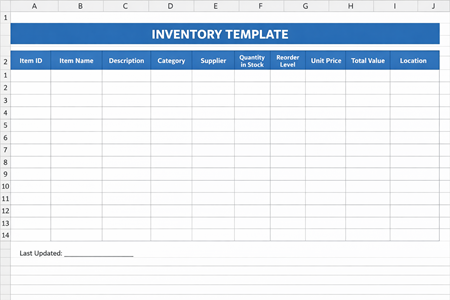
Inventory Sheet Template Example
Benefits of Using Google Sheets for Inventory
Many small business owners prefer Google Sheets inventory templates because they provide several advantages.
1. Cloud Access
You can access your inventory sheet from anywhere using any device.
2. Collaboration
Multiple team members can update the inventory sheet simultaneously.
3. Automatic Saving
Google Sheets automatically saves your changes, reducing the risk of losing data.
4. Integration
It can integrate with other tools and apps used by your business.
Tips to Improve Inventory Efficiency
Managing inventory efficiently helps businesses reduce costs and improve profitability.
Here are some practical tips.
a. Use the FIFO Method
FIFO (First In, First Out) ensures older stock is sold before new stock.
b. Track Fast-Moving Products
Identify best-selling products and maintain adequate stock levels.
c. Remove Dead Stock
Products that do not sell should be discounted or discontinued.
d. Analyze Inventory Data
Use your inventory sheet to identify trends and improve purchasing decisions.
Final Thoughts
An inventory sheet template is one of the simplest and most effective tools for managing stock in a small business. It helps you organize products, track inventory levels, and maintain accurate records without needing expensive software.
Whether you operate a retail store, an online business, or a warehouse, a well-designed inventory tracking spreadsheet can streamline your operations and reduce costly inventory mistakes.
By using the tips and strategies in this guide, small business owners can create a reliable inventory system that supports business growth and improves efficiency.
Start by creating your own inventory sheet template in Excel or Google Sheets, customize it to suit your business needs, and update it regularly to keep your inventory under control.
Artificial Intelligence (AI) is rapidly changing the way businesses operate. From marketing automation to predictive analytics, AI has already transformed many industries. One field that is currently experiencing significant technological disruption is accounting. This raises an important question: Will accounting be replaced by AI, or will it simply be transformed by it?
Many people worry that AI tools and automation will eliminate accounting jobs entirely. However, the reality is more nuanced. While AI can automate repetitive tasks, it cannot fully replace the strategic thinking, judgment, and expertise that human accountants bring to the table.
Understanding AI in Accounting
Artificial Intelligence in accounting refers to the use of machine learning, automation tools, and data analytics systems to perform tasks traditionally handled by accountants. These systems can process large volumes of financial data quickly and accurately.
Today, many businesses already use AI-powered accounting software for tasks like:
Automated bookkeeping
Invoice processing
Expense categorization
Fraud detection
Financial forecasting
Popular accounting platforms now include automation features that help companies reduce manual work and improve efficiency. Many companies choose to invest in custom AI development to tailor these tools to their specific accounting workflows and data requirements.
AI systems analyze financial data patterns and make predictions that help businesses make better financial decisions. Because of this capability, AI is becoming a powerful assistant for accountants rather than a complete replacement.
Why People Think AI Will Replace Accounting
There are several reasons why many people believe accounting may be replaced by AI in the future.
1. Automation of Repetitive Tasks
Accounting involves many repetitive processes such as data entry, reconciliation, and transaction classification. AI tools can complete these tasks faster than humans and with fewer errors.
For example, automated bookkeeping systems can record transactions in real time without manual input.
2. Faster Data Processing
AI systems can analyze large financial datasets in seconds. A task that might take an accountant several hours can be completed almost instantly by AI-powered software.
3. Reduced Operational Costs
Businesses constantly look for ways to reduce operational expenses. Automating accounting processes can lower labor costs, which leads some organizations to adopt AI solutions.
4. Improved Accuracy
Human errors are common in manual accounting processes. AI algorithms can significantly reduce these mistakes by following consistent rules.
Because of these advantages, some experts predict that many traditional accounting roles will change significantly.
What AI Can Already Do in Accounting
AI technology is already being used in various accounting functions. Some of the most common applications include:
Automated Bookkeeping
Modern accounting software can automatically categorize transactions and maintain digital ledgers. This reduces the need for manual data entry.
Invoice Processing
AI tools can scan invoices, extract relevant information, and record them into accounting systems automatically.
Expense Management
Companies now use AI systems that automatically classify expenses and detect unusual transactions.
Fraud Detection
Machine learning algorithms analyze financial patterns and flag suspicious activities that may indicate fraud.
Financial Forecasting
AI can analyze historical financial data and create predictive models that help businesses plan budgets and investments.
These applications show that AI is already playing a major role in modern accounting operations.
The Limitations of AI in Accounting
Despite its capabilities, AI still has significant limitations. Accounting is not only about numbers; it also involves judgment, interpretation, and strategic decision-making.
Here are some areas where AI still struggles.
Human Judgment
Financial decisions often require professional judgment. Accountants evaluate risks, interpret financial regulations, and advise businesses based on experience.
AI cannot fully replicate this level of understanding.
Regulatory Compliance
Tax laws and financial regulations change frequently. Human accountants stay updated with legal frameworks and apply them to complex financial situations.
AI systems require constant updates and supervision to remain compliant.
Client Communication
Accounting professionals often work directly with business owners, explaining financial reports and providing advice. AI lacks the emotional intelligence required for meaningful client interactions.
Ethical Considerations
Financial decisions sometimes involve ethical judgment. Human accountants can assess situations beyond numerical analysis.
Because of these factors, accounting will likely evolve rather than disappear.
How AI Is Transforming the Accounting Profession
Instead of replacing accountants, AI is reshaping the profession. Many routine tasks are becoming automated, allowing accountants to focus on more valuable work.
Shift Toward Advisory Roles
Accountants are increasingly acting as financial advisors rather than just record keepers. With AI handling data processing, professionals can focus on strategic financial planning.
Data Analysis and Insights
AI provides deeper insights into financial data. Accountants can use these insights to guide business decisions in various sectors as in AI powered LMS, which has overturned in shortest period.
Increased Efficiency
Automation reduces manual workload, allowing accountants to manage more clients and deliver faster results.
Better Decision Making
AI-driven analytics help accountants provide more accurate financial advice and forecasting.
Overall, AI is enhancing the capabilities of accounting professionals rather than eliminating them.
Comparison Table: AI Accounting vs Traditional (Non-AI) Accounting
Feature
AI-Powered Accounting
Traditional (Non-AI) Accounting
Data Entry
Automated data entry using AI and machine learning tools
Mostly manual data entry by accountants
Speed of Processing
Processes large financial data instantly
Slower due to manual processing
Accuracy
High accuracy with fewer human errors
Higher risk of human mistakes
Cost Efficiency
Reduces operational costs over time
Requires more staff and time, increasing costs
Fraud Detection
AI detects unusual financial patterns and potential fraud automatically
Fraud detection depends on manual review
Financial Insights
Provides predictive analytics and financial forecasting
Limited to historical financial analysis
Scalability
Easily handles large volumes of financial data
Scaling requires more employees
Human Judgment
Limited; relies on algorithms and patterns
Strong human judgment and experience
Client Interaction
Minimal client communication
Direct advisory and consultation with clients
Decision Making
Supports data-driven decision making
Decisions rely on professional expertise and analysis
The Future of Accounting in the Age of AI
The future of accounting will likely involve a collaboration between humans and artificial intelligence.
Instead of replacing accountants, AI will become a powerful tool that improves productivity and accuracy.
Key Trends in the Future of Accounting
Cloud-based accounting systems
AI-powered financial analytics
Real-time financial reporting
Automation of repetitive tasks
Increased focus on financial consulting
Accountants who adapt to these technological changes will remain highly valuable in the job market.
Skills Accountants Need in the AI Era
To succeed in an AI-driven accounting landscape, professionals need to develop new skills.
Technology Skills
Accountants must understand how to use AI-powered accounting software and digital tools effectively.
Data Analysis
The ability to interpret financial data and generate insights will become increasingly important.
Strategic Thinking
Accountants will focus more on helping businesses make long-term financial decisions.
Communication Skills
Explaining financial information clearly to clients will remain a key responsibility.
Continuous Learning
Technology evolves quickly, so accountants must constantly update their knowledge and skills.
By developing these abilities, accounting professionals can stay relevant and competitive.
Benefits of AI for Accountants
While some fear AI will eliminate jobs, it actually provides several advantages for accountants.
Reduced Manual Work
Automation eliminates repetitive tasks such as data entry and reconciliation.
Improved Accuracy
AI reduces human errors and improves financial reporting accuracy.
Better Client Service
With more time available, accountants can focus on providing valuable financial advice.
Increased Productivity
AI tools allow accountants to handle larger workloads efficiently.
These benefits demonstrate that AI can enhance the accounting profession rather than replace it.
Industries Where AI Is Changing Accounting
AI is transforming accounting across many industries, including:
Banking and finance
E-commerce businesses
Small and medium enterprises
Corporate financial departments
Accounting firms
Companies that adopt AI-powered accounting solutions gain faster insights and improved financial management.
Common Myths About AI Replacing Accountants
There are several misconceptions about AI in accounting.
Myth 1: AI Will Eliminate All Accounting Jobs
In reality, AI will automate tasks but not replace the profession entirely.
Myth 2: Accounting Skills Will Become Obsolete
Accounting expertise remains valuable because businesses need financial interpretation and guidance.
Myth 3: AI Is Perfect
AI systems can still make mistakes and require human supervision.
Understanding these myths helps clarify the real impact of AI on accounting.
Why Human Accountants Will Always Be Needed
Even in a highly automated future, human accountants will continue to play an essential role.
Strategic Financial Planning
Businesses rely on expert advice to make critical financial decisions.
Complex Tax Situations
Tax planning often requires specialized knowledge and interpretation of regulations.
Business Consulting
Accountants provide insights that help companies grow and improve profitability.
Ethical Oversight
Human professionals ensure transparency and accountability in financial reporting.
These responsibilities cannot be fully automated.
AI as a Partner, Not a Replacement
Rather than viewing AI as a threat, accountants should see it as a powerful partner.
AI can handle time-consuming processes while accountants focus on higher-value activities such as:
Financial consulting
Business strategy
Risk management
Investment planning
This partnership creates a more efficient and intelligent financial ecosystem.
Conclusion: Will Accounting Be Replaced by AI or Transformed by It?
So, will accounting be replaced by AI or transformed by it?
The answer is clear: AI will transform accounting, not replace it.
Artificial Intelligence will automate routine tasks, improve efficiency, and provide deeper financial insights. However, the expertise, judgment, and strategic thinking of human accountants will remain indispensable.
The accounting profession is evolving into a more analytical and advisory role. Professionals who embrace AI technology and develop new skills will thrive in the future of finance.
Instead of fearing AI, accountants should view it as an opportunity to enhance their capabilities and deliver greater value to businesses.
The future of accounting is not humans versus AI — it is humans working with AI to create smarter financial decisions.
FAQs: Will Accounting Be Replaced by AI or Transformed by It?
1. Will AI completely replace accountants in the future?
No, AI is unlikely to completely replace accountants. While AI can automate repetitive tasks like bookkeeping and data entry, accountants are still needed for strategic planning, financial advice, and interpreting complex financial data.
2. What accounting tasks can AI automate?
AI can automate tasks such as invoice processing, expense categorization, transaction matching, financial forecasting, and fraud detection. These technologies help improve efficiency and reduce manual workload.
3. How is AI transforming the accounting industry?
AI is transforming accounting by automating routine processes, improving accuracy, providing real-time financial insights, and enabling accountants to focus more on advisory and strategic roles.
4. Do accountants need new skills because of AI?
Yes, accountants need to develop skills in data analysis, financial technology tools, AI-powered accounting software, and strategic consulting to remain competitive in the modern financial environment.
5. Is AI accounting better than traditional accounting?
AI accounting is faster, more efficient, and reduces manual errors. However, traditional accounting is still important because human accountants provide judgment, business advice, and ethical oversight that AI cannot fully replicate.
If you’re a content marketer in 2026, you’ve probably felt the squeeze. You need to produce more content, faster, with tighter budgets. AI tools help you draft faster, but then the alarms go off. Your content gets flagged by detection software. Your rankings drop. Your credibility takes a hit.
The solution isn’t to stop using AI. It’s to make AI-generated content sound genuinely human. That’s where humanizers come in. They restructure sentences, vary your phrasing, and strip away the robotic patterns that scream “this was written by ChatGPT.” For marketers juggling blog posts, email campaigns, and social media, the right humanizer protects your content investment and keeps your strategy running smoothly.
Why AI Detection Actually Matters for Marketing Content
Google’s algorithms have gotten smarter. They’re not just looking for keyword stuffing anymore. They’re analyzing writing patterns, sentence predictability, and content that feels mass-produced. If your blog posts all sound the same, or if they read like they came from a template, you’re going to see your organic traffic suffer.
AI detection tools like Originality.ai and Turnitin are also being used by competitors, clients, and even internal compliance teams. Getting flagged doesn’t just hurt SEO. It damages trust. When your audience suspects your content isn’t authentic, they disengage. Humanizers give you a layer of protection against all of this while letting you keep the efficiency AI provides.
How We Evaluated These Tools
We didn’t just skim marketing pages and call it research. We ran actual marketing content through each humanizer, then tested the results against the most aggressive detection tools available: Originality.ai, Turnitin, GPTZero, and Copyleaks. Many marketers also use an AI checker to quickly verify whether their content might trigger these detection systems before publishing.
We evaluated bypass rates, tone consistency, processing speed, and pricing. We also considered whether these tools could handle the volume and variety content marketers need, from 500-word blog posts to 3,000-word guides. The tools below passed our tests and earned their spots on this list.
The Best Humanizers for Content Marketing
These are the tools that actually work when your content pipeline depends on it.
1. Walter Writes AI – Best Overall for Marketing Content
Walter AI Humanizer is built specifically to handle the kind of content marketers produce at scale. It doesn’t just paraphrase your text. It restructures it using what the platform calls “syntactic and semantic morphing,” which breaks down AI signatures and rebuilds your content with natural variation.
The platform supports over 80 languages and offers tone customization for academic, professional, casual, and marketing styles. That flexibility matters when you’re switching between LinkedIn thought leadership and casual blog posts. Walter’s internal pre-scan runs your content through top detectors before you even see the final output, so you know it’s going to pass.
Pricing starts with a free 300-word trial, then moves to the Starter plan at around $12/month for 30,000 words. The Business plan runs about $24/month for 70,000 words, which is enough for most small marketing teams. Enterprise users get unlimited processing with custom pricing.
According to verified Walter reviews on Trustpilot and Reddit, users consistently report 95%+ human scores on standard detection benchmarks. One agency mentioned producing 50 articles a week and maintaining solid rankings through Google’s 2025 core updates. That kind of reliability is exactly what content marketers need.
2. Grammarly AI Humanizer – Best for Brand Voice Consistency
Grammarly has been a writing assistant staple for years, and their AI humanizer builds on that foundation. It integrates directly with their existing grammar and tone tools, so you can humanize and polish your content in one workflow.
The humanizer analyzes your text for AI patterns and rewrites it to sound more natural while keeping your intended tone intact. As part of an AI Platform, Grammarly’s strength is maintaining brand voice consistency, which matters when you’re publishing across multiple channels and need everything to feel cohesive.
Pricing varies depending on whether you’re using Grammarly Free, Premium, or Business. The humanizer is typically bundled with higher-tier plans, making it a solid option if you’re already paying for Grammarly’s other features.
3. Quillbot Humanizer – Best for Quick Edits
Quillbot has built a reputation as a reliable paraphrasing tool, and their humanizer takes that same approach. It’s fast, straightforward, and doesn’t require a steep learning curve. You paste your text, choose your preferred tone, and get results in seconds.
The tool works well for marketers who need to quickly humanize shorter pieces like social media posts, ad copy, or email subject lines. It’s not as robust for long-form content, but for quick edits and rapid turnaround, it’s hard to beat.
Quillbot offers a free version with limited word counts and premium plans that unlock higher limits and additional features. It’s an accessible starting point if you’re new to humanizers and want to test the concept without a big commitment.
4. Writesonic AI Humanizer – Best for Integrated Workflows
Writesonic is an all-in-one content platform that includes AI writing, SEO optimization, and now humanization. The advantage here is workflow integration. You can draft content with Writesonic’s AI writer, then immediately run it through the humanizer without switching tools.
The humanizer uses advanced natural language processing to detect and eliminate robotic phrasing. It’s particularly effective for blog posts and landing pages where you need content that converts while still passing detection tools.
Pricing is subscription-based with multiple tiers depending on your content volume. Writesonic’s plans are competitive with other all-in-one platforms, and the integrated workflow can save time if you’re already using their writing tools.
5. Clever AI Humanizer – Best for Natural, High-Quality Marketing Content
Clever AI Humanizer is designed to transform AI-generated text into more natural, human-sounding content while preserving the original meaning and overall quality.
It can be useful for marketers who rely on AI for blog posts, landing pages, product descriptions, social media content, and other marketing materials.
The tool focuses on improving sentence flow, reducing repetitive AI-style phrasing, and making content feel more natural and engaging for readers.
This makes it a practical option for content teams looking to add a human touch to AI-assisted content before publishing.
6. Jasper Paraphrasing Tool – Best for Enterprise Teams
Jasper is a major player in the AI content space, and while they don’t market a dedicated “humanizer,” their paraphrasing tool functions as one. It rewrites AI-generated content to sound more natural and varied, which is exactly what humanization does.
Jasper’s strength is its enterprise features. It supports team collaboration, brand voice profiles, and content templates that maintain consistency across large organizations. If you’re managing a marketing team that produces hundreds of pieces per month, Jasper’s infrastructure can handle it.
Pricing is on the higher end, with plans starting around $49/month for individuals and scaling up for teams. Enterprise pricing is custom and includes dedicated support, which matters when you’re running large-scale campaigns.
7. Ahrefs AI Humanizer – Best for SEO Integration
Ahrefs is known for SEO tools, and their AI humanizer ties directly into that ecosystem. You can humanize your content while simultaneously checking keyword optimization, readability scores, and content structure.
The tool is designed for marketers who are already using Ahrefs for keyword research and backlink analysis. It fits naturally into an SEO-first workflow and helps ensure your humanized content still ranks well.
Ahrefs pricing is subscription-based, with plans ranging from $129/month for Lite to $449/month for Advanced. The humanizer is included with all plans, making it a good option if you’re already paying for Ahrefs and want an integrated solution.
8. Surfer SEO Humanizer – Best for Content Performance Tracking
Surfer SEO takes a similar approach to Ahrefs but focuses more heavily on content optimization and performance tracking. Their humanizer rewrites AI content while maintaining the keyword density and structure needed for strong search rankings.
The platform includes a content editor that scores your text in real time, showing you how well it’s optimized for your target keywords. The humanizer works within that editor, so you can see exactly how your changes affect your content score.
Surfer SEO pricing starts at around $89/month for the Essential plan and scales up for teams. If you’re focused on data-driven content marketing and need to track performance alongside humanization, Surfer is worth considering.
Quick Reference: Humanizer Comparison
Tool
Best For
Starting Price
Languages Supported
Walter Writes AI
Overall marketing content
$12/month
80+
Grammarly
Brand voice consistency
Varies by plan
English-focused
Quillbot
Quick edits
Free tier available
Multiple
Writesonic
Integrated workflows
Subscription-based
Multiple
Jasper
Enterprise teams
$49/month
Multiple
Ahrefs
SEO integration
$129/month
Multiple
Surfer SEO
Performance tracking
$89/month
Multiple
Questions to Ask Before Choosing a Humanizer
Does it actually preserve your brand voice, or does it strip away what makes your content unique? Some humanizers are so aggressive that they flatten your writing into generic mush. Test a few samples before committing.
Can it handle your content volume? If you’re producing 20 blog posts a month, you need a tool with high word limits or unlimited plans. Running out of credits mid-campaign creates bottlenecks.
Does it integrate with your existing workflow? If you’re already using a content platform or SEO tool, check whether the humanizer works within that system. Switching between multiple tools wastes time.
What’s the learning curve? Some humanizers are plug-and-play. Others require setup, customization, and trial-and-error. Make sure you have the bandwidth to learn the tool before you need it in production.
Red Flags When Evaluating Humanizers
If a tool makes your content objectively worse, it’s not worth using. Some humanizers introduce awkward phrasing, break sentence flow, or insert errors. Run test samples and read the output carefully.
Pricing that doesn’t match value is another warning sign. If you’re paying enterprise prices for a tool that barely works better than free alternatives, you’re wasting budget. Compare results, not just feature lists.
No transparency about how the tool works should raise concerns. If a company can’t explain their process or provide evidence of effectiveness, you’re gambling with your content.
Poor customer support is a dealbreaker when you’re on deadline. If the tool crashes or produces bad results and you can’t get help, your entire content calendar suffers.
Frequently Asked Questions
1. Can humanizers replace human writers?
No. Humanizers improve AI-generated content, but they don’t replace strategic thinking, creativity, or deep subject matter expertise. Use them to enhance efficiency, not eliminate human involvement.
2. Will Google penalize humanized AI content?
Google’s focus is on quality and user experience, not whether AI was used. If your humanized content is helpful, well-researched, and engaging, it should perform fine. Low-quality content gets penalized regardless of how it’s produced.
3. How often should I run content through a humanizer?
Every time you use AI to draft content. Even minor AI-generated sections can trigger detection tools. Consistent use protects your entire content library.
4. Can humanizers work with content in multiple languages?
Most of the tools listed support multiple languages, but effectiveness varies. English tends to have the best results. Test other languages carefully before relying on them for published content.
5. Do humanizers affect SEO?
They can, depending on how they handle keywords and content structure. Tools like Ahrefs and Surfer SEO are designed to maintain SEO performance while humanizing. Others might dilute keyword density or disrupt readability.
6. Are humanizers worth the cost for small marketing teams?
If you’re producing even a moderate amount of AI-assisted content, yes. The cost of flagged content, lost rankings, and wasted production time far outweighs the subscription price. Start with a free trial and measure the impact before scaling up.
Starting a business is exciting. You focus on building your product, finding customers, and growing revenue. But behind every successful company is something far less glamorous and far more important strong bookkeeping.
Many entrepreneurs ignore bookkeeping in the early stages. It feels technical, time-consuming, or something that can wait until tax season. The truth is, bookkeeping is one of the most powerful tools you have as a business owner. It gives you clarity, control, and confidence in your financial decisions.
In this in-depth guide, you’ll learn what bookkeeping is, why it matters for entrepreneurs, how it works, and how to build a system that supports long-term business growth.
What Is Bookkeeping?
Bookkeeping is the process of recording, organizing, and maintaining all financial transactions within a business. Every time money enters or leaves your company, it must be tracked accurately. This includes sales, expenses, vendor payments, payroll, loan payments, and tax obligations.
At its core, bookkeeping creates a structured record of your business’s financial activity. Without it, you’re operating blindly. With it, you have a clear view of how your business is performing.
Bookkeeping is often described as the foundation of accounting. While accounting focuses on interpreting financial data and providing strategic insights, bookkeeping focuses on capturing and organizing that data correctly. If the records are inaccurate, the financial analysis will be unreliable.
For entrepreneurs, bookkeeping is not just an administrative task. It is a financial management system that protects your business and supports smarter decision-making.
Why Bookkeeping Is Important for Entrepreneurs
1. Clear Financial Visibility
Bookkeeping is essential for entrepreneurs because it provides clear financial visibility. With accurate and up-to-date records, you can clearly see how much profit you are making, whether your expenses are too high, if you can afford to hire someone, and whether your cash flow is healthy. Without organized financial records, these important questions become guesswork, which can lead to costly mistakes.
2. Better Cash Flow Management
Cash flow is the lifeline of any small business, and even profitable companies can fail if their cash flow is poorly managed. Proper bookkeeping helps you track incoming payments, monitor outstanding invoices, plan for upcoming expenses, and avoid unexpected cash shortages that could disrupt your operations.
3. Easier Tax Preparation
When tax season arrives, organized books save you time, reduce stress, and help you avoid unnecessary expenses. Instead of scrambling to gather receipts and documents, your financial records are already categorized and ready. Good bookkeeping also allows you to claim legitimate deductions, avoid penalties, and stay compliant with tax laws.
4. Informed Business Decisions
Entrepreneurs constantly make decisions about pricing, hiring, expansion, and marketing budgets. Accurate bookkeeping provides reliable financial data to guide those decisions. With clear insights into your numbers, you can make smarter, more confident choices that support sustainable business growth.
Bookkeeping vs Accounting: Understanding the Difference
Basis of Comparison
Bookkeeping
Accounting
Primary Focus
Recording daily financial transactions
Analyzing and interpreting financial data
Main Role
Documents every sale, expense, payment, and deposit
Uses financial data to provide insights and strategy
Key Tasks
Categorizing transactions, reconciling bank statements, maintaining organized records
In simple terms, bookkeeping builds the foundation by keeping financial records accurate and organized, while accounting uses that foundation to generate insights, ensure compliance, and guide business strategy. Both are essential, but bookkeeping is where everything begins.
How Bookkeeping Works in a Business
To understand bookkeeping more clearly, it helps to see how it functions in daily operations.
Every financial transaction your business makes must be recorded. If a customer pays you for a service, that income is documented. If you purchase supplies, that expense is recorded. If you pay rent, run payroll, or make a loan payment, those transactions are logged into your bookkeeping system.
These records are organized into categories such as revenue, operating expenses, assets, and liabilities. Over time, this data forms the basis for financial reports that show your company’s performance.
A key part of bookkeeping is bank reconciliation. This involves comparing your recorded transactions with your bank statements to ensure accuracy. Reconciliation helps identify missing transactions, duplicate charges, or potential fraud.
As your records accumulate, they generate essential financial statements. These reports help you evaluate your company’s profitability, financial stability, and cash position.
Types of Bookkeeping Systems
There are two main bookkeeping systems entrepreneurs should understand:
1. Single Entry system
Single-entry bookkeeping is a simple method where each transaction is recorded once. It is similar to maintaining a personal checkbook. This system may work for very small businesses with minimal transactions, but it lacks the accuracy and detail needed for growing companies.
2. Double entry System
Double-entry bookkeeping is more comprehensive and widely used. In this system, every transaction affects at least two accounts. For example, when you make a sale, your revenue increases and your cash account increases. This method provides a more accurate financial picture and reduces errors.
Most modern accounting software uses the double-entry system automatically, which makes it easier for entrepreneurs to maintain accurate records without deep accounting knowledge.
Key Bookkeeping Tasks Every Entrepreneur Should Know
Let’s look at the core bookkeeping tasks that keep your business financially organized.
1. Recording Transactions
Recording transactions is the foundation of effective bookkeeping. Every sale and expense must be accurately entered into your accounting system, including cash sales, credit card transactions, online payments, and business purchases. Consistency is essential—updating your records daily or weekly helps prevent errors, keeps your accounts current, and ensures you always have a clear picture of your financial position.
2. Managing Accounts Receivable
Accounts receivable refers to the money your customers owe you for goods or services provided. Proper bookkeeping involves creating and sending invoices promptly, tracking unpaid invoices, and following up on late payments. Strong receivables management improves cash flow and ensures your business maintains a steady stream of incoming revenue.
3. Managing Accounts Payable
Accounts payable includes the money your business owes to vendors and suppliers. Accurate tracking of bills and payment deadlines ensures that obligations are met on time. This helps you avoid late fees, maintain healthy vendor relationships, and manage your cash flow more effectively by planning outgoing payments strategically.
4. Bank Reconciliation
Bank reconciliation is the process of comparing your internal financial records with your bank statements to ensure they match. This task helps identify errors, missing transactions, duplicate charges, or even potential fraud. Regular reconciliation keeps your financial data accurate and reliable, which is crucial for making informed business decisions.
5. Payroll Processing
If you employ staff, payroll processing becomes a critical bookkeeping responsibility. This includes recording wages, tracking payroll taxes, and managing deductions such as benefits or retirement contributions. Accurate payroll ensures employees are paid correctly and on time, while also keeping your business compliant with tax and labor regulations.
6. Financial Reporting
Good bookkeeping supports the preparation of essential financial reports, such as the Profit and Loss Statement, Balance Sheet, and Cash Flow Statement. These reports provide insight into your company’s profitability, financial position, and cash movement. Regular financial reporting allows you to evaluate performance, identify trends, and make strategic decisions with confidence.
Digital Bookkeeping, Explained
Digital bookkeeping has transformed how modern entrepreneurs manage their finances. Instead of relying on paper records or manual spreadsheets, business owners now use accounting software to simplify and automate daily financial tasks. These tools help record transactions, generate invoices, track expenses, reconcile bank accounts, and produce financial reports with far greater speed and accuracy than traditional methods.
1. QuickBooks
QuickBooks is one of the most widely used bookkeeping solutions for small and medium-sized businesses. It offers comprehensive features such as expense tracking, invoicing, payroll management, tax tools, and detailed financial reporting. Its automation capabilities and user-friendly interface help entrepreneurs save time while maintaining accurate financial records.
2. Xero
Xero is a cloud-based accounting platform known for real-time collaboration and strong bank integration. It allows business owners and accountants to access financial data simultaneously from anywhere. With intuitive dashboards and automated bank feeds, Xero helps entrepreneurs maintain up-to-date and organized financial information.
3. FreshBooks
FreshBooks is especially popular among freelancers and service-based businesses. It focuses on invoicing, time tracking, expense management, and client billing. Its simple design makes it easy for entrepreneurs to manage payments and maintain clear records without needing advanced accounting knowledge.
4. Wave
Wave is a cost-effective solution ideal for startups and small businesses. It offers free core bookkeeping features, including invoicing and expense tracking. Wave is particularly attractive to new entrepreneurs who need reliable financial management tools without significant upfront costs.
Manual Bookkeeping vs Digital Bookkeeping
Basis of Comparison
Manual Bookkeeping
Digital Bookkeeping
Method Used
Paper ledgers, handwritten journals, or basic spreadsheets
Cloud-based accounting software
Time Efficiency
Time-consuming and labor-intensive
Automated processes save significant time
Accuracy
Higher risk of human error
Reduced errors through automation
Task Management
Manual entry of transactions and calculations
Automatic transaction recording, invoicing, expense tracking, and reconciliation
Accessibility
Limited access to physical records
Access anytime, anywhere via cloud systems
Data Updates
Updated periodically
Real-time financial updates
Scalability
Difficult to scale as business grows
Easily scalable with business growth
Essential Financial Statements Every Entrepreneur Should Understand
Bookkeeping generates three primary financial statements that every entrepreneur should review regularly.
The first is the income statement, also known as the profit and loss statement. This report shows your revenue, expenses, and net profit over a specific period. It tells you whether your business is making money.
The second is the balance sheet. This statement provides a snapshot of your company’s financial position at a given moment. It outlines your assets, liabilities, and owner’s equity. Reviewing your balance sheet helps you understand what your business owns and what it owes.
The third is the cash flow statement. This report tracks the movement of cash in and out of your business. It helps you identify potential cash shortages before they become serious problems.
Understanding these reports allows you to evaluate performance, identify trends, and plan strategically.
Common Bookkeeping Mistakes Entrepreneurs Make
One of the most common bookkeeping mistakes is mixing personal and business finances. Using the same bank account for both can create confusion, complicate tax filing, and raise red flags during audits. Opening separate business accounts is essential.
Another frequent issue is falling behind on recordkeeping. When entrepreneurs delay bookkeeping tasks for months, errors accumulate and important details are forgotten. Consistency is far more effective than attempting to catch up all at once.
Some business owners also underestimate small expenses. Minor purchases may seem insignificant, but over time they can significantly impact profitability. Accurate tracking ensures you understand your true costs.
Trying to manage complex bookkeeping without understanding the basics can also lead to compliance issues. While DIY bookkeeping is possible in early stages, growing businesses often benefit from professional support.
When Should You Hire a Professional Bookkeeper?
As your business expands, bookkeeping becomes more complex. If you find yourself spending too much time managing financial records instead of focusing on growth, it may be time to hire a professional.
A bookkeeper can maintain accurate records, reconcile accounts regularly, manage payroll entries, and ensure compliance with tax regulations. This not only saves time but also reduces the risk of costly errors.
Entrepreneurs preparing for investment, loans, or rapid expansion especially benefit from professional bookkeeping. Clean financial records increase credibility and build trust with lenders and investors.
The Long-Term Benefits of Good Bookkeeping
Strong bookkeeping habits create long-term advantages. They improve budgeting accuracy and strengthen financial forecasting. They help you detect issues early and adjust strategies accordingly.
Good bookkeeping also increases business valuation. If you ever decide to sell your company or seek investors, organized financial statements demonstrate stability and professionalism.
Perhaps most importantly, bookkeeping reduces stress. Knowing your numbers brings clarity. Instead of worrying about hidden financial problems, you operate with confidence.
Final Thoughts: Bookkeeping Is a Growth Tool
Bookkeeping is more than a compliance requirement. It is a powerful financial management tool that supports smarter decisions, stronger cash flow, and sustainable business growth.
As an entrepreneur, understanding bookkeeping basics gives you control over your business finances. Whether you manage your own books using software or hire a professional bookkeeper, the key is consistency and accuracy.
Successful entrepreneurs do not ignore their numbers. They track them, analyze them, and use them to build stronger businesses.
If you treat bookkeeping as a priority rather than an afterthought, it becomes one of your greatest competitive advantages.
FAQs:
1. How does bookkeeping help entrepreneurs grow their business?
Bookkeeping gives entrepreneurs clear financial insights, helping them control costs, improve profits, and plan for growth.
2. What happens if an entrepreneur ignores bookkeeping?
Poor bookkeeping can lead to cash flow problems, tax penalties, and bad financial decisions.
3. Do solo entrepreneurs need bookkeeping?
Yes. Even solo business owners must track income and expenses to stay profitable and tax compliant.
4. How much time should entrepreneurs spend on bookkeeping?
Most entrepreneurs should review their books weekly and analyze financial reports monthly.
5. Is bookkeeping important before seeking investors?
Absolutely. Investors expect accurate financial records before funding a startup or growing business.