


A union payroll company helps construction contractors calculate wages, deductions and fringe benefit contributions under each union agreement, then prepares the reports that unions, benefit funds and project owners expect. Depending on the contract, it can also process payments, support certified payroll and match payroll totals to your job-cost records.
That matters because union construction payroll rarely fits in a standard payroll setup. One crew can work under two agreements, on three job sites, at different pay rates, in one week. A specialist handles those moving parts so your office doesn’t have to.
This guide explains what a union payroll company does, how the process runs from timesheet to report, and where your own responsibilities stay put. It also shows a worked example and a checklist for choosing a provider.
What Is a Union Payroll Company?
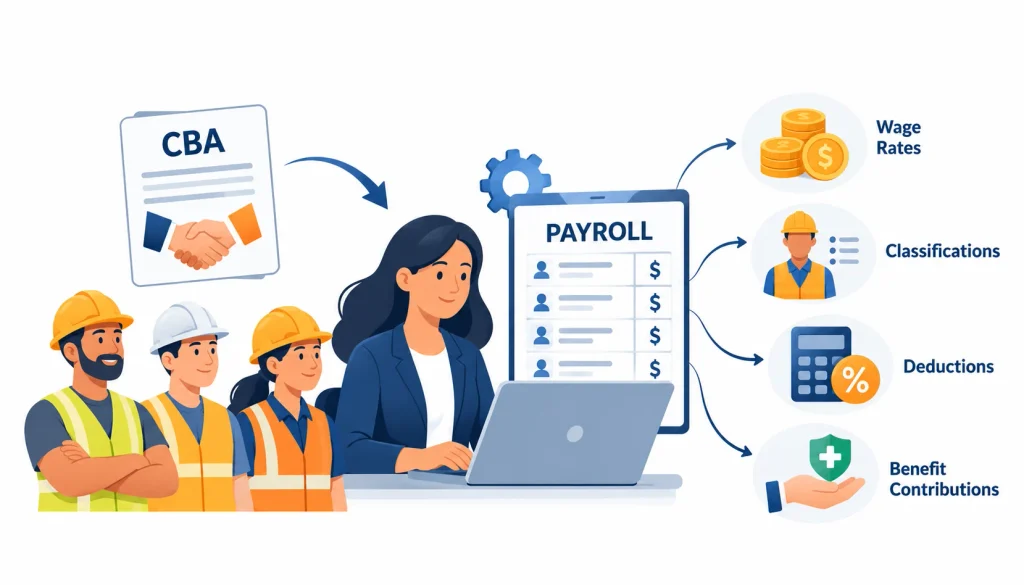
A union payroll company is a payroll provider that understands collective bargaining agreements (CBAs) and the reporting that comes with them. It sets up each agreement’s wage rates, classifications, deductions and benefit contributions, then runs payroll against those rules.
A collective bargaining agreement is the contract between an employer and a union. In construction, it usually sets pay scales by trade and classification, overtime rules, and the contributions you owe to benefit funds.
Service scope varies a lot between providers. Some only calculate payroll. Others also file reports, remit contributions and prepare certified payroll. Always check what your contract actually covers.
1. How Union Payroll Differs From Regular Payroll
Regular payroll is mostly one rate times hours, minus taxes. Union payroll adds layers on top of that.
- Wage rates that depend on trade, classification and sometimes apprenticeship level
- Overtime and premium pay rules written into the agreement
- Union dues and other authorized deductions taken from the employee
- Fringe contributions paid by the employer to health, pension and training funds
- Remittance reports, usually monthly, sent to each union local or fund
The last two catch many new union contractors off guard. Dues come out of the worker’s check. Fringe contributions are your cost on top of wages. They are different money, going to different places, on different schedules.
2. Who Uses Union Payroll Services?
Most clients fall into a few groups: union subcontractors, general contractors with union crews, multi-trade firms, public works contractors, and companies that work across state lines. A small electrical contractor with one local and one fund may manage fine in-house. A mechanical contractor with three locals and five funds often can’t.
3. What Services Can a Union Payroll Company Provide?
Common services include:
- Payroll calculation and processing
- Setting up and updating union agreements
- Calculating dues, deductions and fringe contributions
- Preparing union remittance reports
- Certified payroll support, when a project requires it
- Payroll tax filing, if included in your contract
- Reconciliation with your accounting system
Not every provider offers all of these. Ask for the list in writing.
Why Is Payroll So Complicated for Construction Companies?
Construction payroll is hard because the inputs change constantly. People move between jobs, classifications and agreements, and each move can change the math. The calculation is rarely the problem. Bad inputs are.
1. Managing Multiple Collective Bargaining Agreements
Every local has its own agreement, and every agreement has its own wage scale, classifications and fund rates. Those scales also change, often on a set date each year. If someone forgets to load the new rates, every check after that date is wrong.
2. Calculating Union Wages and Overtime
Pay depends on what a worker did, not just who they are. A journeyman who spends part of a week doing foreman duties may be paid differently for those hours. Overtime rules also differ between agreements, so one formula never fits everyone.
3. Tracking Union Dues and Fringe Benefits
Each fund has its own rate, its own payee and its own due date. Some are charged per hour worked, others as a percentage of gross pay. Miss a month, and the fund may add interest or penalties under the agreement.
4. Handling Multiple Projects and Job Locations
Hours need to land on the right job, cost code and classification. A job code typo might look minor on a timesheet. It can distort job costs and, on a prevailing wage project, throw off a required report.
5. Meeting Payroll Reporting Requirements
Union contractors often owe several kinds of reports at once: remittance reports to funds, certified payrolls to project owners, and tax filings to government agencies. Which ones apply depends on the project, the agreement and the state.
How Can a Union Payroll Company Help Construction Companies?
In short, it applies the right rules to your payroll data, prepares the required reports, and keeps payroll and job costs in agreement. Here are the main ways that shows up in practice.
- Applies union wage rates and classifications
- Calculates overtime under the right rules
- Handles dues and fringe contributions
- Prepares union remittance reports
- Supports certified payroll reporting
- Coordinates payroll across jobs and states
- Feeds accurate labor costs into job costing
- Cuts repetitive data entry
- Keeps records organized for audits
- Makes it easier to add crews and agreements
1. Apply Union-Specific Wage Rates and Classifications
The provider builds each agreement into the payroll system: rates by classification, effective dates, and any premiums. When a new wage scale arrives, they update it, test it and document the change. Good providers will show you who approved the new rates and when.
2. Calculate Union Dues and Fringe Benefit Contributions
A specialist keeps four things separate: employee deductions, employer contributions, payments to funds, and the reports that back those payments up. When those blur together, funds send audit letters. Clean separation avoids most of that.
3. Support Accurate Overtime Calculations
The provider applies the overtime rules from the agreement and any law that applies to the job. They can only be as accurate as the time records they receive, though. If supervisors enter hours late or in the wrong class, the math will be wrong no matter who runs it.
4. Simplify Union Remittance Reporting
Most contractors dread remittance reports because the data has to match what the fund expects, to the cent. A payroll company builds the reports straight from payroll data, so there’s no retyping. They also track due dates, which is where late fees usually begin.
5. Support Certified Payroll and Prevailing Wage Reporting
On federally funded projects covered by the Davis-Bacon and Related Acts, contractors must submit weekly certified payroll with a Statement of Compliance. Understanding certified payroll requirements helps construction companies prepare accurate reports, verify prevailing wages, and maintain compliance with applicable project regulations. The U.S. Department of Labor publishes instructions for Form WH-347, the form many contractors use for these reports. The form is optional as long as the same information is provided.
A provider can prepare these reports from your payroll data. You still sign the certification, so you still need to check the content.
6. Coordinate Payroll Across Multiple Projects and Jurisdictions
When payroll runs through one process, hours, job assignments and tax details sit in one place. That helps most when a crew works in two states in the same pay period and each state needs its own withholding and reporting.
7. Improve Construction Job Costing
Using contractor accounting software can help construction businesses organize project expenses, track labor costs, and compare actual spending against job budgets. A provider that posts labor correctly gives your project managers numbers they can trust.
That supports budget tracking, labor forecasting, work-in-progress reports and future bids.
8. Reduce Manual Administration and Repetitive Data Entry
Timekeeping imports, automatic rate lookups and report generation remove a lot of keying. Most contractors still review and approve payroll each cycle. The savings come from less rework, and the amount depends on how messy your process was to begin with.
9. Improve Payroll Recordkeeping and Reconciliation
When a fund audits you or a worker disputes a check, you need to trace the numbers fast. Organized registers, rate histories and approval records make that possible. Searching old spreadsheets doesn’t.
10. Support Business Growth
Standard procedures let you add a crew or sign a new agreement without rebuilding your payroll process. That is usually where small firms feel the most relief.
How Does Union Payroll Processing Work in Construction?
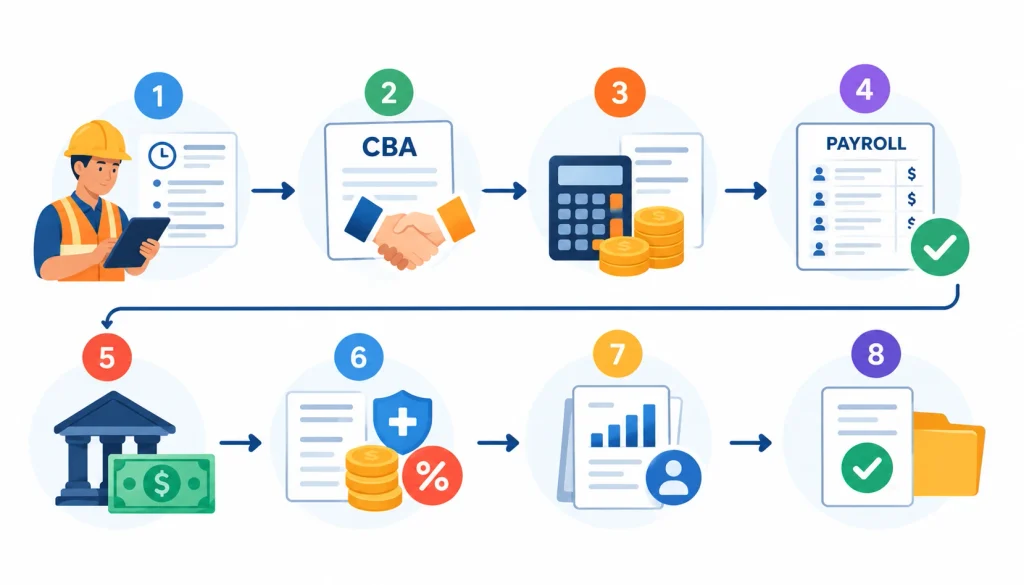
A typical payroll cycle with an outsourced provider runs in eight steps. Your contract may split the work a little differently, but the flow is similar.
- Collect and approve time records.
- Confirm the agreement and classification.
- Verify wage rates and overtime rules.
- Calculate wages, deductions and contributions.
- Review exceptions.
- Process payments and remittances.
- Prepare required reports.
- Reconcile with accounting.
Step 1: Collect and Approve Employee Time Records
Field workers or supervisors submit hours with job codes and classifications. A supervisor should approve them before they reach the provider. Many payroll errors start here, not in the payroll run.
Step 2: Verify Union Agreements and Wage Rates
The provider checks that each worker maps to the right agreement and classification, and that current rates are loaded. If something looks off, such as an apprentice logged at journeyman hours, they should flag it.
Step 3: Calculate Wages, Overtime and Deductions
With clean inputs, the system applies the rules. It figures gross pay, overtime, dues, taxes and other deductions.
Step 4: Calculate and Reconcile Fringe Benefits
Employer contributions are calculated per fund, then totaled to match what you’ll owe in each remittance report. Doing this every cycle, not monthly, catches errors while they’re still small.
Step 5: Review Exceptions Before Payroll Is Finalized
The provider lists anything unusual: missing hours, invalid job codes, unexpected rate changes, very high overtime. You review the list and approve or fix each item. This step is your chance to stop an error before it becomes a correction.
Step 6: Process Payments and Applicable Remittances
Employee pay goes out by direct deposit or check. Contributions and dues go to the right funds and locals, as your contract allows. Some providers make those payments for you. Others prepare the figures and you pay them yourself.
Step 7: Prepare Required Payroll Reports
The provider generates remittance reports, certified payrolls where required, and standard payroll reports. You should receive copies to keep on file.
Step 8: Reconcile Payroll With Construction Accounting
Payroll totals should match the labor posted in your general ledger and job-cost reports. Choosing the right construction accounting software can help contractors track labor expenses, monitor project budgets, and maintain accurate financial records across multiple jobs. A good provider checks this and tells you about gaps. If they don’t, check it yourself.
Practical Example: How Union Payroll Works for a Contractor
The numbers below are made up to show the mechanics. Real union rates, dues and overtime rules depend on your agreement and jurisdiction.
Scenario: One Employee Working Across Two Jobs
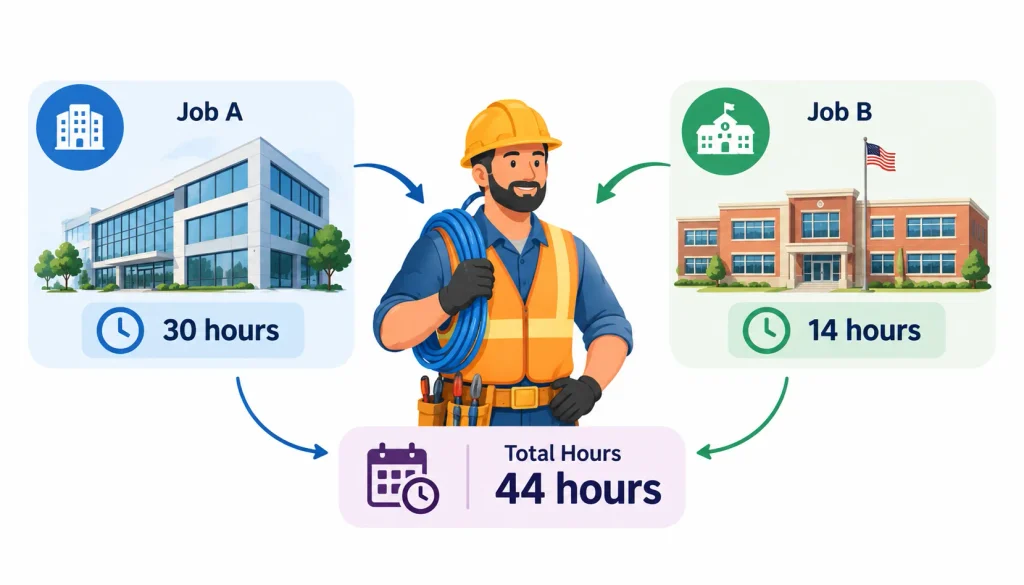
Imagine a journeyman electrician named Sam. In one week he works 30 hours on a private office build (Job A) and 14 hours on a federally funded school project (Job B). That makes 44 hours.
Assume these illustrative terms:
- Job A rate: $48 per hour
- Job B rate: $52 per hour (prevailing wage project)
- Overtime: 1.5 times the rate for hours over 40, with the last 4 hours worked on Job B
- Working dues: $1.50 per hour worked, deducted from Sam’s pay
- Employer fringe contributions: $22 per hour, paid to health, pension and training funds
The math looks like this:
| Item | Calculation | Amount |
| Job A straight time | 30 × $48 | $1,440 |
| Job B straight time | 10 × $52 | $520 |
| Job B overtime | 4 × $78 | $312 |
| Gross wages | $2,272 | |
| Union dues (employee) | 44 × $1.50 | $66 |
| Fringe contributions (employer) | 44 × $22 | $968 |
In real life, mixed-rate overtime can be trickier. Some agreements and federal rules use a weighted average rate rather than the rate of the job where the overtime fell. That’s one reason to confirm how your agreement treats it.
What the Payroll Team Must Verify
Before this payroll is final, someone should confirm:
- Hours by job and classification
- Current wage rates for each job
- Which overtime rule applies
- The dues amount and who receives it
- Fringe rates and which funds are owed
- Whether Job B needs a certified payroll report
How a Specialized Payroll Provider Helps
The provider organizes Sam’s hours by job, applies the rates you’ve approved, flags the overtime split for review, and produces the numbers for the fund report. For Job B, they can generate the weekly certified payroll data.
The $2,272 in wages and $968 in fringe contributions also have to post to the right job. If Job A and Job B end up mixed up in your books, your cost reports will be wrong even though Sam got paid correctly.
Union Payroll vs. Certified Payroll vs. Prevailing Wage
These terms get mixed up constantly. They overlap, but they aren’t the same thing.
1. What Is Union Payroll?
Union payroll is payroll governed by union agreements. It covers negotiated wages, dues and benefit contributions. It can apply on private projects with no government involvement.
2. What Is Certified Payroll?
Certified payroll is a weekly report, signed by the contractor, showing who worked, in what classification, for how many hours and at what pay. Contracts for covered public work usually require it.
3. What Is Prevailing Wage?
A prevailing wage is a minimum wage and fringe benefit level set by law for certain public projects. On federal construction contracts, the Davis-Bacon Act is the main law behind it, and the Department of Labor issues the wage determinations.
4. How Do These Requirements Work Together?
| Factor | Union payroll | Certified payroll | Prevailing wage |
| Main purpose | Manage pay under union agreements | Report and certify payroll on covered work | Set minimum wages and fringes on covered work |
| Source | Union agreements | Contracts and regulations | Prevailing wage laws and determinations |
| Private projects? | Yes | Only if required | Only if the law applies |
| Wage classifications? | Yes | Yes | Yes |
| Reporting? | Fund and union reports | Yes, when required | Compliance must be shown |
A union contractor can work on a private job with no certified payroll. A non-union contractor on a federal job still has certified payroll and prevailing wage duties. Many projects have all three.
Outsourced Union Payroll vs. Payroll Software vs. In-House Payroll
Outsourcing isn’t always the right answer. Here is how the three options compare.
1. When Outsourced Union Payroll Makes Sense
It tends to fit if you have no one with union payroll experience, juggle several agreements and funds, need help with reports, or are growing faster than your office can handle.
2. When Construction Payroll Software May Be Enough
If you already have an experienced payroll person, software that supports union rules, fringes and certified payroll may be enough. Someone still has to set it up, keep rates current and review exceptions.
Before choosing construction payroll software, compare the available payroll features, reporting capabilities, job-costing integrations, and support for union-related requirements.
3. When an In-House Payroll Team Is Appropriate
Larger contractors with seasoned staff sometimes prefer full control. That works when you have the people, the systems and backup coverage for vacations and turnover.
Comparison Table
| Factor | Outsourced provider | Payroll software | In-house team |
| Union expertise | Provided by the vendor | You must supply it | You must supply it |
| Workload | Lower, but you still approve | Moderate, data entry and review remain | Highest |
| Control | Shared | Mostly yours | Fully yours |
| Reporting | Depends on contract | Depends on features | Depends on staff and tools |
| Setup effort | Vendor-led, with your input | You configure | You build |
| Cost structure | Service fees | License fees plus staff time | Salaries and systems |
| Scaling | Easier | Moderate | Requires hiring |
Features differ between vendors in every column. Compare actual proposals, not categories.
How to Choose the Right Union Payroll Company
Use this list when you talk to providers. Get the answers in writing.
1. Verify Construction and Union Payroll Experience
Ask which trades, locals and project types they handle today. Request references from contractors similar to you.
2. Confirm Multi-Union and Multi-Jurisdiction Support
Ask how they handle rate changes, multiple agreements and multi-state withholding. Ask who updates a wage scale and who approves it.
3. Review Union Reporting and Benefit Administration
Find out which reports they prepare, which fund payments they make, and which ones stay with you.
4. Check Certified Payroll Capabilities
Ask whether certified payroll is included, what data you must send, and who signs and submits it.
5. Evaluate Accounting and Timekeeping Integrations
Ask about compatibility with your timekeeping tool and accounting software, and how job codes will sync.
6. Understand Error Correction and Accountability
Ask how errors are found, how fast they are fixed, and who pays for corrections and penalties. The service agreement should answer this clearly.
7. Review Security and Access Controls
Payroll files hold Social Security numbers and bank details. Ask about access controls, encryption, audit logs, backups and breach notification.
8. Compare Total Costs
Ask for a full quote that includes:
- Per-employee or per-payroll fees
- Setup and integration fees
- Extra reporting charges
- Year-end services
- Off-cycle payrolls and corrections
9. Evaluate Customer Support
Find out who you call when payroll is due tomorrow and something is broken. Ask whether that person understands construction.
What Does Union Payroll Outsourcing Cost?
Prices vary too much to quote an average. Providers set fees based on your situation.
Factors That Affect Pricing
- Number of employees
- Payroll frequency
- Number of agreements and benefit funds
- Reporting complexity
- Number of states
- Integrations
- Extra filings and services
How to Calculate the Potential Return on Investment
Use a simple formula with your own numbers:
Estimated annual net benefit = (admin hours saved × loaded hourly labor cost) + measurable savings on corrections and late fees − annual service fees − setup and integration costs
Be realistic about the hours. Count the time spent on payroll, fund reports and fixing mistakes now, and subtract the time you’ll still spend approving payroll. The result is an estimate, not a promise.
Questions to Ask About Pricing
Ask what’s included in the base fee, what triggers extra charges, how rates can change, and what it costs to leave.
Common Union Payroll Mistakes Construction Companies Should Avoid
1. Applying the Wrong Wage Rate or Classification
Pay should match the work actually done. Check classification against the job, not just the worker’s usual title.
2. Using Incorrect or Outdated Agreement Information
When a new wage scale takes effect, update it before the next payroll. Keep a record of who approved the change.
3. Miscalculating Deductions or Benefit Contributions
Compare fund rates with the agreement each time they change. Reconcile contribution totals before reports go out.
4. Submitting Incomplete or Late Reports
Put each due date on a shared calendar. Check the data a few days early, not on the deadline.
5. Failing to Reconcile Payroll With Job Costs
If labor posts to the wrong job, estimates for the next bid get built on bad data. Reconcile each cycle.
6. Assuming Outsourcing Eliminates Every Compliance Risk
You still supply the hours, approve payroll and sign certifications. Treat your provider as a partner with a defined scope, not a replacement for oversight. Contractors who want to compare notes with peers can also browse practitioner discussions in communities like payroll on Reddit, though advice there should never replace your agreement or an advisor’s opinion.
Frequently Asked Questions About Union Payroll Companies
What does a union payroll company do?
It calculates pay, deductions and benefit contributions under union agreements and prepares related reports. Some also pay funds, file taxes and support certified payroll. Scope depends on your contract.
How does union payroll work in construction?
Approved time records go to payroll. Rates and rules from the agreement are applied, then payments, reports and reconciliation follow. The eight steps above show the flow.
What is the difference between union payroll and certified payroll?
Union payroll follows union agreement terms. Certified payroll is a signed weekly report required on certain covered projects. A job can need one, both or neither.
Can a union payroll company manage multiple unions?
Many can, but it depends on the provider. Ask how they set up, test and update each agreement.
Does a union payroll company handle fringe benefits?
Often it calculates contributions and prepares fund reports. Some also make the payments. Confirm exactly what’s included.
Can union payroll be integrated with job costing?
Usually, if the provider supports your accounting system. Ask for a demonstration with your own job codes.
Should construction companies outsource payroll?
It can make sense when you lack union payroll skills, have many agreements, or are growing. If you have an experienced team and good software, you may not need to.
Conclusion
So, how can a union payroll company help manage payroll for construction companies? It applies your agreement rules consistently, handles dues and fringe contributions, prepares the reports funds and project owners expect, and keeps labor costs matched to the right jobs.
It won’t remove your responsibility. You still supply accurate hours, approve each payroll and review what you sign.
To decide, list your agreements, funds, reports and the hours your team spends on payroll today. Then ask two or three providers for itemized proposals and compare them to your current cost. If the numbers and the scope fit, a trial period or a test payroll is a sensible next step.
