

Reedoor2.4.6.8 is a security program that is made to find, stop and get rid of kinds of malware. It looks for viruses phishing attempts, ransomware and spyware.
Reedoor2.4.6.8 gives protection in time. It makes sure every threat is stopped before it can harm the system.
Cybercriminals use tricks to break security. With the system of Reedoor2.4.6.8 companies can improve their security and keep privacy and data safe.
This guide splits what can be checked from what cannot. You will learn why Reedoor2.4.6.8 appears on Windows PCs if it is a virus, how to check it step by step and how to remove it safely.
You will also see why Reedoor2.4.6.8 matters for businesses to look into of ignoring it. The advice is useful, for a home user, an office or a full IT department.
What Is Reedoor2.4.6.8 for Windows?
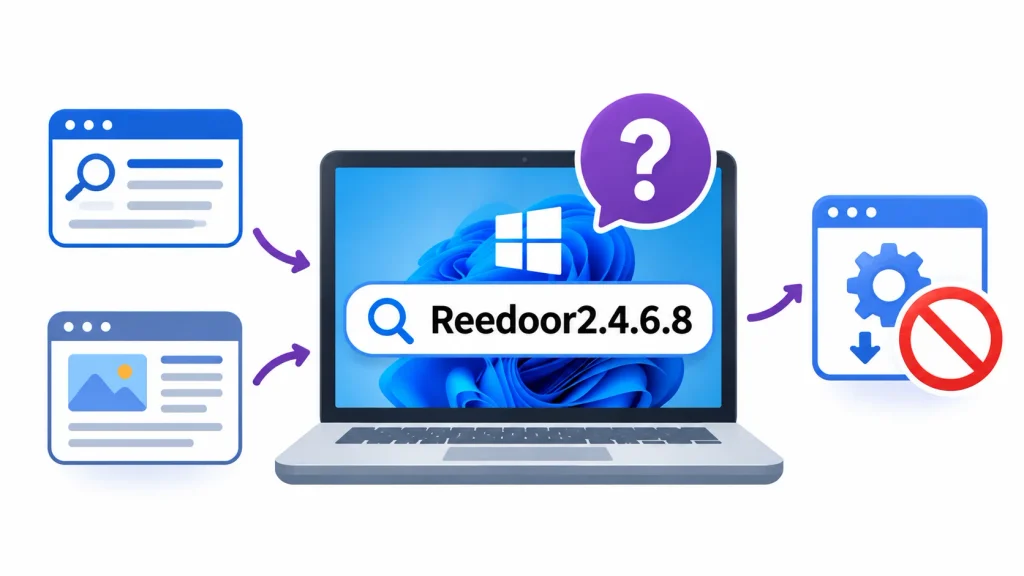
In practical terms, Reedoor2.4.6.8 is a piece of text that appears in search results and on a few web pages, with no verifiable software behind it. Here is what that means, one question at a time.
1. Understanding the Reedoor2.4.6.8 name
Real Windows products come with a clear name, a named company and a website where you can download them. This one has none of those. The name also runs the product word and a version number together with no space, which looks more like a file label or search phrase than a brand.
That oddity proves nothing on its own, but it is a reason to slow down. A search for the exact name turned up no publisher page, no product documentation and no Microsoft listing.
2. Is Reedoor2.4.6.8 an official Windows component?
There is no evidence that it is. Microsoft documents the parts of Windows that matter for security, such as Windows Security, Microsoft Defender Antivirus and SmartScreen. I found nothing from Microsoft that connects Reedoor2.4.6.8 to any of them.
3. Does Reedoor2.4.6.8 have a verified publisher?
Not that anyone has shown. A verified publisher is a company you can look up, with a support contact and a track record. Without one, nobody is answerable for bugs, data handling or malware.
4. What does the 2.4.6.8 version number mean?
Four-part version numbers are common in Windows software. They usually track a major release, a minor release, a build and a revision. So the format itself is normal.
What stands out is the tidy run of even numbers. Real builds often carry larger, less regular numbers. Either way, a version number cannot tell you who made the program or whether it is safe.
5. What do online sources claim about Reedoor2.4.6.8?
The descriptions conflict. Some pages present it as antivirus software. Others call it a data tool. A few admit they cannot confirm what it is.
When pages describe the same “product” in contradictory ways and none names a developer, treat the claims as guesses or search-traffic content, not facts.
Why Is Reedoor2.4.6.8 Important for Businesses?
Reedoor2.4.6.8 is not important because of anything it does. It matters because of what it represents: an unknown program that could land on a company computer. Verifying unfamiliar software protects five things:
- Company data, including customer, financial and employee records.
- Devices, by lowering malware exposure.
- Access, by keeping unknown programs away from accounts and shared drives.
- Compliance, by keeping data handling inside the rules you must follow.
- Uptime, by avoiding crashes and clean-up work.
These are reasons to check the software, not benefits of Reedoor2.4.6.8 itself.
1. Protecting sensitive business information
A business PC often holds customer details, invoices, payroll files and saved logins. A program you cannot trace may read, copy or upload any of it. You only need one careless install for that to happen.
Businesses should also maintain clear financial records and monitor operational risks through reliable systems, such as cloud accounting for business risk management, to improve financial visibility and support informed decisions.
2. Preventing malware and security threats
Unverified software is a common way for unwanted programs to get in. Wikipedia’s overview of potentially unwanted programs explains how bundled installers and misleading downloads put extra software on a PC without a clear opt-out. A business pays for that in lost time and exposed data.
3. Maintaining business data privacy
Some programs ask for access to files, browser data or cloud accounts. If you cannot say who runs the program, you cannot say where that data goes. That is a privacy problem before it is a technical one.
Businesses can improve financial data visibility and management by using reliable cloud-based accounting software with appropriate access controls and security practices.
4. Reducing operational disruptions
Unapproved programs can slow machines, clash with business software and trigger security alerts. Someone then has to find the cause. For a small team, that can mean half a day of lost work.
5. Supporting business IT governance
Security people call software used without IT approval “shadow IT.” According to a summary by Forvis Mazars of UK National Cyber Security Centre guidance, the response looks like other cyber risks: train people, know what devices you have and set clear policies.
Businesses should also evaluate operational tools such as inventory management software before adoption, checking their features, reliability, access permissions and data-handling practices.
6. Protecting business reputation and customer trust
Customers hand you their data on the assumption that you handle it carefully. A leak traced to a random program is hard to explain. Careful software habits are part of earning that trust.
7. A realistic scenario
Picture a 20-person accounting firm. An employee sees a pop-up telling them to install “Reedoor2.4.6.8” to speed up their PC, and they click through. The IT lead’s job is now to find out what was installed, who published it and whether client files were touched. The steps later in this guide are the ones that lead should follow.
Why Are People Seeing Reedoor2.4.6.8 on Windows?
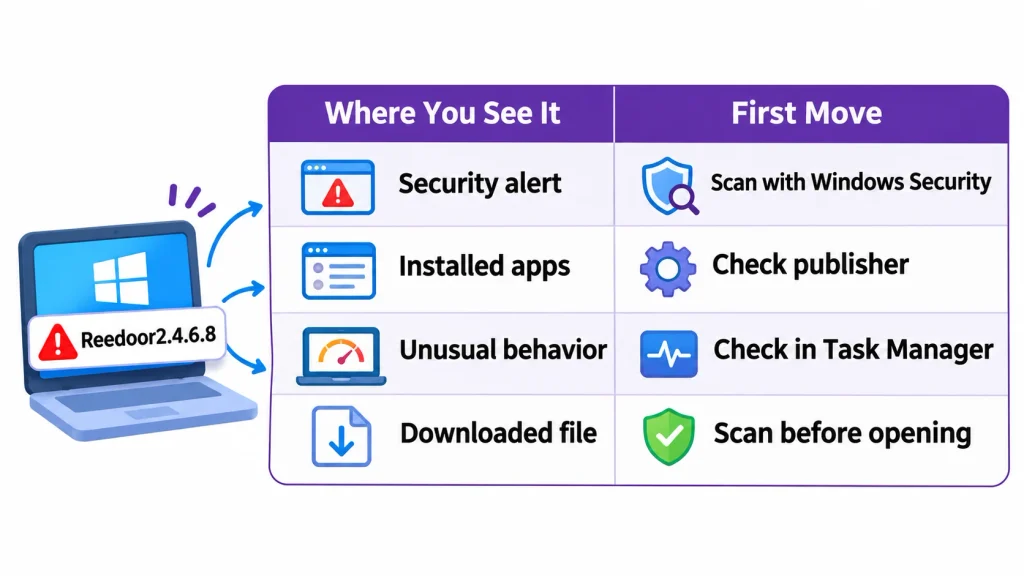
People run into the name in several places, and each one points to a different possible cause. None of them confirms a real program. Use the table to match what you saw to a sensible first move.
| Where you see it | What it could mean | First move |
| Task Manager | A running process or file using that name | Right-click it, choose Open file location, then check the publisher |
| Installed apps | Something installed under that name, perhaps bundled with another download | Note the install date and publisher before uninstalling |
| Browser notifications | A website you allowed to send alerts, not necessarily a program | Remove that site’s notification permission |
| Antivirus alert | A detection label tied to a file | Read the alert details and do not add an exclusion |
| Windows error message | A coincidence, or a leftover file or entry | Check Event Viewer for the real source |
| Downloaded file | An installer from an unknown site | Do not run it; scan it first |
Odd names like this one can spread because worried people search for them and publishers write pages to catch that traffic. That can create the impression of a product where there is only a label. So finding the name on your PC is a prompt to investigate, not proof of anything.
Is Reedoor2.4.6.8 a Virus or Malware?
Nobody has shown that it is, and nobody has shown that it is not. That is the honest answer. A name cannot make a program malicious. What a file does, and who built it, decides that.
Why the name alone cannot confirm a threat
Security tools judge files by behavior, code and reputation, not by what a web page calls them. A harmless file can have a scary name, and a dangerous one can look friendly. So do not trust a page that says “it is a virus” or “it is safe” without evidence tied to a specific file.
Malware, unwanted programs and scareware: what is the difference?
- Malware is software built to harm you or steal from you, such as ransomware or spyware.
- Potentially unwanted programs are things you did not really want, often bundled into another download. Wikipedia’s page on potentially unwanted programs covers how this bundling works.
- Scareware uses fake alerts to frighten you into buying or installing something. Wikipedia describes scareware as a social engineering trick that creates a sense of threat.
The last two matter here, because a fake “your PC is at risk, install this” message is a classic way an unknown name reaches a computer.
Common risks tied to unverified software
- Unauthorized programs that run in the background and open the door to more.
- Data theft, where files, passwords or browser data leave the machine.
- Fake security alerts that push you toward a purchase or a download.
- Unwanted browser notifications that deliver spam or scam links.
- Suspicious download links that serve an installer from an unknown site.
Pros and Cons of Reedoor2.4.6.8
Normally a pros and cons list compares features you can test. Here, nothing can be tested, because no verified software sits behind the name. So the “pros” below are claims made by some web pages, not confirmed benefits. The cons are real risks that come from the lack of verification.
Claimed pros (unverified)
- Described as antivirus or malware protection. Some pages say it detects viruses, phishing, ransomware and spyware. No test results or vendor documentation back this up.
- Described as real-time protection. The claim is that it stops threats before they cause harm. Nothing shows how, or whether, it does.
- Described as a data or privacy tool. Other pages give it a different purpose, which shows the descriptions are not reliable.
- Version number looks normal. The four-part format (2.4.6.8) is common in Windows software, but a version number says nothing about safety or who made the program.
Cons
- No verified publisher. No company is accountable for bugs, data handling or malware.
- No official website or documentation. You cannot check what it does, what it collects or how to uninstall it properly.
- Conflicting descriptions. Pages call it antivirus software, a data tool or “unknown.” Contradictory claims with no named developer should be treated as guesses.
- No Microsoft connection. Nothing links it to Windows Security, Microsoft Defender or SmartScreen.
- Possible data exposure. An untraceable program could read, copy or upload files, saved logins and browser data.
- Possible scareware or bundled-software route. Unknown names often arrive through fake alerts, misleading downloads or notification prompts.
- No support or updates. If something goes wrong, there is nobody to call and no security update channel.
- Compliance and licensing risk. On company devices, unapproved software can break data-handling rules and create legal problems.
- Unknown system requirements. Nobody can say whether it works on Windows 10 or 11, or whether it conflicts with other software.
Is Reedoor2.4.6.8 Safe?
Not to install, no. With no verified publisher, no official documentation and conflicting descriptions, there is nothing to base trust on. It is safe to investigate, as long as you do not run, open or approve anything while you do.
Microsoft’s own tools give a useful signal here. Microsoft Defender SmartScreen checks downloaded apps and installers and warns when a file looks malicious or has an unknown reputation, as described in Microsoft’s documentation for Edge. If you see that warning, take it seriously.
Warning signs businesses should never ignore
- No named publisher, or a publisher you cannot find anywhere else.
- No official website, or a site with no company details or privacy policy.
- A pop-up or message pressuring you to install it right now.
- A request for administrator rights with no clear reason.
- A request to turn off your antivirus or add a security exclusion.
- A “scan” that instantly finds dozens of problems and then asks for payment.
- Download links that point to file-sharing sites or unfamiliar domains.
Any one of these should stop an installation. Two or more mean you should escalate to IT or a security professional.
How to Check What Reedoor2.4.6.8 Actually Is on Your PC
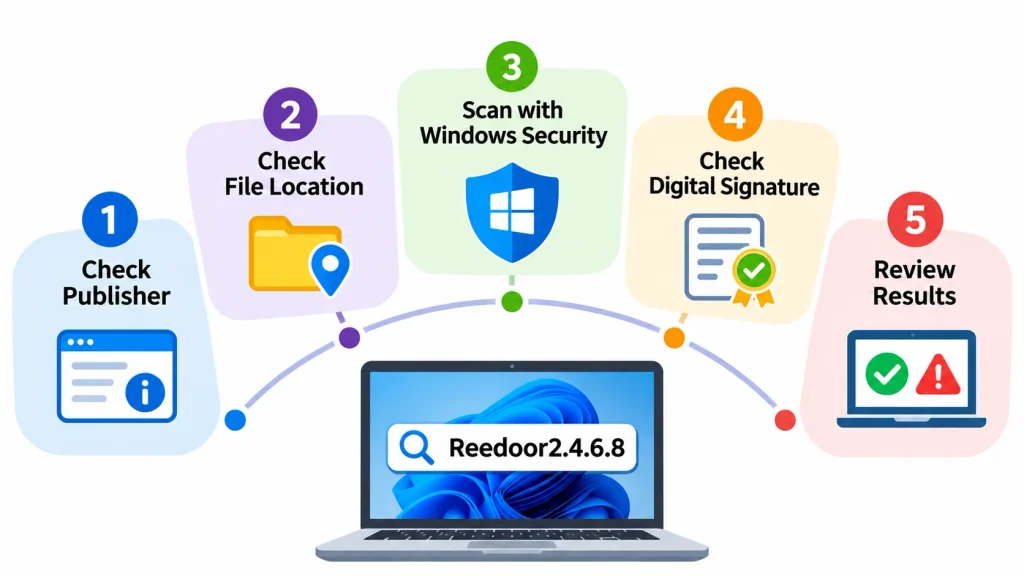
You can check this yourself in about fifteen minutes with tools already built into Windows. The goal is to learn who made the file and whether security tools flag it. Work through these steps in order.
- Do not run anything. Write down exactly where you saw the name: a process, an installed app, a pop-up or a file.
- Find the file. Press Ctrl+Shift+Esc to open Task Manager, go to the Details tab, right-click the process and choose Open file location. Legitimate programs usually live in Program Files. A file sitting in Downloads, Temp or AppData deserves extra suspicion, but that alone is not proof.
- Check the publisher and signature. Right-click the file, choose Properties, and look for a Digital Signatures tab. No tab means the file is unsigned. Unsigned does not automatically mean malicious, and signed does not automatically mean safe. The signature just tells you who stands behind the file.
- Check installed apps. Open Settings, then Apps, then Installed apps (Apps & features on Windows 10). Look at the publisher and install date.
- Review Protection history. Open Windows Security, go to Virus & threat protection, then Protection history, and see whether Microsoft Defender flagged anything.
- Scan the file. Right-click it and choose Scan with Microsoft Defender (on Windows 11, you may need to select Show more options first). Microsoft explains this in its guide to scanning an item with Windows Security.
- Look up its fingerprint. In PowerShell, run the command below to get the file’s hash, then search that hash on VirusTotal. Searching a hash does not upload the file, which matters if the file might hold confidential data.
- Look for the official source. Search for the publisher’s website, privacy policy and support page. If you cannot find them, stop and ask your IT administrator before doing anything else.
Get-FileHash “C:\path\to\the\file.exe”
Treat any result as one signal, not a verdict. A clean scan on a file from an unknown publisher still leaves the publisher question unanswered.
Reedoor2.4.6.8 in Browser Notifications: What to Do
If the name pops up as a browser notification, the cause is almost always a website, not an installed program. At some point, a site asked for permission to send alerts and someone clicked Allow. Often the prompt is disguised as “click Allow to prove you are not a robot.”
An alert you did not expect is a good reason to clean up. Follow these steps:
- Do not click the notification or any button inside it.
- Open your browser’s notification settings. In Microsoft Edge, go to Settings, then Cookies and site permissions, then Notifications. In Google Chrome, go to Settings, then Privacy and security, then Site settings, then Notifications.
- Remove or block every site you do not recognize. Removing a site lets it ask again if you revisit it. Blocking stops the prompt.
- Check your extensions. Remove any you did not install on purpose.
- Run a Windows Security scan to rule out an unwanted program behind the alerts.
On business machines, do not rely on staff to do this alone. Administrators can block notification prompts across all browsers through policy in Microsoft Intune or Group Policy, so a single mistaken click cannot turn into a stream of scam alerts.
How to Remove Reedoor2.4.6.8 Safely
Remove it only after you have confirmed that something with that name is actually on your PC and that you did not install it on purpose. The aim is to take out what does not belong without damaging Windows.
- Contain it first. If the machine belongs to a business, tell IT before you touch anything. If you suspect active data theft, disconnect from Wi-Fi or unplug the network cable.
- Uninstall the app. If it appears under Settings, Apps, Installed apps, select it and choose Uninstall.
- Run a full scan. Open Windows Security, go to Virus & threat protection, choose Scan options, select Full scan, then Scan now.
- Try an offline scan if it keeps coming back. Microsoft Defender Offline restarts the PC and scans before Windows fully loads, which helps with stubborn programs. Microsoft describes the steps in its Defender Offline documentation.
- Check startup items. In Task Manager, open the Startup apps tab. Disable only entries you have identified as unwanted.
- Clean up the browser. Remove unknown extensions and notification permissions, as covered above.
- Protect your accounts. If the program may have run with access to your accounts, change passwords from a different, clean device and turn on multi-factor authentication where you can.
A few things to avoid. Do not delete files from the Windows or System32 folders by hand. Do not download a “removal tool” from a pop-up or an ad. Both are common ways to turn a small problem into a big one.
On a company computer, the safest path is to follow your incident process. IT may isolate the device, collect evidence and, if needed, reinstall Windows from a clean image. Home users who are stuck can ask for help in a moderated community such as Reddit’s cybersecurity_help, which publishes a posting guide. Never post passwords, client data or full file contents there.
Should You Add Reedoor2.4.6.8 to Windows Defender Exclusions?
No. An exclusion tells Microsoft Defender to stop checking a file, folder or process. For software you cannot identify, that blinds your main protection to the exact thing you are unsure about.
Exclusions have a place, but only for software you have verified, when the vendor documents a conflict with antivirus scanning. Even then, an administrator should set them and record the reason.
Be suspicious of any page, pop-up or “installer” that tells you to add an exclusion or switch off protection first. Real software rarely needs that to install.
If an exclusion was already added, you can remove it. Open Windows Security, go to Virus & threat protection, select Manage settings, then Add or remove exclusions. Select the entry and remove it, then run a full scan.
What If Reedoor2.4.6.8 Is Associated With a Windows Error?
An error message that mentions the name does not prove it caused the problem. It might be a leftover file, a coincidence or a fake alert. Work from the evidence instead of the headline.
- Record the exact error. Write down the full text, any error code and what you were doing.
- Find the real source. Open Event Viewer, go to Windows Logs, then Application and System, and look for entries at the time of the error. The Source column shows which program or component raised it.
- Install Windows updates. Open Settings, then Windows Update, and install everything pending.
- Repair system files. Open Terminal as administrator and run the two commands below, restarting afterward.
- Re-check any named file. If the error points to a file path outside normal Windows folders, go back to the checking steps above.
DISM /Online /Cleanup-Image /RestoreHealth
sfc /scannow
Ignore any pop-up that offers to “fix” the error by downloading a tool. A fake error that pushes you to install a fixer is a standard scareware pattern.
Reedoor2.4.6.8 Troubleshooting Decision Tree
Use this troubleshooting decision tree when you encounter Reedoor2.4.6.8 on a Windows computer and are unsure how to investigate it.
Start with the situation that best matches what you noticed, whether it is an unexpected security alert, an unfamiliar application, unusual system behavior, or a suspicious download.
Follow the recommended action for your situation and check whether the issue is resolved. Pay particular attention to the application’s publisher, file location, digital signature, and security scan results. These details can help you determine whether the software is legitimate or requires further investigation.
[embed: node/bf1e61c1-20e2]
All four starting points eventually lead to the same verification check: Can you identify and verify the software’s publisher and confirm that the application is safe?
If the publisher remains unknown, security alerts continue appearing, or your computer displays unusual behavior, avoid opening the application or granting it additional permissions.
Businesses should involve their IT administrator or security team before taking further action. This helps prevent accidental data exposure, unauthorized software installations, and unnecessary changes to important Windows system files.
Reedoor2.4.6.8 vs. Legitimate Windows Security
The gap between an unverified name and established security software is mostly about accountability. With Microsoft Defender, you know who builds it, where the documentation lives and how it gets updated. With Reedoor2.4.6.8, you know none of that.
| Comparison factor | Reedoor2.4.6.8 | Microsoft Defender |
| Verified publisher | Not established | Microsoft |
| Official documentation | None found | Published by Microsoft |
| Windows integration | Not verified | Built into Windows 10 and 11 |
| Malware protection | Not verified | Real-time protection |
| Security updates | No evidence | Delivered through Microsoft’s update channels |
| Business deployment | Not verified | Managed at scale with Microsoft’s business security tools |
A “not verified” in the middle column does not mean the software is broken. It means a business has nothing to rely on, and no one to call when something goes wrong. That alone rules it out for company devices.
1. Microsoft Defender Antivirus
It ships with Windows and is the baseline protection for most PCs. For a very small business with a few devices, it is a sensible starting point when paired with good habits.
2. Microsoft Defender for Endpoint
This is Microsoft’s business-grade endpoint security offering. It adds central management, alerting and investigation tools on top of basic antivirus, and it can be managed alongside Microsoft Intune.
3. Bitdefender GravityZone
GravityZone is Bitdefender’s business endpoint security platform, managed from a central console. It is one of several established options for companies that want a non-Microsoft vendor.
4. CrowdStrike Falcon
Falcon is CrowdStrike’s cloud-delivered platform for endpoint detection and response. It suits organizations with security staff or a managed security provider.
Consumer antivirus protects one PC. Business endpoint protection also lets you see all devices, enforce policy and respond to incidents. Before buying any of these, read the vendor’s current documentation and look at independent test results from labs such as AV-TEST and AV-Comparatives.
What Should Businesses Look for Before Installing New Software?
Businesses can verify unfamiliar Windows software in seven steps. Run them before anyone clicks Install, and keep a note of the answers.
- Identify the publisher. Find a real company with a contact address and a history.
- Find the official website. Reach it from a trusted search, not from the download link you were given.
- Check the digital signature. A valid signature shows who signed the file. On Windows, SmartScreen builds reputation partly from code signing certificates that identify the author, so unsigned installers from new publishers are more likely to trigger warnings.
- Review its security reputation. Check the Defender scan, SmartScreen warnings and independent reviews.
- Verify Windows compatibility. Read the vendor’s stated system requirements for your Windows version.
- Read the privacy policy. Look at what data the software collects and where it goes.
- Get IT approval. Make sure someone accountable signs off and records it.
The table shows how the two kinds of software usually differ:
| Verification factor | Verified software | Unverified software |
| Publisher | Identifiable company | Unknown or hidden |
| Official website | Available and consistent | Cannot be confirmed |
| Digital signature | Verifiable where applicable | Missing or unknown |
| Privacy policy | Published and specific | Missing or vague |
| Security documentation | Available | Unavailable |
| Support | Named provider | No confirmed provider |
Also ask about licensing. Business use often needs a different license from personal use, and an unlicensed copy can create legal problems of its own.
If you have no IT team, keep the rule simple. Install only from the publisher’s own site, let one named person approve every new program, and ask a trusted IT provider whenever the answer to any step is “I could not find that.”
Common Mistakes to Avoid
Most damage from unknown software comes from the reaction, not the program itself. These are the slips that turn a small scare into a real incident.
- Running a “free scan” or fixer from a pop-up. That is the scareware playbook.
- Adding a Defender exclusion because a page told you to.
- Deleting system files by hand after reading a forum post.
- Trusting a verdict without evidence. A page that says “virus” or “safe” and cites no file, hash or publisher has told you nothing.
- Uploading confidential files to online scanners. Search a file’s hash instead.
- Giving everyone administrator rights, so one bad click can install anything.
- Ignoring it because “nothing happened.” Quiet programs can still copy data.
- Reusing passwords after a device may have been exposed. Change them from a clean device.
How to Prevent Similar Security Problems
You will keep meeting names like Reedoor2.4.6.8, so build habits and controls that work on any unknown program. This table lists the controls that matter most, roughly in order of effort.
| Control | What it does | How to put it in place |
| Keep Windows and apps updated | Closes known security holes | Windows Update, or managed update policies in Microsoft Intune |
| Keep SmartScreen on | Warns about risky sites and downloads | On by default in Microsoft Edge; admins can enforce it through Group Policy or Intune |
| Restrict installations | Stops unapproved software from running | Standard user accounts, plus App Control for Business (formerly WDAC) or AppLocker |
| Use least privilege | Limits the damage if someone installs something bad | Remove local administrator rights from daily accounts |
| Turn on multi-factor authentication | Protects accounts if a password leaks | Enable it in Microsoft Entra ID or your identity provider |
| Encrypt devices | Protects data if a laptop is lost or stolen | BitLocker |
| Back up data | Lets you recover from malware or mistakes | The 3-2-1 rule: three copies, on two media types, with one stored offsite; test a restore |
| Monitor endpoints | Shows threats across all devices | Microsoft Defender for Endpoint or another endpoint detection and response tool |
| Keep a software inventory | Tells you what is installed where | Intune or another asset management tool |
Tools only go so far. Train staff with real examples, such as fake “click Allow to continue” prompts, fake virus scans and “your PC is slow, install this” pop-ups. People who have seen the trick once are much harder to fool.
Finally, write a short incident response plan before you need one. It should say who to call, how to isolate a device from the network, and how to reset credentials. A one-page plan used calmly beats a perfect plan nobody can find.
Reedoor2.4.6.8 FAQs
What is Reedoor2.4.6.8 for Windows?
It is an unverified name. No confirmed publisher, official site or documentation shows it is a genuine Windows application, so treat it as unknown software.
Is Reedoor2.4.6.8 a real Windows program?
That has not been shown. Online descriptions conflict, and nothing from Microsoft links the name to Windows.
Is Reedoor2.4.6.8 safe to download?
No. There is no verified source to download it from, so you cannot know what you would be installing.
Is Reedoor2.4.6.8 a virus?
It is unproven either way. What decides it is the behavior of the actual file, which is why scanning the file and checking its publisher matter more than the name.
Why is Reedoor2.4.6.8 important for businesses?
Not for any feature. It is a prompt to check unfamiliar software before it reaches company devices, which protects data, devices and compliance.
Does Reedoor2.4.6.8 protect business data?
There is no verified evidence that it does. Rely on documented tools such as Microsoft Defender or a managed endpoint platform.
Can Reedoor2.4.6.8 run on Windows 10 and Windows 11?
No verified system requirements exist, so nobody can say. If a vendor cannot state its requirements, that is a reason to walk away.
How can I check whether Reedoor2.4.6.8 is installed?
Open Settings, Apps, Installed apps and search the name. Then look in the Task Manager’s Details tab, and run a full Windows Security scan.
Conclusion
So, what is Reedoor2.4.6.8 for Windows? As of November 2026, it is a name with no verifiable publisher, website or documentation behind it, and no evidence that it is a genuine Windows application or business product. Pages that describe it as antivirus software or a data tool offer nothing to back those claims.
That is exactly why Reedoor2.4.6.8 is important for businesses to take seriously. It is not a tool to adopt. It is a test of whether your team checks the publisher, the signature and the source before software reaches a company device.
If you see the name on a PC, do not run, install or exclude anything. Check where it came from, scan it with Windows Security, and escalate to IT if the publisher stays unknown or the alerts return. For protection you can actually rely on, use documented tools such as Microsoft Defender or an established endpoint platform, and keep the habits from this guide: approve before you install, limit admin rights and back up your data.
