


If you’ve typed “startup booted fundraising strategy” into Google, you’re probably trying to figure out one thing: how do founders raise money and grow without handing over their company to investors? The term is really shorthand for a bootstrapped approach to fundraising, building your business on your own terms first, then bringing in outside capital only when it actually helps you.
This guide walks through what that looks like in practice. We’ll cover why founders choose this path, how it stacks up against traditional venture capital, the funding sources that actually work at each stage, and the financial numbers you need to track before you ever talk to an investor. As your business grows, you’ll also need to understand essential compliance topics such as Tax Deducted at Source (TDS) to stay on top of tax obligations and avoid penalties.
A startup booted fundraising strategy means growing your company using your own revenue, savings, or small amounts of outside capital instead of relying on large venture rounds from day one. You keep more ownership, make your own calls, and raise money, if you raise at all, from a position of strength rather than need.
How It Differs from Traditional Startup Fundraising
Traditional fundraising usually follows a path. It starts with pre-seed, then seed, followed by Series A, Series B and so on. Each round reduces the founders’ share a bit.
A different approach is to flip this order. First you show that your business works. You use money from customers or your own funds. Later you decide if taking outside money is an idea.
This doesn’t mean that founders who bootstrap never get outside funding. Many do get it. The difference is that they choose when to get it. They don’t get it only when they are about to run out of money.
They have control. They raise money on their terms. This gives them leverage. They are not forced to raise money because they need it away.
Best Tools for Startup Financial Planning
1. Carta
Carta helps founders manage their company’s capitalization table (cap table), employee equity grants, stock options, and 409A valuations from a single platform. A cap table records who owns shares in the company, how much equity each founder, investor, and employee holds, and how ownership changes after fundraising rounds or stock option exercises. Keeping this information accurate is essential because even small errors can create legal, financial, or tax issues during future funding rounds or acquisitions.
As your startup grows and you begin issuing shares or stock options to employees, advisors, or investors, managing equity manually in spreadsheets quickly becomes difficult. Carta automates these processes by tracking ownership changes, generating equity reports, managing vesting schedules, and supporting compliance requirements such as 409A valuations, which determine the fair market value of private company shares for stock option grants. By centralizing equity management, Carta helps founders stay organized, maintain accurate records, and prepare for fundraising, audits, and due diligence with greater confidence.
2. Gust
Gust is a platform that helps startups connect with angel investors, startup accelerators, incubators, and venture capital networks looking for promising early-stage businesses. Instead of searching for investors individually, founders can create a detailed startup profile, showcase their business model, traction, financials, and growth plans, and submit applications to multiple funding programs through a single platform.
Beyond investor discovery, Gust also provides tools to simplify the fundraising process itself. Founders can organize fundraising documents, track investor conversations, manage due diligence materials, monitor application progress, and keep all fundraising activities in one place. This makes it easier to stay organized throughout the investment journey, respond quickly to investor requests, and build stronger relationships with potential backers. For early-stage startups that are preparing to raise their first round of funding, Gust can streamline both investor outreach and fundraising management, saving valuable time and effort.
3. AngelList
AngelList is a well-known platform that helps startups connect with angel investors and raise capital more efficiently. Founders can create detailed company profiles, share information about their product, team, traction, and funding goals, and reach a network of investors actively looking for early-stage investment opportunities. The platform is especially popular among startups seeking seed or pre-seed funding.
One of AngelList’s standout features is its support for Special Purpose Vehicles (SPVs), which allow multiple investors to pool their money into a single investment entity. This simplifies the fundraising process by reducing the number of individual investors listed on a startup’s cap table while making it easier for founders to manage investments. In addition to fundraising, AngelList is also a popular hiring platform where startups post job openings and connect with talented professionals interested in working at fast-growing early-stage companies. This combination of fundraising and recruitment tools makes AngelList a valuable resource for startups looking to secure both capital and talent as they scale.
4. Crunchbase
Crunchbase is a widely used research platform that helps founders identify the right investors before starting their fundraising efforts. It provides detailed information on startups, venture capital firms, angel investors, funding rounds, acquisitions, and industry trends. Instead of reaching out to investors randomly, founders can use Crunchbase to find investors who have previously funded companies in the same industry, business model, or growth stage.
The platform also lets you analyze an investor’s portfolio, preferred investment size, geographic focus, and recent funding activity. For example, if you’re building a SaaS startup, you can identify venture capital firms or angel investors that have recently invested in other SaaS companies at the pre-seed or seed stage. This targeted approach helps founders prioritize the most relevant investors, personalize their outreach, and improve their chances of securing meetings. By understanding who invests in businesses like yours and when they typically invest, Crunchbase makes the fundraising process more strategic and data-driven.
5. LivePlan
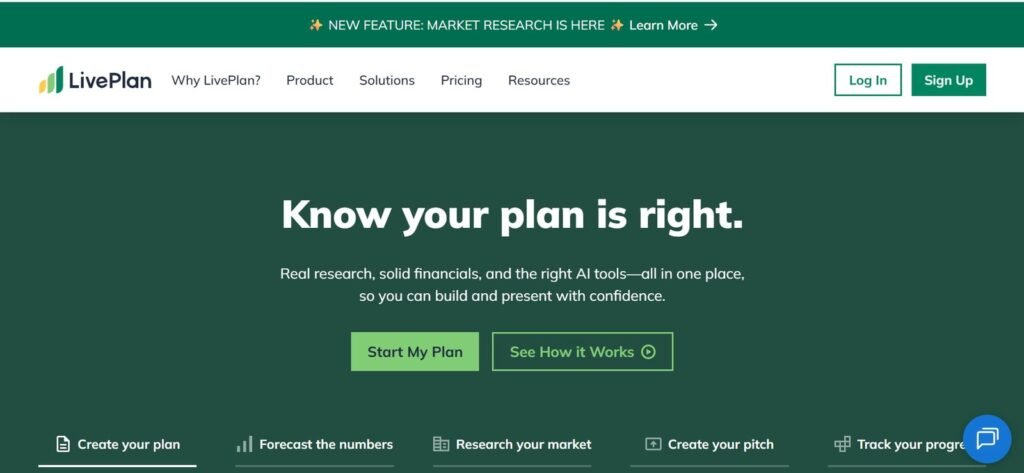
LivePlan is a business planning and financial forecasting tool designed to help entrepreneurs create professional business plans and realistic financial projections without needing advanced finance or accounting expertise. It offers step-by-step guidance, customizable templates, and built-in forecasting tools that make it easier to estimate revenue, expenses, cash flow, profit and loss, and break-even points.
For founders who have never built a financial model before, LivePlan simplifies what can otherwise be a complex process. It helps you organize your assumptions, generate investor-ready financial statements, and create clear projections that demonstrate how your business plans to grow over the next few years. These forecasts can be especially valuable when pitching to angel investors, banks, or venture capital firms, as they show that you understand your business economics and have a realistic plan for managing growth. By combining business planning with financial modeling, LivePlan helps founders present a more credible and well-prepared case when seeking funding.
Why More Founders Are Choosing Bootstrapping
Founders who’ve watched friends give up 20-30% of their company in a single seed round, only to lose control of major decisions two years later, are understandably cautious. A recurring theme in founder discussions on startups is regret over raising too early rather than too late. Bootstrapping lets you build proof points, paying customers, real revenue, a working product, before you ever negotiate a term sheet.
Bootstrapping vs Venture Capital: Which Is Right for Your Startup?
Comparison Table
| Factor | Bootstrapping | Venture Capital |
| Ownership | You keep most or all equity | You give up equity for cash |
| Growth speed | Usually slower, tied to revenue | Can scale faster with outside cash |
| Decision-making | Founders keep full control | Investors often get board seats and a say |
| Risk | Personal financial risk | Risk shared with investors |
| Pressure | Pressure to stay profitable | Pressure to hit growth targets for the next round |
| Exit expectations | Flexible, on your timeline | Investors usually expect an exit event |
Advantage and Disadvantage of Bootstrapping

| Advantages of Bootstrapping | Disadvantages of Bootstrapping |
| Complete ownership and control: Founders retain 100% ownership of the company and make all key decisions, including product development, pricing, hiring, marketing, and business strategy, without needing approval from investors or board members. | Slower business growth: Expansion depends on the revenue the business generates. Without outside funding, it may take longer to hire employees, launch products, invest in marketing, or enter new markets compared to venture-backed competitors. |
| No equity dilution: Since there are no external investors, founders do not have to give up shares of the company. They keep a larger portion of future profits and maintain full control over the company’s direction. | Limited access to capital: Large projects such as research and development, manufacturing, international expansion, or major technology investments can be difficult to fund solely through business revenue. |
| Financial discipline: Bootstrapped startups learn to manage expenses carefully because every dollar matters. This encourages efficient budgeting, better cash flow management, and sustainable growth rather than relying on continuous fundraising. | Higher personal financial risk: Many founders use personal savings, loans, or credit cards to finance their startup. If the business struggles or fails, the founder remains personally responsible for those financial commitments. |
| Customer-focused growth: Revenue comes directly from customers rather than investors, encouraging founders to build products that solve real problems and generate consistent income from the beginning. | Harder to compete in capital-intensive industries: Startups in sectors such as biotechnology, artificial intelligence, hardware, or businesses with strong network effects often require significant upfront investment to compete effectively. |
| Greater long-term financial rewards: If the company becomes highly profitable or is acquired, founders receive a much larger share of the financial returns because they have retained ownership throughout the company’s growth. | Founder workload and burnout: With limited resources, founders often handle multiple responsibilities, including sales, marketing, finance, operations, and customer support, which can lead to stress and burnout over time. |
| Long-term flexibility: Without investor pressure for rapid growth or quick exits, founders can grow the business at a pace that aligns with their vision, customer needs, and long-term sustainability. | Less room for unexpected setbacks: Limited cash reserves make it more difficult to handle economic downturns, market changes, unexpected expenses, or temporary declines in revenue, increasing financial pressure on the business. |
Decision Framework
Ask yourself three questions before choosing a path.
Can you reach meaningful revenue within 6-12 months without outside funding? If yes, bootstrapping is worth trying first.
Does your market reward speed over profitability, meaning a competitor with more capital could out-scale you before you build a moat? If yes, you may need to raise sooner.
Would giving up 15-25% equity now buy you enough speed to matter later? If the math doesn’t clearly favor dilution, hold off.
Why Founders Choose a Booted Fundraising Strategy
1. Maintain Ownership
Every percentage point of equity you keep is a percentage point of future upside and control. Founders who bootstrap through their first $1-2 million in revenue often raise later at a higher valuation, meaning the same investor check buys less of the company.
2. Financial Discipline
When there’s no investor money cushioning mistakes, founders tend to watch spending closely. This isn’t a personality trait, it’s a structural incentive. Basecamp’s founders have written openly on their company blog about how the absence of outside funding forced them to build a business that had to work, not just grow.
3. Better Valuation
A company with real revenue, retained customers, and healthy margins commands a stronger valuation than one with just a pitch deck and a prototype. Bootstrapped founders who eventually raise often negotiate from a position where investors are competing for the deal, not the other way around.
4. Customer-Driven Growth
Without VC money to burn on paid acquisition, bootstrapped startups usually build products people are willing to pay for right away. That customer feedback loop tends to produce a more durable business, even if it grows more slowly at first.
Different Ways Bootstrapped Startups Raise Capital
1. Personal Savings
Most founders who start a company with their money begin this way. This kind of money is really simple. It is also the most dangerous, for the founder themselves, so it is best when the founder does not have to spend a lot of money to try out an idea. The founder can use their money to test the idea when the cost is low.
2. Friends and Family
Small loans or investments from friends and family can help you get started. Think of these as financial deals. Write down the terms even if it’s a small amount. This way you can avoid hurting relationships.
These small loans or investments are really helpful. You can ask people you know. Trust, for help. Make sure you put the agreement in writing.This will help prevent problems.
3. Revenue Reinvestment
This is how it works at its core. You take the money that customers give you and reinvest it into your business instead of relying on outside investors for funding.
One of the biggest advantages of this approach is that your business grows based on what customers actually want. Customers pay for your product or service, and you use that revenue to improve and expand your business.
This creates a sustainable growth cycle where every improvement is backed by real customer demand. As your revenue increases, it’s also important to stay compliant with applicable tax rules so your growing business can avoid penalties and manage its finances effectively.
4. Angel Investors
Angels typically write smaller checks than VC firms and often bring industry experience along with the money. Platforms like AngelList make it easier to find angels who invest in early-stage, capital-efficient companies.
5. Crowdfunding
Kickstarter and Indiegogo work well for product-based startups that can show a prototype and pre-sell to backers. Equity crowdfunding platforms, such as Republic and SeedInvest, let non-accredited investors buy small equity stakes, which can work for consumer brands with an engaged audience.
6. Revenue-Based Financing
You do not have to give up part of your company when you borrow money this way. Instead, you repay the lender with a percentage of your company’s monthly revenue until you reach the agreed repayment amount, which is usually 1.5 to 2 times the amount you borrowed. This financing model works well for Software as a Service (SaaS) and subscription-based businesses because they generate predictable recurring revenue. If revenue falls in a particular month, the repayment amount also decreases since payments are tied to earnings. As your business expands and hires employees, it’s equally important to understand compliance requirements such as Provident Fund (PF) to ensure you meet employee benefit and payroll obligations alongside managing business financing.
7. Venture Debt
Venture debt is a kind of loan. This loan is often given with warrants. Venture debt is for companies that are already making some money or have gotten money from investors before. Venture debt helps these companies by giving them time to grow without having to give up too much of their company. However companies that get venture debt have to pay it back no matter how well or poorly their business is doing. Venture debt is still a loan that needs to be repaid.
8. Startup Grants
Government and nonprofit grants, including programs through the U.S. Small Business Administration, provide non-dilutive funding, though the application process can be slow and competitive. Grants tend to suit startups in research-heavy fields like biotech, cleantech, or hardware.
9. Accelerators
Programs like Y Combinator and Techstars give you some money, not a lot and, in return they get a part of your company. They also help you out with advice. Connect you with investors who can give you more money later on. The part of your company you give up is usually not too big compared to what you would have to give up if you were trying to get a lot of money from investors.
10. Strategic Partnerships
Big companies sometimes give money, cheaper equipment or help with marketing to companies that make things that go well with the big company’s products. The big company and the small company can work together. This can be very helpful. These deals can give the company money without taking away any ownership but the small company should look at the deals very carefully. The small company should check if the deal says they can only work with the company because that might stop them from working with other companies in the future. The small company should think about this carefully because it is very important for their business.
Startup Fundraising Strategy by Growth Stage

1. Idea Stage
At this point, you’re validating whether anyone wants what you’re building. Personal savings, friends and family, or a small grant are usually the only capital sources that make sense — there’s rarely enough proof yet to attract angels or VCs.
2. MVP Stage
Once you have a minimum viable product, focus on getting a handful of paying customers rather than raising money. Their willingness to pay is the strongest signal you can bring to any future investor conversation.
3. Early Revenue
With consistent monthly revenue, you can start exploring revenue-based financing or angel checks to speed up hiring or marketing. This is also a reasonable point to apply to an accelerator if you want structured mentorship.
4. Pre-Seed
If you do decide to raise, pre-seed rounds ($100K-$500K typically) often come from angels or small funds and are meant to extend runway while you refine product-market fit, not to fund aggressive scaling.
5. Seed
By seed stage, investors expect some combination of user growth, revenue, or retention data. Bootstrapped founders who reach seed with real traction generally raise at better terms than those raising purely on an idea.
6. Growth Stage
At this stage, capital is usually about accelerating something that’s already working, whether that’s expanding into new markets, building out a sales team, or investing in infrastructure. Founders who bootstrapped through earlier stages often raise a single, larger round here instead of several smaller dilutive ones.
How to Build a Startup Booted Fundraising Strategy
1. Validate Demand
Talk to potential customers before writing a line of code if you can. Pre-sales, waitlists, or paid pilots tell you more than any survey.
2. Estimate Startup Costs
List out what it actually costs to build and launch a minimum version of your product: tools, hosting, contractor fees, basic legal setup. Most first-time founders underestimate this by a wide margin.
3. Calculate Runway
Runway is simply how many months you can operate before running out of cash, based on your current spending. Divide your available cash by your monthly burn rate to get this number.
4. Reduce Burn Rate
Burn rate is how much cash your business spends each month beyond what it brings in. Cutting unnecessary tools, deferring non-essential hires, and negotiating vendor terms can stretch your runway by months.
5. Improve Unit Economics
Unit economics means understanding whether you make money on each customer, once you account for the cost of acquiring and serving them. If your cost to acquire a customer is close to or higher than what that customer pays you, your growth model needs work before you scale it further.
6. Generate Revenue Early
Even a small amount of paying customers changes the conversation with any future investor. It proves the product solves a real problem people will pay to fix.
7. Prepare Financial Documents
Keep clean records from day one: a simple profit-and-loss statement, a cash flow summary, and a basic cap table if you’ve issued any equity. Waiting until you need to raise to organize these is a common, avoidable mistake.
8. Build Investor Readiness
Even if you don’t plan to raise soon, understanding what investors look for, including growth rate, margins, and market size, helps you build a business that would be fundable if you ever changed your mind.
Financial Metrics Every Founder Should Track
1. Burn Rate
The amount of cash your company spends each month, net of revenue. Track this monthly, not quarterly, so you catch problems early.
2. Runway
Cash on hand divided by monthly burn rate, expressed in months. Most investors want to see at least 12-18 months of runway after any round closes.
3. ARR (Annual Recurring Revenue)
Your predictable subscription or contract revenue, annualized. This is the headline number most SaaS investors care about.
4. MRR (Monthly Recurring Revenue)
The monthly version of ARR, useful for tracking short-term trends and month-over-month growth.
5. CAC (Customer Acquisition Cost)
Total sales and marketing spend divided by the number of new customers acquired in that period. A rising CAC without a corresponding rise in customer value is a warning sign.
6. LTV (Lifetime Value)
The total revenue you expect to earn from a customer over the life of their relationship with you. A healthy business usually has an LTV to CAC ratio of at least 3:1.
7. Gross Margin
Revenue minus the direct cost of delivering your product or service, shown as a percentage. Software businesses typically aim for 70-85% gross margins; anything much lower deserves a closer look.
8. Cash Flow
The actual movement of money in and out of your business, which can look different from your reported profit due to timing of payments. Positive cash flow, even modest, is what lets a bootstrapped company survive without outside funding.
Investor Readiness Checklist

1. Pitch Deck
A clear, concise deck covering the problem, your solution, market size, traction, team, and what you’re asking for. Ten to fifteen slides is usually enough, investors read hundreds of these and reward clarity over length. The best PowerPoint agents can help assemble an investor-ready deck from existing notes and metrics, pulling structure, charts, and narrative flow into a coherent pitch instead of starting from a blank canvas.
2. Financial Statements
Basic profit-and-loss, balance sheet, and cash flow statements, even if they’re simple. Investors want to see that you understand your own numbers, not that you have Wall Street-grade reporting.
3. Customer Metrics
Retention rate, churn, and growth trends matter more than vanity metrics like total signups. Be ready to explain both your wins and your weak spots honestly.
4. Market Validation
Evidence that a real, sizable market wants what you’re building: customer interviews, sales data, or comparable companies that have proven the category works.
5. Cap Table
A clear record of who owns what percentage of your company, including any options or convertible instruments outstanding. Tools like Carta make this straightforward to maintain and share with prospective investors.
Common Startup Fundraising Mistakes
1. Raising Too Early
Raising before you’ve proven anything means giving up more equity for less leverage, and it can also mask problems in your business model that money temporarily hides.
2. Raising Too Late
On the other end, waiting until you’re nearly out of cash puts you in a weak negotiating position and limits your options to whoever will fund you fastest, on whatever terms they offer.
3. Poor Financial Planning
Founders who don’t track burn rate or runway closely are often surprised by how little time they have left, which forces rushed, unfavorable fundraising decisions.
4. Weak Product Validation
Pitching investors on an idea instead of evidence, such as customer conversations, pre-sales, or usage data, is one of the most common reasons early meetings go nowhere.
5. Giving Away Too Much Equity
Early rounds sometimes trade too much ownership for too little capital, especially when founders are desperate to close a round quickly. Every early equity decision compounds through every future round.
Real Examples of Successful Bootstrapped Startups
1. Mailchimp
Mailchimp grew for close to two decades without taking venture funding, eventually selling to Intuit for around $12 billion in 2021. Its founders have spoken publicly about how staying independent lets them build features for customers rather than for the next funding round.
2. Basecamp
Basecamp (formerly 37signals) has operated profitably for over 20 years without outside investment, and its founders have written extensively about the case for staying small and sustainable rather than chasing hypergrowth.
3. Zapier
Zapier scaled to a large, distributed team and significant revenue without raising a traditional venture round, relying instead on early revenue from its automation product.
4. Atlassian
Atlassian bootstrapped for roughly a decade, using cash flow from paying customers to grow, before eventually taking outside capital and going public in 2015.
5. Canva
Canva did raise venture capital, but its founders bootstrapped the earliest validation of the idea and were notably disciplined about capital efficiency relative to its valuation growth. Founder interviews shared on LinkedIn have discussed this discipline in more detail.
Future Trends in Startup Fundraising
1. AI-Powered Investing
Investors increasingly use AI tools to screen deal flow, analyze market data, and even assess founder communication patterns before a first meeting, which means founders should expect more data-driven scrutiny earlier in the process.
2. Revenue-Based Capital
As more lenders offer revenue-based financing, it’s becoming a mainstream middle ground between pure bootstrapping and traditional equity fundraising, particularly for SaaS companies with steady recurring revenue.
3. Alternative Financing
Options like venture debt, invoice financing, and revenue-based loans are growing in popularity as founders look for ways to fund growth without diluting ownership.
4. Global Startup Ecosystems
Fundraising is no longer concentrated in a handful of hubs. Founders in emerging startup ecosystems increasingly have access to local angel networks, government-backed funds, and remote-first accelerators.
Frequently Asked Questions
What is a startup booted fundraising strategy?
It’s an approach to building and funding a company primarily through revenue, savings, and modest outside capital, rather than depending on large venture rounds from the start.
How do bootstrapped startups raise money?
Through personal savings, revenue reinvestment, angel investment, crowdfunding, revenue-based financing, grants, and accelerator programs.
What is the difference between bootstrapping and venture capital?
Bootstrapping relies on your own resources and keeps ownership concentrated with founders, while venture capital provides larger sums of cash in exchange for equity and, often, a say in major decisions.
Can startups succeed without investors?
Yes. Companies like Basecamp and Mailchimp built large, profitable businesses without traditional venture funding.
When should a startup raise funding?
Generally, once you have evidence the business works, such as paying customers, retention, or clear demand, and when outside capital would meaningfully speed up growth you couldn’t achieve on your own.
What is revenue-based financing?
A funding model where you repay a lender a percentage of monthly revenue until you’ve paid back an agreed multiple of the original amount, without giving up equity.
Conclusion
A startup that does its fundraising is not about never talking to investors. It is about making sure the startup is strong and has a plan so that when it does get money from investors the startup is in charge.
The startup should first make sure people really want what it is selling and keep an eye on how much money it has and how fast it is spending that money. The startup should also try to make money as soon as it can.
If the startup does decide to get money from investors it will be able to talk to them in a strong position with a business that investors really want to give money to, rather than a business that is struggling and needs to be saved.
This is the reason why startups do their own fundraising to have control over the money they get from investors and to have a startup that investors want to fund, which is the whole point of doing things this way.
