Author: Riyaz Daga

  • Contractor Accounting Software: How to Choose the Right System

    If you run a contracting business you already know that simple bookkeeping is not enough. You must track money for each job. You often have three or four jobs at the same time. Each job has its budget, its own subcontractors and its own payment schedule.

    That is why contractor accounting software was created. Contractor accounting software is accounting software designed to match how construction really works. It uses jobs, cost codes, progress billing, retainage and payroll rules that normal small‑business tools never cover.

    This guide explains what contractor accounting software really does. It shows how contractor accounting software is different from accounting software such as QuickBooks or Xero.

    It also tells you which platforms are best, for which type of contractor and how to choose one without wasting six months on an implementation.

    Quick answer: Small contractors with jobs often do fine on QuickBooks or Xero with a few contractor‑focused add‑ons.

    Once contractors are managing active jobs, subcontractors, retainage or certified payroll purpose‑built construction accounting software such as Foundation, Sage 100 Contractor or Premier or a project‑accounting layer such, as Adaptive or Knowify usually pays for itself within a year by reducing billing errors and improving job‑cost visibility. 

    What Is Contractor Accounting Software?

    Contractor accounting software is accounting software built around projects instead of just company-wide totals. Every dollar gets tied to a specific job, so you can see whether that job is actually making money, not just whether your bank balance looks healthy.

    Regular accounting software answers “how is my business doing this month?” Contractor accounting software answers “how is this job doing right now, and what will it cost me to finish it?” That second question matters more in construction, where a business can look profitable on paper while individual jobs are quietly bleeding money.

    Wikipedia’s overview of construction accounting sums up why this field is treated as its own discipline: contractors typically recognize revenue using the percentage-of-completion method, tying earned revenue to the percentage of estimated total cost that’s actually been incurred. 

    That single accounting rule is the reason generic bookkeeping software struggles here: it usually has no concept of “percent complete” at all.

    1. How contractor accounting differs from regular accounting

    Contractor accounting comparison showing a single retail ledger versus multiple construction projects consolidated into one financial dashboard.

    A retail business has one ledger and one set of margins. A contractor effectively runs a separate mini-business inside every job, with its own budget, its own costs, and its own profit or loss.

    Contractor accounting software is built to roll all of those mini-businesses up into one clear picture without losing the job-level detail.

    2. What contractor accounting software actually manages

    At a working level, the software touches:

    • Jobs and cost codes
    • Labor, materials, and equipment costs
    • Subcontractor payments and compliance documents
    • Progress billing and retainage
    • Work-in-progress (WIP) reporting
    • Payroll, including certified and prevailing-wage payroll
    • Cash flow and job profitability

    Best Contractor Accounting Software in 2026

    Before naming names here is the methodology. Each platform below was evaluated on how deep the job costing’s on WIP reporting on payroll capability on billing tools, on how easy it is to set up and on how clear the vendor is about pricing. 

    Software prices change often so treat the numbers here as a starting point. Confirm current prices directly with each vendor. This comparison reflects listed information as of September 2026.

    No single platform is best, for every contractor. The honest answer depends on your size, your trade and how complex your payroll and billing already are.

    SoftwareBest forJob costingWIPPayrollConstruction billing
    QuickBooksSmall contractors, existing QuickBooks usersBasicLimitedAdd-onLimited
    XeroSmall service contractors, cloud-first teamsBasic-to-moderateLimitedVia add-onModerate
    AdaptiveMid-market contractors layering project accounting onto existing systemsStrongStrongDepends on integrationStrong
    Foundation SoftwareSpecialty and mid-size construction firmsStrongStrongStrong (certified payroll)Strong
    Sage Construction (Sage 100/300)Established contractors needing broad financial managementStrongStrongStrongStrong
    Premier Construction SoftwareGrowing contractors ready for an ERPAdvancedAdvancedAdvancedAdvanced

    1. QuickBooks

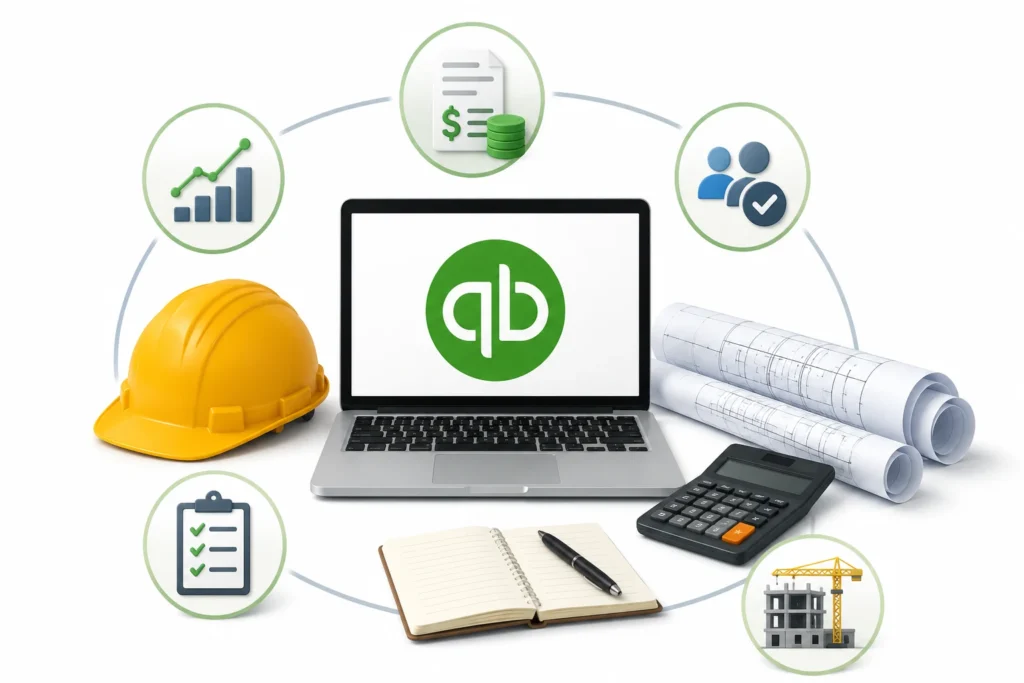
    QuickBooks contractor accounting software displayed on a laptop with construction tools, blueprints, financial charts, calculator, and accounting documents.

    QuickBooks (Online or Enterprise Contractor Edition) is the first choice for most small contractors. That’s mostly because your bookkeeper or CPA likely already uses it. 

    It does a job with tracking income and expenses by comparing estimates to actual results and preparing 1099 forms for subcontractors.

    It starts to fall short when you need certified payroll, manage multi-tier retainage or generate work-, in-progress reporting that meets bank or surety requirements. 

    If your annual revenue is moving past a million dollars or if you are bidding on public projects that require prevailing wage records you’ll probably outgrow what QuickBooks can do.

    2. Xero

    Xero focuses on cloud-based bookkeeping. It includes bank reconciliation, bills, tracking costs at the project level and a good mobile app. It works well for service and remodeling contractors who need simple project profitability without a hard learning curve.

    Xero does not have built-in construction payroll or advanced work in progress tools. So contractors who handle certified payroll or complicated progress billing usually need a construction- add-on or a different platform altogether.

    3. Adaptive

    Adaptive places itself as a project‑accounting layer that sits beside a company’s existing books. Adaptive links job costs, accounts payable, billing, work in progress and forecasts. Adaptive does this without requiring a rip‑and‑replace. 

    Adaptive makes a choice for mid‑market contractors who already have accounting processes they do not want to abandon but need clearer job‑level visibility. 

    4. Foundation Software

    Foundation is a construction-focused accounting system. It handles job costing, payroll, including payroll, invoicing accounts payable and accounts receivable general ledger and project management all in one place. 

    This system is a choice for specialty contractors and mid-size companies. They need construction accounting features. Don’t want to go all the way to a full ERP system. 

    5. Sage Construction

    Sage’s construction products include Sage 100 Contractor for companies and Sage 300 Construction and Real Estate for bigger ones. These products handle finance, compliance, job costing, payroll work in progress and field access. 

    It is an option for companies that have been around for a while and need full financial management. These companies also have the people to manage a more complicated system.

    6. Premier Construction Software

    Premier is built as a cloud-based construction ERP so its pricing, reporting and feature depth go beyond basic accounting. It includes project management and forecasting tools. 

    This makes it a good fit for growing contractors who have moved past the stage where simple accounting software can handle their day- to-day operations. 

    7. Other platforms worth knowing

    A handful of other names show up regularly in contractor accounting searches, each suited to a different niche: Procore Financials (financial tools bolted onto Procore’s project management platform), Acumatica Construction Edition (cloud ERP with strong customization), CMiC and Viewpoint Vista (enterprise-grade systems for large general contractors), Knowify (project accounting for small-to-mid trade contractors), Buildertrend (project management with construction-aware accounting features), and ComputerEase (construction accounting aimed at mechanical, electrical, and specialty trades).

    None of these need a full profile here. The point is knowing they exist and roughly who they’re for, so you can shortlist correctly before you start demos.

    Contractor Accounting Software vs. General Accounting Software

    This is the decision most contractors actually need help with, more than “which vendor is best.”

    General accounting software such as QuickBooks or Xero manages common bookkeeping tasks effectively, including creating invoices, tracking expenses, reconciling bank accounts and producing simple reports.

    For businesses that want to understand these fundamentals, this guide to bookkeeping explains how tasks such as bank reconciliation, payroll processing, and financial reporting fit into everyday financial management.

    When you require job costing divided into cost codes WIP schedules that a bank will accept, certified payroll for government contracts or multi-tier retainage tracking, across many active jobs General accounting software falls short. 

    A rough way to think about it:

    • General accounting software: fine for a solo contractor or a small crew running one or two jobs at a time with simple billing.
    • Construction accounting software: needed once you’re running several jobs simultaneously, using subcontractors regularly, or billing progressively against a contract.
    • Construction ERP: worth it once accounting, estimating, project management, procurement, and field operations all need to share the same data in real time.

    If you’re not sure which bucket you’re in, a useful gut check: can you tell right now, without pulling a report or calling your bookkeeper, whether your three biggest active jobs are on budget? If not, you’ve likely outgrown general accounting software regardless of your revenue size.

    What Features Should Contractor Accounting Software Have?

    1. Job costing

    Job costing dashboard showing construction project costs, budget tracking, financial charts, calculator, blueprints, hard hat, and home construction model.

    Job costing is about keeping track of every cost that happens during a job. This includes things like labor, materials people you hire to do part of the work and the machines or tools you use. It is all linked to the job that caused the cost. Then you compare those costs to the budget you set for that job.

    For example if a home renovation job has a budget of $30,000 for labor, $20,000 for materials, $15,000 for subcontractors and $5,000 for equipment, good job-costing software will show you how much you are actually spending in each of those areas. It doesn’t just show the total of $70,000.

    This is important because a job might go over budget in one area but still look okay when you look at the total. By the time you notice that problem, on your bank statement it could be too late to do anything about it.

    2. WIP accounting and reporting

    Work-in-progress (WIP) reporting compares what you’ve billed against what you’ve actually earned, based on percent complete. If you’ve billed more than you’ve earned, you’re “overbilled,” meaning you’re sitting on cash you haven’t technically earned yet, which can mask a cash-flow problem down the road. 

    If you’ve billed less than you’ve earned, you’re “underbilled,” meaning you’re financing the job out of pocket. Sureties and lenders look closely at WIP schedules, so software that generates them accurately is worth prioritizing if you do any bonded work.

    3. Progress billing and retainage

    Progress billing lets you invoice a percentage of the contract as work is completed, rather than waiting until the whole job is done. Retainage is the portion of each invoice, often 5% to 10%, that the client holds back until the project wraps up and passes final inspection. Software needs to track retainage separately from regular receivables, since it sits on your books differently and affects cash flow differently.

    4. Change orders

    A change order is any modification to the original contract: added scope, removed scope, or a price adjustment. Software should let you track a change order from proposal through client approval to final billing, and flag any work that’s happening on unapproved changes before it becomes a dispute.

    5. Accounts payable, accounts receivable, and subcontractor management

    Beyond standard AP/AR, contractor software should handle W-9 collection, 1099 preparation, lien waivers, and insurance certificate tracking for every subcontractor on a job. Skipping this is a common way contractors end up with compliance headaches at tax time or during an audit.

    6. Construction payroll

    Contractor payroll often isn’t simple hourly pay. Certified payroll (required on many public projects) demands weekly reporting in a specific federal format; prevailing wage rules set minimum pay by trade and location; union payroll adds fringe benefit calculations on top. Software that handles these natively saves real hours compared to managing them in spreadsheets.

    7. Mobile and field accounting

    Field crews need to log time, snap photos of receipts, and submit expenses from a job site, not from an office desk at the end of the week.

    Software with a solid mobile app keeps job costs current instead of two weeks behind, which matters a lot when you’re trying to catch a budget problem while there’s still time to fix it.

    8. Reporting, dashboards, and integrations

    Look for real-time dashboards showing job profitability and cash position. Accounting software with strong analytics can also help you monitor financial trends, create custom reports, and make better decisions, while integrations connect the system with estimating, project management, payroll, and banking tools

    How Contractor Accounting Software Works Across a Project

    This is where the mechanics come together, and it’s worth walking through end to end because it shows why job-based accounting is genuinely different from company-level bookkeeping.

    1. Estimate the job and build a budget broken into cost codes (labor, materials, subs, equipment, permits).
    2. Set up the job in the software with those cost codes attached.
    3. Track labor and materials as they’re spent, coded to the right job and cost code.
    4. Issue purchase orders and subcontracts, so committed costs show up before the invoice even arrives.
    5. Capture vendor invoices and expenses, matched against the right PO or subcontract.
    6. Bill progressively against the contract as work is completed.
    7. Track retainage and change orders as they happen, not after the fact.
    8. Generate WIP reports comparing billed, earned, and costs incurred.
    9. Compare actual costs to the original budget to catch overruns early.
    10. Measure final profitability once the job closes, and feed that data into your next estimate.

    A residential remodeler with three active jobs and a $50M general contractor with forty follow roughly the same sequence. The scale and the compliance requirements differ, but the workflow itself doesn’t change much.

    Choosing Software by Business Size and Contractor Type

    Rather than a long list of trade-by-trade recommendations, here’s the pattern that actually holds up across contractor types.

    Solo contractors and very small crews usually do fine with general accounting software plus simple invoicing and expense tools. The job complexity doesn’t justify a construction-specific platform yet.

    Small contractors running a handful of jobs at once: this is where QuickBooks or Xero with project tracking, or an entry-level construction package like Sage 100 Contractor, tends to fit.

    Growing contractors juggling multiple crews, subcontractors, and progress billing usually need a purpose-built construction accounting platform like Foundation, Sage, or a project-accounting layer like Adaptive or Knowify.

    Mid-market and enterprise contractors running multiple entities, bonded public work, or complex payroll (certified, prevailing wage, union) tend to need either a full construction ERP like Premier or Acumatica, or an enterprise system like Viewpoint Vista or CMiC.

    Contractors managing multiple entities can also benefit from understanding how accounting software for multiple businesses handles separate financial data while keeping reporting and integrations organized.

    Trade matters less than most software marketing suggests. An electrical contractor and a roofing contractor with similar revenue and similar payroll complexity will usually shortlist the same tier of software. The differences that matter are job count, subcontractor volume, payroll type, and whether you’re bidding public work, not the trade itself.

    How Much Does Contractor Accounting Software Cost?

    Sticker price is the smallest part of the real cost. A fuller picture includes:

    • Subscription or license fees: ranges widely, from roughly $30–$90/month for QuickBooks or Xero plans up to custom enterprise pricing for Sage, Foundation, or Premier that’s quoted per company.
    • Implementation and data migration: moving historical job data and chart of accounts into a new system, which can take weeks for a construction-specific platform.
    • Training: construction accounting software has a real learning curve for cost codes, WIP, and job setup.
    • Integrations: connecting payroll, estimating, or project management tools sometimes carries its own fees.
    • Payroll and payment processing: often billed separately, especially for certified payroll modules.
    • Ongoing support: some vendors include it, others charge extra for priority support.

    Construction ERP software costs more than general accounting software mainly because you’re paying for the compliance and reporting depth (certified payroll, multi-tier WIP, bonding-ready financials) that generic tools were never built to handle.

    A contractor group discussion on r/Construction is a decent gut-check on this: you’ll find plenty of contractors describing the jump from QuickBooks to a construction-specific system as expensive up front but worth it once job costing stopped being guesswork.

    How to Choose the Right Contractor Accounting Software

    1. Define your company size and project complexity. How many active jobs run at once, and how big are they?
    2. Document your current accounting workflow. Know what’s broken before you shop for a fix.
    3. List your required construction features. Job costing, WIP, retainage, certified payroll: rank them by how painful the gap is today.
    4. Review payroll and compliance needs. Public work changes the requirements significantly.
    5. Check integrations with your estimating, project management, and payroll tools.
    6. Compare reporting capability, especially WIP reports if you deal with sureties or lenders.
    7. Calculate total cost of ownership, not just the monthly subscription.
    8. Test the software with a real project, not a demo sandbox with fake data.
    9. Evaluate implementation and training support.
    10. Check data security, backups, and export options before you commit.

    Contractor Accounting Software Demo Checklist

    Bring these questions into every vendor demo:

    • Can you show me a real job-costing example with cost codes, not just totals?
    • What does your WIP report actually look like, and can a surety or bank read it?
    • How is certified payroll handled, and does it generate the required federal forms?
    • Can this integrate with [your estimating/project management/payroll tool]?
    • What does implementation actually involve, and how long does it typically take for a company our size?
    • Is pricing based on users, modules, revenue, or something else?
    • What happens to our data if we cancel? Can we export everything cleanly?

    Common Contractor Accounting Mistakes Software Can Help Prevent

    • Mixing job costs with overhead, which makes every job look more profitable than it actually is.
    • Delayed cost coding, so budget overruns aren’t visible until the job’s nearly done.
    • Missed or unapproved change orders, a frequent source of billing disputes.
    • Sloppy progress billing, leading to over- or under-billing without anyone noticing.
    • Poor retainage tracking, which quietly distorts cash flow.
    • Stale WIP data, which undermines credibility with lenders and sureties.
    • Payroll compliance errors, especially on certified payroll or prevailing wage jobs.
    • No visibility into job-level profitability until the job is already closed and it’s too late to course-correct.

    How AI Is Changing Contractor Accounting Software

    AI features are showing up across most of the platforms named above, mostly in a few practical spots:

    • Automated invoice data extraction: pulling line items off a vendor invoice instead of manual entry.
    • AI-assisted cost coding: suggesting the right job and cost code based on invoice content and history.
    • Exception detection: flagging a cost or invoice that looks out of pattern for a given job.
    • Cash-flow forecasting: projecting cash position based on current WIP and committed costs.
    • AI-assisted WIP analysis: surfacing jobs that look over- or under-billed before it becomes a real problem.

    None of this replaces a controller’s judgment. AI can speed up repetitive data entry and flag anomalies, but approvals, financial controls, and the final call on a WIP schedule still need a person who understands the job and the client relationship.

    Contractor Accounting Software Implementation Guide

    Rolling out new software takes longer than most contractors expect, mostly because of data migration and chart-of-accounts setup, not the software itself.

    • Migrate historical data: decide how far back you actually need job history, rather than dragging over everything.
    • Rebuild your chart of accounts and cost codes to match how the new system organizes things, not just copy the old structure.
    • Connect integrations: payroll, estimating, banking.
    • Set user permissions so field staff, project managers, and accounting see only what they need.
    • Train the team, especially anyone entering costs from the field.
    • Run a parallel test on a live job before fully switching over.
    • Go live, then review after 30–60 days to catch setup mistakes before they compound.

    Frequently Asked Questions

    What is contractor accounting software? 

    It’s accounting software built to track costs, billing, and profitability at the individual job level, rather than just at the company level, with features like job costing, WIP reporting, and construction-specific payroll.

    What is the best accounting software for contractors? 

    There isn’t one universal answer. QuickBooks and Xero suit small contractors with simple jobs, while Foundation, Sage, and Premier fit contractors needing deeper job costing, WIP, and certified payroll.

    Is QuickBooks good for contractors? 

    Yes, for small contractors and businesses already using QuickBooks. It handles job-level tracking and basic reporting well but has real limits on WIP reporting and certified payroll as a company scales.

    Is Xero good for construction companies? 

    Xero works well for smaller, cloud-first service and remodeling contractors who want clean project-cost tracking without the complexity of a full construction ERP.

    Do small contractors need construction-specific accounting software? 

    Not always. A solo contractor or small crew running one or two jobs at a time can usually manage on general accounting software with project tracking turned on.

    Conclusion

    There’s no one choice here and any article that gives you just one is missing the part that really counts: your job complexity, payroll needs and plans for growing.

    As a starting point: a small contractor doing jobs is usually okay with QuickBooks or Xero. A contractor who is growing and handling jobs and subcontractors needs a construction accounting system like Foundation or Sage.

    A contractor who works in a specialty area and has a lot of payroll rules needs help with certified payroll more than nice charts and graphs. A mid-market contractor who wants job tracking with the systems they already use is a good match for Adaptive or Knowify.

    A big contractor or one that works on projects or has many companies under one roof is better off with a full construction ERP, like Premier, Acumatica or Viewpoint Vista.

    No matter which way you go, use the demo checklist above with job data before you make a decision. The right contractor accounting software should show you on any day, where every active job is, not just what your bank account looked like last month.

  • AVS Mismatch: What It Means, Why It Happens, and How to Fix It

    AVS Mismatch: What It Means, Why It Happens, and How to Fix It

    If your card just got declined and the error message mentioned “AVS,” you’re probably staring at your screen wondering what you did wrong. Short answer: probably nothing. An AVS mismatch happens when the billing address you entered doesn’t line up with the address your card issuer has on file. It doesn’t automatically mean fraud, and it doesn’t always mean your payment failed for good.

    This guide walks through what an AVS mismatch actually is, why it happens even when you’re sure you typed your address correctly, what happens to your money afterward, and what both shoppers and merchants can do about it.

    Quick answer: An AVS mismatch occurs when the billing address submitted during a card payment doesn’t match what the card issuer has on record. Depending on the merchant’s fraud settings, this can trigger a decline, a manual review, or in some cases get waved through anyway.

    What Is an AVS Mismatch?

    1. What does AVS stand for?

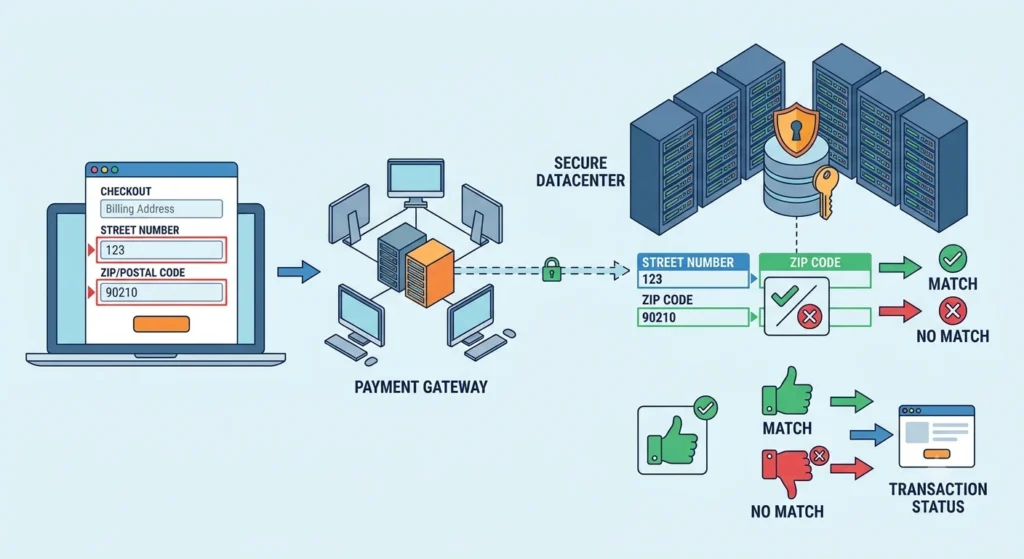
    Diagram illustrating how an online checkout address is verified through a payment gateway and secure datacenter to determine transaction status match.

    AVS stands for Address Verification Service (sometimes called Address Verification System). It’s a check that compares the numeric parts of the billing address you enter at checkout,  usually the street number and ZIP or postal code,  against the address the card issuer has on file for that account.

    2. How Address Verification Service works

    Here’s the path a payment actually takes, which most explanations skip over:

    Customer enters card details → Merchant’s checkout page → Payment gateway/processor → Card network (Visa, Mastercard, etc.) → Issuing bank → AVS response comes back → Gateway applies the merchant’s rules → Payment is approved, flagged for review, or declined.

    For a broader look at how payment processors work and what businesses should consider when choosing one, see our guide to payment processing options.

    The issuing bank is the one that actually runs the address check. It sends back a response code, and it’s the merchant’s payment gateway that decides what to do with that code. Two shoppers with the exact same “mismatch” can get completely different outcomes depending on which store they’re buying from, because each merchant sets its own risk tolerance.

    3. What information does AVS check?

    AVS typically only looks at:

    • The numeric portion of the street address (not the street name)
    • The ZIP or postal code

    It usually ignores things like apartment numbers, city, and state, which is part of why the system produces so many false mismatches. It’s a blunt tool, not a precise one.

    4. What does an AVS mismatch mean?

    An AVS mismatch means the numbers you entered didn’t match what the bank has on record. That’s it. It says nothing on its own about whether you’re the legitimate cardholder — it’s one data point that a merchant’s fraud system weighs alongside others.

    Does an AVS Mismatch Mean Your Card Was Declined?

    Not necessarily. This is where a lot of confusion comes from, because AVS results and payment declines aren’t the same thing.

    1. Why an AVS mismatch can cause a declined payment

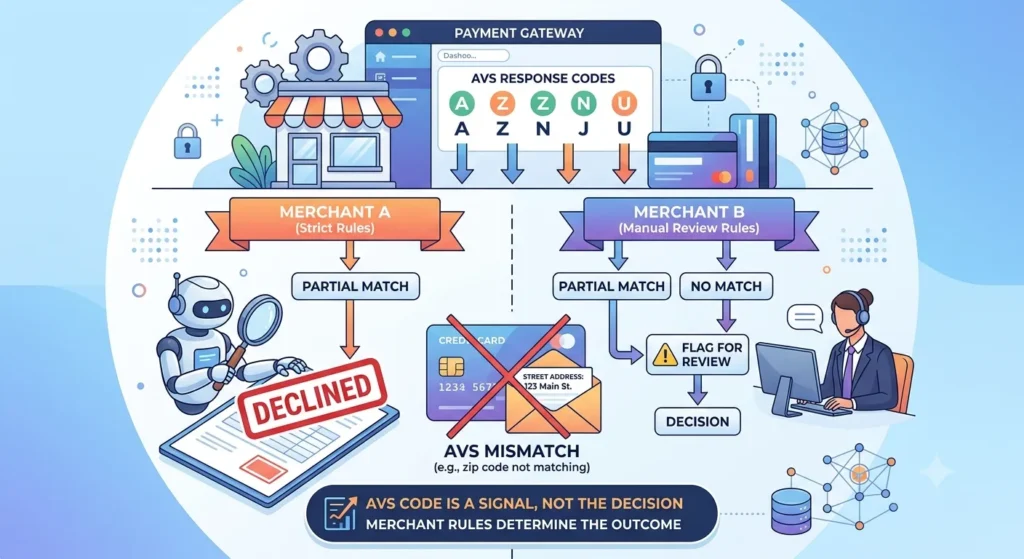
    A conceptual diagram showing how different merchants handle AVS mismatch codes, leading to either an automatic decline or a manual review.

    Some merchants set their systems to auto-decline any transaction with even a partial address mismatch. Others only decline a full “no match,” and treat a partial match as something to flag for manual review instead. The AVS code itself doesn’t decide anything — the merchant’s rules do.

    2. Can a payment succeed despite an AVS mismatch?

    Yes, and this happens more often than people expect. WooCommerce’s own documentation on Stripe payments notes that a charge can go through successfully even when AVS or CVC checks come back as a mismatch, because the issuing bank’s authorization decision and the AVS result are handled as separate signals. A merchant can choose to accept the charge anyway if other risk indicators look fine.

    3. Who actually decides whether to approve or decline?

    Four parties are involved, and it’s worth keeping them straight:

    1. The issuing bank generates the AVS response.
    2. The card network passes that response along.
    3. The payment gateway applies the merchant’s configured rules to it.
    4. The merchant ultimately owns the final call on how strict those rules are.

    If you’re a customer, this explains why the same billing info can work fine on one site and fail on another.

    Why Does an AVS Mismatch Happen?

    Most of the time it’s nothing sinister. Here are the usual suspects.

    Incorrect billing address. A typo in the street number is the single most common cause. Easy to do on a phone keyboard.

    Wrong ZIP or postal code. Even one digit off will trigger a mismatch, since AVS checks numbers exactly.

    Recently changed address. If you moved and updated your address with the postal service or your landlord, that doesn’t automatically update your bank’s records. Card issuers usually need you to contact them directly.

    Bank records haven’t been updated. Sometimes you did notify your bank, but their system hasn’t synced the change yet. This can take a billing cycle or two depending on the issuer.

    Address formatting differences. “123 Main St Apt 4” versus “123 Main Street #4” can occasionally trip up stricter AVS implementations, though this affects the street-name portion less than you’d think since AVS mostly checks numbers.

    Apartment, suite, or unit numbers. Ironically, since most AVS checks ignore unit numbers entirely, entering or omitting them usually isn’t the actual problem — but people often assume it is and waste time troubleshooting the wrong field.

    Browser autofill entered an old address. This one catches a lot of people. Autofill can silently pull in a saved address from years ago.

    International address formats. AVS was built around the US and, to a lesser degree, Canadian and UK address structures. Many other countries don’t have equivalent postal-code granularity, so AVS often can’t return a meaningful result at all.

    Prepaid and gift cards. These frequently aren’t linked to a verified billing address in the issuer’s system, so AVS checks on them are unreliable by design.

    Corporate and business cards. Company cards are sometimes registered to a corporate office address rather than the employee’s own address, which trips up AVS if the employee enters their personal details.

    Recurring or card-on-file payments. If you update your address with the merchant but not with your bank (or vice versa), a subscription renewal can suddenly start failing AVS even though nothing about the card changed.

    How to Fix an AVS Mismatch as a Customer

    If your payment just got flagged, work through these in order.

    1. Check your billing address. Compare it character by character against your card statement, not against what you assume it should be.
    2. Verify your ZIP or postal code. This is the single field most likely to be wrong.
    3. Match your bank’s records exactly. If you moved recently, your bank’s file may still show the old address, use that one at checkout, not your new one, until you’ve formally updated it with them.
    4. Turn off outdated browser autofill. Clear the saved address and type it fresh.
    5. Retry the payment. A simple retry with corrected info resolves most cases.
    6. Contact your card issuer. If everything you’re entering is genuinely correct, call the number on the back of your card and ask them to confirm what address is on file.
    7. Try another payment method. PayPal, a different card, or bank transfer can get you unstuck while you sort out the address issue.

    When to contact the merchant: if the payment keeps failing after you’ve confirmed the address is correct, or if you were charged despite the decline message.

    When to contact your bank: if you suspect your address on file is outdated, or if you don’t recognize why AVS would be failing at all.

    What Happens to Your Money After an AVS Decline?

    This is usually the most urgent question, so let’s deal with it directly.

    1. Authorization hold vs. completed charge

    A card payment isn’t one single event,  it’s typically an authorization first, then a separate capture. An AVS-related decline usually happens at the authorization stage, before any money actually moves. What you often see is a temporary hold, not a completed charge.

    2. Why a declined payment may show as pending

    Banks place a hold to check whether funds are available, and that hold can appear on your account or app before the transaction is fully resolved. Even if the transaction is ultimately declined, the hold can take a little while to clear from your visible balance.

    3. How long can the hold take to disappear?

    There’s no single universal number here, and any article that gives you one is guessing. Support documentation from Authorize.net-based platforms, such as 4aGoodCause’s help center, mentions holds typically clearing within a few business days on their setup — but the actual timeframe depends on your specific bank and the merchant’s processor, so treat any figure you read as a rough guide, not a guarantee.

    4. What to do if the money hasn’t been released

    If a hold is still sitting on your account well past what your bank considers normal, call your bank directly. They can see the authorization on their end and tell you the expected release date, which the merchant usually can’t do for you.

    AVS Response Codes Explained

    Card issuers return a short response code alongside the AVS check. Here’s the catch worth flagging up front: these codes aren’t fully standardized. Meanings can shift slightly depending on the card network and processor, so treat the table below as a general guide rather than gospel.

    CodeMatch resultWhat it generally meansSuggested action
    YFull matchStreet number and ZIP both matchApprove
    XFull matchExact match including extended ZIPApprove
    APartial matchStreet number matches, ZIP doesn’tReview
    ZPartial matchZIP matches, street number doesn’tReview
    NNo matchNeither street number nor ZIP matchesDecline or review
    RRetrySystem couldn’t process the checkRetry the request
    UUnavailableIssuer doesn’t support AVSRely on other checks
    GInternational issuerNon-US card, AVS not supportedUse alternative verification

    If you’re a developer working with a specific processor, check that processor’s own documentation for the exact codes they return. Stripe, for example, publishes its own address-verification explanation with its specific code set — worth a direct read if you’re troubleshooting a Stripe integration.

    AVS Mismatch vs. Other Payment Verification Checks

    AVS is one piece of a bigger fraud-prevention puzzle, not the whole thing. Businesses should also consider broader Data Privacy and Compliance and data-protection practices when handling customer transactions.

    Security checkPrimarily verifies
    AVSBilling address (street number + ZIP)
    CVV/CVCThe 3-4 digit code proving you physically hold the card
    3D SecureCardholder identity, often via a bank app prompt or SMS code
    IP/geolocationWhether the transaction location looks consistent with the cardholder

    AVS and CVV get confused constantly because they often fail together, but they check completely different things. AVS looks at where you supposedly live. CVV checks whether you’re holding the physical card. A stolen card number without the physical card can pass AVS (if the thief has your address) but fail CVV.

    AVS Mismatch Doesn’t Always Mean Fraud

    Three diverse, legitimate credit card users—a traveler with luggage, a business professional, and an international traveler—looking at their smartphones with subtle red error icons floating nearby, representing false payment declines without using any text.

    This is worth stating plainly: a failed AVS check is not proof of fraud, and a passed AVS check is not proof of a legitimate transaction.

    1. Why legitimate customers fail AVS

    Someone who just moved, someone using a company card, someone paying from abroad, none of these people are doing anything wrong, yet all three are likely to trip AVS.

    2. Why fraudulent transactions can still pass AVS

    If a fraudster has stolen someone’s card details along with their billing address (which happens constantly in data breaches), AVS will return a full match. The check only confirms the address matches records,  it says nothing about who’s actually typing it in.

    3. Why AVS should be one part of a fraud-prevention strategy

    Relying on AVS alone means blocking real customers while letting through fraud committed by anyone with stolen address data. A stronger setup layers AVS with CVV checks, 3D Secure, device fingerprinting, and velocity checks (flagging unusual numbers of attempts in a short window).

    Payment security discussions on r/ecommerce and similar communities frequently make this same point from the merchant side, AVS alone is a weak filter, and treating it as a hard gate tends to cost more in lost sales than it saves in blocked fraud.

    How Merchants Should Handle AVS Mismatches

    If you’re running the checkout rather than clicking through it, here’s the practical framework. For a broader look at improving ecommerce websites, checkout experiences, and search visibility, see our Ecommerce SEO Checklist.

    Don’t automatically decline every mismatch. A blanket “decline on any AVS issue” rule is the single biggest cause of false declines, and false declines cost you real revenue from real customers.

    Build risk-based rules instead of all-or-nothing ones. Full matches auto-approve. Partial matches go to manual review or get combined with a CVV check before deciding. Full no-matches get declined or heavily scrutinized, especially on high-value orders.

    Write customer-friendly decline messages. “Your payment couldn’t be processed, please verify your billing address matches your card statement” is more useful, and generates fewer support tickets, than a generic “transaction declined.”

    Offer an alternative payment method at the point of failure. If AVS keeps blocking a genuine customer, letting them switch to PayPal or another method on the spot saves the sale.

    How to Reduce False AVS Declines

    A few concrete things merchants can do beyond adjusting the AVS threshold itself:

    • Validate addresses at the point of entry (before submitting for authorization), using an address-autocomplete service, so typos get caught before they ever reach the payment processor.
    • Keep billing and shipping address fields clearly separate in your checkout form, conflating them is a common source of mismatches.
    • Build a separate, more lenient rule set for international customers, since AVS coverage outside the US is inconsistent at best.
    • Treat prepaid and gift cards differently in your fraud rules, since AVS on these is inherently unreliable.
    • Use network tokenization for recurring billing so a customer’s expired or reissued card doesn’t silently break both the charge and the AVS check at once.
    • Combine AVS with CVV and 3D Secure rather than leaning on AVS by itself.
    • Track your approval rate against your false-decline rate over time,  if declines are climbing without a corresponding drop in chargebacks, your AVS rules are probably too strict.

    AVS Problems With International Payments

    AVS was designed around the US postal system, and it shows.

    Canada has a workable but different postal-code format, so match rates there are decent but not identical to the US. The UK’s alphanumeric postcodes work reasonably well with most implementations.

    Beyond those three countries, though, AVS support drops off fast, many national card networks and issuing banks simply don’t return a usable AVS response, which is where you’ll see code U (unavailable) or G (international issuer, unsupported) show up.

    For merchants selling internationally, this means leaning more heavily on CVV and 3D Secure for non-US, non-Canada, non-UK customers, since AVS isn’t giving you much signal to work with there anyway.

    AVS Mismatch by Payment Scenario

    The same underlying check plays out differently depending on what you’re buying.

    Ecommerce purchases are the classic case, AVS runs once, at checkout, against a billing address the shopper enters fresh.

    Subscriptions and recurring billing are trickier, since the address check that passed on day one can start failing months later if the cardholder moves or the card gets reissued, without the subscriber realizing why their renewal suddenly bounced.

    Travel and hospitality bookings often involve cards from a different country than where the purchase is being made, which is exactly the scenario where AVS is weakest.

    Restaurants and delivery apps sometimes see mismatches simply because the customer is ordering to a work address or a friend’s place rather than their own billing address,  a shipping-address mismatch, not a real problem.

    B2B and corporate cards frequently fail AVS because the card is registered to a company office rather than the individual making the purchase.

    Donations and nonprofit payments tend to be one-off, often from first-time donors on unfamiliar devices, which is part of why organizations like 4aGoodCause see enough AVS-related holds to publish dedicated help documentation on the topic.

    What Does “Gateway Rejected: AVS” Mean?

    If you’re a merchant and you see this specific message in your payment logs, it means the bank’s AVS response came back fine (or the issuer didn’t even flag it), but your own gateway’s configured filter rejected the transaction anyway based on rules you or your platform set.

    This is a configuration issue on your end, not a bank-level decline. Check your gateway’s AVS filter settings (most platforms, including Authorize.net and Stripe, let you adjust exactly which AVS codes trigger a rejection) and loosen them if you’re seeing this too often on transactions that otherwise look legitimate.

    Can You Disable or Bypass AVS?

    Can customers bypass AVS? No, this isn’t something a shopper controls. If your payment fails AVS, your only real options are the fixes covered earlier in this guide.

    Can merchants ignore an AVS mismatch? Yes, technically. Most gateways let merchants turn AVS checking off entirely or set it to advisory-only, where a mismatch is logged but never blocks the sale.

    Why disabling strict AVS rules can increase risk. Turning AVS off completely removes one layer of fraud screening, which can increase chargeback exposure, especially for merchants in card-not-present categories that carry higher fraud rates by default.

    Better alternatives to completely disabling AVS. Loosen the rules instead of removing them, auto-approve partial matches paired with a passing CVV check, for instance, rather than switching AVS off altogether.

    AVS Mismatch Troubleshooting Checklist

    Customer checklist

    • Billing address matches bank records exactly
    • ZIP or postal code is correct
    • No outdated autofill data
    • Recent address changes have been reported to the bank
    • Payment has been retried after corrections
    • Card issuer has been contacted if the address is confirmed correct
    • Alternative payment method tried if needed

    Merchant checklist

    • AVS response code reviewed for the failed transaction
    • Gateway-level AVS filter settings checked
    • Processor-level AVS configuration checked
    • Additional fraud signals (CVV, 3DS, velocity) reviewed alongside AVS
    • International customer status considered before declining
    • False-decline rate monitored over time
    • Rule changes tested before rolling out broadly
    • Approval rate tracked after any rule adjustment

    Frequently Asked Questions About AVS Mismatch

    What does AVS mismatch mean? 

    It means the billing address entered at checkout doesn’t match the address the card issuer has on file, based on the street number and ZIP/postal code.

    How do I fix an AVS mismatch? 

    Double-check your billing address and ZIP code against your card statement, clear outdated autofill data, and retry the payment. If it still fails, contact your card issuer to confirm what address they have on record.

    Why does AVS fail when my address is correct? 

    Usually because your bank’s records haven’t been updated yet, even if you’ve moved and updated your address elsewhere. Use the address your bank has on file, not your new one, until the bank confirms the update.

    Does an AVS mismatch mean fraud? 

    No. It’s one risk signal among several, and plenty of legitimate transactions fail AVS for mundane reasons like a recent move or an international card.

    Does an AVS mismatch mean my card was declined? 

    Not always. Some merchants decline on any mismatch, others only flag partial matches for review and still approve the charge.

    Will an AVS decline charge my card? 

    Usually not a completed charge,  more often a temporary authorization hold that clears on its own within a few business days, though the exact timing depends on your bank.

    Conclusion

    An AVS mismatch means the billing information you submitted doesn’t match the information your card issuer has on file, nothing more, nothing less. It doesn’t automatically mean fraud, and it doesn’t necessarily mean your payment can’t go through. 

    Sometimes the mismatch is caused by something as simple as an outdated address, a missing apartment number, or entering a ZIP code that differs from the one linked to your card.

    If you’re a customer, double-check your billing address and ZIP code against your bank or card statement before assuming something is seriously wrong.

    If the information is correct and the payment still fails, contacting your card issuer or trying another payment method may help.

    If you’re a merchant, treat an AVS mismatch as one risk signal among several rather than an automatic yes-or-no decision. A mismatch can be worth investigating, especially when combined with other warning signs, but blocking every transaction with an AVS mismatch can also reject legitimate customers. 

    The goal is to balance fraud prevention with a smooth checkout experience, so your AVS rules should fit your overall risk strategy rather than acting as the only line of defense.

  • Will AI Replace Accountants? What the Future of Accounting Actually Looks Like

    Will AI Replace Accountants? What the Future of Accounting Actually Looks Like

    AI is not going to eliminate accountants as a profession. But it is already automating a growing share of the routine work that used to fill an accountant’s day. That shift is the real story, and it’s more interesting than a simple yes-or-no answer.

    The short version: AI is much better at replacing accounting tasks than it is at replacing the accountant who reviews, interprets, and takes responsibility for the results. Data entry, reconciliation, and basic reporting are already being automated at scale. 

    Judgment, tax strategy, audit sign-off, and client advice are not,  at least not yet, and arguably not for a long time.

    If you’re asking whether AI will replace accountants, the honest answer has two parts: some accounting jobs will shrink, and the accountant’s role will change substantially. Neither of those things means the profession disappears.

    Will AI Replace Accountants? The Short Answer

    No, not the profession as a whole. AI is automating specific tasks inside accounting (data entry, categorization, reconciliation, first-draft reporting), but it can’t yet take on professional judgment, regulatory accountability, or client trust. Those are still human jobs, and they’re likely to stay that way for the foreseeable future.

    That said, this isn’t a comforting “nothing will change” answer either. Routine, entry-level accounting work is genuinely exposed to automation, and firms are already restructuring around that fact.

    AI is replacing tasks, not the whole job

    An accountant sitting at a desk in a modern, open-plan office, engaged in a face-to-face strategic conversation with two clients. On her desk are financial charts and paper documents, while dual computer monitors in the background display automated AI dashboards showing data analytics, transaction categorization, and progress graphs.

    Every accounting role is really a bundle of tasks. Some of those tasks, matching invoices, categorizing transactions, flagging duplicate payments, are repetitive and rule-based, which is exactly what AI is good at.

    Other tasks, deciding how to treat an ambiguous transaction, explaining a tax position to a client, signing off on an audit opinion, require context, accountability, and judgment that current AI systems don’t have.

    When people say “AI will replace accountants,” they’re usually picturing the first bucket of tasks disappearing. What actually happens is that those tasks get automated, and the accountant’s job shifts toward the second bucket.

    Why the answer isn’t a flat “no”

    It would be easy to write a reassuring article that just says accountants are safe. That wouldn’t be accurate. Bookkeeping-heavy and entry-level roles are already shrinking at some firms as AI tools take over reconciliation and data entry. The profession isn’t vanishing, but the shape of it is changing, and some jobs really are at risk.

    Why People Think AI Will Replace Accountants

    A few things make this question feel more urgent than it did five years ago.

    Accounting has always had a large share of repetitive, rules-based work,  the kind of work that’s easy to describe as “if X happens, do Y.” That makes it a natural target for automation, and software vendors have been chipping away at it for over a decade with optical character recognition, robotic process automation, and now generative AI.

    Generative AI adds a new layer on top of that. It can draft financial summaries, write memo-style explanations of variances, and answer plain-English questions about a dataset, things that used to require a person sitting down and writing. That’s a bigger leap than older automation tools, which could only follow fixed rules.

    Entry-level accounting work is particularly exposed because it’s disproportionately made up of the tasks AI handles well: data entry, basic reconciliation, and first-pass categorization. That’s the part of the job most likely to shrink first.

    What Accounting Tasks Can AI Automate?

    A split-concept workspace depicting the division between automated accounting and human advisory. On the left, robotic arms and glowing futuristic holographic interfaces process receipts, sort digital documents, and handle repetitive data entry. On the right, a female accountant sits at a conference desk, actively reviewing papers and consulting in-person with two male corporate clients in a modern high-rise office.

    Here’s a practical breakdown of where AI is strong, where it’s a useful assistant, and where it still needs heavy human oversight.

    Accounting taskAI automation potentialHuman involvement needed
    Data entryVery highLow — spot checks
    Invoice processingVery highException handling
    Transaction categorizationHighReview edge cases
    Bank reconciliationHighInvestigate mismatches
    Expense managementHighApprove exceptions
    Financial reporting (first draft)MediumHigh — interpretation
    Cash-flow forecastingMediumHigh — assumptions and judgment
    Tax researchMediumHigh — application to facts
    Tax strategyLow to mediumVery high
    Audit judgmentLow to mediumVery high
    Client advisoryLowVery high
    Strategic planningLowVery high

    A useful way to think about this: AI is strongest on tasks with clear rules and lots of historical data to learn from. AI-powered accounting software can automate areas such as invoice processing, expense categorization, forecasting, and reconciliation. It’s weakest on tasks that require weighing incomplete information, understanding a client’s specific situation, or taking legal responsibility for a conclusion.

    What AI Cannot Easily Replace in Accounting

    Several parts of the job don’t reduce to pattern matching, no matter how good the underlying model gets.

    Professional judgment. Deciding how to classify an unusual transaction, or whether a client’s revenue recognition approach is defensible, involves weighing facts against principles,  not just matching a pattern to prior examples.

    Regulatory and compliance decisions. Tax law and accounting standards change constantly and are applied to messy, specific situations. An accountant has to interpret intent, not just text.

    Audit accountability. An audit opinion carries legal and professional weight. Software can flag anomalies, but it can’t stand behind a sign-off the way a licensed auditor does.

    Client relationships. Clients bring accountants problems that don’t come pre-labeled,  a business decision, a family situation, an unexpected tax notice. That conversation is still a human one.

    Ambiguous or unusual transactions. AI models are trained on patterns in historical data. When something genuinely new comes up, a human has to figure out how to treat it.

    AI vs. Accountant: Who Does What?

    Business executives collaborating at a conference table alongside robotic arms processing paperwork in a modern high-rise office
    ResponsibilityAIAccountant
    Process routine transactionsDoes the workReviews exceptions
    Categorize expensesDoes the workReviews edge cases
    Detect anomaliesFlags themInvestigates and decides
    Draft reportsProduces first draftInterprets and finalizes
    Forecast scenariosAssists with modelingDecides which scenario to plan around
    Interpret regulationsAssists with researchMakes the call
    Handle complex tax issuesAssists with researchLeads
    Advise managementSupports with dataLeads the conversation
    Take professional responsibilityNoYes

    That last row is the one that matters most. Software doesn’t carry a license, sign an audit opinion, or represent a client in front of the IRS. A person does.

    Will AI Replace Accounting Jobs, or Reshape Them?

    This is where the employment data gets genuinely interesting, because two respected sources appear to disagree.

    1. What the U.S. employment data says

    The U.S. Bureau of Labor Statistics projects roughly 5% employment growth for accountants and auditors from 2025 to 2035, with about 115,300 average annual openings over that period, driven mostly by the need to replace workers who retire or change occupations 

    2. Why the World Economic Forum paints a different picture

    The World Economic Forum’s Future of Jobs Report 2025 lists accountants and auditors among the roles expected to decline globally through 2030, as part of a broader shift toward AI-augmented finance functions (WEF Future of Jobs Report 2025).

    3. Why both can be true at once

    These two projections aren’t actually measuring the same thing. The BLS figure is a U.S.-specific projection built largely around replacement demand, people retiring or leaving the field,  plus modest net growth.

    The WEF figure is a global survey of employer sentiment about which roles they expect to shrink as they adopt AI, which captures a different signal: employer intent to reduce headcount in routine roles, not total labor market openings.

    Put together, a reasonable read is this: routine accounting labor is likely to shrink as a share of total accounting work, while the overall number of accounting positions in the U.S. keeps growing slowly, largely through replacement hiring and demand for higher-value skills.

    Global employer sentiment and U.S. labor projections just aren’t the same measurement, and treating them as contradictory misses that distinction.

    4. Task automation vs. job elimination

    It helps to separate two different things: a task being automated, and a job disappearing. When AI automates a task, the person doing that job usually absorbs new responsibilities rather than losing the job outright, assuming they adapt.

    Where jobs genuinely disappear is when a role is made up almost entirely of automatable tasks, which describes some junior processing roles more than it describes accounting as a whole.

    Which Accounting Jobs Are Most Vulnerable to AI?

    Some roles carry more automation risk than others, mostly because of how task-heavy they are in the automatable column above.

    • Bookkeeping and data-entry-heavy positions
    • Accounts payable processing roles
    • Accounts receivable processing roles
    • Payroll processing
    • Junior reconciliation work
    • Routine, high-volume tax preparation
    • Basic, templated reporting roles

    These aren’t roles that vanish overnight. But the headcount needed to do them is likely to shrink as software takes on more of the volume.

    Which Accounting Roles Are More Resistant to AI?

    • CPAs and other licensed professionals
    • Tax advisors handling complex or ambiguous situations
    • Forensic accountants
    • Internal auditors
    • Management accountants
    • Financial analysts
    • Advisory-focused accountants
    • Controllers and finance leaders

    “Resistant” doesn’t mean untouched. Every one of these roles will use AI tools daily within a few years, if they don’t already. It means the core of the job, judgment, accountability, and relationships,  is harder to automate.

    Will AI Replace CPAs?

    CPA work is different from general accounting work in one important way: professional accountability. A CPA doesn’t just produce a number, they stand behind it, professionally and sometimes legally.

    Tax representation is a good example. The IRS specifically grants CPAs, attorneys, and enrolled agents unlimited representation rights before the agency, meaning they can represent a client on any tax matter, in front of any IRS office (IRS: Understanding tax return preparer credentials). That’s a legal status a piece of software cannot hold.

    AI can still do a lot for a CPA: research, first-draft analysis, document review, and tax preparation support. But the license, the sign-off, and the liability stay with the person. The realistic future is an AI-enabled CPA, not an AI replacement for one.

    Will AI Replace Entry-Level Accountants?

    This is arguably the most important question for anyone currently studying accounting or early in their career, and it deserves a straight answer: entry-level accounting work is genuinely exposed, more than any other tier of the profession.

    Junior accountants have traditionally learned the job by doing the “grunt work”,  data entry, basic reconciliations, and manual checking. That work is disappearing fastest, which creates a real problem: if AI does the repetitive tasks that used to teach new accountants how the numbers connect, how do future accountants build that judgment in the first place?

    There’s no clean answer yet. Firms that are ahead on this are restructuring junior roles around reviewing AI output, investigating exceptions, and working directly on client-facing analysis earlier than before,  essentially compressing the learning curve rather than removing it. 

    New accountants entering the field should expect fewer pure data-entry roles and more emphasis on being able to read, question, and correct AI output from day one.

    How AI Is Changing an Accountant’s Day-to-Day Work

    AI is changing accounting less by removing the accountant from the process and more by changing where the accountant spends their time.

    Work that once required hours of manual processing can increasingly be handled or accelerated by AI, allowing accountants to focus on reviewing information, solving problems, and helping clients or businesses make better decisions.

    Before AI: an accountant might spend much of the day entering transactions, reconciling accounts, preparing reports, checking figures manually, and communicating with clients once the numbers were finalized.

    With AI in the workflow: the process can look very different. AI can assist with data capture and transaction classification, identify unusual entries, match records, summarize financial information, and prepare initial reports.

    The accountant then reviews exceptions, checks the accuracy of the output, interprets what the numbers actually mean, explores different scenarios, and uses those insights in advisory conversations and business decisions.

    This means accountants can become involved earlier and more often in the decision-making process, rather than being brought in only after the financial work is complete.

    For example, instead of simply producing a monthly cash-flow report, an accountant may use AI-assisted analysis to identify a potential cash shortage, model different scenarios, and recommend actions before the problem becomes serious.

    As this shift continues, some skills become more valuable than others. Professional judgment, communication, business understanding, technology fluency, analytical thinking, and risk management become increasingly important because these are the areas where context and human oversight matter most.

    Meanwhile, tasks that are primarily about processing large amounts of repetitive information quickly and accurately become less differentiated. Data entry, basic reconciliation, routine categorization, and standardized reporting can increasingly be automated or accelerated.

    The result is not an accountant-free workflow. It is an AI-assisted accounting workflow in which the accountant moves from being primarily a processor of financial information to an interpreter, reviewer, advisor, and decision-support professional.

    How AI Can Make Accountants More Productive

    There’s decent evidence this isn’t just theory. Research highlighted by Stanford Graduate School of Business found that AI tools helped accountants close books faster and handle more clients, by taking over the “boring” repetitive parts of the job and freeing up time for review and analysis.

    In practice, that shows up as: faster bookkeeping cycles, quicker month-end close, more clients supported per accountant, better anomaly detection across large transaction volumes, and more time actually spent advising clients instead of processing their data.

    The right best accounting software for analytics can extend these benefits by helping accountants turn financial data into clearer trends, insights, and decisions.

    The Risks of Using AI in Accounting

    None of this works if firms treat AI output as automatically correct. Accounting is a high-stakes environment, and a few risks deserve honest treatment.

    AI models can produce confident-sounding but wrong answers, a known limitation often called hallucination.

    In accounting, that might mean misclassifying a transaction, misapplying a tax rule, or generating a plausible-sounding but incorrect explanation of a variance. Intuit’s own guidance on AI in accounting flags exactly this kind of limitation, along with the need for human oversight and awareness of potential bias in AI outputs.

    Other real risks include data privacy exposure when financial information is fed into third-party AI tools, regulatory and compliance gaps if AI-generated output isn’t properly reviewed, and simple overreliance,  a junior team member trusting AI output without knowing enough to spot when it’s wrong. Human-in-the-loop review isn’t optional here; it’s the whole safety mechanism.

    What Skills Will Accountants Need in the AI Era?

    • AI literacy, understanding what these tools are good and bad at
    • Data analysis and interpretation
    • Financial modeling
    • Tax and regulatory expertise
    • Professional judgment
    • Clear communication, especially explaining numbers to non-accountants
    • Strategic and business thinking
    • Advisory skills
    • Familiarity with accounting-specific AI tools and platforms

    Accounting knowledge is still the foundation. AI skills are the multiplier on top of it, not a replacement for it. Strong Business Data Analytics skills can further strengthen that combination by helping accountants interpret financial data, identify trends, and turn numbers into actionable business insights.

    How Accountants Can Prepare for AI

    1. Learn how the AI tools in your accounting software actually work, including their limitations.
    2. Get hands-on with AI-enabled platforms rather than avoiding them.
    3. Use automation for repetitive tasks so you have time for higher-value work.
    4. Build the habit of reviewing AI output critically instead of accepting it by default.
    5. Keep deepening your core accounting and tax expertise,  it’s still what makes the review meaningful.
    6. Develop advisory and client-communication skills.
    7. Build data literacy so you can question and interpret what AI produces.
    8. Stay current on regulatory and professional standards, since AI tools don’t take responsibility for compliance.

    There’s an active discussion of exactly these adjustments happening among practitioners on forums like r/Accounting on Reddit and in professional groups on LinkedIn, where working accountants are sharing what’s actually changing at their firms,  worth reading alongside any single article, including this one.

    What Will the Accountant of 2030 Look Like?

    Less data entry. More exception management. More analysis and interpretation. More direct client interaction. More strategic decision support. And a growing responsibility for overseeing AI output rather than producing every number by hand.

    A useful shorthand: the accountant becomes the trust layer between AI-generated financial data and the decisions people make based on it.

    AI vs. Automation: Why the Difference Matters

    These terms get used interchangeably, but they’re not the same thing, and the distinction matters for understanding where accounting is headed.

    Traditional accounting automation follows fixed rules,  if a transaction matches a pattern, apply a fixed treatment. Machine learning goes a step further, learning patterns from historical data rather than following hard-coded rules.

    Generative AI, the technology behind tools like ChatGPT and Claude, can produce novel text and analysis rather than just classifying data (Generative artificial intelligence).

    Agentic AI takes this further by chaining tasks together with less human input at each step, and “autonomous finance” describes the (still largely aspirational) end state where financial processes run with minimal human intervention.

    Accounting today sits somewhere between the first and third of these. Full autonomy in high-stakes financial work is not close.

    Is Accounting Still a Good Career in the Age of AI?

    Yes, but with an important caveat. Accounting expertise combined with AI fluency is becoming a much stronger career position than accounting expertise alone.

    AI is making many repetitive accounting tasks faster and easier to automate, so roles built primarily around data entry, basic reconciliation, transaction processing, or routine reporting may face more pressure than they did in the past.

    That does not make accounting a poor career choice. It means the skills that create value are changing. Accountants who understand financial principles, regulations, business operations, and professional judgment while also knowing how to use AI tools can work more efficiently and take on higher-value responsibilities.

    Instead of spending most of their time processing information, they can spend more time interpreting it, identifying risks, explaining financial results, and helping businesses make decisions.

    Some career paths are particularly well positioned for this shift. Advisory services, tax specialization, forensic accounting, audit leadership, financial analysis, and controller-track roles all rely heavily on judgment, context, communication, and accountability.

    AI can support professionals in these areas, but it does not remove the need for someone who can evaluate the output and understand the consequences of acting on it.

    There is also an important change happening at the entry level. New accountants may encounter fewer traditional “grunt work” tasks because AI can handle more routine processing.

    That could make the early career path look different from what previous generations experienced. At the same time, it creates an opportunity for new accountants to develop analytical, technological, and advisory skills earlier.

    So, anyone considering accounting should not be discouraged by AI headlines. Accounting is still a viable career, but the safest path is not to compete with AI at repetitive tasks.

    It is to become the person who knows how to use AI, verify its work, apply accounting judgment, and turn financial information into useful business decisions. AI fluency should increasingly be treated as a core accounting skill rather than an optional extra.

    Frequently Asked Questions About AI and Accounting

    Will AI completely replace accountants? 

    No. AI automates specific tasks within accounting, but professional judgment, regulatory accountability, and client relationships remain human responsibilities.

    Will AI replace CPAs? 

    Unlikely. CPAs hold legal representation rights and professional accountability that software cannot take on, though CPAs will increasingly use AI tools for research and drafting.

    Will AI replace bookkeepers? 

    Bookkeeping is one of the most exposed roles, since much of the work is repetitive data entry and categorization. Bookkeepers who move toward review, oversight, and client communication are better positioned.

    Will accounting jobs disappear? 

    Some routine, entry-level roles will shrink. Overall accounting employment in the U.S. is still projected to grow modestly, according to BLS data.

    What accounting tasks are most likely to be automated? 

    Data entry, invoice processing, transaction categorization, bank reconciliation, and first-draft reporting.

    Conclusion

    AI will replace some accounting tasks, reduce demand for certain routine roles, and change the accounting career path more than many people expect.

    Repetitive work such as data entry, transaction categorization, invoice processing, reconciliation, and basic reporting is increasingly suited to automation.

    That means accountants may spend less time processing numbers manually and more time reviewing results, investigating exceptions, interpreting financial information, managing risk, and advising clients or businesses.

    What the evidence does not support is the idea that accountants as a profession are simply disappearing. Accounting still depends on human judgment, regulatory knowledge, professional responsibility, communication, and the ability to understand the business context behind the numbers.

    AI can generate analysis and identify patterns, but someone still needs to verify the information, understand its implications, and take responsibility for important financial decisions.

    The bigger shift is therefore from doing every accounting task manually to managing and interpreting AI-assisted financial work.

    Accountants who learn how to use AI effectively can become more productive and focus on higher-value responsibilities, while those who rely only on traditional, repetitive workflows may face greater pressure.

    The biggest risk isn’t AI replacing accountants. It’s accountants who know how to use AI replacing accountants who don’t.

  • How to Scale a Marketplace Business: A Practical Growth Strategy

    How to Scale a Marketplace Business: A Practical Growth Strategy

    Scaling a marketplace business isn’t the same as scaling a normal online store or a SaaS product. When you grow an ecommerce brand, you’re mostly solving one problem: get more people to buy. A marketplace has two customers to satisfy at once, buyers and sellers,  and growth on one side without the other just breaks things.

    Add more buyers without enough sellers, and people show up to an empty shelf. Add more sellers without enough buyers, and your best sellers leave for somewhere they can actually make sales. This is why so many marketplace founders hit a wall: they treat “scale” as a traffic problem when it’s really a balance problem.

    The short answer: scale a marketplace by first proving liquidity and unit economics, then strengthening whichever side of the marketplace is holding you back, building acquisition channels you can repeat, and expanding into new locations, categories, or customer segments one at a time, not all at once.

    The rest of this guide walks through that process step by step, from figuring out if you’re actually ready to grow, to picking your next market, to the operational and trust systems that keep a bigger marketplace from falling apart.

    What Does It Mean to Scale a Marketplace Business?

    Scaling means growing transactions, revenue, and reach without losing the thing that made the marketplace work in the first place: a reliable match between buyers and sellers.

    1. Marketplace scaling vs. ordinary e commerce growth

    E-commerce store compared with a two-sided marketplace connecting buyers and sellers.

    An e commerce store scales by increasing traffic and conversion rate. A marketplace has to grow supply and demand together, in roughly the right proportion, or the whole thing gets worse instead of better. More listings with no buyers is just clutter. More buyers with no listings is a bounce rate problem.

    2. Why two-sided marketplaces are harder to scale

    Every growth decision touches two different groups with different motivations. A pricing change that pleases buyers might push sellers out.

    A push to add sellers fast might dilute quality and scare buyers away. You’re not managing one funnel,  you’re managing two, and they depend on each other.

    3. The marketplace flywheel

    Most healthy marketplaces run on a loop like this: more supply leads to better selection, better selection brings in more demand, more demand creates more transactions, more transactions attract more sellers, and the cycle repeats.

    Scaling well means putting your energy into whichever part of that loop is currently weakest, rather than pushing marketing spend into a system that isn’t ready to absorb it.

    When Is a Marketplace Ready to Scale?

    This is the question most articles skip, and it’s the one that matters most. Traffic growth doesn’t mean you’re ready to scale, it just means more people are looking.

    Readiness is about whether your marketplace can actually deliver on what those people are looking for.

    1. You have repeatable transactions

    If most of your transactions come from one-off pushes, a founder emailing their network, a discount code, a press mention, you don’t have a repeatable engine yet. You have a series of favors.

    2. Supply and demand are sufficiently liquid

    Liquidity means a reasonable share of buyer requests actually turn into completed transactions, and a reasonable share of listings actually get bought or booked. If most searches come up empty, or most listings never sell, scaling will only multiply the frustration.

    3. Sellers are staying active

    Sellers who list once and disappear are a warning sign, not a growth number. Active, returning sellers are what make a marketplace feel alive to buyers.

    4. Buyers are returning

    New buyer acquisition is expensive. If people transact once and never come back, you’re running a leaky bucket, and pouring more traffic in just means pouring more out.

    5. Unit economics are becoming predictable

    You should have a rough, working sense of what it costs to acquire a buyer or seller and what they’re worth over time. “We’ll figure out the economics once we’re bigger” is how marketplaces run out of money while growing.

    6. Operations can handle higher volume

    If your support inbox, dispute resolution, or seller onboarding is already stretched thin at your current volume, doubling that volume won’t just be uncomfortable, it can break the trust you’ve built.

    7. Trust and quality systems are working

    Reviews, verification, and dispute handling need to be functioning before you scale, not bolted on after problems show up at a larger scale.

    8. Marketplace scale-readiness checklist

    Before pushing hard on growth, check these:

    • Transactions happen weekly without manual intervention
    • A meaningful share of searches or requests result in a transaction
    • Sellers who join are still active after 60–90 days
    • A meaningful share of buyers make a second purchase
    • You know your rough CAC and LTV for both sides
    • Support and operations aren’t already at capacity
    • Reviews, verification, and dispute processes exist and work
    • You’ve identified which side (supply or demand) is currently the constraint

    If most of these are shaky, the priority is fixing the core marketplace, not adding fuel to it.

    Solve the Marketplace Chicken-and-Egg Problem First

    1. What is the chicken-and-egg problem?

    Buyers won’t come without good selection, and sellers won’t join without buyers. Every marketplace starts here, and it resurfaces every time you enter a new market or category,. it’s not a problem you solve once and forget.

    2. Should you grow supply or demand first?

    There’s no universal rule. It depends on your category. Research from Lenny Rachitsky’s interviews with marketplace operators found that many well-known marketplaces leaned heavily on building supply first, though a number of them were actually demand-constrained rather than supply-constrained (Lenny’s Newsletter).

    The point isn’t “supply always wins”,  it’s that you need to check which side is actually the bottleneck for your specific marketplace before deciding where to put your energy.

    3. How to identify your constrained side

    Use a simple diagnostic. If buyers search but don’t find enough relevant listings, you’re supply-constrained.

    If sellers have listings but aren’t getting transactions, you’re demand-constrained. Look at your own data,  search-to-result rates on one side, listing-to-sale rates on the other,  instead of guessing.

    4. When supply should come first

    Categories where selection and variety drive the decision,  rentals, freelance services, unique goods — usually need a critical mass of supply before demand will stick around.

    5. When demand should come first

    Categories with more standardized listings, or where sellers are professionals who’ll join as soon as there’s proven buyer interest, can sometimes justify demand-first growth.

    Sellers with existing sales channels are often willing to test a new platform if you can show them real buyer intent.

    6. How marketplaces approached the problem

    Airbnb famously grew supply by helping early hosts take better listing photos,  a manual, unscalable tactic that solved a very specific supply-quality problem before the company ever tried to scale demand. Uber launched city by city, deliberately seeding driver supply before marketing to riders in a new city.

    Etsy built its early growth around a community of independent sellers, which created selection before demand was pushed hard. These aren’t templates to copy directly,  they’re evidence that the right sequencing depends on the category, not a fixed playbook.

    Improve Marketplace Liquidity Before Expanding

    1. What is marketplace liquidity?

    Liquidity is how reliably a marketplace turns interest into a completed transaction. A search that returns good options and ends in a booking is liquid. A search that returns nothing relevant is not, no matter how much traffic you’re getting.

    2. Why liquidity matters more than raw traffic

    You can double your traffic and end up with the same number of transactions if liquidity doesn’t improve. Traffic without liquidity just means more disappointed visitors, which quietly raises your acquisition costs because fewer of them convert or come back.

    3. How to measure buyer liquidity

    Look at the share of buyer searches or requests that end in a completed transaction within a reasonable window. Business data analytics can help you identify these patterns and determine where buyers are dropping out of the marketplace.

    4. How to measure seller liquidity

    Look at the share of listings that get at least one transaction within a set period. A high number of dead listings,  things posted and never sold or booked, signals weak seller-side liquidity.

    5. How to reduce time-to-match

    Faster matching keeps both sides engaged. This might mean better search filters, automated matching, or simply having enough density of supply that buyers don’t have to wait.

    6. How to improve search-to-transaction conversion

    Look at where buyers drop off between searching and completing a transaction. Often it’s unclear pricing, too few relevant results, or friction in checkout, all fixable without adding a single new user.

    7. How to increase supply density

    Density matters more than total supply count. A marketplace with 10,000 sellers spread across 50 cities can feel emptier to a buyer than one with 500 sellers concentrated in a single city. Concentrate before you spread out.

    8. How to improve marketplace matching

    Better filters, smarter default sorting, and (where it makes sense) recommendation logic all help buyers find relevant listings faster, which directly improves conversion.

    Build a Strong Marketplace Foundation Before Scaling Acquisition

    Don’t scale acquisition faster than your marketplace can deliver value. If the core transaction experience is shaky, spending more on growth just means more people experiencing that shakiness,  and telling their friends about it.

    1. Improve search and discovery

    Buyers need to find relevant listings quickly. If your search results are noisy or your filters don’t match how people actually shop, fix that before buying more traffic.

    2. Optimize listing quality

    Clear photos, honest descriptions, and consistent pricing formats reduce buyer hesitation. This often matters more than adding more listings.

    3. Simplify transactions and checkout

    Every extra step in booking or purchasing is a place someone can abandon. Watch your funnel for drop-off points.

    4. Build seller onboarding

    A confusing onboarding process is often the real reason sellers “don’t stick around.” Make it fast to list something and start getting visibility.

    5. Create reliable payments and payouts

    Sellers need to trust that money will actually arrive, on time, without confusion. Marketplace-specific payment infrastructure,  split payments, escrow-style holds, scheduled payouts,  is core plumbing, not a nice-to-have.

    Sharetribe’s marketplace-building guide treats payments, seller verification, and payout systems as foundational rather than optional.

    6. Establish reviews and ratings

    Reviews reduce the trust gap for new buyers deciding whether to transact with an unfamiliar seller. Without them, every transaction feels riskier than it needs to.

    7. Build verification and moderation

    Basic identity or listing checks catch bad actors before they damage trust across the whole platform.

    8. Create dispute and refund processes

    Disputes will happen. What matters is whether there’s a clear, fair process, so one bad transaction doesn’t turn into a public trust problem.

    Prove Marketplace Unit Economics

    Metrics like GMV, CAC, and LTV get mentioned everywhere, but the number itself doesn’t matter as much as what decision it helps you make.

    1. GMV (Gross Merchandise Value)

    Total value of transactions flowing through the marketplace. It tells you about volume, not profitability — a marketplace can have huge GMV and still lose money on every transaction.

    2. Revenue

    What the marketplace actually keeps, usually a percentage of GMV (the take rate) or a flat fee.

    3. Take rate

    Revenue divided by GMV. This tells you how much of the transaction value you’re capturing, and whether that’s sustainable given your costs.

    4. Customer acquisition cost (CAC)

    What it costs, in marketing and sales spend, to acquire one paying buyer or one active seller. Customer acquisition cost (CAC) is especially important for marketplaces because buyer and seller acquisition can behave very differently.

    5. Customer lifetime value (LTV)

    The expected revenue from a customer over the time they stay active. This tells you how much CAC you can afford before growth becomes unprofitable.

    6. Contribution margin

    Revenue minus the variable costs of serving a transaction, payment processing, support, fraud losses. This tells you whether growth actually improves your financial position or just moves more money through a leaky system.

    7. Payback period

    How long it takes to recover the cost of acquiring a customer. Shorter payback periods mean you can reinvest in growth faster.

    8. Seller acquisition cost

    Often overlooked, but seller-side CAC can be just as important as buyer CAC, especially in categories where good sellers are scarce.

    9. Repeat purchase rate

    The share of buyers who transact more than once. This is often the clearest early signal of whether the marketplace is actually delivering value.

    10. How CAC, LTV, and take rate work together

    If your take rate is 15%, your LTV needs to reflect that,  a buyer who spends $1,000 over their lifetime is only worth $150 in revenue to you, not $1,000.

    Compare that $150 against your CAC. If CAC is $180, you’re losing money on every buyer you acquire, no matter how good your GMV numbers look on a dashboard.

    11. Example marketplace unit economics calculation

    A home services marketplace has a 12% take rate, average buyer LTV of $2,000 in GMV over two years, and buyer CAC of $60.

    Revenue per buyer works out to $240 (12% of $2,000), against a $60 acquisition cost, a healthy 4x return before accounting for support and processing costs. That’s the kind of math worth doing before scaling acquisition spend, not after.

    Choose How You Want to Scale

    Sharetribe’s marketplace scaling framework identifies location, category, and customer segment as the main vectors marketplaces use to grow. Each comes with different trade-offs.

    1. Scale by geography

    Take your proven model into a new city, region, or country. This works well when your existing market has strong liquidity and the model doesn’t depend heavily on local relationships that don’t transfer.

    .2. Scale by category

    Add adjacent product or service categories that your existing buyers are already asking for. This can work well if your existing supply base can stretch into the new category without diluting quality.

    3. Scale by customer segment

    Serve a new type of buyer or seller with your existing infrastructure,  for example, moving from individual consumers to small businesses.

    This can unlock a much larger addressable market, but the new segment often has different needs than the one you built for.

    4. Scale through adjacent products or services

    Similar to category expansion, but usually smaller in scope,  adding a complementary offering rather than a whole new vertical.

    5. Scale internationally

    The highest-risk, highest-reward option. It usually means dealing with new regulations, payment systems, and buyer behavior all at once.

    6. How to choose the right scaling vector

    Expansion routeBest whenMain advantageMain risk
    New locationLocal liquidity is strong and repeatableReplicates a proven modelLaunch cost in each new market
    New categoryExisting users are already asking for itCross-sell into an existing baseSupply gets fragmented
    New segmentExisting infrastructure fits new usersBigger addressable marketDifferent needs, different expectations
    InternationalModel is highly repeatableLarge growth ceilingRegulation and localization work

    Pick the one that plays to your current strength, not the one that sounds most exciting in a pitch deck.

    How to Choose Your Next Market

    If you’re expanding geographically, score potential markets rather than picking based on gut feel or which city a team member happens to live in.

    Consider market size, existing demand signals, whether supply is available locally, how much competition already exists, local customer behavior, cultural differences that might affect adoption, how comfortable the local population is with the underlying technology, relevant regulation, available payment infrastructure, and your realistic cost of launching there.

    New-market scoring framework

    Market scoring framework comparing potential markets using ratings, charts, growth data, and evaluation factors.

    Score each factor from 1 to 5 for every candidate market, then compare totals. A market that scores well on size but poorly on regulation and payment infrastructure might actually be a worse bet than a smaller market where launch friction is low.

    The scoring exercise is less about the exact number and more about forcing an honest comparison instead of picking the market that feels most familiar.

    Build a Repeatable Marketplace Expansion Playbook

    The goal after your first successful expansion is to turn it into a repeatable process, not a one-off project.

    Document what actually worked in your first successful market and be honest about which parts can be standardized versus which parts had to be handled locally, things like partnerships, regulation, or customer expectations rarely transfer as-is. Launch new markets small, as real tests rather than full rollouts.

    Focus early effort on establishing supply, then demand, and measure liquidity before spending more on that market. Improve the local experience based on what you learn, and set a clear point at which you decide to keep investing or pull back.

    Example 90-day marketplace expansion plan

    Days 1–30: recruit an initial base of sellers manually, focusing on quality over quantity. Days 31–60: introduce demand carefully, ideally through channels that convert well without much spend — referrals, existing-market cross-promotion, local partnerships.

    Days 61–90: measure liquidity and transaction repeat rate, then decide whether to keep investing in that market or shift resources elsewhere.

    Use SEO to Scale Marketplace Demand

    For a lot of marketplaces, SEO for business is one of the most durable demand channels available because organic search can scale without a matching increase in paid spend.

    Category landing pages and location landing pages give search engines (and buyers) a clear entry point for specific intent,”cleaning services in Austin” needs its own page, not just a filter buried in a search bar. Combining category and location (“plumbers in Denver”) often captures long-tail searches that are highly specific and easier to rank for.

    Individual seller or listing pages, when well-optimized, can also capture search traffic on their own. Programmatic SEO,  generating pages at scale from structured data, can work well for marketplaces with many locations or categories, but it needs careful handling of thin or duplicate content, or it does more harm than good.

    Comparison content, genuine user-generated reviews, strong internal linking between related category and location pages, and clean indexation control all support this.

    A marketplace-growth analysis from Journey Horizon specifically points to category, subcategory, and location page combinations as a meaningful SEO opportunity for marketplaces that haven’t built them out yet.

    Build Growth Loops Instead of Relying Only on Paid Acquisition

    Paid acquisition gets expensive fast, especially on both sides of a marketplace at once. Growth loops — where usage itself generates new usage, are more sustainable over time.

    Sellers who succeed on your platform often refer to other sellers. Buyers who have a good experience refer to other buyers. Organic search compounds over time instead of resetting with every ad budget cycle.

    Content built around real buyer or seller questions keeps working long after it’s published. Network effects mean each new user makes the marketplace slightly more valuable to everyone already on it.

    Partnerships with complementary businesses can bring in users who already trust the referring brand. Retention work, keeping existing users active, reduces how much new acquisition you need in the first place. And cross-selling into adjacent categories lets you grow revenue from users you already have.

    Increase Seller Supply Without Sacrificing Quality

    Marketplace seller supply strategy showing verified sellers, outreach, partnerships, onboarding, and growth tracking.

    Growing supply too fast, without a quality bar, is one of the fastest ways to damage buyer trust.

    Direct outreach, personally recruiting the right sellers rather than waiting for them to find you, still works well in the early stages of any new category or market. Referral programs and targeted incentives can accelerate this once you have a base of happy sellers to draw from.

    Partnerships with associations, agencies, or other platforms can bring in vetted supply faster than cold outreach.

    Automating onboarding reduces friction for legitimate sellers, and tracking activation (are new sellers actually getting their first sale quickly?) and retention (are they still active after a few months?) tells you whether your supply growth is healthy or just noisy.

    Increase Buyer Demand and Repeat Transactions

    Acquiring a new buyer is usually far more expensive than keeping an existing one active, which is why repeat transaction rate deserves as much attention as new buyer growth.

    Improving discovery and search relevance helps buyers find what they want faster. Reducing friction at checkout improves conversion without adding a single new visitor.

    Personalized recommendations, where you have enough data to support them, can lift repeat engagement.

    Referral programs turn happy buyers into an acquisition channel. And simply reducing friction throughout the experience, fewer required fields, clearer pricing, faster load times, often moves the needle more than any single growth tactic.

    Scale Marketplace Technology and Operations

    Growth creates operational load that doesn’t show up on a growth chart until it becomes a problem. Search and matching systems need to keep performing as listing volume grows.

    Payments and payouts need to stay reliable as transaction volume increases. Seller management, customer support, fraud prevention, and moderation all need systems, not just more people doing the same manual work.

    AppDirect’s guidance on marketplace ecosystems highlights integrations, automated vendor onboarding, compliance handling, and self-service tools as what let marketplaces support more sellers and partners without support headcount growing at the same rate.

    Analytics dashboards and automated alerts help you catch liquidity or quality problems in a specific market or category before they show up as churn.

    Where it fits your category, AI-assisted matching or recommendations can improve relevance as your catalog grows too large for simple filters to handle well.

    Protect Trust and Quality While Scaling

    Trust is the hardest thing to rebuild once it’s damaged, and scaling puts more stress on trust systems than anything else.

    Seller and buyer verification reduce fraud and give both sides confidence. Reviews and ratings help buyers make decisions without needing to know a seller personally. Fraud detection and content moderation catch problems before they spread.

    Clear dispute resolution and refund policies mean one bad transaction doesn’t turn into a trust crisis across the platform.

    Service-level standards give sellers something concrete to meet, and basic marketplace governance, rules about what’s allowed and how they’re enforced,  keeps the whole system fair as it grows past the point where you can personally know every seller.

    The Most Important Marketplace Metrics to Track

    KPIHow it’s measuredWhat it tells you
    GMVTotal transaction valueOverall marketplace volume
    Take rateRevenue ÷ GMVHow much value you’re capturing
    CACAcquisition spend ÷ new customersGrowth efficiency
    LTVExpected customer value over timeLong-term economics
    LiquiditySuccessful matches ÷ relevant opportunitiesMarketplace health
    Conversion rateTransactions ÷ relevant visitsDemand-side efficiency
    Repeat purchase rateRepeat buyers ÷ total buyersRetention strength
    Seller activationActive sellers ÷ onboarded sellersSupply quality
    Seller retentionRetained sellers ÷ total sellersSupply-side health
    Time-to-matchTime from request to completed transactionMatching efficiency
    Contribution marginRevenue minus variable costsWhether growth is actually profitable

    How to Know When Not to Scale Yet

    Sometimes the right move is to slow down and fix what you have, not push harder on growth.

    Signs it’s not time yet: liquidity is still weak in your core market, one side of the marketplace (usually supply) is largely inactive, CAC is climbing faster than LTV, sellers are churning faster than you’re replacing them, buyers aren’t coming back after their first transaction, quality complaints are trending up, your operations are still mostly manual and already stretched, or your existing market hasn’t reached enough density to feel reliable to either side.

    This is the section founders tend to skip, but it might be the most useful one. The question worth asking isn’t “how do I grow faster”,  it’s “what’s currently stopping me, and is it actually fixed yet.”

    Common Marketplace Scaling Mistakes

    Expanding into too many markets at once, before any single one has proven itself. Adding new categories before the core marketplace has real liquidity. Buying traffic before fixing a broken conversion funnel. 

    Growing supply aggressively without matching demand, or the reverse. Ignoring seller-side economics while focusing only on buyer growth. Letting buyer retention slide while chasing new buyer acquisition. 

    Optimizing for GMV while quietly losing money on every transaction. Automating a process that was already broken, which just breaks it faster and at higher volume. And sacrificing quality standards for growth speed, a mistake that’s cheap to make and expensive to undo.

    Marketplace Scaling Examples

    Airbnb grew by building density in specific cities and neighborhoods first, rather than spreading thin across many markets at once. Their early focus on host photo quality solved a specific supply problem before broader growth.

    Uber launched market by market, seeding driver supply in each new city before marketing hard to riders, a repeatable playbook built city by city rather than all at once.

    Etsy grew around an ecosystem of independent sellers and craft categories, letting the seller community itself become part of the demand story.

    Thumbtack took a broader, less category-specific approach, covering a wide range of local services rather than specializing narrowly.

    DoorDash focused heavily on expanding restaurant supply and delivery reliability, treating selection and fulfillment speed as the core growth lever rather than just marketing spend.

    What founders should actually learn from these examples

    These aren’t blueprints to copy directly. The categories, timing, and competitive landscape were all different from whatever you’re building now. 

    What’s actually useful here is the pattern: each of these companies identified their real constraint and focused resources there before pushing broader growth.

    A discussion thread on r/startups makes a similar point, founders repeatedly note that copying a well-known company’s specific tactics without their underlying market conditions tends to backfire (startups, Reddit).

    A Practical Marketplace Scaling Framework

    Putting it all together, here’s a repeatable sequence:

    1. Validate: confirm buyers and sellers actually want what you’re offering, beyond a small initial group.
    2. Measure: get real numbers on liquidity, CAC, LTV, and retention.
    3. Diagnose: figure out honestly whether supply or demand is your constraint.
    4. Fix liquidity: improve matching and conversion before adding more volume.
    5. Prove economics: confirm the unit economics work at your current scale.
    6. Build growth loops: reduce dependence on paid acquisition.
    7. Choose one expansion vector: location, category, or segment, not all three at once.
    8. Launch a controlled expansion: treat it as a test, not a full commitment.
    9. Automate operations: build systems before volume forces you to.
    10. Repeat what works: turn your first successful expansion into a playbook for the next one.

    Frequently Asked Questions

    How do you scale a marketplace business? 

    Prove liquidity and unit economics in your core market first, fix whichever side (supply or demand) is holding you back, build acquisition channels you can repeat without constantly increasing spend, then expand into one new location, category, or segment at a time.

    How do you increase liquidity in a marketplace? 

    Improve search and matching so buyers find relevant listings faster, increase supply density in your existing market before spreading geographically, and fix friction points in the transaction flow itself.

    Should a marketplace focus on supply or demand? 

    It depends on the category. Check your own data, if searches return too few relevant results, you’re supply-constrained; if listings aren’t converting into transactions, you’re demand-constrained.

    When should a marketplace expand to a new city? 

    Once your current market has strong liquidity, repeatable transactions, and a playbook you can document and hand to a team launching the next market.

    Is it better to expand by geography or category? 

    Neither is universally better. Geography works well when your model is highly repeatable; category works well when existing buyers are already asking for it and your supply base can stretch to meet it.

    What metrics should a marketplace track? 

    GMV, take rate, CAC, LTV, liquidity, conversion rate, repeat purchase rate, seller activation and retention, time-to-match, and contribution margin.

    Conclusion

    A marketplace shouldn’t be judged on how many users, sellers, categories, or markets it has. The real goal is more successful transactions, delivered efficiently, without losing liquidity, trust, retention, or healthy economics along the way.

    There’s no single scaling playbook that fits every marketplace,  a local services platform, a B2B software marketplace, and a rental marketplace all have different liquidity dynamics and different constraints. 

    What holds across all of them is the discipline to check readiness before pushing growth, diagnose the real constraint instead of guessing, and expand in controlled steps you can actually learn from. 

    That discipline, more than any single tactic, is what separates marketplaces that scale well from ones that just get bigger and messier.

    For further reading on marketplace mechanics and network effects, Wikipedia’s overview of two-sided markets is a useful primer, and marketplace-focused discussions on LinkedIn often surface real operator experience worth following.

  • Taxation Without Representation: What It Means and Why It Still Matters for Businesses Today

    Taxation Without Representation: What It Means and Why It Still Matters for Businesses Today

    At its simplest taxation without representation means being forced to pay taxes to a government without having a say in the politics that create those taxes. 

    The phrase became one of the famous complaints of American colonists in the 1760s and 1770s. Their problem was not just that taxes were there. 

    Their problem was being taxed by the British Parliament while not having any elected people from their area in Parliament. (PBS). That difference is important.

    Taxes are a part of running a modern economy. Businesses might have income taxes, employment taxes, excise taxes, sales or use taxes, property taxes and other state or local requirements based on how they’re set up and where they are located. 

    The IRS says that the type of business a company has determined which taxes it might need to pay and how those taxes are managed. (IRS)

    So why link a slogan from the 1700s with businesses today?

    Because taxes are not about money. They are also about having a say in being held responsible, being open and being able to take part in decisions that influence the economy.

    For business owners, knowing about the idea behind taxation without representation can help them understand why tax policy gets much attention, how governments get the power to tax and why businesses often support or oppose changes to taxes.

    What Does Taxation Without Representation Mean?

    Colonial-era illustration showing British authorities collecting taxes from American colonists protesting a lack of political representation.

    Taxation without representation is when the government takes your money without you having a say in how it’s spent. You do not get to choose the people who make the decisions about taxes.

    The American colonies did not like it when the British government taxed them without giving them a voice.

    The main point was simple: if you have to pay taxes you should have a say in how the government spends your money. The problem was not about how much money people had to pay in taxes.

    Taxation without representation is really about having a say in the government and being able to agree or disagree with the decisions they make. It is about being heard and having control over the money you earn.

    The issue of taxation without representation is more about being treated and having representation in the government.

    During the colonial period, Parliament passed measures that affected the American colonies. Colonists objected because they did not elect representatives to Parliament.

    The dispute became particularly intense following measures such as the Stamp Act and Townshend Acts, contributing to protests, boycotts, and eventually the revolutionary movement.

    The principle eventually became closely associated with the broader American argument for representative government.

    Taxation vs. Taxation Without Representation

    Taxation comparison showing representative government on one side and taxation without political representation on the other.

    It is important not to confuse these two concepts.

    Taxation simply means a government requires individuals or businesses to make payments to fund public purposes.

    Taxation without representation refers specifically to the relationship between taxation and political representation.

    A person or business can disagree with a tax rate without necessarily experiencing taxation without representation.

    For example, a business owner might believe that a 30% tax rate is too high. That is a disagreement about tax policy.

    By contrast, taxation without representation raises a different question:

    Does the taxpayer have a meaningful political mechanism to participate in the government that imposes the tax?

    That distinction is essential when discussing the historical meaning of the phrase.

    The History of Taxation Without Representation

    1. Why Did the Colonists Object to British Taxes?

    After the French and Indian War finished in 1763 Britain had a lot of debts and costs to deal with. The British government tried to get money from the American colonies by using different taxes and charges.

    The colonists already paid taxes at the colonial level. Their main issue was not the idea of being taxed.

    The real issue was that Parliament made rules for the colonies even though the colonies did not choose members of Parliament.

    Because of this the colonists said that taxing them without letting them vote was breaking their rights.

    This disagreement turned the topic of taxes into a conversation, about who had power and what it meant to govern yourself.

    2. The Stamp Act

    The Stamp Act of 1765 was a law that made printed things in the colonies have a special stamp. The stamp was linked to a tax that people had to pay. This law affected papers like papers, newspapers, licenses and other printed things. 

    Soon after the law was passed people in the colonies started to object. People who did not like the law said that Parliament did not have the right to make them pay taxes. They said this because they did not have any representatives in Parliament. 

    The argument over the Stamp Act helped make the idea of “no taxation, without representation” well known. 

    3. The Boston Tea Party

    The argument finally got worse.

    The Tea Act from 1773 played a role in the events that led to the Boston Tea Party, when people in the colonies showed their anger about taxes and the special treatment given to the East India Company.

    The Boston Tea Party turned into a sign of resistance from the colonies. It also showed that arguments about taxes could grow into bigger issues than just money. 

    Discussions about taxes started to mix with questions about power in politics, control over the economy, having a voice in government and whether the government was fair.

    4. The Declaration of Independence

    The Declaration of Independence had a list of complaints against the British Crown and the government of Britain.Taxation was one of the issues that the American colonies had with  Britain.

    However the American Revolution was about more than high taxes. The American Revolution was really about who had the power to make decisions, how the colonies were represented in the government of Britain, what laws were passed and whether the colonies could govern themselves.

    The American colonies and Britain did not see eye to eye on these issues. Historians today say that the American Revolution was mainly about the colonies wanting to have a say in how they were governed and who had the power to make decisions, not just about the amount of taxes they had to pay according to PBS.

    Why Representation Matters When Governments Tax

    The principle behind taxation without representation is based on a simple democratic idea:

    People affected by government decisions should have a voice in choosing the people who make those decisions.

    Taxes influence almost every part of an economy.

    They can affect:

    • Business profits
    • Consumer prices
    • Employee compensation
    • Investment decisions
    • Hiring
    • Business formation
    • Property ownership
    • Imports and exports
    • Corporate expansion
    • Entrepreneurial risk
    • Government spending

    Because taxation can have such broad consequences, taxpayers have an interest in how tax laws are created.

    In a representative system, citizens elect lawmakers who create legislation, including tax legislation.

    The U.S. Constitution gives Congress the authority to impose federal taxes. Article I, Section 8 gives Congress power to lay and collect taxes, duties, imposts, and excises for purposes including paying debts, providing for the common defense, and promoting the general welfare.

    This creates an important difference between the colonial situation and the modern federal system.

    The modern U.S. system is built around representative institutions rather than taxation imposed by an unelected Parliament over a population lacking elected representation in that body.

    Does Taxation Without Representation Still Exist Today?

    The phrase Taxation Without Representation is still important today even though it needs to be explained in a way that makes sense for times. In the United States a good example of this is what happens in Washington, D.C.

    The people who live in Washington, D.C. Pay taxes to the government but they do not get to vote for people to represent them in the Senate and they do not have a voting member in the House like people who live in the other states do.

    The city of Washington, D.C. It itself has used the phrase Taxation Without Representation to talk about this situation for a time. You can find information about this on the website ocp.dc.gov.

    Just because a business does not like a tax that does not mean it is an example of Taxation Without Representation.

    Most people and businesses today. Work in a system where they have representatives who make laws about taxes. This is very different from what happened a time ago when the colonies disagreed with the government about taxes and representation.

    Taxation Without Representation is not about paying taxes that you do not like, it is about not having any say in how you are governed and that is what makes the situation in Washington, D.C. A good example of Taxation Without Representation.

    What Does Taxation Without Representation Mean for Businesses?

    For businesses, the concept becomes especially interesting because companies are affected by tax policy even though businesses themselves are not individual voters.

    A business may be affected by decisions involving:

    • Corporate income taxes
    • Pass-through taxation
    • Payroll taxes
    • Sales taxes
    • Excise taxes
    • Property taxes
    • Business licensing fees
    • Import duties
    • Local taxes
    • Tax credits
    • Industry-specific taxes

    The IRS identifies several major categories of federal business taxes, including income tax, estimated tax, self-employment tax, employment taxes, and excise tax. (IRS)

    The tax consequences also depend heavily on the structure of the business.

    A sole proprietorship, partnership, corporation, S corporation, and LLC can have different federal tax treatment and filing requirements.

    This is why business owners should not think of “business tax” as a single tax.

    How Businesses Have Representation in the Tax System

    Businesses have several ways to participate in the political and policy process.

    1. Voting

    Business owners and employees can vote for candidates whose tax and economic policies align with their interests.

    Voting is one of the most direct forms of political representation.

    2. Contacting Legislators

    Business owners can communicate with elected representatives about proposed legislation.

    For example, a small-business owner could explain how a proposed tax increase might affect:

    • Hiring
    • Expansion
    • Cash flow
    • Prices
    • Capital investment

    This allows lawmakers to hear from people directly affected by tax policy.

    3. Industry Associations

    Businesses often participate in industry associations that advocate for particular policy positions.

    These organizations may conduct research, communicate with legislators, submit comments, and educate members about proposed legislation.

    4. Public Policy Advocacy

    Companies can participate in lawful advocacy and public policy discussions.

    Large corporations may have dedicated government-relations teams, while small businesses may rely on chambers of commerce or industry groups.

    5. Public Comment and Regulatory Participation

    Not every business-related rule comes directly from Congress.

    Government agencies also create regulations under authority granted by law.

    Businesses may have opportunities to participate in regulatory processes through comments, hearings, industry consultations, and other lawful channels.

    This means representation is broader than simply voting every few years.

    Why Tax Representation Matters to Small Businesses

    Small business owner reviewing tax documents and calculating expenses at a desk with a laptop, calculator, paperwork, and tax-related business icons.

    Large corporations often have dedicated accounting, legal, tax, and government-relations departments.

    Small businesses usually do not.

    A small business owner may personally handle:

    • Bookkeeping
    • Payroll
    • Taxes
    • Hiring
    • Sales
    • Customer service
    • Compliance
    • Operations

    That makes changes in tax policy particularly important.

    For example, a change in payroll taxation could affect employment costs.

    A change in business deductions could alter taxable income.

    A change in sales-tax requirements could affect pricing and compliance.

    A change in local property taxes could increase the cost of operating a physical location.

    TThe IRS emphasizes that businesses can have federal, state, and local tax responsibilities, particularly when they have employees or operate across jurisdictions.

    For small businesses, therefore, understanding tax policy is not merely a political exercise. It can become a practical business management issue, which is where understanding what a business controller does can be useful.

    Taxation Without Representation vs. High Taxes

    These concepts are often confused.

    A high tax is not automatically taxation without representation.

    Consider two hypothetical businesses.

    Business A

    Business A operates in a state where lawmakers are elected by residents. The state legislature increases the corporate tax rate.

    The owner disagrees with the increase and believes it will hurt the company.

    That is a tax-policy disagreement, not necessarily taxation without representation.

    Business B

    Business B operates under a governing authority where taxpayers have no meaningful elected representation in the legislative body imposing the tax.

    That situation is much closer to the historical concept of taxation without representation.

    The distinction matters because the phrase describes a political relationship, not simply the size of the tax bill.

    How Tax Policy Can Affect Business Decisions

    Taxes influence business decisions in ways that go beyond the amount paid to the government.

    1. Hiring Decisions

    Businesses consider total employment costs when deciding whether to hire.

    Employment taxes can form part of that cost.

    The IRS notes that employers may have responsibilities involving federal income-tax withholding, Social Security and Medicare taxes, and federal unemployment taxes.

    2. Investment Decisions

    Tax rules can influence whether a company purchases equipment, expands facilities, or invests in new technology.

    Tax deductions and credits may change the financial calculation, while sales tax compliance can also affect the overall cost of business purchases and investments.

    3. Pricing

    Businesses may incorporate certain taxes into their pricing decisions.

    For consumer-facing companies, changes in sales or excise taxes can affect final prices and demand.

    4. Business Location

    State and local tax differences can influence where businesses establish operations.

    However, taxes are only one factor. Businesses may also consider labor availability, infrastructure, customers, regulations, transportation, and real estate costs.

    5. Cash Flow

    Tax obligations can affect when money leaves a business.

    Federal income tax is generally structured as a pay-as-you-go system, meaning businesses may need to make payments during the year rather than waiting until the annual return is filed. (IRS)

    Representation, Accountability, and Business Confidence

    A healthy tax system requires more than simply collecting revenue.

    Businesses also need predictability.

    Imagine a company planning a five-year expansion.

    It may invest millions of dollars in:

    • Equipment
    • Buildings
    • Employees
    • Technology
    • Inventory
    • Training

    If tax laws change unpredictably, the company’s financial projections can become less reliable.

    This is one reason businesses pay attention not only to tax rates but also to:

    • Legislative proposals
    • Tax incentives
    • Deduction rules
    • Compliance requirements
    • Filing deadlines
    • Regulatory changes
    • State and local policies

    Representation provides a mechanism for taxpayers to communicate concerns about these policies.

    Taxation and the U.S. Constitution

    The modern U.S. tax system is built on constitutional authority.

    Article I, Section 8, Clause 1 gives Congress the power to lay and collect federal taxes. The Constitution also places limits and conditions on that power. (Constitution.gov)

    The Constitution’s Origination Clause is another important part of the system.

    Revenue bills must originate in the House of Representatives, although the Senate can propose or agree to amendments. (Congress.gov)

    This structure reflects the broader constitutional principle that taxation should occur through established representative institutions.

    In other words, modern U.S. taxation is not based on the British colonial model that inspired the original protest.

    Taxation Without Representation and Washington, D.C.

    Washington, D.C. Offers one of the modern examples of why the phrase keeps coming up.

    People who live in the District pay taxes but do not have voting representation in Congress like people who live in a state.

    The government of the District has actually used the phrase “Taxation Without Representation” in its efforts. (Ocp.dc.gov) For companies that are based in Washington, D.C. this issue can therefore be seen as part of the political environment where local businesses work.

    It is important to make a difference between the political representation of residents and the separate legal and tax responsibilities that are placed on businesses.

    A business does not stop paying a tax just because its owners do not agree with the system.

    Tax responsibilities still apply unless a real law or an exemption says something.

    Can a Business Refuse to Pay Taxes Because It Claims There Is No Representation?

    No.

    Disagreeing with taxation policy does not automatically provide a legal basis for refusing to pay taxes.

    Businesses are generally required to comply with applicable federal, state, and local tax laws.

    The IRS provides businesses with systems for filing and paying taxes, including electronic filing and payment options. (IRS)

    A business that believes a tax is incorrect should use appropriate legal and administrative processes rather than simply stop paying.

    Depending on the situation, legitimate options may include:

    • Filing an amended return
    • Requesting an administrative review
    • Challenging an assessment
    • Appealing through the appropriate process
    • Seeking professional tax advice
    • Pursuing litigation when legally appropriate

    The historical slogan should therefore be understood as a principle concerning political representation, not as a general excuse for tax noncompliance.

    Why Tax Transparency Matters to Businesses

    Representation works best when taxpayers can understand what governments are doing.

    Businesses benefit when tax systems are:

    1. Transparent

    Companies should be able to determine what they owe and why.

    2. Predictable

    Businesses need reasonable stability when making long-term investments.

    3. Administratively manageable

    Complex tax requirements can create significant compliance costs, especially for small businesses.

    4. Accountable

    Taxpayers should have avenues to challenge incorrect assessments and participate in policy debates.

    5. Consistent

    Similar businesses should generally be able to understand how rules apply to them.

    These principles are closely connected to the broader idea behind taxation without representation: taxpayers should not be treated as passive sources of revenue without meaningful avenues for accountability.

    How Business Owners Can Stay Informed About Tax Policy

    You do not need to become a constitutional scholar to understand how tax policy affects your company.

    A practical approach can include the following.

    1. Monitor Legislative Changes

    Keep track of federal and state proposals that could affect your industry.

    2. Follow Official Tax Authorities

    The IRS provides business tax information covering filing, payment, employment taxes, estimated taxes, and other obligations. (IRS)

    State and local tax authorities are also important sources of information.

    3. Work With Tax Professionals

    An accountant, CPA, enrolled agent, or tax attorney can help interpret complicated tax rules.

    4. Understand Your Business Structure

    Your business structure can influence how taxes are calculated and reported. The IRS specifically notes that business structure affects the taxes a business must pay and how those taxes are handled. (IRS)

    5. Participate in Business Organizations

    Industry groups and local business organizations can help business owners understand policy developments and participate in public discussions.

    6. Keep Accurate Records

    Good records make it easier to calculate tax liabilities, claim legitimate deductions, respond to tax authorities, and make informed financial decisions.

    Accounting software can also help businesses organize financial data, track expenses, manage taxes, and maintain accurate records

    Taxation Without Representation in the Digital Economy

    The idea becomes even more interesting as businesses increasingly operate across borders.

    A digital company might have:

    • Customers in multiple states
    • Employees working remotely
    • Contractors in different jurisdictions
    • International customers
    • Digital products
    • Online advertising revenue
    • Cloud infrastructure spread across regions

    This creates complicated questions about which governments have authority to tax particular activities.

    The business may feel economically connected to multiple jurisdictions at once.

    As commerce becomes more digital, businesses increasingly need to understand not only how much tax they owe, but also which government has the authority to impose it and under what legal framework.

    That does not mean every cross-border tax is taxation without representation.

    Rather, it highlights why jurisdiction, legal authority, transparency, and political accountability remain important concepts in modern taxation.

    Common Misconceptions About Taxation Without Representation

    Myth 1: It Means Any Tax Is Unfair

    False.

    The phrase specifically concerns taxation imposed without meaningful political representation.

    Myth 2: The American Revolution Happened Only Because Taxes Were Too High

    Oversimplified.

    Taxation was part of the conflict, but representation, constitutional authority, political rights, trade restrictions, and self-government were also central issues.

    Myth 3: Businesses Can Stop Paying Taxes If They Disagree With Government

    False.

    Businesses generally remain legally responsible for applicable taxes.

    Myth 4: Representation Only Means Voting

    Not necessarily.

    Representation can involve elections, legislative advocacy, public participation, industry organizations, regulatory processes, and other lawful mechanisms.

    Myth 5: The Concept Is Only Historical

    Not entirely.

    The phrase remains part of modern political debate, including discussions surrounding Washington, D.C. and federal representation. (ocp.dc.gov)

    Why Taxation Without Representation Still Matters in 2026

    The phrase remains relevant because the underlying question has not disappeared:

    Who gets to make decisions that require people and businesses to contribute money to the government?

    Modern economies are much more complicated than the colonial economy, but the fundamental relationship between taxation and political authority remains important.

    Businesses today operate within tax systems created through federal, state, and local governments.

    They must understand:

    • Who imposes the tax
    • What authority supports the tax
    • Who makes the rules
    • How tax changes are proposed
    • How taxpayers can participate
    • What compliance obligations apply
    • What legal remedies are available

    The IRS’s current business guidance illustrates just how extensive these obligations can be. Depending on the business and circumstances, federal responsibilities can include income taxes, employment taxes, estimated taxes, self-employment taxes, excise taxes, and information reporting. (IRS)

    This makes tax literacy an important business skill.

    Taxation Without Representation: Key Takeaways for Businesses

    For business owners, the most important lessons are straightforward:

    1. Taxation without representation is primarily a political concept, not simply a complaint about high taxes.
    2. The phrase originated in the colonial conflict with Britain, when colonists objected to taxation by a Parliament in which they lacked elected representation. (PBS)
    3. Modern U.S. taxation operates through constitutional and representative institutions. Congress has constitutional authority to impose federal taxes, subject to constitutional limitations. (Constitution.gov)
    4. Businesses have numerous tax obligations, and those obligations vary according to business structure and circumstances. (IRS)
    5. Political participation matters to businesses because tax policies can affect hiring, investment, pricing, expansion, and cash flow.
    6. Disagreement with a tax does not eliminate a legal obligation to pay it.
    7. Tax representation is ultimately about accountability and political voice, not about eliminating taxes altogether.

    Frequently Asked Questions

    What is taxation without representation in simple terms?

    Taxation without representation means being required to pay taxes to a government without having meaningful elected representation in the body that imposes those taxes.

    Why did the colonists say “no taxation without representation”?

    American colonists objected to British taxes because they believed Parliament was imposing taxes on them even though the colonies did not elect representatives to Parliament. The dispute therefore concerned political representation and authority, not simply the amount of tax. (PBS)

    What is an example of taxation without representation today?

    Washington, D.C. is a commonly cited modern example because District residents pay federal taxes but lack voting representation in Congress equivalent to residents of the states. (ocp.dc.gov)

    Does taxation without representation apply to businesses?

    The historical principle primarily concerns political representation of taxpayers. Businesses are affected by tax laws and can participate in the political and policy process through owners, employees, associations, advocacy, and other lawful channels.

    Can businesses refuse to pay taxes because they disagree with tax policy?

    No. A disagreement with tax policy does not normally eliminate a business’s legal tax obligations. Businesses should use appropriate administrative or legal procedures to challenge taxes they believe are incorrect.

    What taxes do businesses typically pay?

    Depending on their structure and activities, businesses may have federal income tax, estimated tax, employment tax, self-employment tax, excise tax, and other state or local tax obligations. (IRS)

    Why is taxation important to businesses?

    Taxes can affect profitability, cash flow, hiring, investment, pricing, expansion, and business location. Understanding tax policy can therefore help businesses make better financial and strategic decisions.

    Conclusion

    Taxation without representation is more than a phrase from an American history textbook. It captures a fundamental question about the relationship between taxpayers and government: if people and businesses are required to contribute money to the government, what mechanisms give them a voice in the decisions that create those obligations?

    For American colonists, the question became a major source of conflict with Britain and helped fuel the movement toward independence.

    For businesses today, the issue looks different. Modern companies operate within a constitutional system where elected lawmakers establish tax laws and government agencies administer them. 

    Businesses can vote through their owners and employees, communicate with representatives, participate in industry organizations, engage in public policy discussions, and use established legal processes to challenge government decisions.

    At the same time, the underlying principle remains valuable.

    Tax systems work best when taxpayers understand what they are paying, why they are paying it, who created the rules, and how they can participate in the political process.

    For business owners, that makes taxation without representation more than a historical slogan. It is a useful starting point for thinking about tax policy, accountability, transparency, representation, and the economic decisions that shape the business environment.

  • Senior Accountant Jobs: Find Current Opportunities & Apply

    Senior Accountant Jobs: Find Current Opportunities & Apply

    Finding accountant jobs is really tough. It takes a lot of time. You have to look at a lot of websites like Indeed, LinkedIn, and ZipRecruiter.

    You open a lot of tabs and still may not know which job is the right fit for you. If you’re comparing roles, it can also help to understand the top accounting software employers commonly use, so you can match your software skills to job requirements.

    This guide has everything you need to know. It tells you how to search for jobs, what companies want, how much you can make, and what skills you need to get an interview.

    You might be looking for a job in Wichita, KS, or you might want to work from home. Either way, we want to help you spend less time looking at listings and more time applying for jobs that are a good fit.

    We looked at job listings in August 2026. Remember that job listings change quickly, so always check the details with the company before you apply.

    Senior Accountant Jobs Available Now

    Most senior accountant openings fall into a few buckets: on-site roles tied to a specific office, hybrid roles that mix office and home days, and fully remote positions that don’t care where you live. Knowing which bucket you want narrows your search fast. It’s also worth reviewing account audit software requirements, as some senior accountant roles involve auditing, reconciliations, and financial controls.

    1. Senior Accountant Jobs by Location

    Location still has an impact when it comes to hiring in accounting even though more people are working from home these days. A lot of companies prefer someone who’s nearby for tasks like month-end closing, audits or face-to-face meetings with the finance team. 

    Being helped with those important accounting responsibilities. Some companies still feel it’s better to have someone in the place for these kinds of work. Location is still important for accounting jobs. 

    2. Wichita, KS

    Wichita has a steady stream of senior accountant openings, largely driven by the city’s manufacturing and aviation base. Employers here range from mid-size manufacturers to healthcare systems and regional financial services firms. 

    3. Other Major Locations

    Outside Wichita, senior accountant demand tends to cluster around cities with strong manufacturing, healthcare, or corporate headquarters presence. If you’re open to relocating, larger metro areas usually post more openings but also draw more applicants per role. 

    4. Remote Senior Accountant Jobs

    Senior accountant working remotely from home

    Remote senior accountant positions are available. They are harder to get than local ones because companies can hire people from anywhere. Employers looking for accountants usually want someone who knows how to work on their own and talk through Slack, Zoom or email without needing a lot of help. 

    Remote senior accountant positions are available. They are harder to get than local ones because companies can hire people from anywhere. Employers looking for accountants usually want someone who knows how to work on their own and talk through Slack, Zoom or email without needing a lot of help. 

    5. Hybrid Senior Accountant Jobs

    Hybrid setups are popular these days, two or three days in the office and the rest from home. This way works for companies that still need people in the office during month-end close but don’t need a full-time office setup otherwise. 

    6. On-Site Senior Accountant Jobs

    Some jobs are still done completely at the office. This is true for jobs in factories and hospitals. The people who handle money work closely with the people who do the hands on work. 

    If you like doing the things every day and you like seeing your coworkers every day then you should look for these kinds of jobs. Jobs like these are good if you want a schedule and you want to see the people you work with every day. 

    Job TitleCompany TypeLocationSalary RangeWork TypeExperience
    Senior AccountantManufacturingWichita, KS$70,000–$85,000On-site3–5 years
    Senior Accountant, Financial ReportingFinancial ServicesRemote$75,000–$95,000Remote4–6 years
    Senior AccountantHealthcareWichita, KS$68,000–$82,000Hybrid3–5 years

    Use this table as a starting template when you compare real listings side by side, location, salary, work type, and years of experience are the four filters that usually matter most.

    Senior Accountant Job Opportunities in Wichita, KS

    Wichita’s job market for accounting professionals is strongly influenced by the aviation and manufacturing companies that are based in or operate out of the city. This means many senior accountant positions require experience in cost accounting or manufacturing accounting, rather than regular general ledger tasks. Experience with specialized tools, such as accounting software for travel agencies, can also be valuable for candidates targeting accounting roles in travel and hospitality-related businesses.

    1. Current Senior Accountant Openings

    Jobs in Wichita are usually with companies that make things fly planes or take care of people. There are not many jobs with banks or the government. 

    If you want to find a job it is an idea to look at the company’s website, not just websites that list a lot of jobs. Sometimes you can find a job on a company’s website before it is listed on websites, like Indeed or LinkedIn. 

    2. Accounting Jobs in the Wichita Metropolitan Area

    If you don’t mind traveling a bit, looking in the bigger Wichita area gives you more options. There are places to choose from. You can find offices in the suburbs. You can also find places that are part of bigger companies. 

    These places are spread out more. They are not all in the center of the city. This way you have choices. You can see places. You can find something that fits better. 

    The more you look the more you might find. It’s worth trying. You might be surprised. There are opportunities. You can find what you need. You can find a place that works for you. You can find a job that’s right for you.

    You can find a location that’s convenient. You can find a place that feels good. You can find a company that’s right for you. You can find something that’s perfect. 

    3. Companies Hiring Senior Accountants

    The city of Wichita has a lot of manufacturing and aviation companies. These companies are always looking for people to do accounting work. Some hospitals and banks in the area also need accountants. 

    You can look at the company pages on LinkedIn for these companies in Wichita, such as the hospitals and the banks and the manufacturing and aviation companies to see if they are hiring people for their finance teams like accounting jobs, at the manufacturing and aviation companies. 

    4. Remote Opportunities Available to Wichita Candidates

    Even if you live in Wichita you don’t have to stick to jobs. There are remote senior accountant positions with companies in other states. These jobs are available to people across the U.S. It’s worth looking into if there aren’t local options. 

    What Does a Senior Accountant Do?

    A senior accountant does the parts of a company’s accounting work. They close the books every month. Get the financial statements ready. They also make sure all the accounts are correct and that the company is following all the accounting rules.

    A senior accountant is different from a staff accountant. They usually do not need someone to watch over them much. They also work on the complicated parts of the accounting like the really complex transactions. 

    The senior accountant has to make sure the company’s accounting work is done correctly. They have to be very careful, with the financial statements and the accounts.

    1. Core Responsibilities

    Day to day, a senior accountant typically manages the general ledger, leads or supports month-end close, and reconciles accounts to catch discrepancies before they become bigger problems.

    They also prepare financial reports for management, record journal entries, and often help with budgeting, forecasting, and variance analysis, comparing what actually happened against what was planned.

    Internal controls fall under this role too. That means checking that the company’s financial processes are accurate and following proper procedures, which matters a lot during audits.

    2. Senior Accountant vs. Staff Accountant

    A staff accountant usually deals with tasks and works with more direct supervision. A senior accountant handles complicated account reviews, checks the work of the staff accountant and has more influence over how financial reports are created. Money and duties both increase at the level. Along, with that comes the idea that you can solve problems on your own without needing help. 

    3. Senior Accountant vs. Accounting Manager

    An accounting manager typically oversees the accounting team itself reviewing work, managing deadlines, and reporting up to a controller or finance director. A senior accountant, by contrast, is still doing hands-on accounting work but with more independence and complexity than a staff-level role. Moving from senior accountant to accounting manager usually means taking on people management for the first time. 

    Senior Accountant Job Requirements

    Most senior accountant postings ask for a fairly consistent set of qualifications, though the exact mix varies by employer and industry.

    1. Education

    A bachelor’s degree in accounting or finance is a basic requirement for this job. Some companies might look at a business degree that has a lot of accounting classes. Most people who are hired have a specific accounting degree. 

    2. Work Experience

    Most job listings will want you to have three to five years of accounting experience. This is what you can expect. Sometimes it is even more for companies or companies that do lots of complicated things. 

    What employers usually look for is that you started as a staff accountant and then took on more responsibility as time went on. They want to see that you have been a staff accountant and have gotten better and better at your job over time. Accounting experience is very important to them. 

    3. Technical Accounting Skills

    Strong knowledge of GAAP is expected. GAAP stands for Accepted Accounting Principles. The person should have hands-on experience closing the books each month. They should know how to account. 

    They should also prepare statements. Being comfortable with budgeting is important. Forecasting is another task. Variance analysis is also part of the job. This is common in companies. The work is often done in companies. 

    The role is usually found in companies. The responsibilities are typical in companies. The company is usually a company. The person works in a company. The work is done in a company. The job is in a company. The environment is usually a company. 

    4. Software Skills

    People really need to know how to use Excel. Things like pivot tables and VLOOKUP or XLOOKUP come up all the time when companies are looking for someone to hire. They also want people who can do financial modeling in Excel.

    Beyond knowing Excel it is also good to have experience with something called an ERP system. This can be something like NetSuite, SAP, Oracle or Microsoft Dynamics. A lot of companies use these systems. At companies they often use QuickBooks so it is good to know how to use that too.

    5. Communication and Leadership Skills

    Senior accountants often work across departments, explaining financial results to non-finance managers or coordinating with auditors. Clear written and verbal communication matters as much as technical accuracy, especially once you’re the one presenting numbers to leadership.

    6. Is a CPA Required?

    A CPA (Certified Public Accountant) license isn’t always required for senior accountant roles, but it’s frequently preferred and can make you a stronger candidate. Some employers, particularly larger companies or those handling public financial reporting, do require it. If you’re weighing whether to pursue one, the American Institute of CPAs is a useful place to check current licensing requirements by state.

    Skills to Include on a Senior Accountant Resume

    Senior accountant preparing a job application and resume

    Your resume should make it easy for a hiring manager to match your background against their job posting in under a minute. That means leading with the skills and results that map directly to what senior accountant roles actually ask for.

    1. Technical Accounting Skills

    List specific tasks you’ve owned, not just accounting in general,  month-end close, account reconciliation, journal entries, financial statement preparation, and GAAP compliance are all worth naming directly.

    2. Software and ERP Skills

    Name the actual systems you’ve used, not just “accounting software.” If you’ve worked in NetSuite, SAP, Oracle, or QuickBooks, say so, recruiters often scan resumes specifically for these terms.

    3. Analytical Skills

    Budgeting, forecasting, and variance analysis show that you can do more than record transactions,  you can help a company understand its numbers. If you’ve built or maintained financial models, mention it.

    4. Leadership Skills

    Even without formal management experience, note anywhere you’ve reviewed a colleague’s work, trained a junior accountant, or led part of a close process. It signals you’re ready for more responsibility.

    5. Communication Skills

    If you’ve presented financial results to non-accounting stakeholders or worked directly with auditors, include it. This is one of the more overlooked skills on accounting resumes, and it’s one employers specifically ask about in interviews.

    A short skills checklist near the top of your resume, GAAP, month-end close, reconciliations, Excel, your specific ERP system, makes it easy for both a human reviewer and an applicant tracking system to see the match quickly.

    Senior Accountant Salary and Compensation

    Salary for senior accountant roles varies quite a bit based on location, industry, and company size, so treat any single number as a rough guide rather than a guarantee.

    1. Average Senior Accountant Salary

    As of mid-2026, senior accountant salaries in the U.S. generally fall in the $70,000 to $95,000 range, with higher figures more common in larger metro areas and specialized industries like financial services. For a fuller, regularly updated national breakdown, the Bureau of Labor Statistics tracks accountant and auditor wage data by state and metro area.

    2. Salary by Experience

    Candidates closer to three years of experience tend to land toward the lower end of the range, while those with six or more years, especially with a CPA, often push into the upper end or beyond. 

    3. Salary by Location

    Smaller metro areas like Wichita generally pay less than major coastal cities, but the cost of living difference often makes the real-world value comparable or better. Always weigh salary against local cost of living rather than comparing raw numbers across cities. 

    4. Remote Senior Accountant Compensation

    Some companies give money to people who work from home depending on where those people live. Other companies use one pay level for everyone, in the country no matter where they are. It makes sense to ask during the job interview what method a company uses. This can change how much money you expect to get a lot. 

    5. Bonuses and Benefits

    When you are looking at a job do not just look at the salary. You should also think about the bonus that you might get. Some companies also have retirement matching and health benefits. These things can add a lot of value to the salary. 

    Some employers will also pay for you to take the CPA exam or help you with continuing education. The CPA exam reimbursement and continuing education support are really important if you want to get certified as a Certified Public Accountant. You should ask about these things when you talk to the employer about the job. 

    Industries Hiring Senior Accountants

    Senior accountants are needed across nearly every industry, but a few sectors consistently post more openings than others.

    1. Manufacturing

    Manufacturing companies need senior accountants who understand cost accounting,  tracking production costs, inventory valuation, and margins on physical goods.

    2. Healthcare

    Hospital systems and healthcare networks hire senior accountants for both general accounting and healthcare-specific reporting requirements tied to insurance and regulatory compliance.

    3. Aviation

    In cities like Wichita, aviation manufacturers are a major source of accounting jobs, often looking for candidates with cost accounting or government contract accounting experience.

    4. Technology

    Tech companies, particularly ones that are venture-backed or preparing for acquisition, often want senior accountants comfortable with fast-changing processes and detailed investor reporting.

    5. Financial Services

    Banks, credit unions, and investment firms tend to pay toward the higher end of the salary range but often expect deeper regulatory knowledge.

    6. Government and Nonprofit Organizations

    Government agencies and nonprofits hire senior accountants familiar with fund accounting and grant reporting, which works differently from standard corporate accounting.

    7. Professional Services

    Accounting and consulting firms hire senior accountants both for client-facing work and internal finance functions, often with a faster pace than in-house roles.

    How to Find the Best Senior Accountant Jobs

    Finding the right listing is less about searching harder and more about searching smarter with a clear set of filters in mind.

    1. Search by Location

    Start by deciding your realistic commute radius, or confirm you’re open to relocating, before you start filtering listings, it saves time later.

    2. Search for Remote Opportunities

    If remote work matters to you, filter for it explicitly on each platform rather than assuming a listing without a location is remote-friendly. Some postings labeled “remote” are actually hybrid once you read the full description.

    3. Compare Salary and Benefits

    Where salary isn’t listed, check sites like Glassdoor or ask directly during a first-round call rather than guessing based on the job title alone.

    4. Check Required Qualifications

    Match the listed requirements against your actual experience honestly. Applying to roles where you meet most but not all requirements is normal, applying to roles where you meet almost none usually wastes your time and theirs.

    5. Research the Employer

    A quick look at a company’s LinkedIn page can tell you a lot, how big the finance team is, whether they’re actively hiring for multiple roles, and what current employees say about the culture.

    6. Apply Through a Trusted Source

    Where possible, apply directly through the employer’s own careers page rather than only through an aggregator. It reduces the chance of applying to an outdated or duplicate listing.

    Best Websites for Senior Accountant Jobs

    Different job platforms have different strengths, so using a combination of sites can help you find more opportunities and avoid relying on a single source.

    1. Indeed

    Home page of Indeed


    Indeed offers one of the largest volumes of accounting job listings, making it a good starting point for senior accountant positions. You can narrow your search by salary, location, experience level, remote or hybrid work, and other factors. However, because listings come from many different employers and sources, the quality and relevance of postings can vary. It is worth checking the posting date and employer details before applying.

    2. LinkedIn

    Home page of LinkedIn

    LinkedIn is especially useful for senior-level accounting roles because it combines job searching with professional networking. You can see whether you have connections at a company who may be able to provide a referral or introduce you to a hiring manager. LinkedIn may also show applicant activity, giving you an idea of how competitive a position is. Keeping your profile updated can also help recruiters discover you directly.

    3. ZipRecruiter

    Home page of ZipRecruiter


    ZipRecruiter is useful for finding recently posted accounting jobs and applying quickly. Its streamlined application process can save time when you’re applying to multiple positions. Because some applications may give you limited space to explain your experience, your resume should clearly highlight senior accounting skills, financial reporting experience, software knowledge, certifications, and leadership responsibilities.

    4. SimplyHired

    Home page of  SimplyHired


    SimplyHired aggregates job listings from different sources, giving you another place to discover senior accountant opportunities. It can be helpful for finding positions you may have missed elsewhere, although there can be significant overlap with listings on larger job boards such as Indeed. Use it as a supplementary search rather than your only source.

    5. Employer Career Pages


    Don’t overlook the careers pages of companies you would actually like to work for. Many employers post openings on their own websites, sometimes before those positions appear on major job boards. Applying directly can also help you avoid outdated or duplicate listings. Make a list of target companies and check their career pages regularly for senior accountant, accounting manager, financial reporting, and related positions.

    How to Apply for Senior Accountant Jobs

    A strong application takes more time per role but usually performs better than mass-applying to dozens of listings with a generic resume.

    1. Tailor Your Resume

    Adjust your resume’s skills and summary section for each application so the language matches the specific job posting, especially around software and industry experience.

    2. Highlight Measurable Achievements

    Instead of listing duties, note results, for example, reducing month-end close time by two days, or catching a reconciliation error that saved the company money. Numbers stand out.

    3. Match the Job Description

    Read the posting closely and mirror its key terms where they genuinely apply to your background. Many companies use applicant tracking systems that scan for specific keywords before a human ever sees your resume.

    4. Prepare Your Cover Letter

    A short, specific cover letter that references the actual company and role beats a generic template every time. Two to three paragraphs is usually plenty.

    5. Track Your Applications

    Keep a simple spreadsheet of where you’ve applied, when, and what stage each application is at. It’s easy to lose track once you’re applying to more than a handful of roles.

    Senior Accountant Resume Tips

    What to Put in Your Professional Summary

    Keep your summary to two or three sentences that state your years of experience, your core specialty, and one standout achievement or credential.

    Accounting Skills to Highlight

    Prioritize the skills most relevant to the specific job,  if a posting emphasizes reconciliations, lead with that experience rather than burying it lower on the page.

    How to Show Financial Reporting Experience

    Be specific about what kind of reports you’ve prepared, monthly financial statements, board reporting packages, or audit-ready documentation,  rather than just saying “financial reporting.”

    How to Highlight ERP Experience

    Name the specific system and, if possible, what you did with it,  implementing a new module, running month-end processes, or building reports, for instance.

    Resume Mistakes to Avoid

    Common mistakes include listing duties instead of results, using a generic objective statement, and submitting the same resume for every application without adjusting it for the role.

    Senior Accountant Interview Questions

    1. Accounting Knowledge Questions

    Expect questions about GAAP principles, how you’d handle a specific reconciliation scenario, or how you approach identifying errors in financial statements.

    2. Behavioral Questions

    Interviewers often ask about a time you caught a mistake, handled a tight deadline, or disagreed with a colleague about how to record a transaction.

    3. Financial Reporting Questions

    You may be asked to walk through how you’d prepare a specific report or explain a variance between budgeted and actual results.

    4. Month-End Close Questions

    Expect questions about your role in the close process, how you prioritize tasks under a deadline, and how you handle discrepancies discovered late in the cycle.

    5. Leadership Questions

    Even without formal management experience, be ready to discuss times you’ve reviewed someone else’s work or guided a less experienced colleague.

    6. Questions to Ask the Employer

    Good questions to ask include how the finance team is structured, what the company’s month-end close timeline looks like, and what success looks like in the role after six months. A useful r/Accounting Reddit thread on interview prep is worth a browse for real candidate experiences and questions employers actually ask.

    Senior Accountant Career Path

    A typical accounting career moves from staff accountant to senior accountant, then often to accounting manager, controller, and eventually finance director or CFO. Not everyone follows this exact sequence,  some accountants move laterally into specialized roles like FP&A (financial planning and analysis) or internal audit instead of continuing straight up the management track.

    Staff Accountant → Senior Accountant → Accounting Manager → Controller → Finance Director or CFO

    How fast you move through these stages depends on company size, your own goals, and whether you pursue a CPA or other credentials along the way. Wikipedia’s overview of the accountant profession is a decent starting point if you want more background on how the role has developed over time.

    Senior Accountant Job Search Checklist

    Senior accountant comparing job opportunities before applying
    • Define your preferred location or confirm you’re open to relocating
    • Set a minimum acceptable salary
    • Decide on remote, hybrid, or on-site preference
    • Update your resume for the specific role
    • Check whether the employer requires a CPA
    • Review the ERP and software systems the job requires
    • Research the employer on LinkedIn or Glassdoor
    • Verify the posting date before applying
    • Apply through the employer’s own careers page when possible
    • Track every application you submit

    Frequently Asked Questions About Senior Accountant Jobs

    What does a senior accountant do? 

    A senior accountant manages advanced accounting tasks like month-end close, account reconciliation, and financial statement preparation, usually with less supervision than a staff accountant.

    How much does a senior accountant make? 

    Most senior accountants in the U.S. earn between $70,000 and $95,000 a year as of 2026, though this varies by location, industry, and experience level.

    What qualifications do you need to become a senior accountant? 

    A bachelor’s degree in accounting or finance and three to five years of accounting experience are typical requirements, with a CPA often preferred but not always required.

    Do senior accountants need a CPA? 

    Not always. Many senior accountant roles don’t strictly require a CPA, though having one can improve your chances and your earning potential.

    How many years of experience does a senior accountant need? 

    Most job postings ask for three to five years of relevant accounting experience.

    Conclusion

    Finding the senior accountant job is not just about sending your application to a lot of different jobs. You should look for jobs that’re a good match for what you have done before, how much money you want to make, what kind of work setup you like and what you want to do with your career. 

    If you want to work in Wichita or some other big city in the United States or if you want to work from home you should carefully look at what each job requires so you do not waste your time on jobs that’re not a good fit for you.

    Before you send in your application make sure your resume shows that you have the accounting skills that the job needs, that you have experience with ERP systems, that you have done things that can be measured and that you have been a leader. 

    Check when the job was posted, learn about the company, make your application fit the job description and send it in through the company’s website if you can. 

    If you look for jobs in a way and get your application ready you will not have to spend as much time looking at job listings and you can focus on finding senior accountant jobs that are really a good match, for what you can do and what you want to do with your career.

  • Business FTAsiaStock: A Complete Guide to Features, Market Insights, and Investment Research

    Business FTAsiaStock: A Complete Guide to Features, Market Insights, and Investment Research

    If you’ve searched for “business FTAsiaStock,” you’ve probably landed on a mix of confusing results. Some pages call it a business news outlet. Others describe it as a crypto trading platform. A few treat it like a general finance blog.

    That confusion is understandable because FTAsiaStock isn’t just one thing. It’s a name attached to at least two different projects: a finance and business content site (FTAsiaStock Technology, published at ftasiastock.com) and a separately marketed crypto trading platform known as FTAsiaStock Crypto. This guide untangles both, explains what each one actually offers, and gives you a clear overview of whether either is worth your time.

    If you’re interested in exploring more business and finance resources, you can also read our guide on RobTheCoins Business, which covers business insights, market trends, and practical financial information to help you make more informed decisions.

    What Is Business FTAsiaStock?

    Business analyst reviewing stock market trends and financial data on multiple screens.

    Definition

    FTAsiaStock is the finance-focused part of the FTAsia network and operates through the website ftasiastock.com. The platform publishes business news, stock market updates, investing guides, and technology-related content, with a particular focus on Asian markets. According to the website, its goal is to help readers make more informed investment decisions by providing educational articles and market insights.

    Rather than acting as a brokerage or a provider of real-time financial data, FTAsiaStock positions itself as an informational resource for investors, business owners, and anyone interested in understanding financial markets. If you’re also looking for practical advice on growing and managing a company, explore our Local Business guide for insights into business operations, marketing strategies, and long-term growth.

    Purpose

    The stated goal, according to the site’s own about page, is to explain investing and financial markets in plain language for readers who find traditional financial media too technical. It publishes articles on stocks, banking, business management, and fintech, written from the perspective of a self-described financial analyst with an MBA in finance and around nine years of market research experience. 

    Who Uses It

    The people who will like this are investors who are just starting out and want to learn the basics. This also includes business owners who want to know what is happening in the market. Students who are studying finance will also find this helpful. Then there are people who just want to read about business in general and do not need all the details that a professional trader would need.

    This is for people who’re at the beginning of learning about money and business, not for the experts who work with big companies. The main goal is to help investors and other people, like small business owners and students who are studying finance. 

    Company Background

    Public information about FTAsiaStocks ownership and the way the company is structured is not available. The website calls itself part of the “FTAsia network,” which’s a group of websites that each focus on a different area of finance. There is no proof of the company’s registration, no public list of the people in charge and no record of where the money comes from outside of what the website says.

    This lack of information is important. Known websites like Bloomberg and Reuters have many years of public history clear leaders and are watched over by rules that apply to their work. FTAsiaStock is a brand that has only one person listed as the writer and no outside proof that what it says is true. This does not mean it is not trustworthy. It does mean that people who read it should think of it as a place for opinions and learning, not as a source that has been checked and approved.

    How Does FTAsiaStock Business News Analyze Market Trends?

    FTAsiaStock Business News provides simple articles about how the markets are changing. It looks at business news, economic changes, what’s happening in industries and how companies are doing. By giving instant trading advice or special research the website explains what is affecting the financial markets. It also shows how these changes might impact businesses and people who invest money. 

    1. Business and Economic News

    Business news headlines and financial market updates displayed on digital screens.

    The website tracks business events, company news and economic changes that can affect how people feel about the market. Issues, like rising prices, loan costs rules made by the government and trade between countries are usually talked about to help people see the things shaping the money world. 

    2. Industry and Sector Analysis

    FTAsiaStock looks at what’s happening in different industries, like technology and healthcare. The platform also looks at finance and manufacturing and energy. It helps people see which industries are doing well, which ones are having problems and which ones have people wanting things. FTAsiaStock does this by looking at what’s happening in each industry. This way readers can see what is going on in the technology industry, the healthcare industry, the finance industry, the manufacturing industry and the energy industry. 

    3. Company Performance

    Articles may review company earnings, revenue growth, mergers and acquisitions, product launches, and leadership changes to explain how business performance can impact stock prices and investor confidence. These insights are presented in a simplified format that is accessible to readers without a strong financial background. 

    4.  Financial and Market Indicators

    FTAsiaStock talks about things that affect money like inflation, interest rates, how fast a country’s economy is growing, how many people do not have jobs and how well companies are doing with their money.

     When you know about these things you can see how the economy affects what happens in the market and what people decide to do with their investments. FTAsiaStock is helpful because it explains things, like inflation and interest rates and GDP growth and unemployment data and corporate earnings in a way that’s easy to understand. 

    5. Technology and Innovation Trends

    Illustration representing AI, fintech, blockchain, and digital payment technologies.

    The website often talks about technologies, like artificial intelligence, fintech, blockchain and digital payments. Because technology changes and affects how businesses grow and how people invest these subjects are looked at along with business and financial news. The topics of intelligence, fintech, blockchain and digital payments are covered in detail. Technology. Affects how businesses grow and how people invest. The website often talks about technologies. Business and financial news are also discussed. 

    6. Educational Market Commentary

    FTAsiaStock does not tell people what to buy or sell. Instead FTAsiaStock talks about what’s happening in the market and why it is important. They explain how certain events can affect parts of the market. This way people can learn more about how the market works. FTAsiaStock wants people to understand what is going on and then do their research using trusted financial websites before they make any decisions about their money. FTAsiaStock is about helping people learn about the market and make good choices about their investments. 

    How Business FTAsiaStock Works

    1. Business News

    FTAsiaStock is a place where people can find out what is going on in the world of business. They write about things like what’s happening with companies and what is new in different industries. They also talk about events that can affect the economy.

    FTAsiaStock likes to focus on what’s happening in Asian markets.. They also like to tell people about big business stories from around the world that can affect investors and companies.

    The main goal of FTAsiaStock is to keep people up to date on what’s changing in the markets and what new things are happening in business. They want to help people understand FTAsiaStock and business news without needing to know a lot about finance and FTAsiaStock.

    2. Stock Market Coverage

    The platform gives us information about what’s happening in the stock market. We can find out about how the market’s doing, how different sectors are performing and what is going on with specific companies. The platform talks about things like technology, healthcare, finance and manufacturing. It also discusses things that affect how people feel about the market. 

    The platform helps people learn about the market. It is not a place where people can trade stocks in real time. The stock market platform does not give us prices or help us buy and sell stocks. It also does not have tools to help us look at charts and graphs. The platform is for learning about the stock market. It helps us understand the stock market. 

    3. Investment Research

    Business FTAsiaStock has a lot of information that teaches people about the basics of investing. It talks about things like spreading your money around which is called portfolio diversification and investing for a time. It also talks about managing risk and looking at the market to see what is happening. The people who write for FTAsiaStock do not tell you what to invest in.

    They do try to help you understand how to make good investment decisions. They want to help you learn about the market and how things that happen in the world can affect the stocks and other things you invest in. This makes FTAsiaStock a great place to learn about money and investing if you are just starting out. 

    4. Financial Analysis

    Some articles explain concepts with simple words making things, like company earnings, revenue growth, profit margins, balance sheets and economic indicators easier to grasp. Of showing complicated analyst reports the platform works on turning hard financial information into easy to understand explanations. This helps people see how businesses are doing and learn what affects the markets. 

    5. Technology Coverage

    Beyond business and investing FTAsiaStock also shares information about technology, which is called fintech. It also covers intelligence, digital payments, blockchain and other new technologies that are changing today’s markets. This technology reporting looks at how new ideas are changing businesses, making financial services better and opening up new chances to invest. The website’s attention to blockchain and digital money also connects with its content about crypto. This includes topics about FTAsiaStock Crypto and what is happening in the world of cryptocurrency. 

    Key Features of Business FTAsiaStock

    • Regularly published business and finance articles
    • Beginner-friendly explanations of investing terms and concepts
    • Coverage of Asian market trends alongside global business news
    • Fintech and technology reporting, including blockchain topics
    • Educational framing rather than real-time trading tools

    Unlike a stock screener or a trading terminal, there’s no interactive dashboard, no live price feed, and no account-based portfolio tracker built into the core FTAsiaStock Technology site. It functions as a media and education property.

    Types of Information Available

    Readers can expect to find information in different areas. There will be updates about the stock market. There will be news about the economy. There will be advice about how to manage a business. There will be analysis about parts of the market. There will be information about technology and financial technology. 

    There will also be some coverage of cryptocurrency. The cryptocurrency part is important enough to mention on its own. A related brand called FTAsiaStock Crypto has been looked at by websites that focus on cryptocurrency. This product is a mix of types of trading. It combines assets with something similar to stocks.

     Reviews of this product including ones from websites that teach about cryptocurrency say that it is not clear what the ownership is. It is also not clear if the product follows the rules. Anyone thinking about using this product should be just as careful as they would be, with any cryptocurrency project. 

    Benefits for Investors

    Business FTAsiaStock is best viewed as a supplementary educational resource rather than a primary investment research platform. It can help readers understand market developments and financial concepts, but investment decisions should always be supported by additional research from established financial data providers. Here are some of the ways it may benefit investors:

    1. Better Market Awareness

    Regular business and market news can help investors stay informed about economic developments, industry trends, and company updates that may influence financial markets. FTAsiaStock places a strong emphasis on Asian markets while also covering notable global events, giving readers broader exposure to regions that may receive less attention from Western financial media. Keeping up with these developments can help investors better understand the factors driving market sentiment.

    2. Investment Research Starting Point

    For beginners, the platform offers easy-to-understand explanations of common investing concepts such as diversification, asset allocation, earnings reports, and market cycles. Rather than overwhelming readers with technical analysis, the articles explain financial topics in plain language, making it easier to build a solid knowledge base before exploring more advanced research tools or professional investment resources.

    3. Risk Management Understanding

    Successful investing isn’t just about finding opportunities, it’s also about managing risk. Some FTAsiaStock articles introduce readers to fundamental risk management concepts, including portfolio diversification, market volatility, and long-term investing strategies. While these discussions are educational rather than comprehensive, they can help new investors develop a more disciplined approach before learning more advanced risk assessment techniques.

    4. Portfolio Monitoring Context

    Although FTAsiaStock doesn’t provide portfolio tracking, real-time stock monitoring, or brokerage services, its market commentary can offer useful context for understanding changes in your investments. Reading about economic events, industry performance, and company news may help investors better interpret movements in their portfolios and understand how broader market conditions can affect individual stocks and sectors.

    Benefits for Businesses

    Small business owners and managers might use the site for a few practical reasons. Competitive intelligence articles can flag industry shifts worth watching. Sector-specific pieces help with monitoring trends in a given market. Coverage of cross-border business and finance topics can inform early-stage market expansion research. And general business management content offers strategic planning ideas, though again, these should be treated as a starting point rather than a substitute for professional consulting.

    How to Use Business FTAsiaStock Effectively

    A workable daily routine looks like this: skim FTAsiaStock alongside two or three other outlets for a broader picture, rather than relying on it alone. For long-term investing, use it to spot themes worth researching further on a platform with verified data, like TradingView or a brokerage’s own research tools. For business strategy work, treat its articles as one input among several, and validate any specific claim against a primary source like a company’s own filings or an industry report before acting on it.

    Combining sources is the real skill here. No single site, however good, should be your only research input for money decisions.

    Business FTAsiaStock vs Other Financial Platforms

    PlatformBest ForStrengthsWeaknesses
    FTAsiaStockBeginner-friendly business and finance readingPlain-language explanations, Asian market focusNo live data, limited ownership transparency
    BloombergProfessional-grade market data and newsDeep data coverage, global newsroom, regulatory credibilityExpensive terminal access, steep learning curve
    ReutersBreaking business and financial newsWire-service speed and accuracy, global sourcingLess educational content for beginners
    Yahoo FinanceFree stock quotes and portfolio trackingFree access, simple interface, wide coverageAds, occasional data delays on free tier
    Investing.comRetail investor research and economic calendarsBroad asset coverage, real-time alertsInterface can feel cluttered
    TradingViewCharting and technical analysisPowerful charting tools, active trader communityLess focus on written business news

    1. Bloomberg

    Bloomberg remains the industry benchmark for institutional-grade market data, built on decades of newsroom credibility. See Bloomberg L.P. on Wikipedia for background on the company’s scale and history.

    2. Reuters

    Reuters is a wire service known for speed and neutrality in breaking financial and business news, widely cited by other outlets.

    3. Yahoo Finance

    A free, widely used option for stock quotes, basic portfolio tracking, and news aggregation, popular with everyday retail investors.

    4. Investing.com

    Known for its economic calendar and broad coverage of stocks, commodities, and currencies, useful for tracking scheduled market-moving events.

    5. TradingView

    A charting platform with a large community of traders sharing technical analysis, often discussed in forums like r/stocks and r/investing on Reddit.

    Is Business FTAsiaStock Legitimate?

    1. Available Public Information

    FTAsiaStock Technology publishes an about page identifying a single author with stated finance credentials, but there’s no independent registry listing or press coverage confirming corporate details beyond the site itself.

    2. Transparency

    The site is upfront about its editorial mission, which is a positive sign, but it doesn’t publish an editorial team roster, contact address, or clear ownership disclosure that would meet the transparency bar set by established financial media.

    3. Editorial Quality

    Articles read as accessible and beginner-oriented, generally free of the jargon-heavy style common in professional analyst notes. Whether the underlying analysis holds up to expert scrutiny is harder to verify without named sources or citations within the articles themselves.

    4. Strengths

    Plain-language writing, consistent publishing schedule, and a focus on markets that get less Western media attention are real positives for a casual reader.

    5. Limitations

    No live market data, no regulatory disclosures, and limited third-party verification mean it shouldn’t be treated as an authoritative data source for actual trading decisions.

    6. Important Considerations

    If you’re evaluating the separately branded FTAsiaStock Crypto product, apply extra scrutiny. Crypto review sites covering it have flagged that ownership and regulatory status aren’t fully disclosed, which is a common red flag pattern worth researching thoroughly, including checking community discussion on forums like Reddit, before committing any money.

    Advantages and Disadvantages

    Pros

    Plain-language explanations make it approachable for beginners. It covers Asian markets that get less attention from major Western outlets. Publishing appears consistent, with a steady stream of new articles.

    Cons

    There’s limited public verification of ownership and credentials. No live trading data or portfolio tools exist on the core site. The overlap with a separately marketed crypto product adds confusion about what “FTAsiaStock” actually refers to.

    Common Use Cases

    Beginner investors can use it as an entry point before moving to more data-heavy platforms. Active traders will likely find it too general for actual trade decisions and should rely on tools like TradingView or a brokerage terminal instead.

    Business owners might scan it for competitive and industry trend awareness. Financial students could use the plain-language explanations as a study aid alongside textbooks. Market researchers may find occasional value in its Asian market focus, though they’ll still need primary data sources to back up any real analysis.

    Best Practices

    Verify any specific claim, especially numbers or company-specific facts, against a primary source before relying on it. Compare what you read here against at least one established outlet like Reuters or Yahoo Finance. Remember that markets carry real risk, and no article, including this one, should replace your own research or a licensed financial advisor’s guidance. Check publication dates, since fast-moving fintech and crypto coverage can go stale within weeks.

    Frequently Asked Questions

    1. What is Business FTAsiaStock? 

    It’s a finance and business content platform, part of the FTAsia network, publishing articles on markets, investing basics, and business trends.

    2. Is FTAsiaStock a legitimate platform? 

    It’s a real, actively publishing content site, but it lacks the third-party verification and regulatory transparency of major financial platforms, so treat it as an educational read rather than a verified data source.

    3. Is FTAsiaStock free? 

    Yes, the articles are publicly accessible without a paywall.

    4. Does FTAsiaStock provide stock recommendations? 

    It publishes general market commentary and educational content rather than personalized buy or sell recommendations.

    5. How does FTAsiaStock work? 

    It operates as an editorial site, publishing regular articles rather than offering live trading tools or account-based portfolio tracking.

    6. What markets does FTAsiaStock cover? 

    Primarily Asian business and stock markets, alongside general global finance and technology topics.

    7. Is FTAsiaStock good for beginners? 

    Yes, its plain-language style is aimed squarely at readers new to investing and business topics.

    Conclusion

    Business FTAsiaStock can be a useful starting point for readers who want to improve their understanding of business, investing, and Asian market trends without diving into overly technical financial analysis. Its content is generally accessible, making it suitable for beginners, students, and business owners looking for market updates and educational insights. However, it should not be treated as a standalone source for investment research or financial decision-making. Because publicly available information about the platform’s ownership, editorial standards, and regulatory oversight is limited, it’s wise to verify important information through well-established financial resources before acting on it. If you’re exploring FTAsiaStock Crypto or any investment-related offering associated with the platform, conduct additional due diligence and confirm its legitimacy through independent sources. Used alongside trusted platforms and official market data, FTAsiaStock can serve as a helpful supplementary resource for building financial knowledge and staying informed. To further strengthen your business operations, you may also find our guide on Cloud Accounting Helps Businesses useful, as it explains how cloud-based accounting solutions can improve financial management, streamline bookkeeping, and support better business decision-making.

  • What Is Robthecoins Business? Complete Guide to Its Business Model, Features, Risks & Legitimacy

    What Is Robthecoins Business? Complete Guide to Its Business Model, Features, Risks & Legitimacy

    If you have searched for “what’s Robthecoins business” then you are likely one of two kinds of people. You might be someone who found the name Robthecoins in a forum about cryptocurrency. You want to know if Robthecoins is worth your time.. You might be someone who has already looked at the Robthecoins site and you want to get a second opinion before you do anything else with Robthecoins.

    This guide will tell you what Robthecoins says it can do, how the Robthecoins business seems to work and what we can and cannot verify about Robthecoins.

    We want to say this because it is important: being transparent is the most important thing when we are looking at any platform that is related to cryptocurrency and this is what we will focus on in this guide to Robthecoins.

    The Robthecoins business is a platform that teaches people about cryptocurrency and helps them with tools for their investments. Robthecoins says it can help people learn about crypto manage their investments and build their wealth for people who are new to investing in cryptocurrency or who do not have a lot of money to invest.

    Robthecoins is not a bank. It does not seem to have the same kind of licenses that big exchanges like Coinbase or Kraken have. So you should think of Robthecoins as a place to get information not as a bank until we can find out more about Robthecoins.

    Robthecoins Business Explained

    Beginner learning cryptocurrency and blockchain concepts.

    Definition

    Robthecoins is basically a place where people go to learn about crypto, talk about trading and get business tips. Some people say it is a blog. Others think it is more, like a platform that has some tools. This is something that’s worth paying attention to because it is not really clear what Robthecoins is. When you are reading about Robthecoins this is one of the things you should notice. Robthecoins seems to be a bit of everything, which can be confusing. 

    Purpose

    The main idea is to help regular people understand cryptocurrency. They should not need to know a lot about finance to do this. This is a good goal. The truth is, a lot of people do not know much about cryptocurrency. Many people buy their Bitcoin without knowing what a wallet is or what private keys are or what gas fees are. People buy cryptocurrency like Bitcoin without reading any information about these things. The cryptocurrency education gap is real. It affects everyday people who want to buy cryptocurrency. 

    Target Audience

    The content is clearly aimed at three groups:

    • Crypto beginners who want plain-English explanations
    • Small business owners exploring digital payments or Web3 tools
    • Everyday people chasing “extra income” ideas online

    Company Overview

    1. History

    This is where we hit the transparency gap. There is no information about when Robthecoins was started, no record of it being set up as a company and no true story about how Robthecoins began. That is weird for a platform that deals with trading staking or giving advice. Usually good platforms share the year they were started and where their main office is located. Robthecoins does not do this, which’s strange for a company like Robthecoins that handles important things. Robthecoins should be more open about its history. 

    2. Ownership

    We could not find a named founder, executive team or parent company connected to Robthecoins through any official source. There are no LinkedIn profiles, for executives no press releases and no SEC or similar regulatory filings came up during the research. If you are looking at this platform on your own this is the important issue to fix before giving it any money. 

    3. Mission

    Based on the content it shares, the hidden goal seems to be “helping new people understand crypto and online money.” This is a mission that people can guess from the way it talks and what it writes about.. The website never says this mission, in a clear and official way. 

    4. Business Focus

    The business focus, as far as public content indicates, sits somewhere between crypto media and light-touch financial tooling, closer to a content business monetizing attention than a full-service exchange. 

    How Does Robthecoins Business Work?

    1. Platform Structure

    From what we can see the website looks like a place where people can learn things. It has lots of guides and articles that teach you about stuff. There are also pages that explain how certain things work and talk about trading and staking. The trading and staking concepts website has are used to help people understand these things.

     We do not know if the website actually has a system that lets people trade or if they are just using these terms to help people learn. The website has a lot of information about trading and staking concepts. We cannot say for sure what is really going on behind the scenes with the trading engine. The trading and staking concepts are important to understand so the website is trying to help people learn about them. 

    2. Revenue Model

    Most content-driven platforms in this space earn money through a mix of:

    • Display advertising
    • Affiliate commissions (referring users to actual licensed exchanges or wallets)
    • Sponsored educational content
    • Possible premium subscriptions, where offered

    We’re presenting this as the typical model for platforms shaped like this one — not as a confirmed breakdown specific to Robthecoins, since no revenue disclosure is publicly available.

    3. Trading

    If trading features exist, treat any platform that lets you buy or sell crypto directly the same way you would treat a bank: check for licensing, a real support line, and a track record before funding an account. Absent that, be cautious.

    4. Staking

    Staking usually means putting crypto into a wallet to get returns like how a savings account gives interest. This is done to help keep a blockchain network safe or running. Real staking always has rules about how long the money will be locked up the chances of losing some of it and who is, in charge of the funds. If a website offers staking. Doesn’t explain these details that is a warning sign, not just a small thing to ignore. 

    5. Educational Resources

    User reading educational cryptocurrency guides.

    This appears to be the strongest and most verifiable part of the offering, articles, guides, and explainers aimed at beginners. Educational content is low-risk to consume, which is a reasonable place to start if you’re curious about the platform.

    6. Community Features

    Some coverage references forum-style or community engagement. We’d recommend checking any community claims against actual, independently viewable activity (a real subreddit, a real Discord with visible history) rather than taking the claim at face value.

    Key Features

    1. Crypto Learning

    Beginner-oriented explainers covering wallets, exchanges, and market basics, the kind of material that’s genuinely useful if it’s accurate, and easy to verify by cross-checking against neutral sources like Wikipedia’s overview of cryptocurrency exchanges.

    2. Portfolio Tools

    References to tracking or organizing holdings. Standard portfolio tools (price tracking, allocation breakdowns) are low-risk as long as they don’t require you to connect a wallet with withdrawal permissions or share private keys, never do that on any platform.

    3. Security

    Cryptocurrency security with two-factor authentication.

    Content references two-factor authentication, encryption, and cold storage, all standard industry terms. Standard terminology being mentioned isn’t the same as an independently audited security posture. Established exchanges typically publish third-party security audits; look for that before assuming any platform’s security claims.

    4. Analytics

    Market analysis and trend commentary appear to be part of the content mix, similar to what you’d find on many crypto media sites.

    5. Trading Resources

    General guides on trading concepts, terminology, and strategy framing, aimed at people newer to the space.

    How Robthecoins Makes Money

    1. Advertising

    Display ads are the most common and lowest-risk revenue stream for a content-heavy site like this.

    2. Affiliate Partnerships

    Many crypto education sites earn commissions by directing readers to real exchanges, wallets, or trading tools. This is a completely normal and disclosed practice across the industry when done transparently, the key word being disclosed.

    3. Educational Content

    Paid guides, courses, or premium articles are a common monetization path in this niche.

    4. Premium Services (if applicable)

    If subscription or premium tiers exist, we’d expect a clear pricing page. We didn’t find one that we could independently confirm as current and accurate, so treat any pricing claims you encounter directly on the site as something to verify at the point of purchase, not something to take on faith from a third-party summary.

    Benefits of Robthecoins Business

    To be fair to the platform, a few things work in its favor if the educational framing is accurate:

    • Low barrier to entry for crypto beginners
    • Plain-English explanations instead of jargon-heavy content
    • A single destination for learning, rather than hunting across dozens of sites
    • No apparent requirement to trade real money just to read the educational material

    Potential Risks

    1. Market Risk

    Cryptocurrency is volatile by nature. Prices can swing 10-20% in a single day, and that risk exists regardless of which platform or app you use to hold or trade it.

    2. Security Risk

    Any platform touching your crypto, wallet connections, deposits, or account credentials, is a target for phishing and account takeover. Never share seed phrases or private keys with any platform, no matter how legitimate it looks.

    3. Platform Risk

    Unverified ownership and an unclear operating history mean there’s limited recourse if something goes wrong. Established exchanges have compliance teams and dispute processes; unclear entities may not.

    4. Regulatory Risk

    We found no evidence of registration with financial regulators (such as FinCEN in the U.S., the FCA in the U.K., or equivalent bodies elsewhere). That doesn’t automatically mean wrongdoing, but it does mean you’d have far less legal protection than you would with a regulated exchange.

    5. Scam Awareness

    The crypto space is heavily targeted by fake platforms that mimic legitimate education and trading language. The U.S. Federal Trade Commission publishes ongoing guidance on cryptocurrency scams that’s worth reading regardless of which platform you’re evaluating. Common red flags include guaranteed returns, pressure to deposit quickly, and unclear company ownership, several of which overlap with the gaps we found here.

    Is Robthecoins Legitimate?

    1. What We Could Verify

    • The domain is active and publishes ongoing content
    • The subject matter (crypto education, trading concepts, staking) is consistent across its pages
    • Coverage of the platform exists across multiple third-party blog posts

    2. What We Could Not Verify

    • Company registration or incorporation details
    • Named ownership or leadership
    • Regulatory licensing in any jurisdiction
    • Independent security audits
    • A transparent, dated fee or pricing schedule

    3. Trust Signals

    Genuine trust signals for any crypto platform include named leadership, regulatory registration, third-party audits, and a visible, long-standing community (an active subreddit with real discussion history, not just mentions). Robthecoins currently shows few of these in a way we could independently confirm.

    4. Independent Assessment

    Our honest read: this looks more like a content and affiliate-driven media property than a licensed financial platform. That’s not necessarily a scam, a huge share of crypto media works exactly this way, but it does mean you should treat any “trading” or “staking” claims with real caution until you can verify them directly, ideally by contacting the platform and asking for documentation a legitimate business would readily provide.

    How to Evaluate Any Crypto Platform

    Whether you’re looking at Robthecoins or any other platform, run it through the same checklist.

    1. Licensing

    Search for the company in your country’s financial regulator database. In the U.S., that’s FinCEN registration for money services businesses; in the U.K., it’s FCA registration.

    2. Transparency

    Look for a named team, a physical business address, and a company registration number, not just a contact form.

    3. Security

    Confirm two-factor authentication is real and testable, and look for a published, dated third-party security audit, not just the phrase “bank-level security.”

    4. Reviews

    Cross-check reviews across independent platforms like Trustpilot and genuine community discussion — for example, browsing a real, active subreddit such as CryptoCurrency to see how a platform is actually discussed by users, rather than relying on the platform’s own claims.

    5. Community Reputation

    A real community has years of visible history, disagreement, and organic discussion — not just a handful of promotional posts.

    Robthecoins vs Other Crypto Platforms

    FeatureRobthecoinsCoinbaseBinanceKraken
    Regulatory registrationNot publicly disclosedRegistered in multiple jurisdictions, publicly listed (NASDAQ: COIN)Registered/licensed in select jurisdictions, varies by regionRegistered as a money services business in the U.S.
    Named leadershipNot publicly disclosedPublic leadership teamPublic leadership teamPublic leadership team
    Independent security auditsNot publicly disclosedRegularly publishedRegularly publishedRegularly published
    Core focusCrypto education/contentFull exchange + custodyFull exchange + wide asset rangeFull exchange + staking
    Educational contentPrimary focusSecondary offeringSecondary offeringSecondary offering

    The comparison isn’t meant to declare a winner — it’s meant to show exactly where the transparency gaps sit.

    Who Should Use Robthecoins?

    1. Beginners

    If your goal is purely to read educational content and cross-check it against neutral sources before applying anything with real money, the risk is low.

    2. Experienced Traders

    Experienced traders will likely want more transparency (audits, licensing, order-execution data) than currently appears to be publicly available, and may prefer established exchanges for actual trading.

    3. Long-term Investors

    Anyone planning to hold meaningful sums long-term should prioritize regulated custodians with insurance or compensation schemes over platforms with unclear ownership.

    Best Practices Before Investing

    1. Risk Management

    Never invest more than you can afford to lose, and never let a single platform hold funds you haven’t stress-tested with a small amount first.

    2. Portfolio Diversification

    Don’t concentrate savings in one coin, one platform, or one strategy. Diversification is a basic risk-management principle in personal finance generally, not just crypto.

    3. Security Checklist

    Use hardware wallets for large holdings, enable 2FA everywhere, and never reuse passwords across financial accounts.

    4. Avoiding Common Mistakes

    Avoid FOMO-driven deposits, avoid “guaranteed return” language entirely, and always verify a platform’s licensing before funding an account, not after.

    Frequently Asked Questions

    1. Is Robthecoins legitimate? 

    There’s no strong public evidence confirming it’s a scam, but there’s also no verified proof of licensing, ownership, or regulatory registration. Treat it as unverified until documentation says otherwise.

    2. Who owns Robthecoins? 

    Ownership isn’t publicly disclosed in any source we could independently confirm.

    3. Does Robthecoins charge fees?

    No independently verifiable, dated pricing page was found. Confirm any fee claims directly and in writing before depositing funds.

    4. What are the biggest risks of using Robthecoins? 

    The combination of unclear ownership, no confirmed regulatory registration, and general crypto market volatility are the three biggest risk factors.

    5. Does Robthecoins offer real trading and staking? 

    Some content references these features, but we couldn’t independently confirm a functioning trading or staking engine behind the educational content.

    6. Is Robthecoins good for beginners? 

    The educational content is reasonably approachable for beginners, provided you treat it as a learning resource rather than a place to deposit significant funds without further verification.

    Conclusion

    Robthecoins is more like a place to learn about crypto than a real trading platform. It has easy to understand information and explanations that can help you learn the basics of cryptocurrency. This is good if you are new to crypto and want to learn.. There are some problems with Robthecoins. We do not know who owns it. It does not seem to be registered with the right people. We also do not know if it is secure. These are things to know before you put money into it or use it to trade.

    If you just want to learn about crypto the information on Robthecoins might be helpful.. Before you do anything with money you need to make sure it is safe and real. You need to check if it is following the rules and if the people in charge are honest. If not it is better to use a known and regulated crypto exchange. They are safer for your money. Robthecoins may be okay for learning. Not for investing a lot of money. You should be careful with your money. Use a platform that you can trust.

  • 10 Factors That Determine the Real Cost of NetSuite

    10 Factors That Determine the Real Cost of NetSuite

    Moving from entry-level accounting software to a full enterprise resource planning platform can transform how a business operates. Financial reporting, inventory, purchasing, order management, customer data, and operational workflows can all be managed within one connected cloud system.

    Budgeting for that system, however, is rarely straightforward.

    NetSuite does not have one standard price that applies to every organization. A professional services firm using it primarily for accounting will have a very different cost profile from a manufacturer managing several subsidiaries, warehouses, production lines, currencies, and third-party applications.

    Understanding what determines the total cost of NetSuite starts with separating the recurring software subscription from the work required to implement, connect, operate, and improve the platform.

    Published market estimates often place first-year NetSuite investments anywhere from approximately $25,000 to $300,000 or more. Highly customized, multinational, or enterprise-level projects can exceed that range. These figures are directional rather than fixed because every implementation is shaped by a different combination of users, modules, processes, data, integrations, and support requirements.

    Instead of asking only, “How much does NetSuite cost?” decision-makers should ask a more useful question:

    Quick Answer: What Is Included in the Cost of NetSuite?

    netsuite homepage

    A complete NetSuite budget usually contains two broad categories.

    Initial costs

    • Implementation and configuration
    • Data preparation and migration
    • Third-party integrations
    • Custom workflows and development
    • Testing
    • Employee training
    • Change management
    • Go-live assistance

    Ongoing costs

    • Annual software subscription
    • User licenses
    • Additional modules
    • Support and administration
    • Integration maintenance
    • Sandbox environments
    • New training requirements
    • System improvements
    • Contract renewals

    In practice, what determines the total cost of NetSuite is the combined effect of these initial and recurring expenses. The software quote is important, but it does not represent the entire financial commitment.

    Which parts of our proposed NetSuite environment are responsible for the cost?

    The following ten factors provide a practical framework for answering that question.

    1. The Scope of the NetSuite Deployment

    The first major cost driver is the functional scope of the project.

    A finance-focused implementation might include:

    • General ledger
    • Accounts payable
    • Accounts receivable
    • Cash management
    • Budgeting
    • Standard financial reporting

    A more extensive ERP deployment could also cover:

    • Inventory management
    • Procurement
    • Warehouse operations
    • Demand planning
    • Manufacturing
    • Customer relationship management
    • Project accounting
    • Revenue recognition
    • Ecommerce
    • Multi-entity consolidation

    Each additional business function can affect both the subscription cost and the implementation cost. It may require another module, more configuration, additional user roles, new workflows, extra testing, or another integration.

    Consider two businesses with 50 employees.

    The first company needs accounting, basic reporting, and customer invoicing. The second company operates three warehouses, sells through several ecommerce channels, assembles products, and reports across multiple subsidiaries.

    Their employee counts are similar, but their NetSuite requirements are not. The second organization has more processes, transactions, exceptions, and system dependencies to manage.

    Practical takeaway

    Separate requirements into two categories:

    1. Essential for launch
    2. Suitable for a later phase

    A clearly defined first phase is easier to estimate and less likely to suffer from uncontrolled scope expansion.

    2. The Number and Type of User Licenses

    NetSuite generally follows a named-user licensing model. Employees who need access are assigned individual licenses rather than drawing from a shared pool of concurrent access.

    However, not every employee needs the same level of functionality.

    A controller may require full access to financial reporting and transaction management. A warehouse employee may only need to receive inventory or update fulfillment records. A department manager might need to review dashboards and approve purchases without entering complex transactions.

    Assigning full-access licenses to employees who only perform limited tasks can unnecessarily increase annual costs.

    Before requesting a quote, map employees according to their actual responsibilities.

    User groupTypical access requirement
    Finance teamFull accounting and reporting access
    NetSuite administratorsBroad system and configuration access
    Sales representativesCustomer, opportunity, and order access
    Warehouse employeesInventory and fulfillment functions
    Department managersDashboards, reports, and approvals
    Occasional usersLimited or self-service functions

    Do not simply count the number of employees in the business. Identify which employees need NetSuite, what they need to accomplish, and the least expensive license type that still supports their work.

    Question to ask

    Does this person need to create and edit transactions, or do they only need to view information, submit a request, approve an item, or enter an expense?

    That distinction can have a meaningful effect on the recurring subscription.

    3. The Modules the Business Requires

    NetSuite is modular. Companies can add functionality based on their industry, processes, and growth plans.

    Common modules include:

    • Advanced Financials
    • OneWorld and multi-subsidiary management
    • Warehouse Management System
    • Advanced Inventory
    • Manufacturing
    • Demand Planning
    • Fixed Assets
    • Revenue Management
    • Project Management
    • SuitePeople
    • SuiteCommerce

    A module affects more than the subscription price.

    For example, adding warehouse management may require barcode configuration, warehouse process design, mobile-device testing, employee training, and integration with shipping systems. A manufacturing module may require work-center setup, bills of materials, production-routing design, and detailed operational testing.

    Buying modules simply because they might be useful later can create unnecessary recurring costs.

    A better framework is to place modules into three groups:

    1. Required now: The business cannot operate successfully without them.
    2. Needed soon: They support an approved project planned for the next 6 to 18 months.
    3. Potentially useful: They may provide value in the future, but no implementation plan currently exists.

    Only the first category automatically belongs in the initial deployment. The second should be evaluated against the company’s roadmap. The third usually deserves further validation before purchase.

    4. Implementation Complexity

    Implementation is the process of turning licensed software into a working business system.

    It normally includes:

    • Requirements discovery
    • Business-process review
    • Solution design
    • System configuration
    • User-role setup
    • Forms and approval workflows
    • Data migration
    • Integration setup
    • Testing
    • Training
    • Go-live preparation
    • Post-launch support

    This is often where companies begin to see what determines the total cost of NetSuite beyond the subscription itself.

    Implementation expenses increase when the organization has:

    • Unclear requirements
    • Inconsistent processes
    • Numerous exceptions
    • Multiple legal entities
    • Complex approval structures
    • Poorly documented workflows
    • Large transaction volumes
    • Conflicting stakeholder expectations

    For example, a purchasing approval process may initially appear simple. During discovery, the implementation team may learn that approval limits vary by department, location, vendor type, currency, project, and purchase category.

    What looked like one workflow may become several interconnected workflows with different routing rules and exception paths.

    Practical takeaway

    Document critical processes before requesting a final proposal. Implementation partners can estimate more accurately when they understand transaction volumes, approval paths, reporting expectations, system dependencies, and unusual exceptions.

    5. Data Migration and Data Quality

    Data migration is frequently underestimated because the task sounds simple: move information from the old system into NetSuite.

    In reality, migration may involve:

    • Locating data across several systems
    • Removing duplicate records
    • Correcting incomplete information
    • Standardizing naming conventions
    • Mapping legacy fields
    • Resolving conflicting values
    • Deciding how much history to transfer
    • Validating opening balances
    • Reconciling transactions
    • Archiving information that will not be migrated

    Clean, organized data is less expensive to migrate than inconsistent data.

    Suppose the finance, sales, and ecommerce teams maintain separate customer databases. The same customer may appear under different company names, addresses, payment terms, tax settings, and contact details.

    Those records cannot simply be imported without creating duplicates and reporting problems. The organization must identify the correct record and decide how conflicts will be resolved.

    Businesses can control migration costs by answering three questions early:

    1. Which records are required for daily operations?
    2. How much transaction history must be available inside NetSuite?
    3. Which older information can remain in a secure archive?

    Migrating every historical transaction is not always necessary. In some cases, moving master records, open transactions, and summarized balances is more efficient.

    6. Integrations With Other Applications

    Most companies do not operate NetSuite as a completely isolated system.

    The ERP may need to exchange information with:

    • Ecommerce platforms
    • Customer relationship management software
    • Payroll providers
    • Banking systems
    • Payment processors
    • Tax applications
    • Shipping carriers
    • Electronic data interchange networks
    • Business intelligence tools
    • Industry-specific platforms

    Integration cost depends on more than the applications being connected. It is influenced by the volume, frequency, direction, and complexity of the data being exchanged.

    A standard connector that transfers customers and sales orders may be relatively straightforward. A custom integration that manages several transaction types, regional tax rules, inventory allocations, error handling, and near-real-time updates will require significantly more development and testing.

    For each proposed connection, document:

    • Which system creates the original record
    • Which information must be transferred
    • How frequently synchronization should occur
    • Whether data moves in one or both directions
    • How errors will be identified
    • Who will correct failed transactions
    • Who will maintain the integration after launch

    “Connect our ecommerce platform” is too vague to estimate accurately.

    “Send confirmed orders into NetSuite every five minutes, then return fulfillment status and tracking numbers” is much more useful.

    Expert insight

    Integration cost is driven less by the names of the applications and more by the number of data flows, transformation rules, exceptions, and possible failure scenarios.

    7. Customizations, Scripts, and Specialized Workflows

    NetSuite can be configured with standard fields, forms, roles, reports, dashboards, saved searches, and approval workflows.

    When standard configuration cannot satisfy a requirement, a business may consider custom scripts or specialized development.

    Customization can create significant value. It may automate a unique process, improve data accuracy, or eliminate repetitive manual work.

    It also introduces additional expenses for:

    • Requirements analysis
    • Development
    • Testing
    • Documentation
    • Deployment
    • Troubleshooting
    • Release testing
    • Ongoing maintenance

    The most problematic customization is not always the largest one. It may be a small, poorly documented script that becomes difficult to support after the original developer leaves.

    Before approving custom development, ask:

    1. Can standard NetSuite functionality meet the requirement?
    2. Could the business adopt a more conventional workflow?
    3. What measurable benefit will the customization provide?
    4. Who will maintain it?
    5. How will it be tested during future platform updates?

    Customization should solve a clear business problem. It should not automatically reproduce every habit or limitation of the legacy system.

    8. Employee Training and Internal Project Time

    Software does not improve operations on its own. Employees must understand the new processes and use the system correctly.

    Training costs may include:

    • Administrator education
    • Role-based user training
    • Process documentation
    • Recorded tutorials
    • Practice environments
    • Refresher sessions
    • New-hire onboarding

    There is also an internal labor cost.

    Finance leaders, operations managers, IT employees, warehouse supervisors, and other subject-matter experts may spend substantial time:

    • Attending discovery sessions
    • Reviewing requirements
    • Cleaning data
    • Testing transactions
    • Validating reports
    • Training employees
    • Supporting the launch

    This time may not appear on the implementation partner’s invoice, but it still contributes to the project’s economic cost.

    Underinvesting in training can become expensive after go-live. Employees may create workarounds, enter inconsistent data, avoid new workflows, or continue maintaining unofficial spreadsheets outside the ERP.

    Practical takeaway

    Assign process owners before implementation begins. Give them enough time and authority to make decisions, test realistic scenarios, and help their teams adapt to the new system.

    9. Support, Administration, and Post-Launch Improvements

    Go-live is not the end of the NetSuite investment. It marks the beginning of the operating phase.

    Once the platform is in use, the business may need ongoing assistance with:

    • User provisioning
    • Roles and permissions
    • Reports and dashboards
    • Saved searches
    • Workflow adjustments
    • Data-quality issues
    • Integration monitoring
    • Release testing
    • Employee training
    • Additional modules
    • Process improvements

    A growing company may eventually need an internal NetSuite administrator, an outside support partner, or a combination of both.

    Organizations with integrations and custom development may also need sandbox or testing environments. These environments allow changes to be evaluated before they are introduced into the live system.

    The support model should be established before launch.

    Determine:

    • Who answers everyday user questions
    • Who maintains integrations
    • Who can change configurations
    • Who tests platform updates
    • When an issue should be escalated
    • How enhancement requests will be prioritized

    Without clear ownership, small system problems tend to accumulate. Over time, the ERP becomes harder to manage and employees become less confident using it.

    10. Contract Terms, Renewals, and Future Growth

    The initial subscription discount is only one part of a NetSuite agreement.

    A complete commercial review should examine:

    • Contract length
    • Renewal conditions
    • Annual increase protections
    • User commitments
    • Module commitments
    • Rules for reducing licenses
    • Support inclusions
    • Sandbox access
    • Payment schedules
    • Expansion pricing
    • Termination provisions

    Companies should also consider how their needs may change.

    What happens when the business:

    • Opens another subsidiary
    • Adds a warehouse
    • Hires more employees
    • Expands internationally
    • Introduces manufacturing
    • Launches a new ecommerce channel
    • Acquires another company

    A business should avoid buying excessive capacity before it is needed. At the same time, it should understand how future users, modules, entities, and environments will be priced.

    A multi-year agreement may provide better predictability and stronger renewal protection. A shorter agreement may preserve flexibility. The right decision depends on the organization’s growth plans, confidence in the proposed solution, and negotiated commercial terms.

    A Practical Framework for Estimating NetSuite Costs

    Rather than relying on a single headline number, divide the budget into first-year costs and ongoing annual costs.

    First-year cost

    Annual software subscription

    plus

    Implementation services

    plus

    Data migration

    plus

    Integrations

    plus

    Custom development

    plus

    Training and change management

    plus

    Internal project labor

    plus

    Contingency

    Ongoing annual cost

    Subscription renewal

    plus

    Additional users and modules

    plus

    Support and administration

    plus

    Integration maintenance

    plus

    Script maintenance

    plus

    Testing environments

    plus

    Training

    plus

    Future improvement projects

    This framework makes proposals easier to compare.

    One quote may appear cheaper because migration, testing, training, or post-launch support has been excluded. That does not necessarily mean the overall project will cost less.

    Three Examples of How Business Requirements Affect Cost

    Example 1: A Finance-Only Implementation

    A professional services company needs accounting, accounts payable, accounts receivable, reporting, and approximately ten users.

    Its cost profile may be relatively contained because it has:

    • One legal entity
    • Few integrations
    • Limited historical data
    • Standard financial workflows
    • No inventory or manufacturing

    Example 2: A Distributor With Ecommerce Operations

    A distributor needs financial management, purchasing, inventory, warehouse operations, order processing, and ecommerce integration.

    Its cost will likely be higher because the implementation must account for:

    • Several inventory locations
    • Item and pricing records
    • Fulfillment processes
    • Shipping applications
    • Ecommerce synchronization
    • Replenishment rules
    • Warehouse employee training

    Example 3: A Multi-Entity Manufacturer

    A manufacturer operates several subsidiaries and requires consolidated reporting, production management, inventory planning, procurement, and connections to specialized applications.

    Its cost profile will be substantially higher due to:

    • Multi-entity configuration
    • Intercompany transactions
    • Multiple currencies
    • Manufacturing workflows
    • More complex data migration
    • Custom reporting
    • Broader testing requirements
    • Extensive change management

    These examples demonstrate why employee count alone is not a reliable pricing indicator. Operational complexity, deployment scope, and technical requirements are usually more informative.

    Frequently Asked Questions

    What determines the total cost of NetSuite?

    The total cost is determined by the selected platform edition, number and type of users, required modules, implementation complexity, data migration, integrations, customization, training, support, contract terms, and future expansion needs.

    Is NetSuite priced per user?

    User licenses are an important part of the subscription, but they are only one cost component. Modules, implementation, integrations, migration, support, and ongoing administration also affect the total investment.

    Is implementation included in the subscription?

    Implementation is generally treated as a separate professional-services expense. Businesses should confirm which discovery, configuration, migration, integration, testing, training, and post-launch activities are included in the proposal.

    Why do two similar companies receive different NetSuite quotes?

    Even similar companies may require different modules, user roles, subsidiaries, integrations, workflows, reports, migration volumes, support arrangements, and implementation services.

    How can a business control NetSuite costs?

    Start with essential modules, match licenses to actual job duties, clean data before migration, define integrations clearly, limit unnecessary customization, phase lower-priority functions, and negotiate renewal terms before signing.

    Build the Budget Around Business Requirements, Not a Headline Price

    The clearest way to understand what determines the total cost of NetSuite is to examine the complete system the organization needs—not just the initial software quote.

    User licenses and modules establish the subscription baseline. Implementation, migration, integrations, customization, and training shape the first-year investment. Administration, support, maintenance, expansion, and renewals influence the long-term cost of ownership.

    A reliable budget begins with clear requirements.

    Document what employees need to accomplish, which processes must be included at launch, which applications need to connect, what information must be migrated, and who will manage the environment after go-live.

    With that groundwork in place, businesses can compare proposals based on complete solutions rather than incomplete headline prices. They can also avoid unnecessary complexity while investing in the capabilities that deliver the greatest operational value.

  • Best Ways to Support Local Businesses: 20 Practical Ideas That Strengthen Your Community

    Best Ways to Support Local Businesses: 20 Practical Ideas That Strengthen Your Community

    A year ago, the coffee shop on my corner was about to close. Costs were rising, fewer people were coming in, and large chain cafés were attracting many of its regular customers. One day, the owner posted an honest message on Instagram explaining the situation and asking the local community for support.

    The owner didn’t have a big marketing budget or a detailed recovery plan. A few loyal customers shared the post, recommended the café to friends, and encouraged others to stop by. Within a week, the shop was noticeably busier. New customers visited because someone they trusted recommended it, while existing customers made a conscious effort to return more often. Those small actions helped the business generate enough revenue to cover its rent for the month.

    Stories like this happen more often than you might think. Buying one product, leaving a positive review, or sharing a social media post may not seem like much on its own, but when many people do the same, the impact can be significant.

    For many small businesses operating on tight margins, just a few additional customers each day or a handful of positive online reviews can mean the difference between surviving, expanding, or shutting down. As these businesses grow, they also face operational responsibilities such as managing payroll, taxes, and compliance. If you’re interested in understanding one of those obligations, you can also read our guide on Tax Deducted at Source (TDS) and how it affects businesses.

    That is what supporting local businesses is really about: taking small actions that create meaningful results. Whether you shop locally, recommend a business to friends, leave a positive review, or engage with a company on social media, every action helps increase visibility, build trust, and strengthen the local economy.

    The best part is that many of the most effective ways to help don’t cost anything. In this guide, you’ll discover 20 practical ways to support local businesses, including several free methods that can make a real difference, just like the community support that helped the coffee shop on my corner stay open.

    20 Best Ways to Support Local Businesses

    1. Shop locally whenever possible

    Not everything, not always, but when the option exists at a fair price, choose it. Even one or two purchases a month redirected toward a local shop adds up over a year. 

    2. Leave honest online reviews

    Person using a smartphone to leave a five-star online review while sitting at a cozy café table with a cup of coffee.

    I think reviews on Google Business Profile or Yelp are really important. They are one of the things you can do for your business and they do not cost you anything. When you get a lot of reviews that say something specific like what people liked about your business it helps your business show up higher in search results. This also helps people who have never been to your business before feel trust.
    Reviews on Google Business Profile or Yelp are very helpful for your business. Reviews are just one piece of the puzzle — many small businesses also work with agencies like to build a broader local SEO strategy that helps them get found beyond review platforms alone.

    3. Recommend businesses to friends and family

    Word of mouth is really good for businesses that do not have a lot of money to spend on advertising. If someone has a problem with a faucet you can tell them about your favorite plumber. This does not cost you anything. Your favorite plumber will get customers because people are talking about them. Word of mouth is very helpful for businesses, like your favorite plumber. 

    4. Share businesses on social media

    A quick story or post tagging a local shop puts it in front of your entire network. This is basic advocacy marketing, and it’s one of the few channels a small business without a marketing department can actually use for free.

    5. Buy gift cards

    Customer receiving a gift card from a small business owner at a cozy independent shop checkout counter.

    Gift cards give business cash today for a purchase that happens later. During slow seasons, this is one of the most direct ways to help with cash flow, and it’s a natural gift idea anyway.

    6. Attend local events

    Farmers markets, craft fairs, pop-up shops, and small business open houses exist because owners are trying to reach new customers face to face. Showing up is support, even before you buy anything.

    7. Subscribe to newsletters

    Email is one of the few marketing channels a small business fully owns (unlike social media, where algorithms decide who sees what). Subscribing, and actually opening the emails, keeps that channel useful for the owner. 

    8. Tag businesses in your posts

    Tagging does more than sharing without a tag. It puts the business directly on people’s radar when they view your profile or the business’s tagged photos, and it can surface in Instagram or TikTok search. 

    9. Purchase directly from their website

    Buying through a business’s own site instead of a third-party marketplace usually means the owner keeps more of the sale, since marketplaces and delivery apps typically take a cut of anywhere from 15% to 30%.

    10. Join loyalty or rewards programs

    Signing up costs nothing and gives you a reason to return. For the business, repeat customers cost far less to keep than new customers cost to win in the first place.

    11. Hire local service providers

    When people say shop local they usually miss one thing. Supporting people in our area is not about buying things from stores. If we hire someone from our town to do our accounting or build our website, that’s just as good as buying something from a local store. It also helps when we hire an electrician or someone to cater our food instead of going with a big company from somewhere else. This way we are helping the people who have businesses in our town like when we buy a sweater from a store near us. 

    12. Support local restaurants

    Family enjoying a meal at a cozy independent restaurant while the friendly owner greets them with a warm smile.

    Order takeout directly through the restaurant’s phone line or website instead of a delivery app when you can. It’s a small habit, but delivery-app commissions can meaningfully cut into a restaurant’s already thin margins.

    13. Buy seasonal and holiday gifts locally

    Small Business Saturday (the Saturday after Thanksgiving in the U.S., started by American Express in 2010) is the obvious moment for this, but any holiday shopping list is a chance to swap in a local option.

    14. Volunteer your professional skills

    If you’re a photographer, offer to shoot product photos for a local shop. If you’re a writer, help with website copy. Skills-based volunteering is a real form of community wealth building, and it costs you time rather than money.

    15. Collaborate if you’re another business owner

    Cross-promotions between complementary businesses, like a bakery and a coffee roaster running a joint discount, expose each business to the other’s customer base at no extra ad spend.

    16. Participate in crowdfunding campaigns

    For nonprofits and community organizations running similar campaigns, dedicated giving platforms like Donorbox go further by enabling recurring donations, branded fundraising pages, and donor management tools that help sustain community-driven causes well beyond a single campaign.

    17. Engage with Google Business Profiles

    Beyond leaving a review, you can answer questions other customers post, upload your own photos, and mark listings as accurate. This activity signals to Google that the listing is active, which helps it show up in local search and in AI-generated search summaries.

    18. Visit farmers markets and craft fairs

    These markets exist specifically to connect small producers with buyers, and showing up regularly (not just once a season) helps vendors plan inventory and stay viable.

    19. Choose local delivery options

    Some towns have their own local delivery co-ops or apps that charge lower commissions than the national delivery giants. Using one, when available, keeps more money with the business.

    20. Become a long-term brand advocate

    The businesses that survive tend to have a core group of repeat customers who talk about them unprompted. Being that person for a few businesses you genuinely like is worth more over years than any single purchase.

    Why Supporting Local Businesses Matters

    1. Economic benefits

    Money spent at a local business tends to stay local longer. When you buy from a national chain, a large share of that revenue gets sent to a corporate office elsewhere. When you buy from an independent shop, the owner is more likely to bank locally, hire locally, and spend their profit at other businesses in town. 

    Researchers call this the local multiplier effect, and it’s been studied by groups like the American Independent Business Alliance (AMIBA) and the Institute for Local Self-Reliance. The general finding across these studies is that independent businesses recirculate a noticeably larger share of revenue within the community than chains do.

    2. Community impact

    Local businesses are really good to the youth soccer team. They gave us a raffle basket for the school fundraiser. The people who work at these businesses know your name. They remember what you like to order. You will not see any of this on a balance sheet. It is a big part of what makes a neighborhood feel like a real neighborhood and not just a strip mall, with a lot of stores. Local businesses are what make this happen. They are the ones who make our neighborhood feel like home. 

    3. Environmental benefits

    Shorter supply chains generally mean less shipping and packaging. A farmer selling produce at a Saturday market isn’t trucking it across three states first. This isn’t a reason to boycott every online order, but it’s a real, measurable difference on the margins. 

    4. Innovation and entrepreneurship

    Small business owners take on real financial risk to open their doors. According to the U.S. Small Business Administration, small businesses make up the large majority of U.S. businesses and are responsible for a substantial share of net new job creation. Every dollar spent locally helps keep that pipeline of entrepreneurship alive.

    What Counts as a Local Business?

    A local business is one that is owned and operated by people who live in your community. It is not run by a company from somewhere else. A local business can be very small like a person who takes care of lawns or it can be a little bigger, like a grocery store with locations. What matters is that the people who make decisions about the business are from your community and make decisions locally. They decide what to do with the business. 

    Examples of local businesses

    We should think about restaurants and hair salons and hardware stores and bookshops and dog groomers and accountants and plumbers and farmers and freelance designers. These service businesses are just as important as the ones. Most of the time when people talk about supporting businesses they only talk about stores like bookshops and hardware stores.. Service businesses like restaurants and hair salons and freelance designers are also a big part of the local community. Service businesses like plumbers and accountants and farmers and dog groomers are just as important as businesses, like bookshops and restaurants. 

    Small business vs. local business

    The two terms overlap but aren’t identical. A small business is defined by size (usually employee count or revenue, per SBA guidelines). A local business is defined by ownership and location. A regional franchise owner might run a “small business” that isn’t fully independent, while a mid-sized locally owned manufacturer is very much a local business even if it employs 200 people. 

    How to Support Local Businesses Without Spending Money

    You do not have to spend money to help businesses. Buying something from them is one way to support them, but there are many other actions that are completely free. Local businesses often have limited advertising budgets, so word-of-mouth recommendations, positive online reviews, and social media shares can make a real difference. If you want to help local businesses without opening your wallet, there are plenty of simple ways to do it. Local businesses rely on people sharing their experiences and recommending them to others, helping them reach new customers and build trust. Supporting businesses means creating opportunities for them to grow, and when that growth isn’t enough, many startups and small companies also look for a fundraising strategy to secure the capital they need to expand. Whether through community support or the right funding approach, every effort helps businesses succeed. Supporting your favorite local businesses by talking about them is one of the easiest and most effective ways to make an impact.

    1. Write Honest Online Reviews

    When you leave a review on Google, Facebook or Yelp it is an idea to say what you really liked about the product, the service or the experience you had. This will take you a minute.. It can help a lot of people who are thinking about using the product, the service or the experience you had. If you just give a star rating it does not say much. So when you write a review try to include some details about the product, the service or the experience you had. This makes your review more believable and useful to people. Writing a review about a business is also good for the business. It helps the business get a reputation online and makes it easier for people to find the business when they search online for something in their area. This is good for the business because it helps them get customers. 

    2. Share Their Posts on Social Media

    When you like something a business is doing you should share it with the people who follow you. If a restaurant comes out with a menu you can post about it. If a boutique has clothes you can tell people about that too. You can also share information about things that are happening in your town. This helps the business because it gets their name out to people who might not know about it yet. Even if you do not have a lot of people looking at what you post it is still helpful to the business. This is because people are more likely to try something when someone they know tells them about it. They trust that person so they are more likely to listen to what they have to say about a business. 

    3. Recommend Businesses to Friends and Family

    Word of mouth is a great way to help out businesses. When people ask you for suggestions you should tell them about the businesses you like. This could be the coffee shop near your house, the mechanic you trust, the person who cuts your hair or the bakery where you buy bread. If you say something about these places it can help them get new customers. You can just say something like “I had a time at this local business. You should really check out the local business. They are very good.” This can make a difference, for the local business.

    4. Engage With Their Social Media Content

    You don’t have to create content to help a business gain visibility. Simply liking posts, leaving meaningful comments, answering questions, or sharing updates sends positive engagement signals to social media platforms. Higher engagement often increases the chances that the business’s posts will appear in more people’s feeds, helping them reach a wider audience without paying for advertising.

    5. Create User-Generated Content

    If you’ve purchased a product or enjoyed a service, consider posting a photo or short video and tagging the business. Authentic customer content is often seen as more trustworthy than branded advertising because it reflects real experiences. Whether it’s sharing your meal at a local restaurant, showing off a handmade product, or posting before-and-after photos from a local salon, user-generated content builds credibility and encourages others to support the business as well.

    Supporting Different Types of Local Businesses

    1. Retail stores

    Buy in person when you can, and if not, buy through their own website rather than a marketplace.

    2. Restaurants

    Order direct, tip well, and leave reviews that mention specific dishes, since specificity helps other diners decide.

    3. Home-based businesses

    Many home-based businesses (bakers, tutors, seamstresses) rely entirely on referrals. A single introduction to a friend can matter more than any ad.

    4. Freelancers

    If you’ve worked with a local freelancer and were happy with the result, a LinkedIn recommendation or public endorsement carries real weight for their next client search.

    5. Artists

    Commission work directly, attend gallery openings, and share their work with proper credit rather than reposting without attribution.

    6. Farmers

    Buy a CSA share if one’s available. It gives farmers upfront cash for the season and guarantees you fresh produce in return.

    7. Tradespeople

    Plumbers, electricians, and contractors depend heavily on reputation. A specific, honest review (what the job was, how it went) helps them far more than a generic one. Recommendations and positive reviews can also help these businesses generate leads for home improvement services by improving trust and making it easier for potential customers to choose a local contractor.

    How Local Businesses Benefit the Economy

    1. The local multiplier effect

    Every dollar spent at a local business circulates through the community multiple times as it gets spent again on local wages, rent, inventory, and other business expenses. Studies comparing local versus chain spending, including work referenced by AMIBA, generally find that a meaningfully larger share of each dollar spent at an independent business stays within the local economy compared to spending at national chains. Covering essential business expenses such as payroll, utilities, rent, insurance, and supplier payments is one of the biggest challenges for small businesses, making consistent customer support even more valuable.

    2. Job creation

    Small businesses account for a large share of net new jobs created in the U.S. economy, according to SBA data. That means the health of local businesses is directly tied to local employment.

    3. Community development

    Foot traffic from thriving small businesses supports nearby businesses too. A busy bookstore brings people who then grab coffee next door.

    4. Tax revenue

    Local sales and property taxes from businesses fund schools, roads, and public services in the same town where the business operates.

    Common Mistakes People Make When Trying to Support Local Businesses

    Most people genuinely want to support local businesses, but good intentions don’t always translate into meaningful impact. In many cases, it’s the small habits, not occasional grand gestures, that help businesses thrive. Avoiding a few common mistakes can make your support more valuable and sustainable.

    1. Treating “Shop Local” as a Once-a-Year Event

    Many people make an effort to shop locally during events like Small Business Saturday or the holiday season, then return to larger retailers for the rest of the year. While seasonal campaigns provide an important sales boost, local businesses rely on consistent customers throughout the year to cover rent, payroll, inventory, and operating expenses. Making even one or two local purchases each month can have a greater long-term impact than spending heavily on a single day.

    2. Only Leaving Reviews After a Bad Experience

    Customers are often more motivated to leave reviews when they’re unhappy, but positive reviews are just as important, if not more so, for small businesses. A steady stream of honest, positive feedback builds trust with potential customers and improves a business’s visibility in local search results. If you’ve had a great experience at a restaurant, salon, bookstore, or repair shop, take a few minutes to share it online. Your review could be the reason someone else decides to visit.

    3. Assuming Supporting Local Only Means Buying Products

    Supporting local businesses goes far beyond shopping at neighborhood stores. Hiring local service providers such as accountants, electricians, plumbers, photographers, designers, landscapers, tutors, or fitness trainers also keeps money circulating within the community. Likewise, dining at independent restaurants, booking local accommodations, and using locally owned repair services all contribute to a stronger local economy.

    4. Choosing Convenience Every Time

    Large online retailers often offer lower prices and faster shipping, making them an easy choice. However, when possible, consider whether a local business can provide the same product or service. Even shifting a portion of your purchases to local businesses can make a noticeable difference to their success while helping create jobs and strengthen the local economy.

    5. Thinking Small Actions Don’t Matter

    Some people believe that one purchase, one social media share, or one online review won’t have much impact. In reality, these small actions add up. A recommendation to a friend, a five-star review, or sharing a business’s post can introduce them to new customers and improve their online visibility. For many small businesses, consistent community support is what drives long-term growth.

    By avoiding these common mistakes and making supporting local businesses part of your everyday routine, you can help create stronger neighborhoods, encourage entrepreneurship, and contribute to a more resilient local economy.

    How Businesses Can Support Other Local Businesses

    People who own businesses can help each other out. They can do this by buying things they need from local businesses instead of from big companies. They can also tell people about each other’s businesses. For example if someone asks a business owner if they know a good place to get something they can say go to the business down the street.

    Local groups like the chamber of commerce and groups like SCORE often help make these connections happen. Main Street America also has programs that’re just for making local businesses work together better.

    Building a Shop Local Habit

    Consistency beats intensity here. A rough framework:

    1. Weekly checklist

    Leave one review. Share one local business on social media. Choose one local option over a chain for a routine purchase.

    2. Monthly checklist

    Try one new local business you haven’t visited before. Buy one gift card for an upcoming occasion. Attend one local event or market.

    3. Annual community support plan

    Do your holiday shopping locally where possible. Volunteer a skill to one business or nonprofit. Write a year-end thank-you note or review for the business you relied on most.

    Frequently Asked Questions

    Why is supporting local businesses important? 

    It keeps more money circulating in the community, supports local jobs, and helps fund local tax revenue that pays for schools and public services.

    How can I support local businesses without spending money?

    Leave reviews, share their posts, recommend them by word of mouth, and engage with their social media content.

    What happens when you buy local?

    More of your money stays in the local economy, since local owners tend to spend and bank locally rather than sending revenue to a distant headquarters.

    How does buying local help the economy? 

    Through the local multiplier effect: local spending recirculates through local wages, rents, and supplier purchases multiple times before leaving the area.

    What is the local multiplier effect?

    It’s the idea that money spent locally gets re-spent locally several times over, generating more total economic activity than the same dollar spent at a business headquartered elsewhere.

    How do online reviews help local businesses?  

    They improve visibility in local search results and build trust with potential customers who’ve never visited before.

    How can social media support local businesses?

    Sharing posts, tagging locations, and engaging with content extends a business’s reach without costing anything, and it works especially well because algorithms tend to favor content with active engagement.

    Conclusion

    None of the 20 ideas above requires a big gesture. A review here, a shared post there, choosing the local plumber over the national chain when the quote is close. Do a handful of these regularly and the businesses in your community stay open longer, hire more people, and keep the neighborhood feeling like one. 

    If you want more detail on any of these approaches, there are active discussions on small business on Reddit where business owners describe exactly which kinds of support made the biggest difference for them.