


At its simplest taxation without representation means being forced to pay taxes to a government without having a say in the politics that create those taxes.
The phrase became one of the famous complaints of American colonists in the 1760s and 1770s. Their problem was not just that taxes were there.
Their problem was being taxed by the British Parliament while not having any elected people from their area in Parliament. (PBS). That difference is important.
Taxes are a part of running a modern economy. Businesses might have income taxes, employment taxes, excise taxes, sales or use taxes, property taxes and other state or local requirements based on how they’re set up and where they are located.
The IRS says that the type of business a company has determined which taxes it might need to pay and how those taxes are managed. (IRS)
So why link a slogan from the 1700s with businesses today?
Because taxes are not about money. They are also about having a say in being held responsible, being open and being able to take part in decisions that influence the economy.
For business owners, knowing about the idea behind taxation without representation can help them understand why tax policy gets much attention, how governments get the power to tax and why businesses often support or oppose changes to taxes.
What Does Taxation Without Representation Mean?
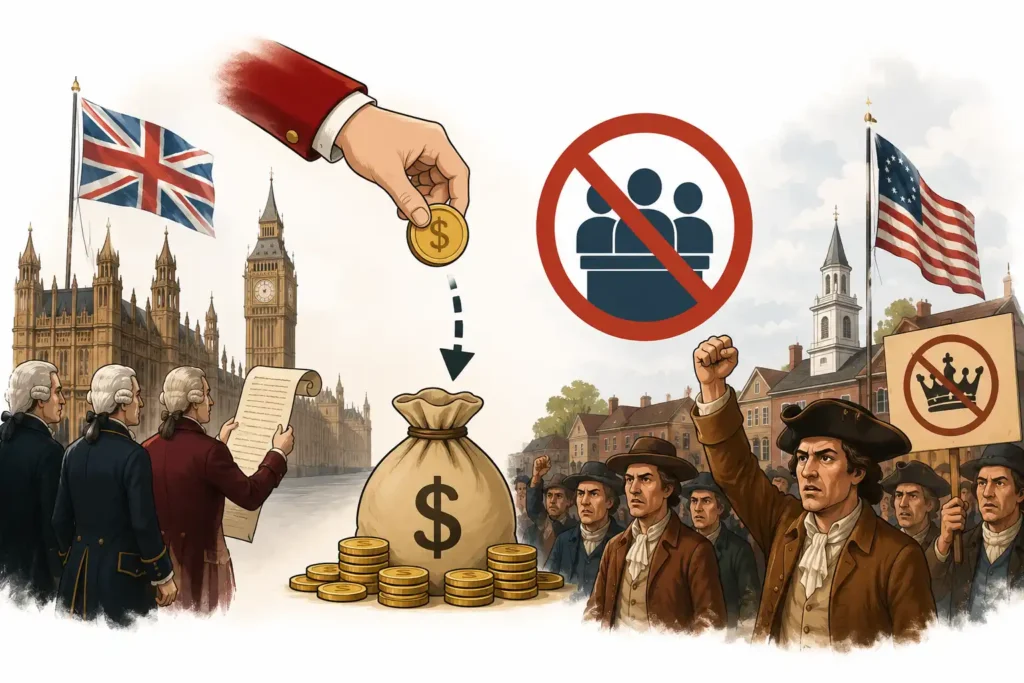
Taxation without representation is when the government takes your money without you having a say in how it’s spent. You do not get to choose the people who make the decisions about taxes.
The American colonies did not like it when the British government taxed them without giving them a voice.
The main point was simple: if you have to pay taxes you should have a say in how the government spends your money. The problem was not about how much money people had to pay in taxes.
Taxation without representation is really about having a say in the government and being able to agree or disagree with the decisions they make. It is about being heard and having control over the money you earn.
The issue of taxation without representation is more about being treated and having representation in the government.
During the colonial period, Parliament passed measures that affected the American colonies. Colonists objected because they did not elect representatives to Parliament.
The dispute became particularly intense following measures such as the Stamp Act and Townshend Acts, contributing to protests, boycotts, and eventually the revolutionary movement.
The principle eventually became closely associated with the broader American argument for representative government.
Taxation vs. Taxation Without Representation

It is important not to confuse these two concepts.
Taxation simply means a government requires individuals or businesses to make payments to fund public purposes.
Taxation without representation refers specifically to the relationship between taxation and political representation.
A person or business can disagree with a tax rate without necessarily experiencing taxation without representation.
For example, a business owner might believe that a 30% tax rate is too high. That is a disagreement about tax policy.
By contrast, taxation without representation raises a different question:
Does the taxpayer have a meaningful political mechanism to participate in the government that imposes the tax?
That distinction is essential when discussing the historical meaning of the phrase.
The History of Taxation Without Representation
1. Why Did the Colonists Object to British Taxes?
After the French and Indian War finished in 1763 Britain had a lot of debts and costs to deal with. The British government tried to get money from the American colonies by using different taxes and charges.
The colonists already paid taxes at the colonial level. Their main issue was not the idea of being taxed.
The real issue was that Parliament made rules for the colonies even though the colonies did not choose members of Parliament.
Because of this the colonists said that taxing them without letting them vote was breaking their rights.
This disagreement turned the topic of taxes into a conversation, about who had power and what it meant to govern yourself.
2. The Stamp Act
The Stamp Act of 1765 was a law that made printed things in the colonies have a special stamp. The stamp was linked to a tax that people had to pay. This law affected papers like papers, newspapers, licenses and other printed things.
Soon after the law was passed people in the colonies started to object. People who did not like the law said that Parliament did not have the right to make them pay taxes. They said this because they did not have any representatives in Parliament.
The argument over the Stamp Act helped make the idea of “no taxation, without representation” well known.
3. The Boston Tea Party
The argument finally got worse.
The Tea Act from 1773 played a role in the events that led to the Boston Tea Party, when people in the colonies showed their anger about taxes and the special treatment given to the East India Company.
The Boston Tea Party turned into a sign of resistance from the colonies. It also showed that arguments about taxes could grow into bigger issues than just money.
Discussions about taxes started to mix with questions about power in politics, control over the economy, having a voice in government and whether the government was fair.
4. The Declaration of Independence
The Declaration of Independence had a list of complaints against the British Crown and the government of Britain.Taxation was one of the issues that the American colonies had with Britain.
However the American Revolution was about more than high taxes. The American Revolution was really about who had the power to make decisions, how the colonies were represented in the government of Britain, what laws were passed and whether the colonies could govern themselves.
The American colonies and Britain did not see eye to eye on these issues. Historians today say that the American Revolution was mainly about the colonies wanting to have a say in how they were governed and who had the power to make decisions, not just about the amount of taxes they had to pay according to PBS.
Why Representation Matters When Governments Tax
The principle behind taxation without representation is based on a simple democratic idea:
People affected by government decisions should have a voice in choosing the people who make those decisions.
Taxes influence almost every part of an economy.
They can affect:
- Business profits
- Consumer prices
- Employee compensation
- Investment decisions
- Hiring
- Business formation
- Property ownership
- Imports and exports
- Corporate expansion
- Entrepreneurial risk
- Government spending
Because taxation can have such broad consequences, taxpayers have an interest in how tax laws are created.
In a representative system, citizens elect lawmakers who create legislation, including tax legislation.
The U.S. Constitution gives Congress the authority to impose federal taxes. Article I, Section 8 gives Congress power to lay and collect taxes, duties, imposts, and excises for purposes including paying debts, providing for the common defense, and promoting the general welfare.
This creates an important difference between the colonial situation and the modern federal system.
The modern U.S. system is built around representative institutions rather than taxation imposed by an unelected Parliament over a population lacking elected representation in that body.
Does Taxation Without Representation Still Exist Today?
The phrase Taxation Without Representation is still important today even though it needs to be explained in a way that makes sense for times. In the United States a good example of this is what happens in Washington, D.C.
The people who live in Washington, D.C. Pay taxes to the government but they do not get to vote for people to represent them in the Senate and they do not have a voting member in the House like people who live in the other states do.
The city of Washington, D.C. It itself has used the phrase Taxation Without Representation to talk about this situation for a time. You can find information about this on the website ocp.dc.gov.
Just because a business does not like a tax that does not mean it is an example of Taxation Without Representation.
Most people and businesses today. Work in a system where they have representatives who make laws about taxes. This is very different from what happened a time ago when the colonies disagreed with the government about taxes and representation.
Taxation Without Representation is not about paying taxes that you do not like, it is about not having any say in how you are governed and that is what makes the situation in Washington, D.C. A good example of Taxation Without Representation.
What Does Taxation Without Representation Mean for Businesses?
For businesses, the concept becomes especially interesting because companies are affected by tax policy even though businesses themselves are not individual voters.
A business may be affected by decisions involving:
- Corporate income taxes
- Pass-through taxation
- Payroll taxes
- Sales taxes
- Excise taxes
- Property taxes
- Business licensing fees
- Import duties
- Local taxes
- Tax credits
- Industry-specific taxes
The IRS identifies several major categories of federal business taxes, including income tax, estimated tax, self-employment tax, employment taxes, and excise tax. (IRS)
The tax consequences also depend heavily on the structure of the business.
A sole proprietorship, partnership, corporation, S corporation, and LLC can have different federal tax treatment and filing requirements.
This is why business owners should not think of “business tax” as a single tax.
How Businesses Have Representation in the Tax System
Businesses have several ways to participate in the political and policy process.
1. Voting
Business owners and employees can vote for candidates whose tax and economic policies align with their interests.
Voting is one of the most direct forms of political representation.
2. Contacting Legislators
Business owners can communicate with elected representatives about proposed legislation.
For example, a small-business owner could explain how a proposed tax increase might affect:
- Hiring
- Expansion
- Cash flow
- Prices
- Capital investment
This allows lawmakers to hear from people directly affected by tax policy.
3. Industry Associations
Businesses often participate in industry associations that advocate for particular policy positions.
These organizations may conduct research, communicate with legislators, submit comments, and educate members about proposed legislation.
4. Public Policy Advocacy
Companies can participate in lawful advocacy and public policy discussions.
Large corporations may have dedicated government-relations teams, while small businesses may rely on chambers of commerce or industry groups.
5. Public Comment and Regulatory Participation
Not every business-related rule comes directly from Congress.
Government agencies also create regulations under authority granted by law.
Businesses may have opportunities to participate in regulatory processes through comments, hearings, industry consultations, and other lawful channels.
This means representation is broader than simply voting every few years.
Why Tax Representation Matters to Small Businesses

Large corporations often have dedicated accounting, legal, tax, and government-relations departments.
Small businesses usually do not.
A small business owner may personally handle:
- Bookkeeping
- Payroll
- Taxes
- Hiring
- Sales
- Customer service
- Compliance
- Operations
That makes changes in tax policy particularly important.
For example, a change in payroll taxation could affect employment costs.
A change in business deductions could alter taxable income.
A change in sales-tax requirements could affect pricing and compliance.
A change in local property taxes could increase the cost of operating a physical location.
TThe IRS emphasizes that businesses can have federal, state, and local tax responsibilities, particularly when they have employees or operate across jurisdictions.
For small businesses, therefore, understanding tax policy is not merely a political exercise. It can become a practical business management issue, which is where understanding what a business controller does can be useful.
Taxation Without Representation vs. High Taxes
These concepts are often confused.
A high tax is not automatically taxation without representation.
Consider two hypothetical businesses.
Business A
Business A operates in a state where lawmakers are elected by residents. The state legislature increases the corporate tax rate.
The owner disagrees with the increase and believes it will hurt the company.
That is a tax-policy disagreement, not necessarily taxation without representation.
Business B
Business B operates under a governing authority where taxpayers have no meaningful elected representation in the legislative body imposing the tax.
That situation is much closer to the historical concept of taxation without representation.
The distinction matters because the phrase describes a political relationship, not simply the size of the tax bill.
How Tax Policy Can Affect Business Decisions
Taxes influence business decisions in ways that go beyond the amount paid to the government.
1. Hiring Decisions
Businesses consider total employment costs when deciding whether to hire.
Employment taxes can form part of that cost.
The IRS notes that employers may have responsibilities involving federal income-tax withholding, Social Security and Medicare taxes, and federal unemployment taxes.
2. Investment Decisions
Tax rules can influence whether a company purchases equipment, expands facilities, or invests in new technology.
Tax deductions and credits may change the financial calculation, while sales tax compliance can also affect the overall cost of business purchases and investments.
3. Pricing
Businesses may incorporate certain taxes into their pricing decisions.
For consumer-facing companies, changes in sales or excise taxes can affect final prices and demand.
4. Business Location
State and local tax differences can influence where businesses establish operations.
However, taxes are only one factor. Businesses may also consider labor availability, infrastructure, customers, regulations, transportation, and real estate costs.
5. Cash Flow
Tax obligations can affect when money leaves a business.
Federal income tax is generally structured as a pay-as-you-go system, meaning businesses may need to make payments during the year rather than waiting until the annual return is filed. (IRS)
Representation, Accountability, and Business Confidence
A healthy tax system requires more than simply collecting revenue.
Businesses also need predictability.
Imagine a company planning a five-year expansion.
It may invest millions of dollars in:
- Equipment
- Buildings
- Employees
- Technology
- Inventory
- Training
If tax laws change unpredictably, the company’s financial projections can become less reliable.
This is one reason businesses pay attention not only to tax rates but also to:
- Legislative proposals
- Tax incentives
- Deduction rules
- Compliance requirements
- Filing deadlines
- Regulatory changes
- State and local policies
Representation provides a mechanism for taxpayers to communicate concerns about these policies.
Taxation and the U.S. Constitution
The modern U.S. tax system is built on constitutional authority.
Article I, Section 8, Clause 1 gives Congress the power to lay and collect federal taxes. The Constitution also places limits and conditions on that power. (Constitution.gov)
The Constitution’s Origination Clause is another important part of the system.
Revenue bills must originate in the House of Representatives, although the Senate can propose or agree to amendments. (Congress.gov)
This structure reflects the broader constitutional principle that taxation should occur through established representative institutions.
In other words, modern U.S. taxation is not based on the British colonial model that inspired the original protest.
Taxation Without Representation and Washington, D.C.
Washington, D.C. Offers one of the modern examples of why the phrase keeps coming up.
People who live in the District pay taxes but do not have voting representation in Congress like people who live in a state.
The government of the District has actually used the phrase “Taxation Without Representation” in its efforts. (Ocp.dc.gov) For companies that are based in Washington, D.C. this issue can therefore be seen as part of the political environment where local businesses work.
It is important to make a difference between the political representation of residents and the separate legal and tax responsibilities that are placed on businesses.
A business does not stop paying a tax just because its owners do not agree with the system.
Tax responsibilities still apply unless a real law or an exemption says something.
Can a Business Refuse to Pay Taxes Because It Claims There Is No Representation?
No.
Disagreeing with taxation policy does not automatically provide a legal basis for refusing to pay taxes.
Businesses are generally required to comply with applicable federal, state, and local tax laws.
The IRS provides businesses with systems for filing and paying taxes, including electronic filing and payment options. (IRS)
A business that believes a tax is incorrect should use appropriate legal and administrative processes rather than simply stop paying.
Depending on the situation, legitimate options may include:
- Filing an amended return
- Requesting an administrative review
- Challenging an assessment
- Appealing through the appropriate process
- Seeking professional tax advice
- Pursuing litigation when legally appropriate
The historical slogan should therefore be understood as a principle concerning political representation, not as a general excuse for tax noncompliance.
Why Tax Transparency Matters to Businesses
Representation works best when taxpayers can understand what governments are doing.
Businesses benefit when tax systems are:
1. Transparent
Companies should be able to determine what they owe and why.
2. Predictable
Businesses need reasonable stability when making long-term investments.
3. Administratively manageable
Complex tax requirements can create significant compliance costs, especially for small businesses.
4. Accountable
Taxpayers should have avenues to challenge incorrect assessments and participate in policy debates.
5. Consistent
Similar businesses should generally be able to understand how rules apply to them.
These principles are closely connected to the broader idea behind taxation without representation: taxpayers should not be treated as passive sources of revenue without meaningful avenues for accountability.
How Business Owners Can Stay Informed About Tax Policy
You do not need to become a constitutional scholar to understand how tax policy affects your company.
A practical approach can include the following.
1. Monitor Legislative Changes
Keep track of federal and state proposals that could affect your industry.
2. Follow Official Tax Authorities
The IRS provides business tax information covering filing, payment, employment taxes, estimated taxes, and other obligations. (IRS)
State and local tax authorities are also important sources of information.
3. Work With Tax Professionals
An accountant, CPA, enrolled agent, or tax attorney can help interpret complicated tax rules.
4. Understand Your Business Structure
Your business structure can influence how taxes are calculated and reported. The IRS specifically notes that business structure affects the taxes a business must pay and how those taxes are handled. (IRS)
5. Participate in Business Organizations
Industry groups and local business organizations can help business owners understand policy developments and participate in public discussions.
6. Keep Accurate Records
Good records make it easier to calculate tax liabilities, claim legitimate deductions, respond to tax authorities, and make informed financial decisions.
Accounting software can also help businesses organize financial data, track expenses, manage taxes, and maintain accurate records
Taxation Without Representation in the Digital Economy
The idea becomes even more interesting as businesses increasingly operate across borders.
A digital company might have:
- Customers in multiple states
- Employees working remotely
- Contractors in different jurisdictions
- International customers
- Digital products
- Online advertising revenue
- Cloud infrastructure spread across regions
This creates complicated questions about which governments have authority to tax particular activities.
The business may feel economically connected to multiple jurisdictions at once.
As commerce becomes more digital, businesses increasingly need to understand not only how much tax they owe, but also which government has the authority to impose it and under what legal framework.
That does not mean every cross-border tax is taxation without representation.
Rather, it highlights why jurisdiction, legal authority, transparency, and political accountability remain important concepts in modern taxation.
Common Misconceptions About Taxation Without Representation
Myth 1: It Means Any Tax Is Unfair
False.
The phrase specifically concerns taxation imposed without meaningful political representation.
Myth 2: The American Revolution Happened Only Because Taxes Were Too High
Oversimplified.
Taxation was part of the conflict, but representation, constitutional authority, political rights, trade restrictions, and self-government were also central issues.
Myth 3: Businesses Can Stop Paying Taxes If They Disagree With Government
False.
Businesses generally remain legally responsible for applicable taxes.
Myth 4: Representation Only Means Voting
Not necessarily.
Representation can involve elections, legislative advocacy, public participation, industry organizations, regulatory processes, and other lawful mechanisms.
Myth 5: The Concept Is Only Historical
Not entirely.
The phrase remains part of modern political debate, including discussions surrounding Washington, D.C. and federal representation. (ocp.dc.gov)
Why Taxation Without Representation Still Matters in 2026
The phrase remains relevant because the underlying question has not disappeared:
Who gets to make decisions that require people and businesses to contribute money to the government?
Modern economies are much more complicated than the colonial economy, but the fundamental relationship between taxation and political authority remains important.
Businesses today operate within tax systems created through federal, state, and local governments.
They must understand:
- Who imposes the tax
- What authority supports the tax
- Who makes the rules
- How tax changes are proposed
- How taxpayers can participate
- What compliance obligations apply
- What legal remedies are available
The IRS’s current business guidance illustrates just how extensive these obligations can be. Depending on the business and circumstances, federal responsibilities can include income taxes, employment taxes, estimated taxes, self-employment taxes, excise taxes, and information reporting. (IRS)
This makes tax literacy an important business skill.
Taxation Without Representation: Key Takeaways for Businesses
For business owners, the most important lessons are straightforward:
- Taxation without representation is primarily a political concept, not simply a complaint about high taxes.
- The phrase originated in the colonial conflict with Britain, when colonists objected to taxation by a Parliament in which they lacked elected representation. (PBS)
- Modern U.S. taxation operates through constitutional and representative institutions. Congress has constitutional authority to impose federal taxes, subject to constitutional limitations. (Constitution.gov)
- Businesses have numerous tax obligations, and those obligations vary according to business structure and circumstances. (IRS)
- Political participation matters to businesses because tax policies can affect hiring, investment, pricing, expansion, and cash flow.
- Disagreement with a tax does not eliminate a legal obligation to pay it.
- Tax representation is ultimately about accountability and political voice, not about eliminating taxes altogether.
Frequently Asked Questions
What is taxation without representation in simple terms?
Taxation without representation means being required to pay taxes to a government without having meaningful elected representation in the body that imposes those taxes.
Why did the colonists say “no taxation without representation”?
American colonists objected to British taxes because they believed Parliament was imposing taxes on them even though the colonies did not elect representatives to Parliament. The dispute therefore concerned political representation and authority, not simply the amount of tax. (PBS)
What is an example of taxation without representation today?
Washington, D.C. is a commonly cited modern example because District residents pay federal taxes but lack voting representation in Congress equivalent to residents of the states. (ocp.dc.gov)
Does taxation without representation apply to businesses?
The historical principle primarily concerns political representation of taxpayers. Businesses are affected by tax laws and can participate in the political and policy process through owners, employees, associations, advocacy, and other lawful channels.
Can businesses refuse to pay taxes because they disagree with tax policy?
No. A disagreement with tax policy does not normally eliminate a business’s legal tax obligations. Businesses should use appropriate administrative or legal procedures to challenge taxes they believe are incorrect.
What taxes do businesses typically pay?
Depending on their structure and activities, businesses may have federal income tax, estimated tax, employment tax, self-employment tax, excise tax, and other state or local tax obligations. (IRS)
Why is taxation important to businesses?
Taxes can affect profitability, cash flow, hiring, investment, pricing, expansion, and business location. Understanding tax policy can therefore help businesses make better financial and strategic decisions.
Conclusion
Taxation without representation is more than a phrase from an American history textbook. It captures a fundamental question about the relationship between taxpayers and government: if people and businesses are required to contribute money to the government, what mechanisms give them a voice in the decisions that create those obligations?
For American colonists, the question became a major source of conflict with Britain and helped fuel the movement toward independence.
For businesses today, the issue looks different. Modern companies operate within a constitutional system where elected lawmakers establish tax laws and government agencies administer them.
Businesses can vote through their owners and employees, communicate with representatives, participate in industry organizations, engage in public policy discussions, and use established legal processes to challenge government decisions.
At the same time, the underlying principle remains valuable.
Tax systems work best when taxpayers understand what they are paying, why they are paying it, who created the rules, and how they can participate in the political process.
For business owners, that makes taxation without representation more than a historical slogan. It is a useful starting point for thinking about tax policy, accountability, transparency, representation, and the economic decisions that shape the business environment.
