
Author: Shabir Ahmad

  • Start a Travel Agency Business: Costs, Requirements & Tips

    Start a Travel Agency Business: Costs, Requirements & Tips

    The travel industry in the United States is one of the largest and most dynamic sectors in the world. Millions of Americans travel every year for vacations, business trips, cruises, and adventure experiences. While many travelers book trips online, travel agencies continue to thrive because they provide expert guidance, customized travel planning, and time-saving services.

    If you’re passionate about travel and want to turn that passion into a profitable business, starting a travel agency can be a great opportunity. The good news is that launching a travel agency today is much easier than it was years ago. With the help of online booking systems, digital marketing, and travel supplier networks, many entrepreneurs start successful travel agencies from home.

    In this guide, we’ll explain how to start a travel agency business in the USA, including startup costs, legal requirements, and tips to grow your business successfully.

    Why Start a Travel Agency Business in the USA?

    people with bags

    The U.S. travel industry continues to grow rapidly. Even with online booking platforms, many travelers still prefer working with travel agents who can provide personalized travel experiences.

    Here are some reasons why starting a travel agency in the United States can be a smart business decision.

    Growing Travel Demand

    Travel demand in the United States is massive. Americans spend billions of dollars each year on vacations, cruises, flights, and hotel stays. As people increasingly look for customized travel experiences, travel agents are becoming valuable again.

    Low Startup Investment

    Compared to many other businesses, travel agencies can be started with relatively low investment. Many travel entrepreneurs launch their businesses from home with just a laptop and internet connection.

    Work From Home Opportunity

    One of the biggest advantages of starting a travel agency is flexibility. Many travel agents run their businesses remotely and work from anywhere.

    High Commission Potential

    Travel agencies earn commissions from airlines, cruise lines, hotels, and tour operators. The more bookings you generate, the more revenue you can earn.

    Types of Travel Agencies You Can Start

    Before launching your business, it’s important to decide what type of travel agency you want to build.

    1. Home-Based Travel Agency

    Many entrepreneurs start a home-based travel agency because it requires minimal startup costs. You can operate your business online and communicate with clients through email, phone, or video calls.

    This model is ideal for beginners and part-time entrepreneurs.

    2. Online Travel Agency (OTA)

    An online travel agency operates through a website or booking platform. Customers can browse travel packages, flights, and hotels online and book directly.

    This model requires strong digital marketing and technology infrastructure.

    3. Niche Travel Agency

    Some agencies focus on a specific type of travel. Specializing in a niche can help your agency stand out in a competitive market.

    Examples of travel niches include:

    • Luxury travel
    • Adventure travel
    • Honeymoon packages
    • Cruise travel
    • Corporate travel
    • Family vacations
    • Destination weddings

    4. Retail Travel Agency

    Retail travel agencies operate from physical office locations where customers visit to plan trips. While this model requires higher startup costs, it can help build strong local relationships and provide personalized customer service, similar to the premium experience offered by London Executive Chauffeurs, where professionalism, trust, and direct client interaction are key to building long-term customer loyalty.

    Travel Agency Startup Costs in the USA

    A common question many entrepreneurs ask is: How much does it cost to start a travel agency business?

    The answer depends on the type of agency you want to start.

    Estimated Startup Costs

    Typical startup costs for travel agencies in the United States include:

    Home-based travel agency

    • $500 – $5,000

    Online travel agency

    • $3,000 – $10,000

    Retail travel agency

    • $20,000 – $100,000+

    Your total investment will depend on technology, marketing, office space, and licensing requirements.

    Breakdown of Travel Agency Startup Costs

    Let’s take a closer look at the main expenses involved when starting a travel agency business.

    Business Registration

    Registering your business is the first step in starting a travel agency.

    Common business structures in the United States include:

    • Sole proprietorship
    • Limited Liability Company (LLC)
    • Partnership
    • Corporation

    Most small travel agencies choose an LLC structure because it provides legal protection and flexibility.

    Business registration costs usually range from $50 to $500 depending on the state.

    Travel Seller Licenses

    Unlike many industries, the United States does not have a nationwide travel agent license. However, some states require travel sellers to register.

    States that require Seller of Travel registration include:

    • California
    • Florida
    • Washington
    • Hawaii

    If your business operates in these states or sells travel to residents there, you may need to register and obtain a travel seller license.

    Host Agency Fees

    Many new travel agents join a host agency. A host agency provides access to travel booking systems, supplier relationships, and commission structures.

    Typical host agency fees range from:

    $0 – $500 per year depending on the provider.

    Working with a host agency allows beginners to start their travel businesses without building supplier partnerships from scratch.

    Website Development

    A professional website is essential for modern travel agencies.

    Your website should include:

    • Travel packages
    • Booking forms
    • Destination guides
    • Customer testimonials
    • Contact information

    Website development costs can range from $500 to $5,000 depending on complexity.

    Booking Software and Tools

    Travel agencies rely on several digital tools to manage bookings and customer relationships. For specialized tour operators, software for managing online tours can help streamline reservations and improve customer experience.

    Common travel agency software includes:

    • Global Distribution Systems (GDS)
    • Customer Relationship Management (CRM) software
    • Booking management systems
    • Payment processing tools

    These tools help streamline operations and improve customer service.

    Marketing and Advertising

    Marketing is one of the most important investments for a new travel agency.

    Common travel marketing strategies include:

    • Search engine optimization (SEO)
    • Google Ads
    • Social media marketing
    • Email marketing
    • Travel blogging

    New travel agencies typically invest $500 to $3,000 in marketing during their early stages.

    Requirements to Start a Travel Agency

    Launching a successful travel agency requires more than just a business registration. You also need the right skills, tools, and partnerships.

    Market Research

    Understanding your target market is critical before starting a travel agency.

    Research questions to consider include:

    • What destinations are popular among travelers?
    • What services are customers looking for?
    • Who are your main competitors?

    Market research helps you identify profitable travel niches.

    Travel Industry Training

    While formal education is not required to become a travel agent, training can help you understand the industry better.

    Many travel agents complete certifications such as:

    • Travel agent certification programs
    • Cruise specialist training
    • Destination specialist programs

    Training helps build credibility and industry knowledge.

    Supplier Partnerships

    Travel agencies work with suppliers such as:

    • Airlines
    • Hotels
    • Cruise lines
    • Tour operators
    • Transportation companies

    Strong supplier relationships help travel agencies offer better prices and exclusive travel deals.

    Customer Service Skills

    Customer service is one of the most important skills for travel agents.

    Successful travel agents must:

    • Understand customer preferences
    • Provide travel recommendations
    • Solve travel problems quickly
    • Offer personalized experiences

    Great service often leads to repeat customers and referrals.

    Step-by-Step Guide to Starting a Travel Agency

    Here is a simple roadmap to help you launch your travel agency business.

    Step 1: Choose Your Travel Niche

    Selecting a niche helps differentiate your agency from competitors.

    Examples include:

    • Luxury travel
    • Budget travel
    • Family vacations
    • Adventure tourism
    • Cruise vacations

    Specialization can make marketing easier and attract targeted customers.

    Step 2: Create a Business Plan

    A business plan outlines your strategy for success.

    Your travel agency business plan should include:

    • Target market
    • Services offered
    • Pricing strategy
    • Marketing plan
    • Financial projections

    A strong plan helps guide your business decisions.

    Step 3: Register Your Business

    Choose a business name and register your travel agency legally.

    You should also:

    • Open a business bank account
    • Register for taxes
    • Set up accounting systems

    Step 4: Build Your Travel Website

    Your website acts as your online storefront.

    It should include:

    • Travel packages
    • Blog content
    • Booking inquiries
    • Contact forms

    A well-designed website builds credibility and attracts clients.

    Step 5: Partner With a Host Agency or Suppliers

    Working with a host agency can simplify your startup process.

    Host agencies provide:

    • Booking platforms
    • Supplier partnerships
    • Training
    • Commission opportunities

    This allows new travel agents to focus on selling travel rather than building systems from scratch.

    Step 6: Launch Marketing Campaigns

    Marketing is essential for growing your travel agency.

    Focus on:

    • SEO for travel websites
    • Social media marketing
    • Travel blogs
    • Paid advertising

    Consistent marketing helps generate leads and bookings.

    Tips to Grow a Successful Travel Agency

    planet earth

    Starting a travel agency is only the first step. To succeed in the long run, you need effective growth strategies.

    Build a Strong Brand

    Branding helps customers recognize and trust your business.

    Your brand should include:

    • A professional logo
    • Consistent messaging
    • A memorable business name

    Focus on Personalized Travel Experiences

    Travelers increasingly want customized trips rather than generic travel packages.

    Offering personalized travel planning can help your agency stand out.

    Use Content Marketing

    Travel blogs and destination guides can attract organic traffic from search engines.

    Examples of travel blog topics include:

    • Best honeymoon destinations
    • Top cruise travel tips
    • Budget travel guides
    • Family vacation ideas

    Content marketing improves SEO and builds authority.

    Encourage Customer Reviews

    Online reviews play a major role in travel decisions.

    Encourage satisfied clients to leave reviews on:

    • Google
    • Yelp
    • Travel websites

    Positive reviews help build trust and credibility.

    Challenges of Running a Travel Agency

    Like any business, travel agencies face challenges.

    Common challenges include:

    • Competition from online booking platforms
    • Changing travel regulations
    • Travel disruptions and cancellations
    • Seasonal demand fluctuations

    However, travel agents who offer personalized services and expert advice can still thrive in this competitive industry.

    Future of the Travel Agency Industry

    The travel industry is evolving rapidly due to technology and changing consumer behavior.

    Major trends shaping the future of travel agencies include:

    • Personalized travel experiences
    • Sustainable tourism
    • AI-powered travel planning
    • Mobile booking platforms

    Travel agencies that adapt to these trends will have greater opportunities for growth.

    Final Thoughts

    Starting a travel agency business in the United States can be a rewarding opportunity for entrepreneurs who love travel and customer service.

    With relatively low startup costs and flexible business models, many people successfully launch travel agencies from home or online. By choosing a niche, building strong supplier partnerships, and implementing effective marketing strategies, you can create a profitable travel business.

    The key to success is providing personalized travel experiences and building lasting relationships with clients. When travelers trust your expertise, they will return for future trips and recommend your services to others.

    With dedication, creativity, and a strong marketing strategy, your travel agency can grow into a successful business that helps people explore the world.


  • Uber Clone Technology Providers Helping Startups Launch Faster

    Uber Clone Technology Providers Helping Startups Launch Faster

    It would take a huge budget, several months to develop, and a complete technical team to launch a ride-hailing business. Today, things have changed. Uber clone technology solutions have provided startups an opportunity to enter the market much faster.

    These off-the-shelf solutions are those that offer the essentials necessary to operate a ride-hailing company. Startups do not need to create everything themselves, but can rather use pre-made apps, dashboards, and systems and tailor them to their own needs, which are already tested and ready to go.

    In this article we examine how Uber clone technology providers can help startups to launch more quickly, why this method is favored by so many entrepreneurs and what to consider when selecting the right provider.

    The Increasing Need of Ride-hailing Services

    map navigation on phone

    Ride-hailing has become a regular practice in most cities. The society is demanding fast transport that can be booked within seconds using their phones. Due to such change of behavior, the ride-hailing apps demand continues increasing throughout the world.

    Nevertheless, to compete with mature platforms, one should be fast and efficient. In case a startup takes 1 year to develop the technology, the opportunity in the market may be lost.

    This is where Uber clone technology providers are important. They enable entrepreneurs to introduce their service within weeks instead of months.

    What Is Uber Clone Technology?

    Uber clone technology can be described as a pre-developed ride-hailing software platform that is developed to act like Uber. It also tends to cover all the necessary elements needed to operate a ride-sharing platform.

    A typical solution includes:

    • Passenger mobile application
    • Driver mobile application
    • Administrative dashboard
    • Real-time GPS tracking
    • Payment integration
    • Ride management system

    Startups do not have to develop these systems though they can acquire the technology, either by buying it or licensing it, and tailor it to their business model.

    This will go a long way to minimize development time and cost.

    Reason why startups favor Uber Clone Solutions

    Startups use Uber clone app platforms rather than developing a ride-hailing application because of several reasons.

    1. Faster Time to Market

    A complete ride-hailing platform may take between 8 and 12 months (or more) to be developed. 

    Uber clone solutions already include the core functionality required to operate a ride-hailing platform.  It is due to this fact that startups can get their platform up and running within relatively a short period of time – in some cases within a few weeks.

    This speed might translate into a significant difference upon the introduction to a competitive app market.

    2. Lower Development Cost

    The construction of a ride-hailing platform will include:

    • Mobile app development
    • Backend infrastructure
    • GPS tracking integration
    • Payment gateway setup
    • Security and testing

    These mechanisms are time consuming in the development team and financially intensive.

    Uber clone providers cut these costs down to the fact that the core system is already developed. Customization and deployment are the only things that startups pay.

    3. Tested and Proven Features

    Some of the greatest threats of software development are bugs and performance problems.

    The majority of the Uber clone platforms already have been tested in practice business. This implies that startups get software that has undergone improvements in terms of past implementations.

    Consequently, the platform is more likely to be stable in the outset.

    4. Easy Customization

    A lot of startups desire to introduce their own brand and exclusive features.

    Typically, Uber clone technology providers offer customization, which includes:

    • Logo and brand identity
    • Payment methods
    • Language support
    • Pricing models
    • Driver commission settings

    This is flexibility in the sense that the startups can build a platform that suits the market instead of having to start over.

    Characteristics of Uber Clone Sites

    Most of the contemporary Uber clone solutions have a number of basic features, although various providers have varied packages.

    Passenger App Features

    The passenger application allows one to book rides easily.

    Common features include:

    • Ride booking using GPS location
    • Fare estimation
    • Real-time driver tracking
    • Multiple payment options
    • Trip history
    • Ratings and reviews

    The attributes contribute to the establishment of a seamless user experience just like other popular ride-hailing apps.

    Driver App Features

    A different mobile application is used by the drivers to handle the requests of rides.

    Common functionalities of driver apps are:

    • Ride request notifications
    • Route navigation
    • Earnings tracking
    • Rejection or acceptance of the ride
    • Trip history

    The tools assist the motorists to drive effectively and to remain in touch with the passengers.

    Admin Dashboard

    Administrator dashboard enables the owner of the business to control the whole platform.

    It normally comprises equipment used to:

    • Monitoring rides
    • Drivers and passengers management
    • Dealing with commissions and payments
    • Seeing the analytics and reports
    • Controlling promotions or discounts

    This centralized control mechanism is useful in assisting the startups to control operations efficiently.

    How Uber Clone Providers Help Startups in Launching Faster

    map navigation and taxi

    Uber clone technology providers do not only sell software. A lot of them offer entire launch assistance that aids start-ups to transition between idea and operation within a short period of time.

    Pre-Built Infrastructure

    The technical framework of ride-hailing apps may be complicated. It entails real-time communication, tracking of whereabouts and payment.

    This infrastructure is ready with Uber clone providers. This does not require the startups to create the backend architecture on their own.

    Deployment and Setup Support

    Many providers assist with:

    • Application deployment in Google Play and App Store
    • Server setup
    • Database configuration
    • Introduction of payment gateway

    This assistance allows non-technical founders to roll out their platforms without having to establish a large team of developers.

    Custom Development Options

    Even though the base system is already prepared, most startups desire that features are specific to their market.

    There are others that provide further development services that the startups may add with Uber clone providers, such as:

    • multi-city operations
    • subscription models
    • corporate ride services
    • delivery integrations

    This is flexible to enable the businesses to fit the platform to various industries.

    Key Features Offered by Uber Clone Platforms

    Uber clone solutions are not identical. It is crucial to select the provider who will be successful in the long term.

    The following are some important considerations that can be made by startups.

    Customization Capability

    Startups are advised to make sure that the platform is customizable enough. Each market is unique in terms of its needs, hence flexibility is needed.

    Scalability

    A system that can support 100 users might not work when the number of users increases to thousands.

    Startups are advised to select service providers that provide scalable architecture that is able to handle the growth.

    Technical Support

    The opening of the app is just a start. New features, bug fixes and updates are frequently necessary.

    The technical support is reliable and can be used to make sure the platform runs smoothly.

    Security and Data Protection

    Ride-hailing apps deal with sensitive information including user data and payment information.

    Proper security control is necessary to secure the customers and the trust.

    Top 5 Uber-Like App Providers for Startups

    There are various firms that are focused on creating Uber-like companies and white-label ride-hailing services to startups. These providers provide pre-prepared technology platforms that enable entrepreneurs to start taxi or mobility platforms fast without developing the whole system.

    The following are some of the popular providers that are usually sought out by startups looking into Uber clone technology.

    1. Uberclone.co

    Uberclone.co offers ready-made ride-hailing solutions designed for entrepreneurs who want to enter the market quickly. The platform usually includes rider applications, driver applications, and a centralized admin dashboard to manage operations efficiently.

    The company focuses on scalability, meaning the software is built to support a growing number of users, drivers, and expanding fleets as the business grows.Many startups building mobility platforms in emerging markets use these solutions to launch their services faster.

    2. Elluminati

    Elluminati is offer white label Uber-like applications that help startups in launching ride-hailing applications quickly. They have a rider and driver app, and a powerful administration panel to organize rides, drivers, and payments.

    The company specializes in scalable mobility solutions, which enable the businesses to spread across multiple cities and operate using the same dashboard to manage it. Elluminati is favored by startups due to its out-of-the-box infrastructure and the ability to customize it.

    3. QuickWorks

    QuickWorks is a white-label ride-hailing company that is aimed at assisting start-ups in launching taxi operations in the shortest possible time. Their platform has such features as multi-city control, auto-fleet, and on-road driver tracking.

    Since the core system is already developed, the businesses can concentrate on branding, driver onboarding, and local marketing instead of extended development processes.

    4. Apptunix

    Another known player in the Uber clone development industry is Apptunix. The company develops customizable ride-hailing applications, which include GPS, payment programs, and driver management applications.

    This provider is favored by many startups in cases when they are required to have a scalable platform that may be extended to other cities or regions.

    5. Hyperlocal Cloud

    Hyperlocal Cloud is dedicated to the provision of versatile Uber-like platforms which can be adjusted to other on-demand models of doing business. This encompasses taxi services, delivery platforms and local mobility applications.

    The firm also focuses on the idea of customization, by which a start-up can adapt the platform to its business approach and local demands.

    Future of Uber Clone Technology

    The ride-hailing technologies are also in a state of development.

    The following are some of the emerging trends:

    • AI-based route optimization
    • integrations of electric vehicles
    • ride-hailing and delivery multi-service platforms
    • models of transportation that are based on subscription

    Uber clones are slowly implementing these features into their systems, improving business growth and profitability while providing more opportunities for startups to compete in the market.

    Final Thoughts

    To most entrepreneurs, it is costly and time consuming to establish a ride-hailing platform by itself. The Uber clone technology providers provide a viable alternative in that they can offer ready-to-use solutions that can be customized and introduced within a short period.

    These platforms reduce development time, cost and offer features that are tested which then enable startups to concentrate on the most important things which are an increase in the size of the user base and the formation of a robust transportation network.

    The Uber clone technology will probably be a significant resource to startup firms aiming at penetrating the ride-hailing industry effectively, given that the demand on on-demand services is bound to keep growing.

  • Ultimate Inventory Sheet Template Guide for Small Business Owners

    Ultimate Inventory Sheet Template Guide for Small Business Owners

    Running a small business involves juggling many responsibilities, and inventory management is one of the most critical. Whether you run a retail store, an online shop, a warehouse, or a small manufacturing unit, knowing exactly what products you have in stock can make the difference between smooth operations and costly mistakes.

    This is where an inventory sheet template becomes extremely useful. It helps small business owners track products, monitor stock levels, prevent shortages, and maintain accurate records without investing in expensive software.

    In this ultimate guide, you’ll learn everything you need to know about using an inventory sheet template for small business, including what it is, why it’s important, how to create one, and best practices to manage your inventory effectively.

    What Is an Inventory Sheet Template?

    An inventory sheet template is a structured document used to record and track inventory items in a business. It typically includes important details such as product names, item numbers, quantities, purchase dates, suppliers, and stock levels.

    Inventory sheets are commonly created in tools like:

    • Microsoft Excel
    • Google Sheets
    • Printable PDF formats

    These templates allow businesses to easily monitor stock levels and maintain organized records of their inventory.

    For small businesses, an inventory management sheet template offers a simple and cost-effective way to manage stock without using complex inventory software.

    Why Small Businesses Need an Inventory Sheet Template

    inventory management on tablet

    Many small businesses initially track inventory manually or rely on memory. However, this can lead to errors, lost sales, and financial losses.

    Using a simple inventory sheet template provides several important benefits.

    1. Better Stock Control

    An inventory sheet helps you track how much stock you currently have. This prevents situations where you run out of popular products or overstock items that do not sell.

    2. Improved Organization

    Keeping a structured inventory sheet ensures that all product details are recorded in one place. This makes it easier to find product information when needed.

    3. Accurate Financial Records

    Inventory directly affects your business finances. An inventory tracking spreadsheet helps you maintain accurate cost records and calculate profit margins.

    4. Prevents Stockouts

    Running out of inventory can damage customer trust. With an inventory tracking template, you can set minimum stock levels and reorder products before they run out.

    5. Saves Time

    Instead of manually checking every item in your store or warehouse, an inventory sheet helps you quickly monitor stock levels and make faster business decisions.

    Types of Inventory Sheet Templates

    Different businesses require different types of inventory tracking systems. Below are some common types of inventory sheet templates for small businesses.

    1. Basic Inventory Sheet Template

    This template is simple and ideal for small shops or startups. It includes columns such as:

    • Item name
    • Item ID
    • Quantity in stock
    • Purchase price
    • Supplier

    It is best suited for businesses with a limited number of products.

    2. Retail Inventory Sheet Template

    A retail inventory template helps store owners track items sold in physical shops. It often includes:

    • Product name
    • SKU number
    • Category
    • Quantity available
    • Selling price

    Retailers use this template to manage stock efficiently and track product movement.

    3. Warehouse Inventory Template

    Businesses with large storage facilities need a warehouse inventory sheet template to manage inventory across different storage locations.

    Key fields include:

    • Warehouse location
    • Item code
    • Quantity received
    • Quantity shipped
    • Remaining stock

    This template helps warehouse managers maintain accurate stock records.

    4. Inventory Tracking Spreadsheet

    A stock tracking spreadsheet is usually created in Excel or Google Sheets and automatically calculates stock levels.

    It may include formulas for:

    • Total stock value
    • Stock movement
    • Inventory turnover

    This type of template is useful for growing businesses.

    Essential Columns in an Inventory Sheet Template

    An effective inventory sheet template for small business should include specific columns that provide complete information about each product.

    Here are the most important fields to include.

    a. Item Name

    This column records the name of the product. Clear naming helps avoid confusion when managing inventory.

    b. Product ID or SKU

    A unique SKU (Stock Keeping Unit) helps identify products quickly and prevents duplicate entries.

    c. Category

    Grouping items by category makes inventory management easier, especially for businesses with many products.

    d. Quantity in Stock

    This shows how many units of the product are currently available.

    e. Purchase Price

    The cost at which the product was purchased from the supplier.

    f. Selling Price

    The price at which the product is sold to customers.

    g. Supplier Information

    Recording supplier details helps businesses reorder products quickly when stock runs low.

    h. Reorder Level

    The minimum stock level that triggers a new order.

    i. Total Inventory Value

    This calculates the total value of the available stock.

    How to Create an Inventory Sheet Template in Excel

    Creating an inventory sheet template in Excel is simple and requires only a few steps.

    Step 1: Open Excel or Google Sheets

    Create a new spreadsheet where you will build your inventory template.

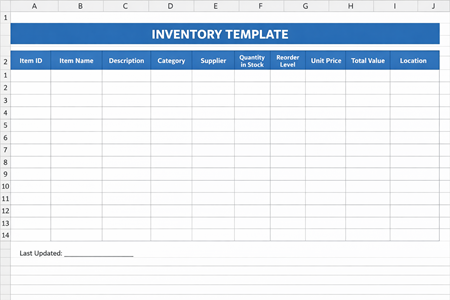
    Step 2: Create Column Headers

    Add the following headers in the first row:

    • Item ID
    • Product Name
    • Category
    • Quantity in Stock
    • Purchase Price
    • Selling Price
    • Supplier
    • Reorder Level
    • Last Updated

    These columns will form the structure of your inventory tracking sheet.

    Step 3: Add Inventory Data

    Enter details for each product in separate rows. Ensure that each item has a unique product ID. You can also save time by taking pictures of handwritten inventory records and converting them directly into Excel sheets using a JPG to Excel Converter.

    Step 4: Add Formulas

    You can include formulas such as:

    Total Inventory Value = Quantity × Purchase Price

    This allows you to quickly calculate the value of your stock.

    Step 5: Save the Template

    Once your template is ready, save it as an inventory sheet template so you can reuse it whenever needed.

    Best Practices for Using an Inventory Sheet Template

    Simply creating an inventory sheet is not enough. To get the best results, you need to use it correctly.

    1. Update Inventory Regularly

    Always update your inventory sheet whenever new stock arrives or products are sold.

    2. Use Unique Product Codes

    Assigning unique SKUs to products helps prevent confusion and ensures accurate tracking.

    3. Perform Regular Stock Audits

    Conduct physical inventory checks periodically to ensure your records match actual stock levels.

    4. Set Reorder Alerts

    Use reorder levels to avoid running out of stock.

    5. Keep Backup Copies

    Always maintain backup copies of your inventory spreadsheet to prevent data loss.

    Common Inventory Management Mistakes

    Even with an inventory sheet template, businesses sometimes make mistakes that lead to inaccurate records.

    Here are some common errors to avoid.

    Not Updating the Sheet Daily

    Failing to update inventory regularly can cause inaccurate stock counts.

    Duplicate Entries

    Entering the same product multiple times creates confusion and incorrect stock totals.

    Ignoring Reorder Levels

    Not paying attention to minimum stock levels can lead to unexpected stockouts.

    Lack of Standardization

    Using inconsistent product names or categories makes inventory tracking difficult.

    When Should You Upgrade to Inventory Software?

    An inventory sheet template works well for small businesses, but as your business grows, manual tracking may become difficult.

    You may need inventory software when:

    • Your product catalog becomes very large
    • You manage multiple warehouses
    • You need real-time inventory updates
    • Your business operates across multiple sales channels

    However, many small businesses successfully use Excel inventory templates for years before needing advanced tools.

    Inventory Sheet Template Example

    inventory excel sheet

    Benefits of Using Google Sheets for Inventory

    Many small business owners prefer Google Sheets inventory templates because they provide several advantages.

    1. Cloud Access

    You can access your inventory sheet from anywhere using any device.

    2. Collaboration

    Multiple team members can update the inventory sheet simultaneously.

    3. Automatic Saving

    Google Sheets automatically saves your changes, reducing the risk of losing data.

    4. Integration

    It can integrate with other tools and apps used by your business.

    Tips to Improve Inventory Efficiency

    Managing inventory efficiently helps businesses reduce costs and improve profitability.

    Here are some practical tips.

    a. Use the FIFO Method

    FIFO (First In, First Out) ensures older stock is sold before new stock.

    b. Track Fast-Moving Products

    Identify best-selling products and maintain adequate stock levels.

    c. Remove Dead Stock

    Products that do not sell should be discounted or discontinued.

    d. Analyze Inventory Data

    Use your inventory sheet to identify trends and improve purchasing decisions.

    Final Thoughts

    An inventory sheet template is one of the simplest and most effective tools for managing stock in a small business. It helps you organize products, track inventory levels, and maintain accurate records without needing expensive software.

    Whether you operate a retail store, an online business, or a warehouse, a well-designed inventory tracking spreadsheet can streamline your operations and reduce costly inventory mistakes.

    By using the tips and strategies in this guide, small business owners can create a reliable inventory system that supports business growth and improves efficiency.

    Start by creating your own inventory sheet template in Excel or Google Sheets, customize it to suit your business needs, and update it regularly to keep your inventory under control.

  • Will Accounting Be Replaced by AI or Transformed by It?

    Will Accounting Be Replaced by AI or Transformed by It?

    Artificial Intelligence (AI) is rapidly changing the way businesses operate. From marketing automation to predictive analytics, AI has already transformed many industries. One field that is currently experiencing significant technological disruption is accounting. This raises an important question: Will accounting be replaced by AI, or will it simply be transformed by it?

    Many people worry that AI tools and automation will eliminate accounting jobs entirely. However, the reality is more nuanced. While AI can automate repetitive tasks, it cannot fully replace the strategic thinking, judgment, and expertise that human accountants bring to the table.

    Understanding AI in Accounting

    robot and PC

    Artificial Intelligence in accounting refers to the use of machine learning, automation tools, and data analytics systems to perform tasks traditionally handled by accountants. These systems can process large volumes of financial data quickly and accurately.

    Today, many businesses already use AI-powered accounting software for tasks like:

    • Automated bookkeeping
    • Invoice processing
    • Expense categorization
    • Fraud detection
    • Financial forecasting

    Popular accounting platforms now include automation features that help companies reduce manual work and improve efficiency. Many companies choose to invest in custom AI development to tailor these tools to their specific accounting workflows and data requirements.

    AI systems analyze financial data patterns and make predictions that help businesses make better financial decisions. Because of this capability, AI is becoming a powerful assistant for accountants rather than a complete replacement.

    Why People Think AI Will Replace Accounting

    There are several reasons why many people believe accounting may be replaced by AI in the future.

    1. Automation of Repetitive Tasks

    Accounting involves many repetitive processes such as data entry, reconciliation, and transaction classification. AI tools can complete these tasks faster than humans and with fewer errors.

    For example, automated bookkeeping systems can record transactions in real time without manual input.

    2. Faster Data Processing

    AI systems can analyze large financial datasets in seconds. A task that might take an accountant several hours can be completed almost instantly by AI-powered software.

    3. Reduced Operational Costs

    Businesses constantly look for ways to reduce operational expenses. Automating accounting processes can lower labor costs, which leads some organizations to adopt AI solutions.

    4. Improved Accuracy

    Human errors are common in manual accounting processes. AI algorithms can significantly reduce these mistakes by following consistent rules.

    Because of these advantages, some experts predict that many traditional accounting roles will change significantly.

    What AI Can Already Do in Accounting

    AI technology is already being used in various accounting functions. Some of the most common applications include:

    Automated Bookkeeping

    Modern accounting software can automatically categorize transactions and maintain digital ledgers. This reduces the need for manual data entry.

    Invoice Processing

    AI tools can scan invoices, extract relevant information, and record them into accounting systems automatically.

    Expense Management

    Companies now use AI systems that automatically classify expenses and detect unusual transactions.

    Fraud Detection

    Machine learning algorithms analyze financial patterns and flag suspicious activities that may indicate fraud.

    Financial Forecasting

    AI can analyze historical financial data and create predictive models that help businesses plan budgets and investments.

    These applications show that AI is already playing a major role in modern accounting operations.

    The Limitations of AI in Accounting

    Despite its capabilities, AI still has significant limitations. Accounting is not only about numbers; it also involves judgment, interpretation, and strategic decision-making.

    Here are some areas where AI still struggles.

    Human Judgment

    Financial decisions often require professional judgment. Accountants evaluate risks, interpret financial regulations, and advise businesses based on experience.

    AI cannot fully replicate this level of understanding.

    Regulatory Compliance

    Tax laws and financial regulations change frequently. Human accountants stay updated with legal frameworks and apply them to complex financial situations.

    AI systems require constant updates and supervision to remain compliant.

    Client Communication

    Accounting professionals often work directly with business owners, explaining financial reports and providing advice. AI lacks the emotional intelligence required for meaningful client interactions.

    Ethical Considerations

    Financial decisions sometimes involve ethical judgment. Human accountants can assess situations beyond numerical analysis.

    Because of these factors, accounting will likely evolve rather than disappear.

    How AI Is Transforming the Accounting Profession

    group discussion on AI

    Instead of replacing accountants, AI is reshaping the profession. Many routine tasks are becoming automated, allowing accountants to focus on more valuable work.

    Shift Toward Advisory Roles

    Accountants are increasingly acting as financial advisors rather than just record keepers. With AI handling data processing, professionals can focus on strategic financial planning.

    Data Analysis and Insights

    AI provides deeper insights into financial data. Accountants can use these insights to guide business decisions in various sectors as in AI powered LMS, which has overturned in shortest period.

    Increased Efficiency

    Automation reduces manual workload, allowing accountants to manage more clients and deliver faster results.

    Better Decision Making

    AI-driven analytics help accountants provide more accurate financial advice and forecasting.

    Overall, AI is enhancing the capabilities of accounting professionals rather than eliminating them.

    Comparison Table: AI Accounting vs Traditional (Non-AI) Accounting

    FeatureAI-Powered AccountingTraditional (Non-AI) Accounting
    Data EntryAutomated data entry using AI and machine learning toolsMostly manual data entry by accountants
    Speed of ProcessingProcesses large financial data instantlySlower due to manual processing
    AccuracyHigh accuracy with fewer human errorsHigher risk of human mistakes
    Cost EfficiencyReduces operational costs over timeRequires more staff and time, increasing costs
    Fraud DetectionAI detects unusual financial patterns and potential fraud automaticallyFraud detection depends on manual review
    Financial InsightsProvides predictive analytics and financial forecastingLimited to historical financial analysis
    ScalabilityEasily handles large volumes of financial dataScaling requires more employees
    Human JudgmentLimited; relies on algorithms and patternsStrong human judgment and experience
    Client InteractionMinimal client communicationDirect advisory and consultation with clients
    Decision MakingSupports data-driven decision makingDecisions rely on professional expertise and analysis

    The Future of Accounting in the Age of AI

    The future of accounting will likely involve a collaboration between humans and artificial intelligence.

    Instead of replacing accountants, AI will become a powerful tool that improves productivity and accuracy.

    Key Trends in the Future of Accounting

    1. Cloud-based accounting systems
    2. AI-powered financial analytics
    3. Real-time financial reporting
    4. Automation of repetitive tasks
    5. Increased focus on financial consulting

    Accountants who adapt to these technological changes will remain highly valuable in the job market.

    Skills Accountants Need in the AI Era

    To succeed in an AI-driven accounting landscape, professionals need to develop new skills.

    Technology Skills

    Accountants must understand how to use AI-powered accounting software and digital tools effectively.

    Data Analysis

    The ability to interpret financial data and generate insights will become increasingly important.

    Strategic Thinking

    Accountants will focus more on helping businesses make long-term financial decisions.

    Communication Skills

    Explaining financial information clearly to clients will remain a key responsibility.

    Continuous Learning

    Technology evolves quickly, so accountants must constantly update their knowledge and skills.

    By developing these abilities, accounting professionals can stay relevant and competitive.

    Benefits of AI for Accountants

    While some fear AI will eliminate jobs, it actually provides several advantages for accountants.

    Reduced Manual Work

    Automation eliminates repetitive tasks such as data entry and reconciliation.

    Improved Accuracy

    AI reduces human errors and improves financial reporting accuracy.

    Better Client Service

    With more time available, accountants can focus on providing valuable financial advice.

    Increased Productivity

    AI tools allow accountants to handle larger workloads efficiently.

    These benefits demonstrate that AI can enhance the accounting profession rather than replace it.

    Industries Where AI Is Changing Accounting

    AI is transforming accounting across many industries, including:

    • Banking and finance
    • E-commerce businesses
    • Small and medium enterprises
    • Corporate financial departments
    • Accounting firms

    Companies that adopt AI-powered accounting solutions gain faster insights and improved financial management.

    Common Myths About AI Replacing Accountants

    There are several misconceptions about AI in accounting.

    Myth 1: AI Will Eliminate All Accounting Jobs

    In reality, AI will automate tasks but not replace the profession entirely.

    Myth 2: Accounting Skills Will Become Obsolete

    Accounting expertise remains valuable because businesses need financial interpretation and guidance.

    Myth 3: AI Is Perfect

    AI systems can still make mistakes and require human supervision.

    Understanding these myths helps clarify the real impact of AI on accounting.

    Why Human Accountants Will Always Be Needed

    Even in a highly automated future, human accountants will continue to play an essential role.

    Strategic Financial Planning

    Businesses rely on expert advice to make critical financial decisions.

    Complex Tax Situations

    Tax planning often requires specialized knowledge and interpretation of regulations.

    Business Consulting

    Accountants provide insights that help companies grow and improve profitability.

    Ethical Oversight

    Human professionals ensure transparency and accountability in financial reporting.

    These responsibilities cannot be fully automated.

    AI as a Partner, Not a Replacement

    Rather than viewing AI as a threat, accountants should see it as a powerful partner.

    AI can handle time-consuming processes while accountants focus on higher-value activities such as:

    • Financial consulting
    • Business strategy
    • Risk management
    • Investment planning

    This partnership creates a more efficient and intelligent financial ecosystem.

    Conclusion: Will Accounting Be Replaced by AI or Transformed by It?

    So, will accounting be replaced by AI or transformed by it?

    The answer is clear: AI will transform accounting, not replace it.

    Artificial Intelligence will automate routine tasks, improve efficiency, and provide deeper financial insights. However, the expertise, judgment, and strategic thinking of human accountants will remain indispensable.

    The accounting profession is evolving into a more analytical and advisory role. Professionals who embrace AI technology and develop new skills will thrive in the future of finance.

    Instead of fearing AI, accountants should view it as an opportunity to enhance their capabilities and deliver greater value to businesses.

    The future of accounting is not humans versus AI — it is humans working with AI to create smarter financial decisions.

    FAQs: Will Accounting Be Replaced by AI or Transformed by It?

    1. Will AI completely replace accountants in the future?

    No, AI is unlikely to completely replace accountants. While AI can automate repetitive tasks like bookkeeping and data entry, accountants are still needed for strategic planning, financial advice, and interpreting complex financial data.

    2. What accounting tasks can AI automate?

    AI can automate tasks such as invoice processing, expense categorization, transaction matching, financial forecasting, and fraud detection. These technologies help improve efficiency and reduce manual workload.

    3. How is AI transforming the accounting industry?

    AI is transforming accounting by automating routine processes, improving accuracy, providing real-time financial insights, and enabling accountants to focus more on advisory and strategic roles.

    4. Do accountants need new skills because of AI?

    Yes, accountants need to develop skills in data analysis, financial technology tools, AI-powered accounting software, and strategic consulting to remain competitive in the modern financial environment.

    5. Is AI accounting better than traditional accounting?

    AI accounting is faster, more efficient, and reduces manual errors. However, traditional accounting is still important because human accountants provide judgment, business advice, and ethical oversight that AI cannot fully replicate.

  • Business Solutions: Best AI Humanizers for Marketing Content

    Business Solutions: Best AI Humanizers for Marketing Content

    If you’re a content marketer in [this_year], you’ve probably felt the squeeze. You need to produce more content, faster, with tighter budgets. AI tools help you draft faster, but then the alarms go off. Your content gets flagged by detection software. Your rankings drop. Your credibility takes a hit.

    The solution isn’t to stop using AI. It’s to make AI-generated content sound genuinely human. That’s where humanizers come in. They restructure sentences, vary your phrasing, and strip away the robotic patterns that scream “this was written by ChatGPT.” For marketers juggling blog posts, email campaigns, and social media, the right humanizer protects your content investment and keeps your strategy running smoothly.

    Why AI Detection Actually Matters for Marketing Content

    Google’s algorithms have gotten smarter. They’re not just looking for keyword stuffing anymore. They’re analyzing writing patterns, sentence predictability, and content that feels mass-produced. If your blog posts all sound the same, or if they read like they came from a template, you’re going to see your organic traffic suffer.

    AI detection tools like Originality.ai and Turnitin are also being used by competitors, clients, and even internal compliance teams. Getting flagged doesn’t just hurt SEO. It damages trust. When your audience suspects your content isn’t authentic, they disengage. Humanizers give you a layer of protection against all of this while letting you keep the efficiency AI provides.

    How We Evaluated These Tools

    We didn’t just skim marketing pages and call it research. We ran actual marketing content through each humanizer, then tested the results against the most aggressive detection tools available: Originality.ai, Turnitin, GPTZero, and Copyleaks. Many marketers also use an AI checker to quickly verify whether their content might trigger these detection systems before publishing.

    We evaluated bypass rates, tone consistency, processing speed, and pricing. We also considered whether these tools could handle the volume and variety content marketers need, from 500-word blog posts to 3,000-word guides. The tools below passed our tests and earned their spots on this list.

    The Best Humanizers for Content Marketing

    These are the tools that actually work when your content pipeline depends on it.


    1. Walter Writes AI – Best Overall for Marketing Content

    Walter AI Humanizer is built specifically to handle the kind of content marketers produce at scale. It doesn’t just paraphrase your text. It restructures it using what the platform calls “syntactic and semantic morphing,” which breaks down AI signatures and rebuilds your content with natural variation.

    The platform supports over 80 languages and offers tone customization for academic, professional, casual, and marketing styles. That flexibility matters when you’re switching between LinkedIn thought leadership and casual blog posts. Walter’s internal pre-scan runs your content through top detectors before you even see the final output, so you know it’s going to pass.

    Pricing starts with a free 300-word trial, then moves to the Starter plan at around $12/month for 30,000 words. The Business plan runs about $24/month for 70,000 words, which is enough for most small marketing teams. Enterprise users get unlimited processing with custom pricing.

    According to verified Walter reviews on Trustpilot and Reddit, users consistently report 95%+ human scores on standard detection benchmarks. One agency mentioned producing 50 articles a week and maintaining solid rankings through Google’s 2025 core updates. That kind of reliability is exactly what content marketers need.

    2. Grammarly AI Humanizer – Best for Brand Voice Consistency

    Grammarly has been a writing assistant staple for years, and their AI humanizer builds on that foundation. It integrates directly with their existing grammar and tone tools, so you can humanize and polish your content in one workflow.

    The humanizer analyzes your text for AI patterns and rewrites it to sound more natural while keeping your intended tone intact. As part of an AI Platform, Grammarly’s strength is maintaining brand voice consistency, which matters when you’re publishing across multiple channels and need everything to feel cohesive.

    Pricing varies depending on whether you’re using Grammarly Free, Premium, or Business. The humanizer is typically bundled with higher-tier plans, making it a solid option if you’re already paying for Grammarly’s other features.

    3. Quillbot Humanizer – Best for Quick Edits

    Quillbot has built a reputation as a reliable paraphrasing tool, and their humanizer takes that same approach. It’s fast, straightforward, and doesn’t require a steep learning curve. You paste your text, choose your preferred tone, and get results in seconds.

    The tool works well for marketers who need to quickly humanize shorter pieces like social media posts, ad copy, or email subject lines. It’s not as robust for long-form content, but for quick edits and rapid turnaround, it’s hard to beat.

    Quillbot offers a free version with limited word counts and premium plans that unlock higher limits and additional features. It’s an accessible starting point if you’re new to humanizers and want to test the concept without a big commitment.


    4. Writesonic AI Humanizer – Best for Integrated Workflows

    Writesonic is an all-in-one content platform that includes AI writing, SEO optimization, and now humanization. The advantage here is workflow integration. You can draft content with Writesonic’s AI writer, then immediately run it through the humanizer without switching tools.

    The humanizer uses advanced natural language processing to detect and eliminate robotic phrasing. It’s particularly effective for blog posts and landing pages where you need content that converts while still passing detection tools.

    Pricing is subscription-based with multiple tiers depending on your content volume. Writesonic’s plans are competitive with other all-in-one platforms, and the integrated workflow can save time if you’re already using their writing tools.

    5. Clever AI Humanizer – Best for Natural, High-Quality Marketing Content

    Clever AI Humanizer is designed to transform AI-generated text into more natural, human-sounding content while preserving the original meaning and overall quality.

    It can be useful for marketers who rely on AI for blog posts, landing pages, product descriptions, social media content, and other marketing materials.

    The tool focuses on improving sentence flow, reducing repetitive AI-style phrasing, and making content feel more natural and engaging for readers.

    This makes it a practical option for content teams looking to add a human touch to AI-assisted content before publishing.

    6. Jasper Paraphrasing Tool – Best for Enterprise Teams

    Jasper is a major player in the AI content space, and while they don’t market a dedicated “humanizer,” their paraphrasing tool functions as one. It rewrites AI-generated content to sound more natural and varied, which is exactly what humanization does.

    Jasper’s strength is its enterprise features. It supports team collaboration, brand voice profiles, and content templates that maintain consistency across large organizations. If you’re managing a marketing team that produces hundreds of pieces per month, Jasper’s infrastructure can handle it.

    Pricing is on the higher end, with plans starting around $49/month for individuals and scaling up for teams. Enterprise pricing is custom and includes dedicated support, which matters when you’re running large-scale campaigns.

    7. Ahrefs AI Humanizer – Best for SEO Integration

    Ahrefs is known for SEO tools, and their AI humanizer ties directly into that ecosystem. You can humanize your content while simultaneously checking keyword optimization, readability scores, and content structure.

    The tool is designed for marketers who are already using Ahrefs for keyword research and backlink analysis. It fits naturally into an SEO-first workflow and helps ensure your humanized content still ranks well.

    Ahrefs pricing is subscription-based, with plans ranging from $129/month for Lite to $449/month for Advanced. The humanizer is included with all plans, making it a good option if you’re already paying for Ahrefs and want an integrated solution.

    8. Surfer SEO Humanizer – Best for Content Performance Tracking

    Surfer SEO takes a similar approach to Ahrefs but focuses more heavily on content optimization and performance tracking. Their humanizer rewrites AI content while maintaining the keyword density and structure needed for strong search rankings.

    The platform includes a content editor that scores your text in real time, showing you how well it’s optimized for your target keywords. The humanizer works within that editor, so you can see exactly how your changes affect your content score.

    Surfer SEO pricing starts at around $89/month for the Essential plan and scales up for teams. If you’re focused on data-driven content marketing and need to track performance alongside humanization, Surfer is worth considering.

    Quick Reference: Humanizer Comparison

    ToolBest ForStarting PriceLanguages Supported
    Walter Writes AIOverall marketing content$12/month80+
    GrammarlyBrand voice consistencyVaries by planEnglish-focused
    QuillbotQuick editsFree tier availableMultiple
    WritesonicIntegrated workflowsSubscription-basedMultiple
    JasperEnterprise teams$49/monthMultiple
    AhrefsSEO integration$129/monthMultiple
    Surfer SEOPerformance tracking$89/monthMultiple

    Questions to Ask Before Choosing a Humanizer

    Does it actually preserve your brand voice, or does it strip away what makes your content unique? Some humanizers are so aggressive that they flatten your writing into generic mush. Test a few samples before committing.

    Can it handle your content volume? If you’re producing 20 blog posts a month, you need a tool with high word limits or unlimited plans. Running out of credits mid-campaign creates bottlenecks.

    Does it integrate with your existing workflow? If you’re already using a content platform or SEO tool, check whether the humanizer works within that system. Switching between multiple tools wastes time.

    What’s the learning curve? Some humanizers are plug-and-play. Others require setup, customization, and trial-and-error. Make sure you have the bandwidth to learn the tool before you need it in production.

    Red Flags When Evaluating Humanizers

    If a tool makes your content objectively worse, it’s not worth using. Some humanizers introduce awkward phrasing, break sentence flow, or insert errors. Run test samples and read the output carefully.

    Pricing that doesn’t match value is another warning sign. If you’re paying enterprise prices for a tool that barely works better than free alternatives, you’re wasting budget. Compare results, not just feature lists.

    No transparency about how the tool works should raise concerns. If a company can’t explain their process or provide evidence of effectiveness, you’re gambling with your content.

    Poor customer support is a dealbreaker when you’re on deadline. If the tool crashes or produces bad results and you can’t get help, your entire content calendar suffers.

    Frequently Asked Questions

    1. Can humanizers replace human writers?

    No. Humanizers improve AI-generated content, but they don’t replace strategic thinking, creativity, or deep subject matter expertise. Use them to enhance efficiency, not eliminate human involvement.

    2. Will Google penalize humanized AI content?

    Google’s focus is on quality and user experience, not whether AI was used. If your humanized content is helpful, well-researched, and engaging, it should perform fine. Low-quality content gets penalized regardless of how it’s produced.

    3. How often should I run content through a humanizer?

    Every time you use AI to draft content. Even minor AI-generated sections can trigger detection tools. Consistent use protects your entire content library.

    4. Can humanizers work with content in multiple languages?

    Most of the tools listed support multiple languages, but effectiveness varies. English tends to have the best results. Test other languages carefully before relying on them for published content.

    5. Do humanizers affect SEO?

    They can, depending on how they handle keywords and content structure. Tools like Ahrefs and Surfer SEO are designed to maintain SEO performance while humanizing. Others might dilute keyword density or disrupt readability.

    6. Are humanizers worth the cost for small marketing teams?

    If you’re producing even a moderate amount of AI-assisted content, yes. The cost of flagged content, lost rankings, and wasted production time far outweighs the subscription price. Start with a free trial and measure the impact before scaling up.

  • What Is Bookkeeping? A Guide for Entrepreneurs

    What Is Bookkeeping? A Guide for Entrepreneurs

    Starting a business is exciting. You focus on building your product, finding customers, and growing revenue. But behind every successful company is something far less glamorous and far more important strong bookkeeping.

    Many entrepreneurs ignore bookkeeping in the early stages. It feels technical, time-consuming, or something that can wait until tax season. The truth is, bookkeeping is one of the most powerful tools you have as a business owner. It gives you clarity, control, and confidence in your financial decisions.

    In this in-depth guide, you’ll learn what bookkeeping is, why it matters for entrepreneurs, how it works, and how to build a system that supports long-term business growth.

    What Is Bookkeeping?

    record book and calculator

    Bookkeeping is the process of recording, organizing, and maintaining all financial transactions within a business. Every time money enters or leaves your company, it must be tracked accurately. This includes sales, expenses, vendor payments, payroll, loan payments, and tax obligations.

    At its core, bookkeeping creates a structured record of your business’s financial activity. Without it, you’re operating blindly. With it, you have a clear view of how your business is performing.

    Bookkeeping is often described as the foundation of accounting. While accounting focuses on interpreting financial data and providing strategic insights, bookkeeping focuses on capturing and organizing that data correctly. If the records are inaccurate, the financial analysis will be unreliable.

    For entrepreneurs, bookkeeping is not just an administrative task. It is a financial management system that protects your business and supports smarter decision-making.

    Why Bookkeeping Is Important for Entrepreneurs

    1. Clear Financial Visibility

    Bookkeeping is essential for entrepreneurs because it provides clear financial visibility. With accurate and up-to-date records, you can clearly see how much profit you are making, whether your expenses are too high, if you can afford to hire someone, and whether your cash flow is healthy. Without organized financial records, these important questions become guesswork, which can lead to costly mistakes.

    2. Better Cash Flow Management

    Cash flow is the lifeline of any small business, and even profitable companies can fail if their cash flow is poorly managed. Proper bookkeeping helps you track incoming payments, monitor outstanding invoices, plan for upcoming expenses, and avoid unexpected cash shortages that could disrupt your operations.

    3. Easier Tax Preparation

    When tax season arrives, organized books save you time, reduce stress, and help you avoid unnecessary expenses. Instead of scrambling to gather receipts and documents, your financial records are already categorized and ready. Good bookkeeping also allows you to claim legitimate deductions, avoid penalties, and stay compliant with tax laws.

    4. Informed Business Decisions

    Entrepreneurs constantly make decisions about pricing, hiring, expansion, and marketing budgets. Accurate bookkeeping provides reliable financial data to guide those decisions. With clear insights into your numbers, you can make smarter, more confident choices that support sustainable business growth.

    Bookkeeping vs Accounting: Understanding the Difference

    Basis of ComparisonBookkeepingAccounting
    Primary FocusRecording daily financial transactionsAnalyzing and interpreting financial data
    Main RoleDocuments every sale, expense, payment, and depositUses financial data to provide insights and strategy
    Key TasksCategorizing transactions, reconciling bank statements, maintaining organized recordsPreparing financial statements, tax planning, evaluating profitability
    PurposeEnsures accurate and complete financial recordsHelps with decision-making and financial planning
    Level of AnalysisTransaction-level, detail-orientedBig-picture, analytical, and strategic
    DependencyForms the foundation of financial managementRelies on accurate bookkeeping data
    Business ImpactKeeps records accurate and up to dateGuides financial growth and compliance strategy

    In simple terms, bookkeeping builds the foundation by keeping financial records accurate and organized, while accounting uses that foundation to generate insights, ensure compliance, and guide business strategy. Both are essential, but bookkeeping is where everything begins.

    How Bookkeeping Works in a Business

    To understand bookkeeping more clearly, it helps to see how it functions in daily operations.

    Every financial transaction your business makes must be recorded. If a customer pays you for a service, that income is documented. If you purchase supplies, that expense is recorded. If you pay rent, run payroll, or make a loan payment, those transactions are logged into your bookkeeping system.

    These records are organized into categories such as revenue, operating expenses, assets, and liabilities. Over time, this data forms the basis for financial reports that show your company’s performance.

    A key part of bookkeeping is bank reconciliation. This involves comparing your recorded transactions with your bank statements to ensure accuracy. Reconciliation helps identify missing transactions, duplicate charges, or potential fraud.

    As your records accumulate, they generate essential financial statements. These reports help you evaluate your company’s profitability, financial stability, and cash position.

    Types of Bookkeeping Systems

    female working on pc

    There are two main bookkeeping systems entrepreneurs should understand:

    1. Single Entry system

    Single-entry bookkeeping is a simple method where each transaction is recorded once. It is similar to maintaining a personal checkbook. This system may work for very small businesses with minimal transactions, but it lacks the accuracy and detail needed for growing companies.

    2. Double entry System

    Double-entry bookkeeping is more comprehensive and widely used. In this system, every transaction affects at least two accounts. For example, when you make a sale, your revenue increases and your cash account increases. This method provides a more accurate financial picture and reduces errors.

    Most modern accounting software uses the double-entry system automatically, which makes it easier for entrepreneurs to maintain accurate records without deep accounting knowledge.

    Key Bookkeeping Tasks Every Entrepreneur Should Know

    Let’s look at the core bookkeeping tasks that keep your business financially organized.

    1. Recording Transactions

    Recording transactions is the foundation of effective bookkeeping. Every sale and expense must be accurately entered into your accounting system, including cash sales, credit card transactions, online payments, and business purchases. Consistency is essential—updating your records daily or weekly helps prevent errors, keeps your accounts current, and ensures you always have a clear picture of your financial position.

    2. Managing Accounts Receivable

    Accounts receivable refers to the money your customers owe you for goods or services provided. Proper bookkeeping involves creating and sending invoices promptly, tracking unpaid invoices, and following up on late payments. Strong receivables management improves cash flow and ensures your business maintains a steady stream of incoming revenue.

    3. Managing Accounts Payable

    Accounts payable includes the money your business owes to vendors and suppliers. Accurate tracking of bills and payment deadlines ensures that obligations are met on time. This helps you avoid late fees, maintain healthy vendor relationships, and manage your cash flow more effectively by planning outgoing payments strategically.

    4. Bank Reconciliation

    Bank reconciliation is the process of comparing your internal financial records with your bank statements to ensure they match. This task helps identify errors, missing transactions, duplicate charges, or even potential fraud. Regular reconciliation keeps your financial data accurate and reliable, which is crucial for making informed business decisions.

    5. Payroll Processing

    If you employ staff, payroll processing becomes a critical bookkeeping responsibility. This includes recording wages, tracking payroll taxes, and managing deductions such as benefits or retirement contributions. Accurate payroll ensures employees are paid correctly and on time, while also keeping your business compliant with tax and labor regulations.

    6. Financial Reporting

    Good bookkeeping supports the preparation of essential financial reports, such as the Profit and Loss Statement, Balance Sheet, and Cash Flow Statement. These reports provide insight into your company’s profitability, financial position, and cash movement. Regular financial reporting allows you to evaluate performance, identify trends, and make strategic decisions with confidence.

    Digital Bookkeeping, Explained

    Digital bookkeeping has transformed how modern entrepreneurs manage their finances. Instead of relying on paper records or manual spreadsheets, business owners now use accounting software to simplify and automate daily financial tasks. These tools help record transactions, generate invoices, track expenses, reconcile bank accounts, and produce financial reports with far greater speed and accuracy than traditional methods.

    1. QuickBooks

    QuickBooks is one of the most widely used bookkeeping solutions for small and medium-sized businesses. It offers comprehensive features such as expense tracking, invoicing, payroll management, tax tools, and detailed financial reporting. Its automation capabilities and user-friendly interface help entrepreneurs save time while maintaining accurate financial records.

    2. Xero

    Xero is a cloud-based accounting platform known for real-time collaboration and strong bank integration. It allows business owners and accountants to access financial data simultaneously from anywhere. With intuitive dashboards and automated bank feeds, Xero helps entrepreneurs maintain up-to-date and organized financial information.

    3. FreshBooks

    FreshBooks is especially popular among freelancers and service-based businesses. It focuses on invoicing, time tracking, expense management, and client billing. Its simple design makes it easy for entrepreneurs to manage payments and maintain clear records without needing advanced accounting knowledge.

    4. Wave

    Wave is a cost-effective solution ideal for startups and small businesses. It offers free core bookkeeping features, including invoicing and expense tracking. Wave is particularly attractive to new entrepreneurs who need reliable financial management tools without significant upfront costs.

    Manual Bookkeeping vs Digital Bookkeeping

    Basis of ComparisonManual BookkeepingDigital Bookkeeping
    Method UsedPaper ledgers, handwritten journals, or basic spreadsheetsCloud-based accounting software
    Time EfficiencyTime-consuming and labor-intensiveAutomated processes save significant time
    AccuracyHigher risk of human errorReduced errors through automation
    Task ManagementManual entry of transactions and calculationsAutomatic transaction recording, invoicing, expense tracking, and reconciliation
    AccessibilityLimited access to physical recordsAccess anytime, anywhere via cloud systems
    Data UpdatesUpdated periodicallyReal-time financial updates
    ScalabilityDifficult to scale as business growsEasily scalable with business growth

    Essential Financial Statements Every Entrepreneur Should Understand

    Bookkeeping generates three primary financial statements that every entrepreneur should review regularly.

    The first is the income statement, also known as the profit and loss statement. This report shows your revenue, expenses, and net profit over a specific period. It tells you whether your business is making money.

    The second is the balance sheet. This statement provides a snapshot of your company’s financial position at a given moment. It outlines your assets, liabilities, and owner’s equity. Reviewing your balance sheet helps you understand what your business owns and what it owes.

    The third is the cash flow statement. This report tracks the movement of cash in and out of your business. It helps you identify potential cash shortages before they become serious problems.

    Understanding these reports allows you to evaluate performance, identify trends, and plan strategically.

    Common Bookkeeping Mistakes Entrepreneurs Make

    One of the most common bookkeeping mistakes is mixing personal and business finances. Using the same bank account for both can create confusion, complicate tax filing, and raise red flags during audits. Opening separate business accounts is essential.

    Another frequent issue is falling behind on recordkeeping. When entrepreneurs delay bookkeeping tasks for months, errors accumulate and important details are forgotten. Consistency is far more effective than attempting to catch up all at once.

    Some business owners also underestimate small expenses. Minor purchases may seem insignificant, but over time they can significantly impact profitability. Accurate tracking ensures you understand your true costs.

    Trying to manage complex bookkeeping without understanding the basics can also lead to compliance issues. While DIY bookkeeping is possible in early stages, growing businesses often benefit from professional support.

    When Should You Hire a Professional Bookkeeper?

    As your business expands, bookkeeping becomes more complex. If you find yourself spending too much time managing financial records instead of focusing on growth, it may be time to hire a professional.

    A bookkeeper can maintain accurate records, reconcile accounts regularly, manage payroll entries, and ensure compliance with tax regulations. This not only saves time but also reduces the risk of costly errors.

    Entrepreneurs preparing for investment, loans, or rapid expansion especially benefit from professional bookkeeping. Clean financial records increase credibility and build trust with lenders and investors.

    The Long-Term Benefits of Good Bookkeeping

    Strong bookkeeping habits create long-term advantages. They improve budgeting accuracy and strengthen financial forecasting. They help you detect issues early and adjust strategies accordingly.

    Good bookkeeping also increases business valuation. If you ever decide to sell your company or seek investors, organized financial statements demonstrate stability and professionalism.

    Perhaps most importantly, bookkeeping reduces stress. Knowing your numbers brings clarity. Instead of worrying about hidden financial problems, you operate with confidence.

    Final Thoughts: Bookkeeping Is a Growth Tool

    Bookkeeping is more than a compliance requirement. It is a powerful financial management tool that supports smarter decisions, stronger cash flow, and sustainable business growth.

    As an entrepreneur, understanding bookkeeping basics gives you control over your business finances. Whether you manage your own books using software or hire a professional bookkeeper, the key is consistency and accuracy.

    Successful entrepreneurs do not ignore their numbers. They track them, analyze them, and use them to build stronger businesses.

    If you treat bookkeeping as a priority rather than an afterthought, it becomes one of your greatest competitive advantages.

    FAQs:

    1. How does bookkeeping help entrepreneurs grow their business?

    Bookkeeping gives entrepreneurs clear financial insights, helping them control costs, improve profits, and plan for growth.

    2. What happens if an entrepreneur ignores bookkeeping?

    Poor bookkeeping can lead to cash flow problems, tax penalties, and bad financial decisions.

    3. Do solo entrepreneurs need bookkeeping?

    Yes. Even solo business owners must track income and expenses to stay profitable and tax compliant.

    4. How much time should entrepreneurs spend on bookkeeping?

    Most entrepreneurs should review their books weekly and analyze financial reports monthly.

    5. Is bookkeeping important before seeking investors?

    Absolutely. Investors expect accurate financial records before funding a startup or growing business.

  • How to Calculate Wholesale Price for Maximum Profit

    How to Calculate Wholesale Price for Maximum Profit

    Setting the right wholesale price is one of the most important decisions you will make as a business owner. It directly affects your profitability, your relationship with retailers, and your ability to grow sustainably. Many entrepreneurs make the mistake of guessing their pricing or copying competitors without understanding their own numbers. While that might work temporarily, it rarely leads to maximum profit.

    If you want to build a strong and scalable business, you must understand how to calculate wholesale price properly. This guide will walk you through the complete process in a clear, practical, and human way—without overwhelming jargon. By the end, you’ll know exactly how to structure your wholesale pricing strategy to increase profit margins while staying competitive.

    Understanding What Wholesale Price Really Means

    person delighted

    Before jumping into formulas, it’s important to understand what wholesale price actually represents. Wholesale price is the amount you charge retailers or distributors when they purchase your products in bulk. It is not the final price customers pay. Retailers take your wholesale price and apply their own markup to determine the retail price.

    For example, if your wholesale price is $30 and a retailer doubles it, the retail price becomes $60. That difference covers the retailer’s operating expenses and profit. This is why your wholesale pricing strategy must leave enough room for retailers to earn money while ensuring you maintain healthy profit margins.

    The difference between wholesale price and retail price is often misunderstood. Wholesale price is based on production costs and desired profit margin, while retail price is based on consumer demand, market perception, and store overhead. When calculating wholesale price for maximum profit, you must balance both sides of the equation.

    Why Accurate Wholesale Pricing Is Crucial

    Wholesale pricing affects more than just your immediate revenue. It influences cash flow, inventory turnover, brand positioning, and long-term sustainability. If you set your wholesale price too low, you may attract retailers quickly, but your margins will suffer. Over time, this can create financial pressure and limit your growth potential.

    On the other hand, pricing too high without justification can push retailers toward competitors. The key is finding a profitable yet competitive price point that reflects your product’s value.

    A strong wholesale pricing formula ensures you cover every cost involved in producing and delivering your product. It also allows you to reinvest in marketing, product development, and scaling operations. Businesses that ignore structured pricing often struggle because they underestimate hidden expenses.

    Step One: Calculate Your True Cost of Goods Sold

    To calculate wholesale price accurately, you must first determine your total cost per unit. This includes every expense required to produce and prepare your product for sale.

    Start with direct costs. These are expenses directly tied to production, such as raw materials, manufacturing labor, packaging, and assembly. If you manufacture clothing, for example, your fabric, thread, labels, and stitching labor are all direct costs.

    Next, include indirect costs, often referred to as overhead. These expenses may not be tied to one specific product, but they are essential to running your business. Rent, utilities, insurance, software subscriptions, marketing expenses, equipment depreciation, and administrative salaries all fall under this category.

    Many business owners forget to allocate overhead costs per unit. This leads to underpricing. If your monthly overhead is $5,000 and you produce 1,000 units per month, then $5 should be added to each unit’s cost. Ignoring this step can significantly reduce your profit margin.

    Once you add direct and indirect costs together, you will have your true cost per unit. This number forms the foundation of your wholesale pricing formula.

    Step Two: Decide on Your Desired Profit Margin

    After identifying your total cost per unit, the next step is choosing your desired profit margin. Profit margin is the percentage of revenue that remains after costs are deducted. It is different from markup, though the two are related.

    In wholesale businesses, profit margins typically range between 20 percent and 50 percent, depending on the industry. High-volume industries often operate on lower margins, while niche or premium products can command higher margins.

    Your ideal margin depends on several factors, including market competition, product uniqueness, demand level, and brand strength. If your product offers clear differentiation, you may be able to justify higher wholesale pricing.

    Choosing a realistic profit margin is critical when calculating wholesale price for maximum profit. If your margin is too low, scaling becomes difficult. If it is too high without strong brand value, retailers may resist.

    Step Three: Apply the Wholesale Pricing Formula

    Now comes the mathematical part. One of the most reliable methods is the cost-plus pricing formula. This approach ensures your price covers all costs while achieving your target profit margin.

    The formula looks like this:

    Wholesale Price = Total Cost ÷ (1 – Desired Profit Margin)

    Imagine your total cost per unit is $20 and you want a 40 percent profit margin. You divide $20 by 0.60, which equals approximately $33.33. That becomes your wholesale price.

    This formula ensures your margin is calculated correctly. Many beginners mistakenly add 40 percent directly to $20, which would give $28. That calculation only provides a 28.5 percent margin, not 40 percent. Understanding this distinction is essential for maximizing profit.

    Another common approach is keystone pricing. In this model, retailers double the wholesale price to determine retail price. If you know your product will retail at $80, dividing by two gives you a wholesale price of $40. Keystone pricing is popular in fashion, accessories, and gift industries.

    How to Calculate Wholesale Price for Different Business Types

    Manufacturers

    Focus on:

    • Raw material cost
    • Production scaling
    • Equipment depreciation

    Dropshippers

    Include:

    • Supplier cost
    • Platform fees
    • Marketing cost

    Handmade Businesses

    Factor in:

    • Time valuation
    • Artisan labor
    • Limited production capacity

    Each model requires a customized wholesale pricing formula.

    Considering Market and Competitive Pricing

    While formulas are essential, pricing should never happen in isolation. You must study your competitors and understand industry benchmarks. Research what similar products sell for at both wholesale and retail levels.

    If your wholesale price is significantly higher than competitors, you must justify it with better quality, stronger branding, or unique features. If it is significantly lower, retailers may question quality or sustainability.

    Market positioning plays a major role in wholesale pricing strategy. Are you offering a luxury product, a mid-range option, or a budget-friendly alternative? Your pricing should align with that identity.

    Demand also matters. If your product is trending or highly sought after, you may have more flexibility to increase margins. If demand is low, competitive pricing becomes more important.

    Factoring in Volume Discounts

    Wholesale buyers expect incentives for bulk purchasing. Volume discounts encourage larger orders and improve cash flow. However, these discounts must be carefully calculated to protect profitability.

    For example, you might offer a 5 percent discount for orders over 200 units and 10 percent for orders over 500 units. Before offering discounts, calculate how they affect your margin. If your margin shrinks too much, you risk reducing overall profit despite higher sales volume.

    When structured properly, bulk pricing can increase average order value without sacrificing financial stability. Always ensure your base wholesale price leaves room for tiered discounts.

    Accounting for Hidden and Variable Costs

    Many businesses struggle with wholesale pricing because they overlook hidden costs. Returns, damaged goods, shipping subsidies, transaction fees, and promotional allowances can significantly impact margins.

    Inflation and rising supplier costs also require periodic adjustments. Reviewing your wholesale pricing formula every six to twelve months helps maintain profitability.

    Building a small buffer into your pricing can protect against unexpected expenses. A two to five percent cushion often prevents financial stress later.

    Improving Profit Without Raising Wholesale Price

    Sometimes the market limits how high you can set your wholesale price. In those cases, focus on reducing costs or increasing perceived value.

    Negotiating better supplier contracts can lower raw material expenses. Streamlining operations and reducing waste can improve efficiency. Investing in stronger branding and packaging can justify higher pricing over time.

    Perceived value is powerful. If retailers believe your product will sell quickly and generate repeat purchases, they are more willing to accept higher wholesale pricing.

    Common Wholesale Pricing Mistakes

    Avoid these costly errors:

    1. Underpricing to Attract Retailers

    This kills long-term profitability.

    2. Ignoring Overhead

    Small costs add up quickly.

    3. Not Researching Competitors

    You must understand your market.

    4. Inconsistent Pricing Structure

    Retailers value stability and transparency.

    5. Failing to Rple of Calculating Wholesale Price

    Imagine you run a small skincare brand. Your ingredient cost per unit is $8. Packaging costs $4. Labor costs $5. Overhead allocation is $3. Your total cost per unit equals $20.

    You want a 50 percent profit margin. Using the wholesale pricing formula, you divide $20 by 0.50, resulting in a $40 wholesale price. Retailers can then double that to sell at $80 retail.

    This structure ensures both you and your retail partners earn sustainable profits.

    When to Reevaluate Your Wholesale Price

    Wholesale pricing should never remain static. As production costs rise, demand shifts, or brand recognition grows, adjustments may be necessary.

    If your product consistently sells out, that may indicate room for a price increase. If competitors raise prices industry-wide, you may follow strategically. Communicating changes clearly and professionally helps maintain retailer relationships.

    Final Thoughts on Calculating Wholesale Price for Maximum Profit

    Learning how to calculate wholesale price correctly is one of the most powerful skills a business owner can develop. It combines financial clarity, market research, and strategic positioning.

    Start by understanding your true cost of goods sold. Choose a realistic profit margin that supports growth. Apply a reliable wholesale pricing formula. Study your competitors and industry standards. Factor in volume discounts and hidden costs. Review and adjust regularly.

    When done properly, wholesale pricing becomes more than just a number. It becomes a strategic tool that drives sustainable profit, strengthens partnerships, and positions your business for long-term success.


    FAQs:

    1. What is a wholesale price?

    A wholesale price is the amount a manufacturer or supplier charges retailers when products are sold in bulk. It is lower than the retail price because retailers add their own markup to cover operating costs and generate profit.

    2. How do you calculate wholesale price?

    You can calculate wholesale price using the wholesale pricing formula:

    Wholesale Price = Total Cost ÷ (1 – Desired Profit Margin)

    This ensures your pricing covers production costs and achieves your target profit margin.

    3. What is the difference between wholesale price and retail price?

    Wholesale price is what retailers pay suppliers for products in bulk, while retail price is what customers pay in stores or online. Retailers typically apply a markup (often 50% or keystone pricing) to determine the final selling price.

    4. What is a good wholesale profit margin?

    A good wholesale profit margin typically ranges between 20% and 50%, depending on the industry. Premium or niche products may support higher margins, while high-volume industries often operate with lower margins.

    5. What is the cost-plus pricing method?

    Cost-plus pricing is a wholesale pricing strategy where you add a desired profit percentage to your total cost of goods sold (COGS). This method ensures all production and overhead costs are covered before profit is calculated.

    6. How do volume discounts affect wholesale pricing?

    Volume discounts reduce the wholesale price for larger orders. While they can increase sales volume and cash flow, they must be structured carefully to maintain healthy profit margins.

    7. Should wholesale pricing include overhead costs?

    Yes, wholesale pricing must include overhead costs such as rent, utilities, salaries, marketing, and equipment depreciation. Ignoring these expenses can significantly reduce your actual profit.

    8. How often should you review your wholesale price?

    It is recommended to review your wholesale pricing strategy every 6 to 12 months or whenever production costs, supplier pricing, or market demand changes.

    9. What is keystone pricing in wholesale?

    Keystone pricing is a common retail strategy where the retail price is set at double the wholesale price. For example, if the wholesale price is $40, the retailer sells it for $80.

    10. How can I increase profit without raising wholesale price?

    You can increase profit by reducing production costs, improving operational efficiency, negotiating better supplier contracts, and enhancing brand value to support stronger sales volume.

  • Tax Classification for LLC and How It Impacts Your Business Taxes

    Tax Classification for LLC and How It Impacts Your Business Taxes

    Starting a Limited Liability Company (LLC) is an exciting step for any entrepreneur. It signals that you are serious about your business, ready to protect your personal assets, and thinking long term. But one of the most misunderstood parts of forming an LLC has nothing to do with the legal paperwork. It has everything to do with taxes.

    Many business owners assume that once they form an LLC, their tax situation is automatically optimized. The reality is quite different. An LLC is a legal structure created under state law. It is not, by itself, a federal tax classification. How your LLC is taxed depends on how it is classified by the Internal Revenue Service, and that choice can significantly impact how much you pay, how you file, and how you take money out of your business.

    Understanding tax classification for LLC and how it impacts your business taxes can save you thousands of dollars over time. It can also prevent costly mistakes that many small business owners make in their first few years.

    What an LLC Really Means for Taxes

    When you form an LLC, you are creating a legal entity that separates your personal assets from your business liabilities. If your business is sued or goes into debt, your personal home, car, and savings are generally protected. That protection is one of the biggest advantages of the LLC structure.

    However, from a federal tax perspective, the IRS does not recognize “LLC” as a standalone tax category. Instead, the IRS allows LLCs to be taxed under existing tax frameworks. By default, your LLC will be taxed either as a sole proprietorship or a partnership, depending on how many members it has. You can also choose to have your LLC taxed as an S Corporation or a C Corporation if it benefits your situation.

    This flexibility is powerful, but it also means the responsibility falls on you to understand what each option means.

    What Is an LLC?

    tax

    A Limited Liability Company (LLC) is a business structure created under state law that combines the liability protection of a corporation with the flexibility of a partnership or sole proprietorship. The main advantage of forming an LLC is that it protects your personal assets—such as your home, car, and savings—from business debts and legal claims. If the business is sued or cannot pay its obligations, your personal property is generally shielded.

    However, when it comes to federal taxes, an LLC is unique. The Internal Revenue Service does not recognize “LLC” as its own tax classification. Instead, the IRS allows LLCs to choose how they want to be taxed. By default, the classification depends on how many members (owners) the LLC has. An LLC can also elect to be taxed as a corporation if that better fits the business strategy.

    Let’s break down each tax classification in detail and understand how it impacts income, distributions, and self-employment taxes.

    1. Sole Proprietorship (Single-Member LLC)

      If you are the only owner of your LLC, the IRS automatically treats your business as a sole proprietorship for federal tax purposes. This is known as a “disregarded entity,” meaning the business is not taxed separately from you.

      In this structure, all profits and losses are reported directly on your personal tax return using Schedule C (Form 1040). The LLC itself does not file a separate federal income tax return. Business income is simply added to your personal income.

      The biggest impact of this classification is self-employment tax. Since you are considered self-employed, all net profits from the business are subject to self-employment taxes, which cover Social Security and Medicare contributions. The current combined rate is 15.3 percent, in addition to regular income tax.

      This setup is simple and cost-effective from an administrative standpoint. There are fewer filings and minimal compliance requirements. However, as profits increase, self-employment taxes can become significant. For small businesses with modest profits, this structure works well. For businesses generating higher income, owners often explore alternative classifications to reduce tax burdens.

      2. Partnership (Multi-Member LLC)

        If your LLC has two or more members, the default tax classification is a partnership. In this case, the LLC must file an informational return using Form 1065. Although the business files this return, it does not pay federal income tax directly.

        Instead, the LLC issues a Schedule K-1 to each member. The K-1 outlines each owner’s share of profits, losses, deductions, and credits. Each member then reports their portion of the income on their personal tax return and pays taxes at their individual rate.

        Like a single-member LLC, profits pass through to the owners. This avoids double taxation at the corporate level. However, members who actively participate in the business are generally subject to self-employment taxes on their share of the profits.

        Partnership taxation offers flexibility in allocating profits among members. The operating agreement can define how income is distributed, which does not always have to match ownership percentages. This flexibility is one reason many multi-owner businesses prefer the LLC structure.

        The downside is that members must pay taxes on profits even if the money is not distributed to them. If the LLC retains earnings for growth, members may still owe taxes on their allocated share.

        3. S Corporation

          An LLC can elect to be taxed as an S Corporation by filing Form 2553 with the IRS. Legally, the business remains an LLC under state law, but it adopts S Corporation tax treatment at the federal level.

          The primary advantage of S Corporation taxation is the potential reduction in self-employment taxes. Under this structure, the owner must pay themselves a reasonable salary, which is subject to payroll taxes. However, any remaining profits can be distributed as dividends, which are not subject to self-employment tax.

          For example, if an LLC earns $120,000 in profit and the owner pays themselves a $70,000 salary, only that salary is subject to payroll taxes. The remaining $50,000 distribution avoids the 15.3 percent self-employment tax. This can result in meaningful savings.

          However, S Corporation status comes with added responsibilities. The business must run payroll, file quarterly payroll tax reports, and submit an annual corporate tax return using Form 1120-S. The IRS also requires that the salary paid to the owner be “reasonable” based on industry standards. Paying an unreasonably low salary to avoid taxes can trigger audits and penalties.

          S Corporation classification is often beneficial for businesses earning consistent profits above $50,000 to $70,000 annually. Below that threshold, the additional administrative costs may outweigh the tax savings.

          4. C Corporation

            An LLC may also choose to be taxed as a C Corporation by filing Form 8832. Under this structure, the business becomes a separate tax-paying entity at the federal level.

            C Corporations pay corporate income tax at a flat rate of 21 percent. If profits are distributed to shareholders as dividends, those dividends are taxed again on the shareholders’ personal tax returns. This is known as double taxation.

            Although double taxation is often viewed as a disadvantage, C Corporation taxation can make sense in certain situations. If the company plans to reinvest most of its profits rather than distribute them, the 21 percent corporate tax rate may be lower than the owner’s personal tax rate. This can allow the business to grow faster by retaining earnings.

            C Corporations also offer more flexibility in offering employee benefits. Certain fringe benefits, such as health insurance and retirement plans, may receive more favorable tax treatment compared to pass-through entities. Additionally, venture capital firms and institutional investors often prefer the C Corporation structure.

            However, for small, closely held businesses where profits are regularly distributed to owners, double taxation can significantly increase the total tax burden.

            How Each Classification Impacts Taxes

            Each tax classification affects your business in three major ways: how income is taxed, how profits are distributed, and how much you pay in self-employment or payroll taxes.

            With sole proprietorship and partnership taxation, income passes directly to the owners and is subject to self-employment tax. These options are simple but can become costly as profits rise.

            With S Corporation taxation, income still passes through to the owner’s personal return, but only the salary portion is subject to payroll taxes. Distributions can reduce the overall tax burden.

            With C Corporation taxation, the business pays its own taxes, and distributions are taxed again at the individual level. While this can lead to double taxation, it may benefit businesses focused on reinvestment and growth.

            Comparing LLC Tax Classifications

            Here’s a simplified comparison:

            Tax ClassificationIncome TaxSelf-Employment TaxComplexityBest For
            Sole ProprietorPersonalYes (all profits)LowSmall solo businesses
            PartnershipPersonalYes (all profits)ModerateMulti-owner businesses
            S CorporationPersonalOnly salaryHigherProfits over $50k
            C CorporationCorporate + PersonalNo SE taxHighGrowth startups

            How Tax Classification Affects How You Pay Yourself

            Your tax classification determines how you legally take money out of your business. Under sole proprietorship or partnership taxation, you take owner draws or distributions. These draws are not considered wages, and you do not run payroll for yourself.

            Under S Corporation taxation, you must pay yourself wages through payroll, withholding taxes just as you would for an employee. You can then take additional distributions beyond that salary.

            Under C Corporation taxation, you can receive a salary as an employee and also dividends as a shareholder. Each type of payment has different tax consequences.

            The method of payment directly affects your tax liability and reporting requirements.

            The Qualified Business Income Deduction

            One major advantage of pass-through taxation is eligibility for the Qualified Business Income deduction under Section 199A. This deduction allows eligible business owners to deduct up to 20 percent of their qualified business income.

            Sole proprietors, partnerships, and S Corporations can generally benefit from this deduction, subject to income limits and other restrictions. C Corporations do not qualify for this deduction because they are taxed separately at the corporate level.

            This deduction can significantly reduce taxable income and is an important factor when comparing tax classifications.

            When It Makes Sense to Change Your Classification

            Many businesses start as sole proprietorships under default LLC taxation because it is simple. As profits grow, the self-employment tax burden increases. At that stage, electing S Corporation taxation may provide meaningful savings.

            Changes in your business goals can also justify a new classification. If you plan to bring in investors, retain significant earnings, or scale aggressively, a C Corporation structure might align better with your long-term strategy.

            The decision should be based on profit levels, growth plans, administrative capacity, and long-term vision. There is no universal best option, only what fits your business at its current stage.

            State Taxes and Additional Considerations

            Federal tax classification is only part of the picture. Some states impose franchise taxes, annual LLC fees, or different rules for S Corporations. The overall tax impact depends not only on federal law but also on where your business operates.

            Additionally, retirement contributions, health insurance deductions, and fringe benefits can vary depending on your classification. These factors can further influence your total tax liability.

            Final Thoughts on Tax Classification for LLC

            Tax classification for LLC and how it impacts your business taxes is not a minor administrative detail. It is a strategic decision that shapes your financial future. The right classification can reduce tax burdens, increase reinvestment potential, and align with your growth goals. The wrong choice can result in unnecessary taxes or compliance headaches.

            As your business evolves, your tax strategy should evolve with it. Many entrepreneurs begin with default taxation and later elect S Corporation status once profits justify the additional complexity. Others remain satisfied with pass-through simplicity throughout the life of their business.

            Because tax laws are complex and individual circumstances vary, consulting a qualified tax professional is often the smartest move before making a change. A well-informed decision today can create substantial savings over the long term and keep your business positioned for sustainable growth.

            Frequently Asked Questions (FAQs) About LLC Tax Classification

            1. Is an LLC automatically taxed as an S Corporation?

            No, an LLC is not automatically taxed as an S Corporation. By default, a single-member LLC is taxed as a sole proprietorship, and a multi-member LLC is taxed as a partnership. If you want S Corporation taxation, you must file Form 2553 with the IRS and meet specific eligibility requirements.

            2. Can I change my LLC’s tax classification later?

            Yes, you can change your LLC’s tax classification if your business needs evolve. For example, many business owners start with default taxation and later elect S Corporation status once profits increase. However, there are deadlines and filing requirements, so timing is important.

            3. Do all LLC owners have to pay self-employment tax?

            It depends on the tax classification. If your LLC is taxed as a sole proprietorship or partnership, you generally pay self-employment tax on all net profits. If taxed as an S Corporation, only your salary is subject to payroll taxes, while distributions are not subject to self-employment tax. C Corporation owners who receive dividends do not pay self-employment tax on those dividends.

            4. Which LLC tax classification saves the most money?

            There is no one-size-fits-all answer. For small businesses with lower profits, default taxation may be sufficient and simpler. For businesses earning consistent higher profits, S Corporation taxation can reduce self-employment taxes. The best choice depends on your income level, expenses, and long-term goals.

            5. Does forming an LLC automatically lower my taxes?

            No, forming an LLC does not automatically reduce your taxes. An LLC primarily provides liability protection. Tax savings depend on how your LLC is classified and how your business is structured. Proper planning and choosing the right tax classification are what impact your total tax liability.

          1. How TikTok Engagement Metrics Impact Ecommerce Sales

            How TikTok Engagement Metrics Impact Ecommerce Sales

            In ecommerce, data drives decisions. Business owners closely monitor inventory, conversion rates, and advertising spend. However, TikTok is still sometimes dismissed as an entertainment platform disconnected from measurable revenue outcomes.

            This assumption overlooks a critical reality. TikTok engagement metrics are not vanity indicators. They function as leading signals that can predict and influence ecommerce sales performance. When interpreted correctly, these metrics transform TikTok from a content channel into a revenue generating system.

            Understanding TikTok Engagement Metrics

            Customer engagement signals vary in meaning and intensity. Views reflect awareness, comments and shares point to active interest, followers suggest ongoing affinity, and strong TikTok likes indicate clear positive audience approval. When assessed together, these metrics uncover patterns related to market demand, product validation, and brand strength.

            For ecommerce brands, engagement data works as an early forecasting mechanism. Consistently high TikTok likes and solid platform performance frequently appear before traffic growth, faster inventory turnover, and improved conversion rates.

            Why Views and Likes Matter for Sales

            Views represent reach and algorithmic distribution, and a high view count signals that the TikTok algorithm is pushing your content to a broader audience, especially when brands create a video to maximize visibility and organic reach. This exposure functions as targeted organic advertising.

            Likes represent basic validation. They indicate that viewers find the content appealing or useful. While simple, this form of engagement serves as visible social proof. High like counts make products appear desirable and popular.

            Industry research consistently shows that a significant percentage of users have purchased products after discovering them on TikTok. For new product launches, strategic boosts in engagement can help trigger early algorithmic distribution and expose products to a wider audience more quickly. Increased visibility often leads directly to increased traffic and sales opportunities.

            How Comments and Shares Drive Conversions

            Passive engagement builds awareness, but active engagement drives conversion potential. Comments provide qualitative insight. They reveal customer questions, objections, preferences, and enthusiasm. Similar insights can often be observed in external discussion spaces like the Social Media Girls Forum, where users analyze influencer content, viral trends, and social media personalities—offering brands additional perspective on audience sentiment and digital culture.

            The comment section functions as a live focus group. Addressing questions publicly reduces friction for other viewers considering a purchase. Transparent interaction builds credibility and trust.

            Shares carry even greater weight. When users share a product video, they effectively recommend it to their own network. This behavior represents peer endorsement, which is more persuasive than traditional advertising. Each share expands reach and drives highly qualified traffic toward your product page or link in bio. Building on this momentum, live video streaming encourages real-time interaction and instant sharing, amplifying engagement and increasing the likelihood of broader audience reach.

            Shares carry even greater weight. When users share a product video, they effectively recommend it to their own network. This behavior represents peer endorsement, which is more persuasive than traditional advertising.

            Each share expands reach and drives highly qualified traffic toward your product page or link in bio. To scale this kind of peer-driven sharing, brands can use an influencer marketing platform like Stack Influence to get products into the hands of vetted micro-influencers.

            Follower Growth and Customer Retention

            Individual viral videos can generate short-term sales spikes. However, sustained ecommerce growth depends on audience retention. The follower count reflects long term brand interest.

            Followers are subscribed viewers who have chosen to receive ongoing content from your brand. This creates a direct communication channel for new product launches, promotional campaigns, and storytelling.

            A steadily growing follower base indicates strong brand resonance. Customer retention research consistently shows that retaining existing customers is significantly more cost effective than acquiring new ones. Your TikTok following therefore represents a long-term revenue asset, not just a visibility metric.

            Using TikTok Data for Inventory Planning

            One of the most strategic advantages of TikTok engagement metrics is their predictive value for inventory management. Engagement patterns often reveal upcoming demand shifts before sales data fully reflects them.

            If a video featuring a specific product begins gaining traction, this signals potential demand acceleration. Increased saves, shares, and product tag clicks suggest strong purchase intent. These insights allow ecommerce businesses to restock proactively and prevent lost revenue due to stockouts.

            TikTok analytics can also guide product strategy. High engagement on certain product categories may indicate where to allocate marketing budget, which items to feature more prominently, or what types of new products to develop.

            In this way, TikTok evolves from a marketing channel into a business intelligence tool that directly influences supply chain and merchandising decisions.

            Frequently Asked Questions

            How Fast Can TikTok Engagement Turn into Sales

            The timeline varies. A single viral video can generate noticeable sales increases within 24 to 48 hours. However, building a consistent sales funnel through audience growth and brand loyalty typically requires weeks or months of sustained content performance.

            Do You Need a Large Follower Count to Generate Sales

            A large follower count is not mandatory. TikTok prioritizes content relevance and engagement over account size. Even small accounts can achieve significant reach if their content resonates with their target audience. Quality and relevance are more important than scale.

            What Type of TikTok Content Performs Best for Ecommerce

            Several formats consistently perform well. Product demonstrations that show real usage build credibility. Behind the scenes, content increases brand transparency. User generated content reinforces authenticity. Educational videos that address customer problems position the product as a solution. Authenticity typically outperforms overly polished production.

            Can Negative Comments Reduce Ecommerce Sales

            Negative comments can influence perception, but they also create an opportunity. Responding professionally and transparently to criticism strengthens trust. Ignoring valid concerns can damage credibility more than addressing them openly. Constructive feedback also provides insight for product improvement and customer experience optimization.

          2. Best Place to Buy 3D Print Files: Top Paid STL Marketplaces Reviewed

            Best Place to Buy 3D Print Files: Top Paid STL Marketplaces Reviewed

            Whether you‘re a serious hobbyist, an engineer or a business representative, premium 3D print files can solve a lot of your problems. Do you need a replacement part? Making a prototype? Looking for a fun collectable or piece to spice up the office décor?

            Whatever you name, paid STL files can usu2ally fulfil those needs. However, with that said, it’s crucial to know the best place to buy 3D print files

            In this review, we will show why CGTrader claimed the top spot and what other platforms are worth checking out. Thanks to the work of experienced designers, paid STL files will offer you higher print success rates, cleaner geometry, and clear licensing terms. These are the advantages you can’t overlook!

            How We Evaluated the Best Paid STL Marketplaces?

            In order to name the best place to buy 3D print files, we examined and evaluated top platforms based on key criteria. They include

            • STL quality and print-readiness – how well curated and refined are the listings
            • Designer verification – are designers vetted? Is there a ratings system? Etc.
            • Commercial-use licenses – how clear and flexible are the licensing rules
            • Pricing transparency – no hidden costs or unfair practices
            • Support and updates – libraries and repositories should be updated with fresh content from creators

            1. CGTrader – Best Place to Buy Professional 3D Print Files

            In our opinion, there’s no better spot online to find premium 3D print files than CGTrader. They have over 2 million models available in categories ranging from home décor to toys and seemingly everything in between. Designers are verified pros, and there are flexible licensing opportunities on CGTrader as well. It’s our #1 pick.

            Best for:

            • Commercial-grade printing
            • Detailed models
            • Reliable production 

            2. Cults3D – Well-Organized Platform for Premium STL files

            If you are looking for hobbyist STL marketplaces and plenty of quirky items and parts, Cults3D is probably the place to be. With a nicely animated web platform, they stand out from the crowd, offering a variety of trendy and humorous designs, mainly aimed at casual or intermediate makers. The sheer volume of models is amazing, while the Open Price feature allows for flexibility to purchase specific models.

            Best for

            • Trendy & Quirky things
            • Exceptional and unique design savants
            • Personal use and collectables

            3. MyMiniFactory – Cool Space With Tons of Creativity

            If you‘re a gamer, a hobbyist or just an enthusiast of toys and tabletop games, MyMiniFactory should definitely be on your watchlist. It’s a great place to buy STL files online because they manually verify each file’s printability before it’s published. Yet, their library is a bit on the smaller side, since the category list may be narrower. 

            Best for:

            • Gaming enthusiasts
            • Fans of collectables
            • Cosplay

            Other Worthy Mentions

            While we mentioned top-tier platforms, there are some other places that we should acknowledge. 

            1. Gambody – Cool Place for Gaming and Fantasy Enthusiasts

            If you like Star Wars, Star Trek, Marvel Comics and similar forms of entertainment, Gambody is worth checking out. They have a convenient platform where you can purchase detailed designs. Yet, it must be said that most of them are not commercial-use STL files, only fan creations.

            2. Etsy – Quick Way to Find Designs

            Users can also find some designs on Etsy’s catalogue. However, quality can be hit-or-miss, and there aren’t that many specialist designs as on these other platforms. Thus, do your research and manage your expectations.

            3. Patreon STL Creators

            If you like a specific creator, they usually have a Patreon (or similar) profile, where supporters can get access to their newest and most exclusive work. However, you need to become a paying subscriber and can only access a limited variety of models.

            Paid vs Free STL Files – Why Paid Marketplaces Can be Better?

            When you compare free and paid STL files, the latter usually reigns supreme, even though both have their pros and cons.

            Paid STL marketplaces usually deliver higher print reliability and eliminate the need for tweaking or troubleshooting. These files are often crafted by talented and experienced designers. Furthermore, buying usually includes at least limited or full commercial rights, meaning you can sell prints.

            Finally, paid platforms tend to offer support and updates, while free ones can’t.

            Final Verdict: Best Place to Buy 3D Print Files

            So, to sum things up, if you’re looking for the best place to buy 3D print files, you can’t go wrong with CGTrader. With over 2 million models and a user-friendly interface with tons of extra services, it can become a one-stop shop for businesses and serious hobbyists, too.

            At the same time, platforms like MyMiniFactory and Cults3D can fulfill many niche-related needs. It’s best to evaluate your needs and to choose the platform accordingly. Just don’t forget to check the licensing conditions if you wish to use STL files for business purposes. 

            FAQs About Buying 3D Print Files

            Where Is the Best Place to Buy STL Files?

            While CGTrader is the best place to buy 3D print files, you might also want to check out MyMiniFactory, Cults3D and Gambody for a variety of novelty and specialist STLs.

            Are Paid STL Files Worth It?

            Yes, if you do your research and choose a reliable platform, the cost is usually worth it. Thus, opt for the likes of CGTrader and similar A-rank marketplaces.

            Can I Use Paid STL Files Commercially?

            Yes, but only if they’re sold with a commercial license. Always check it before committing to buy.

            How Much Do Premium STL Files Cost?

            The cost depends on the creator, the niche, file specifics, complexity and so on. Rates can range from $2 all the way to $1,000 or more.