

If you’ve ever spent a Friday night reconciling capital account spreadsheets before an LP call on Monday, you already know why fund reporting software exists.
It’s the category of tools that pulls fund data together, runs the calculations, and turns all of it into reports your investors, auditors, and regulators can actually use, without you rebuilding the same workbook every quarter.
This guide walks through what fund reporting software actually does, how it’s different from fund accounting and fund administration tools, which platforms are worth a look, and how to pick one that fits your fund’s size, strategy, and stack.
We’ll also cover pricing, integrations, security, and where AI genuinely helps versus where it’s just marketing.
What Is Fund Reporting Software?
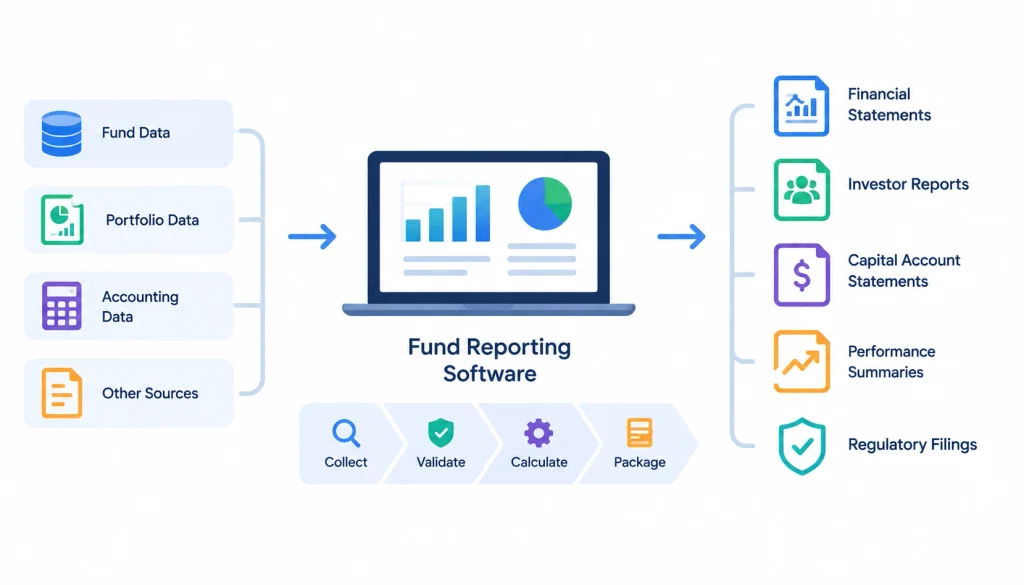
Fund reporting software is a platform that takes raw fund and portfolio data and turns it into finished reports (financial statements, investor letters, capital account statements, performance summaries, and regulatory filings) with far less manual work than spreadsheets require.
Some platforms handle reporting on top of a general ledger they also maintain. Others sit above your existing accounting system and just handle the reporting layer. Either way, the job is the same: collect data, check it, calculate the numbers that matter, and package everything for the people who need to see it.
1. What fund reporting software does
At a practical level, these tools:
- Pull data from accounting systems, portfolio trackers, and custodians
- Consolidate numbers across multiple funds, entities, and currencies
- Run standard calculations like NAV, IRR, and capital account rollforwards
- Generate reports in the formats LPs, auditors, and regulators expect
- Route drafts through review and approval before anything goes out
- Deliver finished reports securely, often through an investor portal
- Keep a record of who changed what and when, for audit purposes
2. Who uses fund reporting software
The buyers are usually general partners, fund controllers, and finance teams at investment firms, plus the fund administrators who handle back-office work on their behalf. Investor relations teams rely on it for LP communications, and compliance staff use it when regulatory filings are involved. A CFO at a mid-size PE firm and a one-person controller function at an emerging VC fund will use the same category of software very differently, but the underlying need, accurate reports with less manual effort, is the same.
3. What types of funds use it
Private equity, venture capital, private credit, real estate, hedge funds, and fund-of-funds vehicles all use some version of this software. So do family offices managing multiple entities and fund administrators serving several clients at once. The reporting requirements differ by strategy (a real estate fund cares about property-level rent rolls in a way a VC fund doesn’t), which is part of why fund-type fit matters so much in vendor selection, a point we’ll come back to.
What Does Fund Reporting Software Actually Report?
It helps to know what’s actually coming out the other end before you evaluate vendors on features. Reports generally fall into four buckets.
Fund financial reports cover balance sheets, income statements, cash flow statements, general ledger detail, and net asset value (see Wikipedia’s overview of net asset value for the accounting mechanics). These are the books-and-records side of reporting.
Investor and LP reports include capital account statements, capital call notices, distribution notices, and quarterly investor letters. This is the reporting LPs actually read, so formatting and clarity matter as much as accuracy.
Portfolio reports track portfolio company or asset-level performance: valuations, KPIs, exposure by sector or geography, and investment-level returns like IRR and MOIC.
Regulatory and compliance reports cover filings and disclosures required by regulators, along with the documentation auditors need at year-end. Depending on your jurisdiction and fund structure, this might mean Form PF, Form ADV, or other filings your compliance team tracks closely.
Fund Reporting Software vs. Fund Accounting vs. Fund Administration
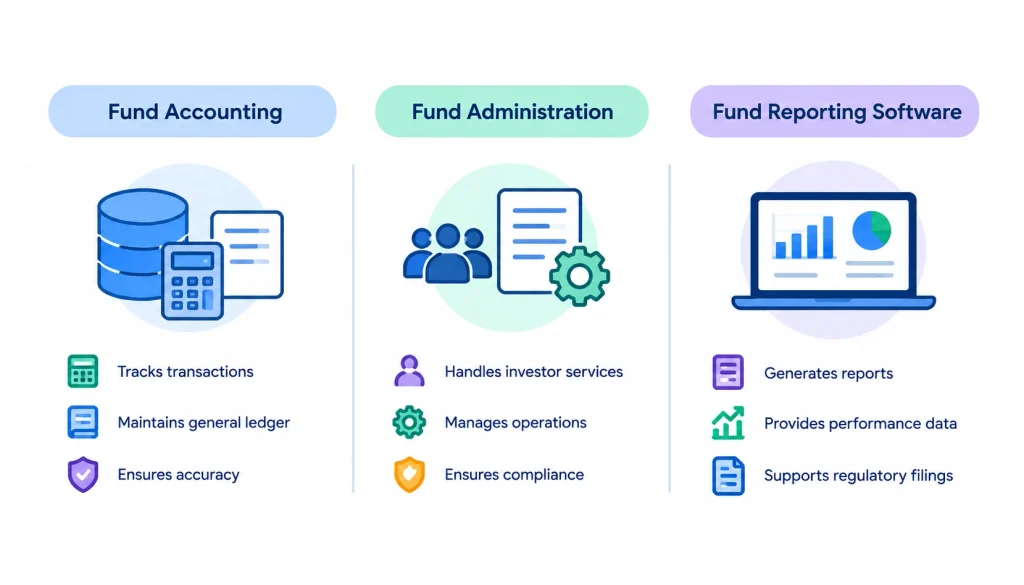
This is where a lot of buyers get confused, and honestly, vendors don’t always help. Many blur these categories in their own marketing because their products span more than one.
| Capability | Reporting Software | Fund Accounting | Fund Administration |
| Financial books | Sometimes | Core function | Usually |
| Investor reporting | Core function | Often included | Often included |
| Portfolio monitoring | Varies | Limited | Varies |
| LP portal | Often included | Sometimes | Often included |
| Regulatory reporting | Often included | Often included | Often included |
| Data consolidation | Core function | Core function | Core function |
| Administration workflows | Limited | Limited | Core function |
Fund accounting software keeps the books, while strong bookkeeping and accounting processes provide the underlying financial records that reporting systems rely on. Fund administration covers the broader operational work a back office does: accounting plus investor onboarding, capital calls processing, and more. Fund reporting software is the layer that turns whatever’s in the books into something a human can read and act on.
When do you need one platform instead of multiple systems?
If your fund is small and your data lives in one clean general ledger, a single combined platform usually makes sense: less integration work, one vendor relationship, one login for your team. Once you’re running several funds, multiple entities, or a mix of asset classes, the calculus changes. At that point, a dedicated reporting layer that pulls from whatever accounting system you already trust can be less disruptive than ripping out your books to adopt an all-in-one platform. Threads on privateequity and AccountingPE regularly cover this exact debate from people who’ve lived through both setups. Worth a read if you want unfiltered opinions before a vendor call.
Key Features to Look for in Fund Reporting Software
A few features separate genuinely useful platforms from glorified spreadsheet replacements.
Automated report generation. The software should build reports from a template and live data, not require someone to copy numbers into a Word doc every quarter.
Multi-fund and multi-entity reporting. If you run more than one fund or have SPVs and blockers in your structure, the platform needs to consolidate across all of them without manual workarounds.
Investor and LP reporting. This includes capital account statements, capital call and distribution notices, and the ability to customize what each LP sees based on their commitment and side letter terms.
Portfolio reporting. For PE and VC funds especially, you’ll want portfolio company KPI tracking and valuation support built in or well integrated.
Financial consolidation. The system should combine data across entities and currencies correctly, including intercompany eliminations where relevant.
Custom report builder. Templates rarely fit every LP’s requested format exactly, so the ability to adjust layout and content without an engineering ticket matters.
Workflow and approval automation. Reports should route through review before they go out the door, with a clear record of who approved what.
Audit trails and version control. Every change should be logged. This isn’t optional if you’re dealing with institutional LPs or auditors.
Investor portal. A secure place for LPs to log in and retrieve their own documents, rather than everything going out over email.
Regulatory reporting. Built-in support for the filings your fund type requires saves real time at deadline.
Data validation and reconciliation. The software should flag numbers that don’t tie out, not just accept whatever gets fed in.
APIs and integrations. Connections to your general ledger, portfolio monitoring tool, CRM, and data warehouse determine how much manual data entry survives implementation.
Role-based access controls. Not everyone on your team, or at your fund administrator, should see everything.
AI-powered reporting and analytics. Increasingly common, though the maturity varies a lot by vendor. More on this later.
Best Fund Reporting Software Platforms to Consider
A quick note on methodology before the list: this comparison is based on publicly available vendor documentation and product pages as of 2026. Where a claim comes directly from a vendor, we’ve noted it as such rather than presenting it as independently verified. Pricing and feature depth change often in this space, so confirm current details directly with each vendor before you commit.
1. Quick comparison
| Platform | Best suited for | Accounting | Investor reporting | Portfolio reporting | Portal | Integrations | Pricing |
| Workiva | Enterprise financial & regulatory reporting | Partial | Yes | Varies | Yes | Strong | Custom |
| FIS | Investment accounting across asset classes | Yes | Yes | Limited | Varies | Strong | Custom |
| Entrilia | PE/VC firms wanting an integrated platform | Yes | Yes | Yes | Yes | Growing | Custom |
| Allvue | Multi-strategy funds needing deep fund accounting | Yes | Yes | Yes | Yes | Strong | Custom |
2. Workiva
Workiva positions itself around connected data and automated financial reporting for investment firms, with features for investor communications, regulatory filings, audit trails, and reporting across multiple funds. It’s built for organizations that need reporting to tie tightly into broader financial and regulatory workflows, not just LP-facing documents.
3. FIS
FIS markets its Investment Accounting Manager as a modular, SaaS-based platform that supports multiple investment types, asset classes, and accounting methodologies. It leans more heavily into the accounting side of the equation, which makes it a common choice for firms that need robust investment accounting first and reporting layered on top.
4. Entrilia
Entrilia takes a broader approach aimed at private equity and alternative asset managers, combining fund accounting with investor insights, an investor portal, portfolio monitoring, and data integrations. The company has also been building out agentic AI features for reporting workflows, which is worth asking about directly if that’s a priority for your team.
5. Allvue
Allvue combines fund accounting (including partnership accounting and a multi-currency general ledger) with investor reporting, cash management, and portfolio monitoring. According to the vendor, the platform runs on Microsoft Azure and Dynamics infrastructure with SOC 1 and SOC 2 alignment, and it explicitly supports PE, VC, private debt, CLOs, and fund-of-funds structures.
6. Other platforms worth evaluating
Depending on your fund type and size, it’s worth putting these on your shortlist too: eFront, Dynamo, Investran (now part of FIS’s Private Capital Suite), Juniper Square, Carta, FundCount, Chronograph, Visible, Cobalt, and Qapita. Some of these are full fund-accounting platforms; others are lighter-weight LP-reporting layers meant to sit on top of accounting data you already have elsewhere. Don’t assume two vendors in the same shortlist are solving the same problem; check which layer of the stack each one actually covers.
Best Fund Reporting Software by Use Case
Private equity funds typically need strong waterfall calculations, capital account tracking across multiple share classes, and portfolio company KPI reporting for their investment committee.
Venture capital funds usually prioritize a simpler cap table and capital account structure but want fast, clean quarterly reporting and portfolio valuation tracking that doesn’t require a finance team the size of a PE shop.
Private credit funds need reporting built around loan-level data (interest accruals, covenant tracking, and payment schedules), which not every platform handles well out of the box.
Real estate funds need property-level reporting, rent rolls, and often more granular cash flow tracking than a typical PE platform is built for.
Fund administrators managing multiple client funds need multi-client architecture, strict data segregation, and the ability to apply different reporting templates per client without duplicating work.
Emerging fund managers are usually price-sensitive and need something they can implement quickly without a large operations team. This is where lighter LP-reporting tools sometimes beat full accounting platforms.
Enterprise investment firms running many funds and entities need deep consolidation, strong API access, and enterprise-grade security more than they need simplicity.
How Fund Reporting Software Fits Into Your Technology Stack
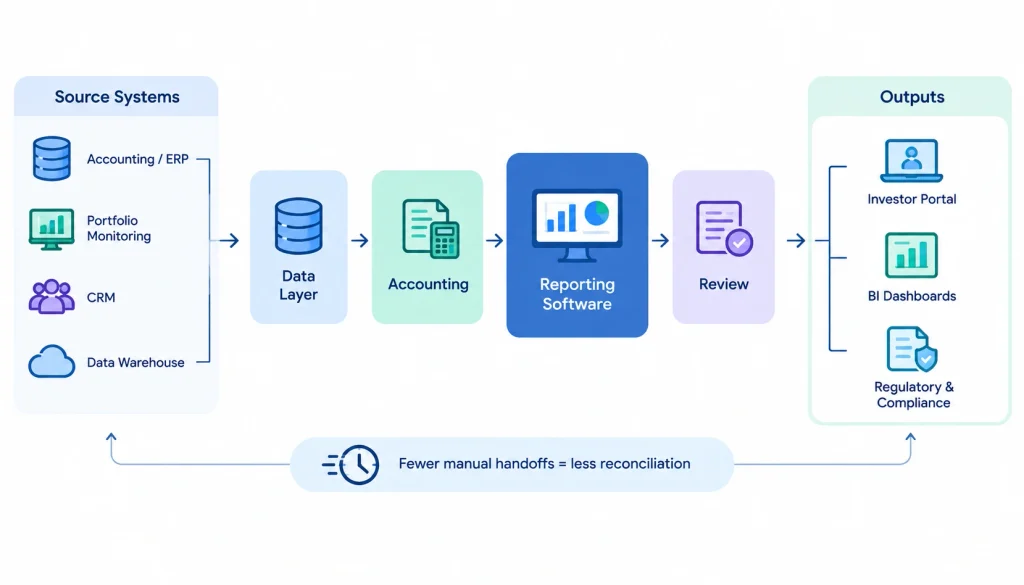
Reporting software rarely works alone. It usually sits between your source systems and the reports that leave the building:
Source systems → data layer → accounting → reporting engine → review → investor portal
On the input side, It typically connects to your accounting or ERP system, including accounting software with analytics capabilities, a portfolio monitoring tool, your CRM for investor contact and commitment data, and sometimes a data warehouse if you’re consolidating from several sources. On the output side, it feeds your investor portal and, in some cases, your business intelligence tools for internal dashboards. Regulatory and compliance systems may also need a feed, depending on what you’re required to file.
The fewer manual handoffs between these systems, the less time your team spends reconciling numbers that should already match.
How Automated Fund Reporting Works
Here’s the process most platforms follow, whether or not they market it this way:
- Collect fund and portfolio data from accounting systems, custodians, and portfolio trackers.
- Validate and reconcile data to catch mismatches before they end up in a report.
- Consolidate funds and entities, including intercompany eliminations where needed.
- Calculate performance and investor metrics, NAV, IRR, MOIC, capital account balances, and similar figures.
- Generate reports using templates mapped to the calculated data.
- Review and approve drafts internally before anything is finalized.
- Distribute reports securely, usually through an investor portal rather than email attachments.
- Preserve the audit trail so every number can be traced back to its source.
Skipping steps 2 and 6 is how bad numbers end up in an LP’s inbox. Good software makes those steps hard to skip, not just possible to do.
What Reports Should Your Fund Reporting Software Generate?
| Report | Audience | Frequency | Purpose |
| NAV report | Finance, LPs | Monthly or quarterly | Fund valuation |
| Capital account statement | LPs | Quarterly | Investor position tracking |
| Capital call notice | LPs | As needed | Funding requests |
| Distribution statement | LPs | As needed | Distribution details |
| Portfolio report | GP, investment committee | Monthly or quarterly | Investment monitoring |
| Financial statements | Finance, auditors | Quarterly or annual | Financial reporting |
| Performance report | GP, LPs | Quarterly | Fund performance |
| Regulatory filing | Regulators | Periodic | Compliance |
How Much Does Fund Reporting Software Cost?
Almost no vendor in this space publishes pricing on their website, which is frustrating but common for enterprise financial software. Expect a sales call before you see a real number.
1. Common pricing models
Pricing tends to follow one of a few patterns: custom enterprise quotes, per-user licensing, fees based on assets under management, fees based on the number of funds or entities managed, or modular pricing where you pay separately for accounting, reporting, and portal access.
2. Additional costs to budget for
The license fee is rarely the whole story. Budget for implementation, data migration from your existing spreadsheets or legacy system, integration setup with your accounting and portfolio tools, custom report template design, training, and ongoing support. On a mid-size implementation, these costs can add up to a meaningful fraction of year-one license spend.
3. How to compare total cost of ownership
Ask each vendor for a full first-year cost estimate, not just the license fee, and get a sense of what year two looks like once implementation is behind you. A cheaper license with expensive implementation can end up costing more than a pricier platform that’s faster to stand up.
How to Choose Fund Reporting Software
- Define your reporting requirements. List the exact reports you need to produce today, plus any you expect to need as the fund grows.
- Map your current data sources. Know where your fund’s data actually lives before you evaluate anyone’s integration claims.
- Identify required reports. Match your list against what each vendor can actually generate out of the box versus what needs custom work.
- Define integrations. Confirm the platform connects cleanly to your accounting system, portfolio tools, and CRM.
- Evaluate security and compliance. Ask for SOC 1 or SOC 2 reports directly rather than taking a marketing page at face value.
- Test reporting workflows. Have your finance team walk through an actual quarterly close cycle in a demo environment, not just a canned presentation.
- Compare implementation requirements. Ask how long a comparable client took to go live, not just the vendor’s best-case timeline.
- Run a vendor demo using your own data. This is the single best way to catch problems before you sign a contract.
Fund Reporting Software Demo Checklist
Bring these questions to every vendor call:
Data and integrations: Which systems does this connect to out of the box? What does a custom integration cost and how long does it take? Can it handle multi-currency data?
Reporting: Can we build a custom report template ourselves, or does every change go through support? How are capital account statements generated per LP?
Investor communications: Does the portal support side-letter-specific reporting? Can we control what each LP sees?
Automation: What parts of the process still require manual data entry? How does the system flag data that doesn’t reconcile?
Security: What certifications does the platform hold? Where is data hosted and stored?
Scalability: How does pricing change as we add funds or entities? Has this platform been tested at our target scale?
Administration: Can our fund administrator access the system directly if we use one?
Support: What does onboarding look like, and who do we call when something breaks at 11pm before an LP call?
Common Fund Reporting Challenges and How Software Solves Them
Too many spreadsheets. When every fund, entity, and report lives in its own workbook, errors multiply fast. Reporting software consolidates that into one system of record.
When financial data is scattered across systems, better financial management and reporting processes can help consolidate information and reduce manual work
Duplicate data entry. Manually re-entering numbers between accounting and reporting tools wastes time and introduces mistakes. Integrations remove that step.
Reconciliation problems. Numbers that don’t tie out between systems are one of the most common sources of delayed reporting. Built-in validation catches these earlier.
Inconsistent investor reports. Without templates, report formatting drifts over time and between team members. A shared template library keeps things consistent.
Manual report formatting. Copying numbers into a Word or PDF template by hand is slow and error-prone. Automated generation removes that bottleneck.
Slow quarter-end close. Manual processes stretch out over weeks. Automated data collection and calculation can compress that meaningfully.
Lack of auditability. Spreadsheets don’t track who changed what. Reporting software logs every edit.
Data scattered across systems. Consolidation tools pull everything into one place instead of forcing your team to hunt across five logins.
Growing fund and entity complexity. What works for one fund breaks down at five. Purpose-built software scales in a way spreadsheets don’t.
Fund Reporting Software Implementation
Implementation is where good software either pays off or turns into a headache. Expect these phases:
Data migration: moving historical fund data from spreadsheets or a legacy system into the new platform, and checking it matches.
System configuration: setting up your fund and entity structure correctly.
Integration setup: connecting your accounting system, portfolio tools, and CRM.
Report template creation: building the templates your LPs and internal team actually need.
User permissions: setting role-based access for your team and any external stakeholders.
Testing and reconciliation: running a full cycle against known numbers before going live.
Training and rollout: making sure your team can actually use the system day to day.
Ongoing optimization: refining templates and workflows as reporting needs change.
Rushing the testing and reconciliation phase is the most common implementation mistake. It’s tempting to go live fast, but a platform that produces wrong numbers quickly is worse than a spreadsheet that produces right numbers slowly.
Can Fund Reporting Software Replace Excel?
1. Where Excel still works
For a very small fund with one entity and a handful of LPs, a well-built spreadsheet can still get the job done. There’s no shame in that, and plenty of emerging managers run this way successfully for their first fund.
2. Where Excel becomes risky
Once you’re managing multiple funds, multiple entities, or a growing LP base, spreadsheets start breaking in predictable ways, broken formulas, version control chaos, and no real audit trail. Institutional LPs also increasingly expect a level of reporting polish and security that a shared Excel file can’t provide.
3. How software and Excel can coexist
Most funds don’t do a clean cutover. It’s common to keep Excel for ad hoc analysis and modeling while moving the recurring, LP-facing reporting into dedicated software. That split keeps flexibility where you need it and control where it matters most.
AI in Fund Reporting Software
AI is showing up in most fund reporting platforms now, with varying degrees of actual usefulness.
Automated report narratives: drafting the written commentary sections of an LP letter based on the underlying numbers, which a human then edits.
Data anomaly detection: flagging numbers that look off compared to historical patterns before a human catches them manually.
Natural-language data queries: letting a finance team ask a question about fund data in plain English instead of writing a query.
Automated reconciliation assistance: speeding up the matching process between systems, though rarely replacing human review entirely.
Report generation: pulling data into a draft report faster than a manual process would.
Risks and controls for AI-generated financial outputs
None of this should replace financial controls. AI-generated numbers still need human review before they go to an LP or a regulator, the same way a junior analyst’s work would. If a vendor pitches AI as a way to skip review steps rather than speed them up, that’s worth pushing back on directly.
Security and Compliance Requirements
Fund data is sensitive, and LPs increasingly ask about security before they’ll even engage with a new fund. At minimum, look for SOC 1 and SOC 2 attestations, data encryption at rest and in transit, role-based permissions, detailed audit trails, version control on documents, clear data residency policies, support for the regulatory reporting your fund type requires, and a documented disaster recovery plan. Ask vendors for their actual SOC reports rather than accepting a badge on a marketing page, a real audit report will tell you exactly what was tested and when.
Frequently Asked Questions
1. What is fund reporting software?
It’s software that collects fund and portfolio data, runs the standard calculations, and generates the reports investors, auditors, and regulators need, replacing manual spreadsheet-based reporting.
2. What is the difference between fund accounting and fund reporting software?
Fund accounting software maintains the financial books. Fund reporting software turns that financial data into finished, distributable reports. Many platforms today do both, but the two functions are conceptually distinct.
3. What features should fund reporting software have?
At minimum: automated report generation, multi-fund consolidation, investor reporting, an audit trail, and integrations with your accounting and portfolio tools.
4. How much does fund reporting software cost?
Most vendors use custom pricing based on fund size, number of entities, or user count, so expect a sales conversation rather than a published price.
5. Can fund reporting software automate LP reporting?
Yes. Most platforms automate capital account statements, capital calls, distributions, and quarterly letters, though templates still need human review before distribution.
Conclusion
Choosing fund reporting software isn’t about finding the vendor with the longest feature list; it’s about finding a platform that fits your fund structure, reporting requirements, existing systems, and growth plans.
Look for strong accounting integrations, investor and LP reporting, multi-entity support, automation, security, audit trails, and reliable scalability, while considering the full cost of implementation and ongoing support. Before making a decision, run demos using your own data, test the workflows your team relies on, and ask detailed questions about pricing, integrations, implementation timelines, and support.
The right software should reduce manual work, improve reporting accuracy, and make every reporting cycle more efficient, not simply replace one complicated process with another.
