

Yes, it is possible to run multiple businesses under one LLC. This setup allows multiple business activities to be managed under a single legal company, which can simplify management, reduce costs, streamline operations, and reduce administrative work.
However, business owners should consider whether the different businesses fit well together and make sense under the same LLC structure. It is also important to consult an LLC business attorney to determine whether this approach is appropriate for your specific situation.
While operating multiple businesses under one LLC can be convenient, it also carries risks, including shared liability, which means legal or financial issues involving one business could potentially affect the other businesses operating under the same LLC.
Can you have multiple businesses under one LLC?

Yes, in most U.S. states one LLC can run several business activities. An LLC is a legal entity. It is not limited to one product, one brand, or one type of work, unless your state, your license, or your own operating agreement says otherwise.
Think of the LLC as a container. You can put one business in it or five. The state sees one company. Your customers might see five brands.
Here is a simple example. Maria forms Ridgeway Ventures LLC. Under it she runs Ridgeway Consulting, Ridgeway Marketing, and Ridgeway Training. Legally, there is one company. Each brand is a trade name it operates under.
If you want the background on how the LLC works as a structure, the Wikipedia article on limited liability companies is a decent starting point. The SBA’s guide to choosing a business structure covers the basics from a government source.
Is it better to have multiple businesses under one LLC?
It is generally more practical to operate multiple businesses under one LLC when the businesses are closely related, owned by the same people, and carry similar levels of risk. It can be less suitable when one business could expose the others to significant liability or when you may eventually want to sell, finance, or bring separate ownership into one business independently.
The key question is not simply, “What is cheapest?” but rather, “What is the worst thing that could happen in each business, and am I comfortable with that risk affecting the others?” Business owners should also understand LLC tax filing for small business owners, including how the LLC’s tax treatment can affect reporting and tax obligations as the business structure becomes more complex.
Consulting a qualified tax professional or business attorney can help determine whether using one LLC for multiple businesses fits your situation.
One LLC may be the better fit when
- You are the only owner of every business, or the same owners hold all of them.
- The businesses carry similar and fairly low risk.
- They are related, like consulting and training in the same field.
- They share customers, tools, or staff.
- You are testing a new idea and don’t want to pay for a new entity yet.
- Keeping paperwork simple matters more to you than strict separation.
Separate LLCs may be the better fit when
- One business is much riskier than the others.
- The businesses have different owners or investors.
- One business owns valuable assets, such as real estate or equipment.
- You might sell one business and keep the rest.
- The businesses are in unrelated industries.
- A state or industry rule pushes you toward separation.
One LLC vs multiple LLCs: side-by-side comparison
This table gives the general pattern. Your state and facts can change it.
| Factor | One LLC | Separate LLCs |
| Formation cost | One filing fee | A filing fee for each LLC |
| Ongoing fees | One annual report or franchise fee, in states that charge one | Repeated for each LLC |
| Liability between businesses | Shared. One business’s debts and claims can reach the others | Better separation between businesses |
| Branding | May need a DBA for each brand name | Each business can use its own legal name |
| Taxes | One entity, but each business activity still needs clear records | Each LLC has its own tax treatment |
| Accounting | Centralized, but you must track each business inside it | Separate books by default |
| Ownership | Everyone owns the whole entity | Different owners per business are easier |
| Selling one business | Harder, since assets and contracts sit together | Cleaner, since the business is its own entity |
| Financing | One lender or investor looks at the whole entity | Lenders and investors can focus on one business |
| Admin workload | Lower | Higher |
Advantages of putting multiple businesses under one LLC
1. Lower formation and administrative costs
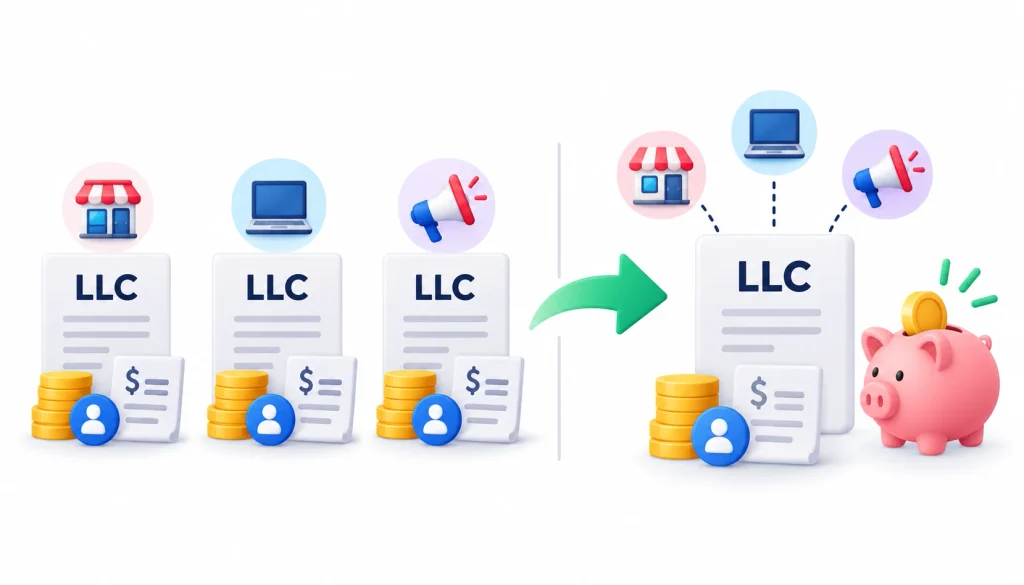
Every LLC comes with a state filing fee. Many states also charge annual fees or require annual reports, and you may need a registered agent for each entity. With one LLC, you pay those once. Fees vary a lot by state, so check your Secretary of State’s website for current numbers.
2. Simpler management
One operating agreement. One set of annual deadlines. One entity to keep in good standing. If you run everything yourself, that matters.
3. Shared resources
When your businesses use the same bank relationship, software, and team, one entity can be less awkward. You avoid billing one LLC for work done by another.
4. Easier to test new ideas
Launching a new service line under your existing LLC is quick. If the idea fails, you close a brand, not a company.
Disadvantages and risks of multiple businesses under one LLC
1. Shared liability
This is the big one. An LLC separates your personal assets from the company’s debts in most situations. It does not build walls between businesses inside the same LLC. A claim against one business can generally reach assets used by the others.
2. Messier accounting
You can run clean books for several businesses in one LLC, but it takes discipline. Without separate tracking, you won’t know which business makes money.
3. Harder to sell one business
If a buyer wants only one of your businesses, you have to untangle contracts, licenses, bank accounts, and assets from the rest. That takes time and legal work.
4. Different risk levels cause trouble
A low-risk consulting practice sitting next to a business with employees, vehicles, or foot traffic is a mismatch. The safer business pays the price for the riskier one.
5. Ownership and financing complications
If a partner or investor wants into one business only, one shared LLC makes that awkward. They would own part of everything unless you restructure.
How liability works when multiple businesses share one LLC
Liability is where most people get this decision wrong, so it deserves a closer look.
1. One LLC means one legal entity
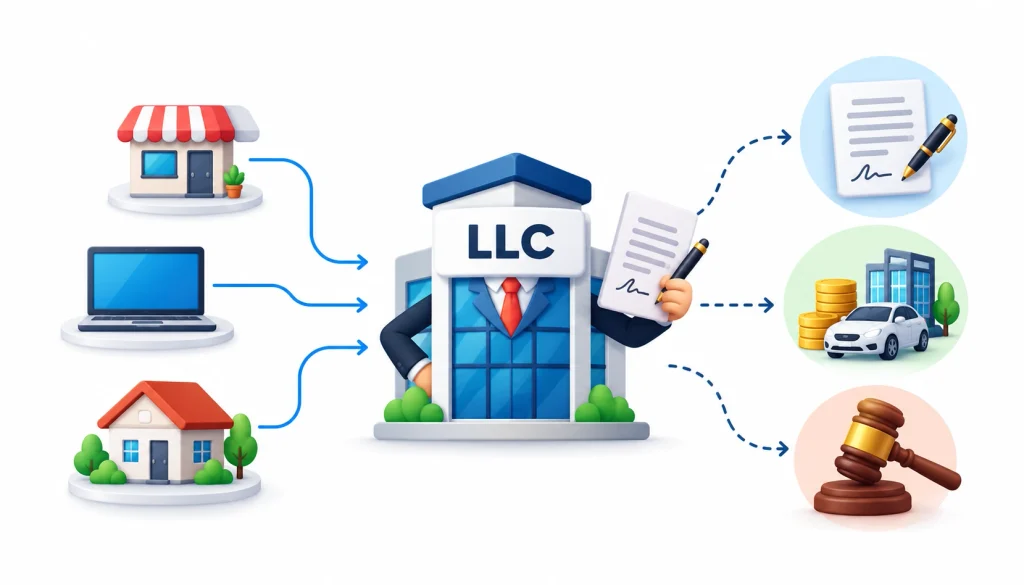
The law treats your LLC as one person-like entity. It signs contracts, owns assets, and can be sued. Your brand names do not change that. Whether you call a business “Ridgeway Consulting” or “Ridgeway Rentals,” the party on the contract is Ridgeway Ventures LLC.
2. What happens if one business is sued?
Say you run a small marketing agency and a short-term rental out of the same LLC. A guest is seriously injured at the rental and sues. The lawsuit names the LLC. The LLC’s assets, which may include the agency’s bank account and receivables, can be exposed to a judgment.
Now change the setup. The agency is in one LLC and the rental is in another. The injured guest generally has to go after the rental LLC. The agency’s assets are usually out of reach, though a court can look at the facts. Insurance still matters in both setups.
3. An LLC does not remove every risk
An LLC does not protect you from your own wrongdoing or from personal guarantees you sign. If you guarantee a loan, the lender can come after you. Courts can also set aside LLC protection in some situations, an idea known as piercing the corporate veil. Mixing personal and business money is a common trigger.
4. Why records matter
Keep your LLC’s finances, contracts, and paperwork in order. Use a business bank account. Sign contracts in the LLC’s name. Follow your operating agreement and state filing rules. Good habits make it much easier to defend the structure if anyone challenges it.
When should you use one LLC for multiple businesses?
Here are the situations where one LLC tends to work well.
Related businesses. A web design studio and a hosting service for the same clients are a natural pair.
Similar risk. Two desk-based service businesses with no employees on site or heavy equipment share about the same exposure.
Same owners. If every business has identical owners, shared ownership is not a problem.
Shared customers and tools. When clients and resources overlap, one entity is easier to run.
Early-stage experiments. Before a new idea earns money, paying for a separate entity may be premature.
Small operations. For a solo owner with modest income, the savings in time and fees can be real.
When should you consider separate LLCs?
Here is when splitting usually makes sense.
Different risk levels. Put the higher-risk business in its own LLC so a claim there stays contained.
Different owners. If you run one business with a partner and another alone, separate entities keep ownership clean.
Valuable assets. Real estate, expensive equipment, and intellectual property are often better held apart from a business that deals with the public. For businesses that also manage physical products, inventory management software can help maintain accurate records of stock and business assets.
A planned sale. A buyer can purchase a standalone LLC more easily than a division of a shared one.
Different investors. An investor in one venture usually does not want a share of unrelated ventures.
Unrelated industries. If the businesses have nothing in common, there is little reason to tie them together.
Regulatory rules. Some licensed professions and regulated industries have their own entity rules. Check your licensing board.
How to run multiple businesses under one LLC
If you go with one LLC, set it up carefully.
- Form the LLC. File articles of organization with your state and appoint a registered agent.
- Write an operating agreement. Even a single-member LLC benefits from one. List the business lines it will run.
- Register DBAs where needed. Most states require you to register a trade name if you operate under any name other than the LLC’s legal name.
- Open a business bank account. Consider tracking each business by sub-account or by class in your accounting software.
- Track income and expenses by business. You will want to know what each business earns and spends, especially when multiple businesses operate under the same LLC. Keeping separate financial records can make it easier to prepare accurate tax reports and understand the performance of each business. It can also help small business owners better understand CIS tax, including what it is, who it applies to, and how it affects payments and tax reporting.
- Check licenses and permits. Local, state, and industry licenses are often tied to the activity, not just the entity.
- Review insurance. Make sure your policies cover every activity the LLC runs. Tell your insurer what you do.
- Check your state’s rules. Fees, DBA filing places, and annual report rules are set at the state level, and sometimes the county or city.
Do you need a DBA for multiple businesses under one LLC?
Usually yes, if you use any name other than the LLC’s exact registered name.
1. What a DBA is
A DBA stands for “doing business as.” It is also called a trade name or fictitious name. It lets a company operate publicly under a different name. You can read a short overview on Wikipedia’s page on doing business as.
2. When you need one
If Ridgeway Ventures LLC wants to sell under the name Ridgeway Training, it generally needs to register that name. Where you register depends on the state. It might be the state, the county, or both.
3. Can one LLC have multiple DBAs?
Yes. Many states allow an LLC to register several trade names. Each one usually carries its own fee and renewal schedule.
4. A DBA does not create a separate LLC
This point trips up a lot of owners. A DBA is a name. It does not create a new legal entity and it does not wall off liability. If Ridgeway Training is sued, the defendant is still Ridgeway Ventures LLC.
What is a Series LLC?
A Series LLC is a special kind of LLC that lets you create internal “series,” each with its own assets and liabilities, under one umbrella entity. The goal is to get separation between businesses without forming a new LLC for each one.
1. How it works
In states that allow it, you file once for the master LLC and then set up series according to the state’s rules and your operating agreement. Each series is meant to keep its own records and assets.
2. Limits you should know
Only some states permit Series LLCs, such as Delaware, Texas, and Illinois. Rules differ widely. Some states have detailed requirements for how series must be set up and recorded. Courts outside those states may not treat series the way you expect, and banks, lenders, and tax agencies can handle them differently.
If you operate in more than one state, get advice from an attorney who knows Series LLC law in each of them. Do not assume it works the same everywhere.
3. What is a holding company structure?
A holding company, sometimes called a parent LLC, owns other companies instead of (or in addition to) running a business itself. The companies it owns are subsidiaries.
For example, Maria could form Ridgeway Holdings LLC. It would own 100% of Ridgeway Consulting LLC and Ridgeway Rentals LLC. Each subsidiary runs its own business and carries its own liability. The parent owns the shares or membership interests.
This setup suits owners with several valuable or higher-risk businesses, or owners who plan to sell, bring in investors, or hold assets separately. It also adds cost and paperwork, since each subsidiary needs its own filings. See the Wikipedia overview of holding companies for general background.
Tax considerations for multiple businesses under one LLC
Taxes are where oversimplified advice does the most damage, so go slowly here.
1. Legal entity vs tax classification
An LLC is a legal structure. It is not a tax category. The IRS decides how an LLC is taxed based on its members and any elections it makes. The IRS page on LLCs explains the defaults.
In general, a single-member LLC is taxed as a disregarded entity (reported on the owner’s personal return), and an LLC with two or more members is taxed as a partnership. Either kind can elect to be taxed as a corporation, including an S corporation, if it qualifies.
2. Pass-through taxation
Under the default rules, the LLC’s profit passes through to the owners and is taxed on their personal returns. The LLC itself does not usually pay federal income tax. That is not the same as owing no tax.
3. Tracking each business separately
Even when the IRS sees one entity, you should know the numbers for each business. A single-member LLC with several unrelated businesses may need to report each one separately on the owner’s return. Ask a tax professional how that applies to you.
4. EIN considerations
An EIN is an Employer Identification Number issued by the IRS. One LLC generally uses one EIN. Separate LLCs each need their own. A DBA does not get its own EIN. The IRS has a page on who needs an EIN if you want the official rules.
5. State taxes
States handle LLC taxes differently. Some charge a flat annual fee. Some charge a franchise tax based on income or net worth. Some require sales tax registration for each type of sale. Check your state revenue department.
6. When to bring in a tax professional
Talk to a CPA or enrolled agent when you have multiple businesses with different income levels, when you are thinking about an S corporation election, when you hire employees, or when you sell goods in more than one state.
Should each business have a separate bank account?
The LLC should have its own bank account, separate from your personal money. That part is not optional if you want to keep your liability protection solid.
Whether each business needs its own account is a judgment call. Many owners open one account per business line because it makes bookkeeping simple. Others use one account and rely on accounting software categories. Both approaches can work.
What matters is that you can answer, for any month, how much each business earned and spent. Never pay personal bills from the business account or deposit business income into a personal one.
Here is a quick example. Ridgeway Ventures LLC has one bank account and one credit card. In the accounting software, Maria tags every transaction as Consulting, Marketing, or Training. At month end she can see that Training lost money while Consulting carried the company. She would not know that without the tags.
Real-world examples: one LLC or multiple LLCs?
Example 1: SEO agency and content writing. Same owner, same clients, similar low risk. One LLC is likely a sensible choice.
Example 2: Software consulting and a rental property. The rental carries injury risk and holds a large asset. Most advisors would at least consider separate LLCs here.
Example 3: Consulting and a high-risk physical business. Think of a consultant who also runs a landscaping crew with trucks and equipment. A single accident could hurt the whole LLC. Separation makes sense.
Example 4: Two businesses with different owners. If you own one business with a partner and another alone, keep them in separate entities so each group owns only what it should.
Example 5: Testing a new idea. You run a design practice and want to try an online course. Start under the current LLC with a DBA. If the course takes off or grows risky, move it into its own LLC.
Decision tree: should you use one LLC or multiple LLCs?
Work through these questions in order.
- Do all the businesses have the same owners?
- No: consider separate entities.
- Yes: go to question 2.
- Do they carry similar risk?
- No: consider separate LLCs.
- Yes: go to question 3.
- Does any one business own valuable assets, like real estate?
- Yes: consider holding those assets in a separate entity.
- No: go to question 4.
- Do you plan to sell or bring investors into one of them?
- Yes: consider separation now.
- No: go to question 5.
- Do they share customers and resources?
- Yes: one LLC may make sense.
- No: one LLC is still possible, but you have less reason to combine them.
This is a general framework, not legal advice. A lawyer can tell you how your state’s rules affect the answer.
One LLC vs multiple LLCs: cost and complexity
Exact costs depend on your state, so I won’t give numbers. Here is what changes when you add LLCs.
| Item | One LLC | Multiple LLCs |
| Formation filing | Once | Each LLC |
| Annual reports and fees | One | One per LLC |
| Registered agent | One | One per LLC (often one provider can serve all) |
| Bank accounts | At least one | At least one per LLC |
| Bookkeeping | One set, tracked by business | Separate sets |
| Tax returns | Depends on classification | Possibly one per LLC |
| Licenses and permits | Per activity | Per LLC and activity |
| Insurance | One program covering all activities | Policies per LLC, or a shared policy with each named |
The extra cost of multiple LLCs is real, but it is often small next to what an uncovered lawsuit can cost. That trade-off is the heart of the decision.
How to decide: a 7-factor checklist
- Liability risk. Which business could produce the biggest claim? If one is much riskier than the others, lean toward separation.
- Ownership. Same owners everywhere points to one LLC. Different owners point to several.
- Business assets. Valuable property or equipment often belongs in its own entity.
- Tax structure. Ask whether different tax treatment could help one business, such as an S corporation election.
- Administrative cost. Add up fees, accounting time, and filings for each option.
- Exit strategy. If you could sell a business in the next few years, set it up to be sold.
- State and industry rules. Check licensing, DBA rules, and Series LLC availability where you operate.
Common mistakes when running multiple businesses under one LLC
- Believing a DBA protects one brand from another.
- Mixing personal and business money.
- Not tracking each business’s numbers.
- Skipping insurance or buying a policy that does not cover every activity.
- Assuming tax and filing rules are the same in every state.
- Forgetting local licenses and permits for each activity.
- Waiting until a lawsuit or a sale to separate the businesses. Moving assets after a claim arises can be treated as an attempt to dodge creditors.
Owners also compare notes in public forums. Communities like smallbusiness on Reddit are useful for hearing how others handled the same choice. Treat what you read there as personal experience, not legal advice.
Frequently asked questions
Is it better to have multiple businesses under one LLC?
It is better when the businesses are related, have the same owners, and carry similar low risk. It is worse when risk, ownership, or assets differ a lot, or when you may sell one business separately.
Can an LLC own multiple businesses?
Yes. One LLC can run several business activities, and it can also own other LLCs as a parent company.
How many businesses can one LLC have?
Most states set no fixed limit. The practical limits come from your licenses, insurance, and how well you can keep records.
Can one LLC have multiple DBAs?
Yes, in most states. Each DBA is registered separately and may have its own fee and renewal.
Does each business under an LLC need a separate EIN?
Generally no. One LLC normally uses one EIN, and DBAs share it. Separate LLCs each need their own. Confirm with the IRS or a tax professional for your case.
Are multiple businesses under one LLC taxed separately?
Not as separate entities, in most cases. The IRS sees one LLC. But you still need to track each business’s income and expenses, and a tax professional can tell you whether you must report them separately.
Does a lawsuit against one business affect the other businesses?
It can. When businesses share one LLC, a judgment against the LLC can reach assets used by all of them. Insurance helps but may not cover everything.
Should I have a separate LLC for each business?
Not necessarily. Use separate LLCs when risk, ownership, assets, or exit plans differ. For small, related, low-risk businesses, one LLC can be enough.
Final takeaway
Is it better to have multiple businesses under one LLC? For related, low-risk businesses with the same owners, often yes. You save money and time, and the shared liability is a risk you may be willing to take.
For businesses with different risk levels, owners, valuable assets, investors, or exit plans, separate LLCs usually make more sense. The extra paperwork buys you real protection and a cleaner path to selling.
Before you decide, talk to a business attorney and a tax professional in your state. They can check the details this guide cannot see.
