

SOW stands for Statement of Work. A Statement of Work is a formal project document that says what work will be done, what will be delivered, who is responsible, when it will be finished, what it will cost, and how the finished work will be accepted.
If you landed here searching for the SOW full form, that is the short answer. The rest of this guide covers what goes inside an SOW, the main types, a worked example, how to write one, and how it differs from a contract, proposal, charter, MSA, SLA and purchase order.
I’ll keep the language plain. Where a term needs explaining, I’ll explain it before using it.
SOW Full Form: What Does SOW Stand For?
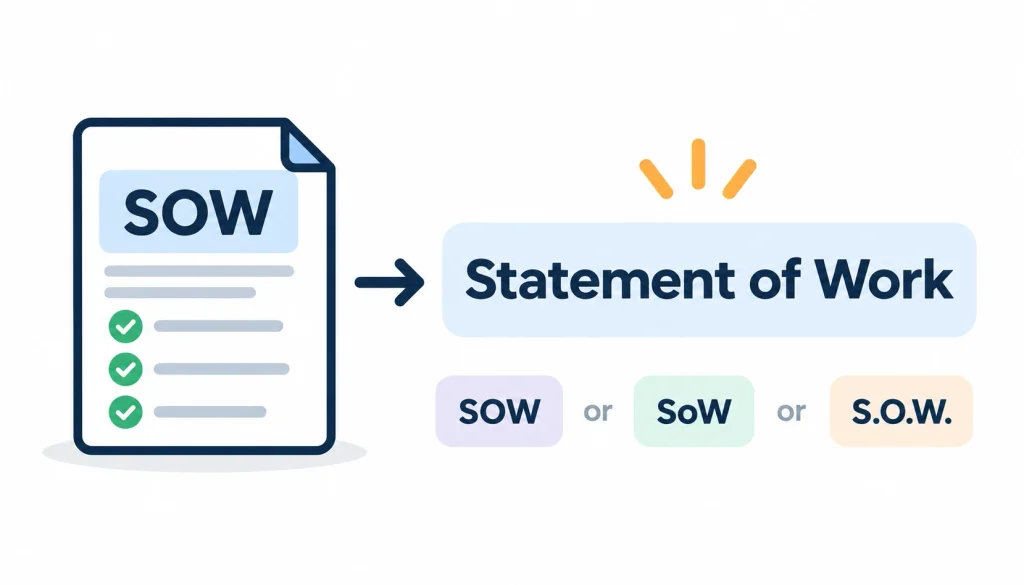
The SOW full form is Statement of Work. People also write it as “SoW” or “S.O.W.” All three mean the same thing.
What Is a Statement of Work?
Think of a Statement of Work as a shared description of a job. One side needs something done. The other side agrees to do it. The SOW puts the details in writing so both sides picture the same result.
Wikipedia has a short overview of the statement of work if you want a neutral reference point. Most business and project teams use the term in a very practical way: it is the document that answers “what exactly are we doing here?”
Why Is a Statement of Work Important?
Here is a situation I see all the time. A client hires an agency to “build a website.” The client imagines 50 pages with a blog and a store. The agency prices 5 pages. Nobody lied. They just never wrote it down.
An SOW prevents that gap. It gives you:
- Shared expectations before work starts
- A defined scope that both sides can point to
- Clear accountability for each task
- Better control over budget and schedule
- Fewer disputes, because the answers are already on paper
- A way to say “that’s outside the agreed scope” without it feeling personal
What Is the Purpose of an SOW?
An SOW has one central job: to remove guesswork from a project. It creates a shared understanding between the client, vendor, contractor, or project team about what needs to be done, who is responsible for it, when it should be completed, and what counts as successful delivery.
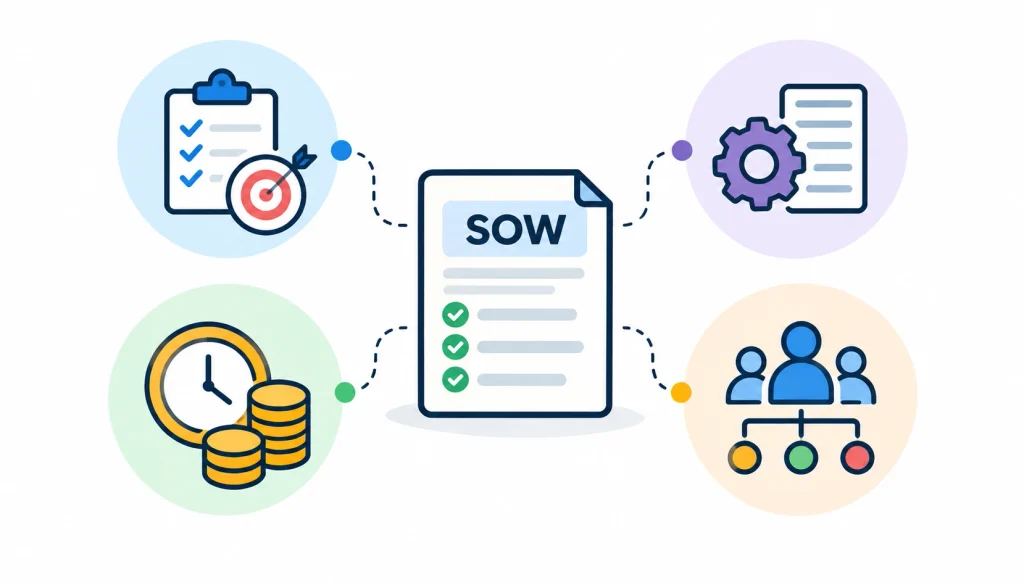
A well-written SOW helps prevent misunderstandings before they become delays, unexpected costs, or disputes. It does that in seven important ways.
1. Define the Project Scope
Scope is the boundary around the work. The SOW clearly explains what the project includes and, just as importantly, what it does not include.
For example, a website development SOW might include designing and developing 10 pages but exclude copywriting, hosting, and ongoing maintenance. Defining these boundaries early helps everyone understand what they are agreeing to and makes it easier to evaluate requests that come up later.
2. Establish Deliverables
A deliverable is a specific item, result, or outcome that the project team is expected to provide. It could be a report, design file, software feature, completed website, training session, or configured system.
Good SOWs make deliverables specific enough to be identified and checked. Instead of saying “improve the website,” a better deliverable might be “redesign and launch 10 responsive website pages based on the approved UI designs.”
Clear deliverables give both sides a concrete way to track progress and determine whether the agreed work has been completed.
3. Assign Responsibilities
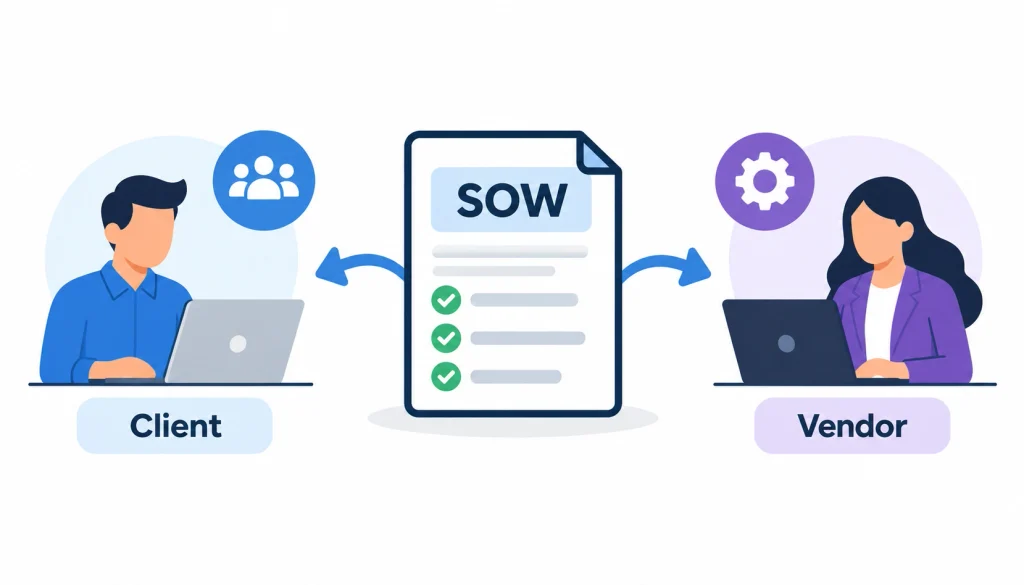
An SOW identifies who is responsible for each major part of the project. This can include the vendor’s responsibilities as well as tasks that must be completed by the client.
For example, a client may be responsible for providing brand assets, content, login credentials, product information, or approvals within a specified timeframe. If these dependencies are not documented, the project can be delayed even when the service provider has completed its own work.
Clearly assigning responsibilities helps prevent the common problem of each party assuming that the other is handling a task.
4. Set the Timeline and Milestones
The SOW establishes when the project should start, when major deliverables are expected, and when the overall work should be completed.
Milestones divide a larger project into manageable checkpoints. For example, a software project might have milestones for requirements approval, UI design, development, testing, and final deployment.
These checkpoints make it easier to measure progress, identify delays early, and review completed work before moving to the next stage. If payments are tied to milestones, they can also provide clear points for releasing scheduled payments.
5. Define Cost and Payment Structure
The SOW explains how much the project will cost or how the cost will be calculated. Depending on the project, this could be a fixed project fee, hourly or daily rates, milestone-based payments, or another agreed pricing model.
It should also clarify when payments are due and what triggers each payment. For example, a project could require 30% upfront, 40% after development, and 30% after final acceptance.
Making the financial terms clear helps both parties understand the commercial expectations and reduces the risk of unexpected charges or payment disputes.
For projects involving financial operations, businesses can also use cloud accounting to maintain better visibility into expenses, payments, assets, and revenue.
6. Establish Acceptance Criteria
Acceptance criteria are the specific conditions used to determine whether a deliverable is complete and acceptable.
Simply saying “deliver a website” leaves room for interpretation. A stronger SOW might state that the website must contain the agreed 10 pages, work across specified browsers and devices, pass the agreed QA checklist, and receive written client approval.
Clear acceptance criteria make the completion of work more objective. They also reduce disagreements over whether a deliverable is actually finished.
7. Prevent Scope Creep
Scope creep occurs when additional requirements or work are gradually added to a project without adjusting the agreed budget, timeline, or resources.
It often begins with a seemingly small request: “Could you just add this one feature?”
One small change may not seem significant, but several additions can eventually turn into substantial extra work. A well-defined SOW gives the project team a reference point for determining whether a request is part of the original scope or requires a formal change.
If additional work is requested, the SOW’s change-control process can be used to assess its impact on cost, timeline, resources, and deliverables before the work is approved.
Ultimately, an SOW protects both sides. The client gets a clearer understanding of what they will receive, while the service provider gets a defined boundary around the work they have agreed to deliver.
What Does a Statement of Work Include?
SOW formats vary by company, industry and country. Still, most strong ones cover the same ground. You may see articles that say an SOW has “seven parts”. That number is a convention, not a rule. Some templates merge sections, others split them.
Here is a full list, with a plain explanation of why each part earns its place.
- Project overview
- Objectives
- Scope of work
- Deliverables
- Milestones
- Timeline and schedule
- Roles and responsibilities
- Pricing and payment terms
- Acceptance criteria
- Assumptions and dependencies
- Exclusions
- Change management
- Risks and constraints
- Approval and signatures
1. Project Overview
A short paragraph on the background and the reason the project exists. Keep it to a few sentences. New readers, such as a finance approver who joins late, should understand the project from this section alone.
2. Objectives
State what the project is meant to achieve, ideally in measurable terms. “Improve the checkout experience” is fuzzy. “Reduce checkout abandonment” is better, and a target number is better still, if both sides can agree on one.
3. Scope of Work
This is the core of the document. List the activities the provider will carry out. Use specific verbs: design, build, test, migrate, train. For projects involving physical products, the scope may also cover inventory management, stock tracking, inventory audits, and processes for preventing stockouts or excess inventory.
When the scope is large, many teams break it into smaller pieces using a work breakdown structure, which is simply a tree of tasks that gets more detailed at each level.
4. Deliverables
Name each deliverable, its format and its quantity. “Ten responsive page templates in Figma and the final HTML/CSS files” leaves little room for argument.
5. Project Milestones
Milestones are dated checkpoints, such as “design approved” or “first working build delivered.” They work best when each one is tied to a deliverable, not to a vague percentage of completion.
6. Timeline and Schedule
Give start and end dates, or durations, and say what depends on what. If the developer can’t start until the designer finishes, say so.
7. Roles and Responsibilities
List the people or teams on both sides, and what each is responsible for. A simple table works well here.
8. Pricing and Payment Terms
State whether the work is fixed price, time and materials, or another model. Add the invoice schedule and payment due dates. If payments are linked to milestones, say which ones.
9. Acceptance Criteria
Spell out how and when the client reviews work, how long they have to respond, and what happens if they request fixes. Without this, projects can sit in “almost done” for months.
10. Assumptions and Dependencies
Assumptions are things you believe to be true when you write the SOW. Dependencies are things that must happen for the plan to work. Example: “The client will provide content within 10 working days of kickoff.” If an assumption turns out wrong, the schedule and cost may need to change.
11. Exclusions
This section lists what is not included. It is the most underused part of the document, and it can save the most arguments. Typical entries: hosting, ongoing maintenance, content writing, third-party licence fees.
12. Change Management
Projects change. The SOW should say how. A common path looks like this: a change is requested, the provider assesses the effect on cost and time, both sides approve, and the SOW is updated.
13. Risks and Constraints
Note known risks, such as a tight regulatory deadline or a legacy system nobody fully understands. Also list constraints like a fixed budget or a mandatory technology.
14. Approval and Signatures
Name the people authorised to approve the SOW and have them sign. Make sure the signer actually has the authority to commit their organisation.
What Are the Different Types of SOW?
Terminology differs between organisations and industries. Some people use “type” to describe how the work is specified. Others use it to describe how the work is paid for. The four labels below cover both uses, so you will recognise them wherever you meet them.
1. Design or Detail SOW
The client spells out exactly how the work must be done: materials, methods, specifications. The provider follows the instructions. This suits construction, manufacturing and tightly regulated work, where the client knows precisely what they want.
2. Performance-Based SOW
The client describes the outcome they need and leaves the method to the provider. For example, “the website must load in under three seconds on a standard mobile connection.” It works well when you trust the provider’s expertise and care more about results than process.
3. Level-of-Effort SOW
The client buys an amount of time and skill, such as “two senior developers for six months.” The deliverable is the effort itself. It fits ongoing support, staff augmentation and work where the end result is hard to define in advance.
4. Time-and-Materials SOW
The client pays for hours worked plus materials or expenses. It suits projects where the scope will probably shift. The risk is cost drift, so the SOW should include a cap or regular budget reviews.
A fixed-price project, by contrast, sets one price for a defined scope. It gives the client cost certainty, but it needs a tight scope and a firm change process.
Statement of Work Example
Below is a short, simplified SOW for a website redesign. A real one would be longer, but the structure is the same.
Example SOW for Website Development
| SOW element | Example |
| Project | Redesign of the company marketing website |
| Objective | Make the site easier to use and increase enquiry form submissions |
| Scope | UX research, wireframes, UI design, front-end development, QA testing |
| Deliverables | 10 responsive page templates, design source files, tested website build |
| Timeline | 8 weeks from kickoff |
| Cost | Fixed project fee, paid in three milestone instalments |
| Client responsibilities | Provide logo, brand guidelines and copy within 10 working days of kickoff |
| Acceptance | Written client approval of designs, then a passed QA checklist |
| Exclusions | Hosting, ongoing maintenance, copywriting, stock photography |
| Changes | Handled through a written change request with revised cost and timeline |
What This Example Shows
The scope names the work, not just the result. “Design and development” alone would leave room for argument. Listing UX research, wireframes and QA makes each step visible.
The client responsibilities line matters more than it looks. If copy arrives six weeks late, the provider has a documented reason the schedule slipped.
The acceptance row removes the “is it done?” debate. And the exclusions row answers the question the client will ask in month three: “Wait, who is hosting this?”
How to Write a Statement of Work Step by Step
You don’t need special software. A word processor and a clear head are enough. Follow these steps in order.
Step 1: Define the Project Objective
Write one or two sentences on why the project exists and what success looks like. If you can’t do this, stop and talk to your stakeholders first.
Step 2: Define the Scope
List the activities that are in. Then, while you still have the picture in your head, list a few things that are out. Doing both at once makes the boundary clearer.
Step 3: Identify Deliverables
For each deliverable, note the name, format, quantity and owner. Ask yourself whether a stranger could check it off.
Step 4: Define Milestones
Pick points where something is finished and reviewable. Avoid milestones like “50% complete,” because two people will measure 50% differently.
Step 5: Assign Roles and Responsibilities
Name who delivers, who reviews, who approves and who gets informed. Include the client’s tasks and response times.
Step 6: Establish the Timeline
Set start dates, end dates and dependencies. Add a little buffer for review cycles. Reviews almost always take longer than people plan.
Step 7: Define Pricing and Payment Terms
State the pricing model, the amounts and the invoice triggers. If expenses are billed separately, say so.
Step 8: Establish Acceptance Criteria
Describe how each deliverable will be tested, who signs off, how long the review window is, and how many revision rounds are included.
Step 9: Document Assumptions and Exclusions
Write down what you are taking for granted and what you are leaving out. Be blunt. Awkward clarity now is cheaper than an awkward conversation later.
Step 10: Define Change-Control Procedures
Decide how change requests are submitted, who assesses them and who approves them. Agree that nothing outside the SOW starts until the change is approved in writing.
Step 11: Review and Approve the SOW
Have the right people read it: the project lead, a technical reviewer, finance and, where needed, legal. Then collect signatures. Keep the final version somewhere everyone can find it.
SOW vs Contract: What’s the Difference?
A contract is the legal agreement between the parties. An SOW describes the work under that agreement. In many deals, the SOW is attached to a contract or issued under it.
| Factor | SOW | Contract |
| Primary purpose | Defines the work | Sets the legal and commercial terms |
| Main focus | Scope, deliverables, schedule, acceptance | Obligations, liability, termination, confidentiality, disputes |
| Time frame | Usually one project or engagement | Can cover a long relationship |
| Pricing | Often included | May include it or point to the SOW |
| Relationship | Can be part of a contract | Can include one or many SOWs |
The legal effect of an SOW depends on how the documents are written and which law governs them. Some SOWs are signed as standalone agreements. Others only work when read together with a master contract. Check the wording, and ask a lawyer if the stakes are high.
SOW vs Proposal: What’s the Difference?
The two documents appear at different moments in a deal.
Proposal
A proposal is the provider’s pitch. It explains how they would solve the problem, why they are a good fit and roughly what it would cost. It is persuasive by nature.
Statement of Work
An SOW comes after the pitch is accepted, or is negotiated alongside it. It records what both sides agree the project will involve. It is precise by nature.
Key Differences
| Factor | Proposal | SOW |
| Purpose | Win the work | Define the agreed work |
| Tone | Persuasive | Specific and factual |
| Stage | Before agreement | At or after agreement |
| Binding force | Usually an offer | Depends on how it is signed and referenced |
In a formal procurement process, a buyer may issue a request for proposal first, then turn the winning proposal into an SOW.
SOW vs Project Charter
These two overlap, but they serve different people. A project charter is an internal document that formally authorises a project and names the project manager. An SOW defines work that is agreed with, or performed by, another party.
| Project charter | SOW |
| Authorises the project | Defines the agreed work |
| Usually internal | Usually between a client and a provider |
| High-level direction | Detailed scope and deliverables |
| Names sponsor and project authority | Names responsibilities, dates and acceptance rules |
A company might write a charter to get internal approval, then use that charter as input when drafting the SOW for an outside vendor.
SOW vs MSA vs SLA vs PO
Several documents can sit together in a vendor relationship. People mix them up often, so here is each one in plain terms.
1. Statement of Work (SOW)
Describes a specific piece of work: scope, deliverables, schedule, price and acceptance.
2. Master Services Agreement (MSA)
Sets the general legal terms between two parties, such as confidentiality, liability, intellectual property and dispute handling. Once the MSA is in place, new projects can be added without renegotiating everything.
3. Service Level Agreement (SLA)
A service level agreement sets measurable standards for ongoing service, such as uptime or response time, and what happens when those standards are missed. An SOW says what work will be done. An SLA says how well an ongoing service must perform.
4. Purchase Order (PO)
A purchase order is a buyer’s document authorising a purchase and committing funds. It usually refers to the agreed SOW and price.
5. How These Documents Work Together
A common pattern looks like this: the MSA sets the ground rules, an SOW describes each project, a PO releases the budget, and an SLA covers service performance after launch. Real structures vary. Some companies skip the MSA, some fold the SLA into the SOW, and some use work orders instead of POs. Follow your own organisation’s procurement rules.
When Should You Use an SOW?
Create an SOW before work begins, ideally before money changes hands. Any time one party does work for another and the result must be checked, an SOW makes sense.
1. Software Development Projects
Software scope drifts easily. The SOW should list features, platforms, testing responsibilities and how bugs found after delivery will be handled.
For projects involving stock tracking or business operations, inventory management software can also be part of the scope and deliverables that need to be clearly defined in the SOW.
2. Website Development
Fix the page count, design rounds, content responsibilities and browser or device support. Say who owns hosting and updates after launch.
3. Consulting Projects
Define the questions to be answered, the interviews or analysis to be performed, and the format of the final report. Be clear about how many review rounds are included.
4. Marketing Services
Spell out channels, content volumes, reporting frequency and who approves creative work. State whether ad spend is inside or outside the fee.
5. IT Outsourcing
Include the systems covered, support hours, handover steps and security requirements. Pair the SOW with an SLA if the service is ongoing.
6. Construction Projects
Construction work often needs a detailed, design-style specification: materials, standards, inspection points and site access. Local regulations apply, so involve qualified professionals.
7. Freelance Projects
Freelancers benefit from an SOW as much as large vendors do. A one-to-two page version covering scope, deliverables, number of revisions, price and payment dates is usually enough. It protects both the freelancer’s time and the client’s budget.
Who Creates and Approves an SOW?
There is no single owner. It depends on the size of the organisation and the kind of work.
1. Client
The client usually explains the need and reviews the final text. In some organisations, the client writes the first draft.
2. Vendor or Service Provider
Providers often draft the SOW because they understand the effort involved. The client then reviews and negotiates it.
3. Project Manager
The project manager often coordinates drafting, collects input and makes sure the plan is realistic.
4. Procurement Team
In larger companies, procurement checks that the SOW follows buying policies and matches the underlying agreement.
5. Legal and Finance Teams
Legal reviews risk and wording. Finance checks pricing, payment terms and budget approval.
6. Project Stakeholders
Technical leads and business owners confirm the scope matches what they need. Their early input is cheaper than their late objections.
As for who signs: it should be someone with authority to commit each organisation. That is often a department head, a director or a procurement officer, depending on spending limits.
What Makes a Good Statement of Work?
A good SOW is easy to check against reality. Use these eight tests.
- Specific. It names tasks, quantities and formats.
- Measurable. You can tell when each item is done.
- Realistic. The schedule and budget match the effort.
- Complete. Nothing important lives only in email threads.
- Easy to read. A new team member can follow it without a glossary.
- Explicit about exclusions. Out-of-scope items are written down.
- Clear about acceptance. Everyone knows how work gets approved.
- Flexible through change control. It expects change and says how to handle it.
Common Statement of Work Mistakes
Most problems trace back to a handful of habits. Watch for these.
- Vague scope. “Improve the website” can mean almost anything.
- Unclear deliverables. If nobody can say what gets handed over, nobody can say when it’s done.
- Missing acceptance criteria. The project drifts into endless rounds of feedback.
- No exclusions. Each side fills the silence with its own assumptions.
- Unrealistic deadlines. Teams promise dates to win the work, then miss them.
- Unclear responsibilities. Client-side tasks get forgotten, and the provider takes the blame.
- Missing payment terms. Cash flow problems follow quickly.
- No change-control process. Every small request becomes an argument.
- Heavy jargon. If a business owner can’t follow it, they can’t really approve it.
How an SOW Helps Prevent Scope Creep
Scope creep rarely arrives as one big request. It comes as many small ones. The SOW gives you a calm, neutral way to handle each of them.
The path looks like this:
Original scope → Change request → Impact assessment → Approval → Updated scope → Delivery
Say the client asks for a blog section halfway through the website project. The provider doesn’t refuse and doesn’t quietly absorb it. They check the SOW, see that a blog was not included, estimate the extra time and cost, and send a short change request. The client approves or declines. Either way, nobody is surprised.
This protects both sides. The provider avoids unpaid work. The client gets a clear price and date before agreeing to anything new.
Statement of Work Checklist
Use this list to check a draft before you send it for signature.
- ☐ Project objective defined
- ☐ Scope documented
- ☐ Deliverables listed with format and quantity
- ☐ Milestones established
- ☐ Timeline agreed
- ☐ Responsibilities assigned on both sides
- ☐ Pricing defined
- ☐ Payment terms documented
- ☐ Acceptance criteria established
- ☐ Assumptions and dependencies documented
- ☐ Exclusions documented
- ☐ Change-control process defined
- ☐ Approval and signatures completed
Frequently Asked Questions About SOW
What is the full form of SOW?
The SOW full form is Statement of Work.
What is a Statement of Work?
It is a document that defines the work to be done, the deliverables, responsibilities, schedule, cost and how the work will be accepted.
What are the main components of an SOW?
Most include the project overview, objectives, scope, deliverables, milestones, timeline, roles, pricing, acceptance criteria, assumptions, exclusions and a change process. Some also add risks and approval signatures.
Is an SOW legally binding?
It can be. Whether it is depends on how it is signed, how it connects to any master agreement, and the governing law. Don’t assume either way. Read the surrounding documents and get legal advice if the stakes are meaningful.
Is an SOW the same as a contract?
No. A contract is the broader legal agreement. An SOW describes the work and often sits under or inside a contract. In some deals one document does both jobs.
Who writes an SOW?
Either side can. Vendors, project managers and procurement teams commonly draft it, with input from legal, finance and technical stakeholders.
Who signs an SOW?
An authorised representative of the client and of the provider. Signing authority depends on each company’s internal rules.
Can an SOW be changed?
Yes, through the agreed change process. Document the change, assess its effect on cost and schedule, get written approval, and update the SOW.
What is the difference between SOW and SLA?
An SOW defines what work will be performed. An SLA defines the performance standards for an ongoing service, such as response times or uptime.
What is the difference between SOW and MSA?
An MSA sets the general legal terms for a relationship. An SOW describes one specific project under those terms.
What is an example of an SOW?
A website redesign SOW that lists 10 page templates, an 8-week timeline, a fixed fee, QA-based acceptance and exclusions such as hosting. The example above shows the layout.
Do freelancers need an SOW?
Yes, in nearly every case. Even a short one reduces misunderstandings about scope, revisions and payment.
Final Takeaway
The SOW full form is Statement of Work, and the document earns its name. It turns a loose project idea into a written agreement about the work, the deliverables, who does what, the schedule, the cost and the way completion is judged.
If you remember one thing, make it this: a good SOW states what will be delivered and also what is outside the agreed scope.
