


If you have ever counted stock by hand at the end of the month and used that count to figure out what you sold, you have already used an inventory system. You may not have called it that, but you have still used it. A periodic inventory system is one of the two main ways businesses track what is on their shelves and what it costs them. Many small and mid-sized companies continue to rely on this method because it is simple and cost-effective. If your business still tracks stock using spreadsheets, our guide on Inventory Management in Excel can help you organize inventory records more efficiently before moving to advanced inventory software.
This guide will explain what a periodic inventory system is, how it works, and when it makes sense to use one. You will learn the formulas, journal entries, and inventory valuation methods involved. We will also look at practical examples from different industries and discuss the software that supports periodic inventory systems today.
A periodic inventory system is a method of tracking inventory where records are updated at specific intervals, such as monthly, quarterly, or annually. Unlike a perpetual inventory system, inventory levels are not updated after every sale or purchase. Instead, purchases are recorded throughout the period, and the actual inventory balance is determined after a physical stock count.
Think of a periodic inventory system like checking your pantry once a week. You do not record every spoonful of flour you use. Instead, you buy groceries as needed and count what is left at the end of the week. Businesses using a periodic inventory system follow the same approach, except they count products instead of pantry items.
Why Businesses Use It
Small businesses and companies with a limited number of Stock Keeping Units (SKUs) often choose a periodic inventory system because it is affordable and easy to manage. Since inventory is counted only at specific intervals, businesses do not need to invest in expensive barcode scanners or advanced inventory tracking systems. This makes the method a practical choice for organizations with relatively simple inventory needs. As a business grows, however, many companies transition to Industrial Inventory Management Software to gain real-time inventory visibility, automate stock tracking, and improve operational efficiency.
Many businesses use spreadsheets or notebooks to track their SKUs, while others rely on accounting software and perform physical inventory counts at the end of each week or month. This approach works well for retailers, small wholesalers, and businesses with lower sales volumes because it keeps operating costs low while still providing an accurate inventory count at regular intervals.
However, a periodic inventory system also has its limitations. Since inventory records are not updated continuously, businesses may not know their exact stock levels between physical counts. This can lead to stockouts, excess inventory, or delayed purchasing decisions. The lack of real-time inventory visibility can also make it more difficult to respond quickly to changes in customer demand. We will explore these challenges in more detail later in this guide.
Key Characteristics
A few things set periodic inventory apart from other approaches:
- Inventory counts happen physically, usually by hand or with basic scanning tools, at fixed intervals.
- Purchases are recorded in a “Purchases” account rather than directly updating inventory.
- Cost of Goods Sold (COGS) isn’t calculated per transaction, it’s calculated once, at period-end, using a formula.
- There’s no real-time visibility into stock levels between counts.
How Does a Periodic Inventory System Work?
1. Inventory Purchase Process
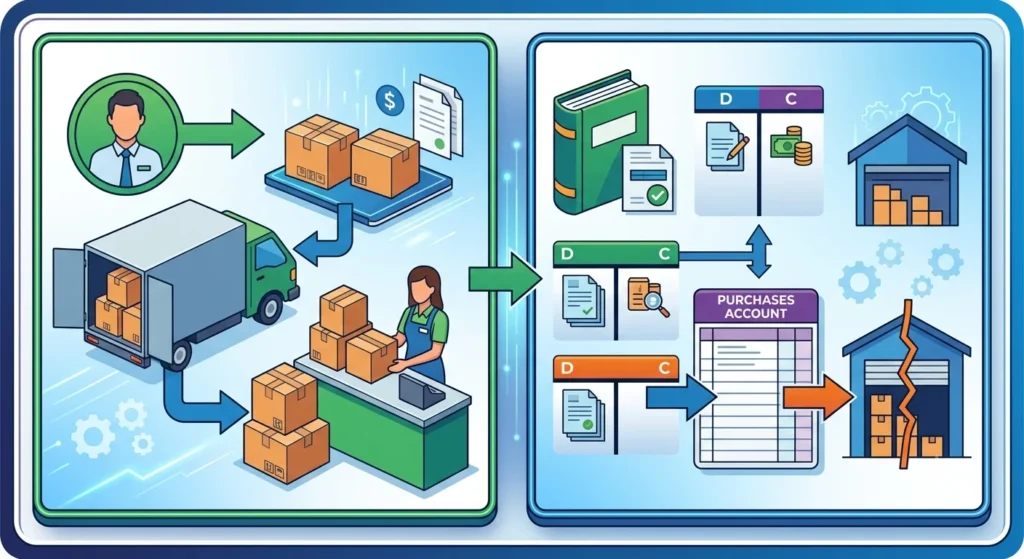
When a business buys stock, the purchase gets recorded in a Purchases account instead of directly increasing the Inventory account. This is one of the biggest differences from a perpetual system, where every purchase immediately updates inventory in real time.
2. Physical Inventory Counts
At the end of the chosen period, someone on the team physically counts everything on hand, every unit, every SKU, every location if there’s more than one. This is usually the most labor-intensive part of the whole process, and it’s often done after hours or over a weekend to avoid disrupting sales.
3. Recording Purchases
Throughout the period, purchases, purchase returns, and freight-in costs accumulate in separate accounts. None of these touch the main Inventory account until the period closes.
4. Updating Inventory at Period End
Once the physical count is done, the business assigns a dollar value to what’s left using an inventory valuation method (FIFO, LIFO, or weighted average, more on this below). That value becomes the new Ending Inventory figure.
5. Calculating Ending Inventory
With the count finished and valued, the accounting team plugs the numbers into the COGS formula to see what was sold during the period. This is the step that actually tells the business how much inventory left the building, not through tracking, but through subtraction.
Periodic Inventory Formula
1. Cost of Goods Sold Formula
This is the core calculation behind the entire system:
Beginning Inventory + Purchases − Ending Inventory = Cost of Goods Sold
If a business started the month with $10,000 in inventory, bought $15,000 more, and counted $8,000 left at month-end, then COGS = $10,000 + $15,000 − $8,000 = $17,000.
2. Inventory Calculation Formula
Rearranged, the same formula tells you ending inventory if you already know COGS:
Ending Inventory = Beginning Inventory + Purchases − COGS
3. Worked Example with Numbers
Say a small hardware store starts the quarter with $40,000 in inventory. Over three months, it buys another $60,000 worth of stock. At quarter-end, the physical count comes to $35,000.
COGS = $40,000 + $60,000 − $35,000 = $65,000
That $65,000 is what the store reports as the cost of goods sold on its income statement for the quarter, even though nobody tracked a single sale transaction-by-transaction.
Journal Entries in a Periodic Inventory System
Because a periodic inventory system updates inventory only at the end of an accounting period, businesses record purchases and related costs in temporary accounts throughout the period. Once a physical inventory count is completed, these accounts are adjusted to determine the final inventory value and the cost of goods sold (COGS).
1. Recording Purchases
When a business purchases inventory on credit, the purchase is recorded in a Purchases account rather than directly increasing the Inventory account. This is one of the key differences between periodic and perpetual inventory systems.
Journal Entry:
- Debit: Purchases
- Credit: Accounts Payable
If the purchase is made with cash instead of on credit, Cash is credited instead of Accounts Payable. Since the Inventory account is not updated with every purchase, businesses rely on a physical inventory count at the end of the period to determine the actual inventory on hand.
2. Purchase Returns and Allowances
Sometimes businesses return damaged, defective, or incorrect goods to suppliers or receive a price reduction. Instead of reducing the Purchases account directly, these transactions are recorded in a separate Purchase Returns and Allowances account.
Journal Entry:
- Debit: Accounts Payable
- Credit: Purchase Returns and Allowances
Keeping purchase returns separate provides a clearer picture of total purchases made during the accounting period and helps businesses analyze supplier performance.
3. Recording Freight Costs
Shipping or transportation costs incurred to bring inventory to the business are treated as part of the cost of acquiring inventory. Under the periodic inventory system, these costs are recorded in a separate Freight-In (or Transportation-In) account.
Journal Entry:
- Debit: Freight-In
- Credit: Cash or Accounts Payable
At the end of the accounting period, Freight-In is included when calculating the total cost of goods available for sale, ensuring inventory costs are measured accurately.
4. Closing Entries at the End of the Period
Once the accounting period ends, the business performs a physical inventory count to determine the value of inventory remaining on hand. The balances in the Purchases, Purchase Returns and Allowances, and Freight-In accounts are then combined to calculate the total cost of goods available for sale.
Using this information, the business calculates Cost of Goods Sold (COGS) and updates the Inventory account to match the physical count. Temporary accounts used throughout the period are closed, and the necessary adjusting entries are made so that the financial statements accurately reflect ending inventory and the cost of inventory sold during the period.
This end-of-period adjustment is what makes the periodic inventory system simpler to maintain during the accounting period but more dependent on accurate physical inventory counts.
Inventory Valuation Methods
Once you’ve got a physical count, you still need to know what that inventory is worth in dollars. That’s where valuation methods come in.
1. FIFO
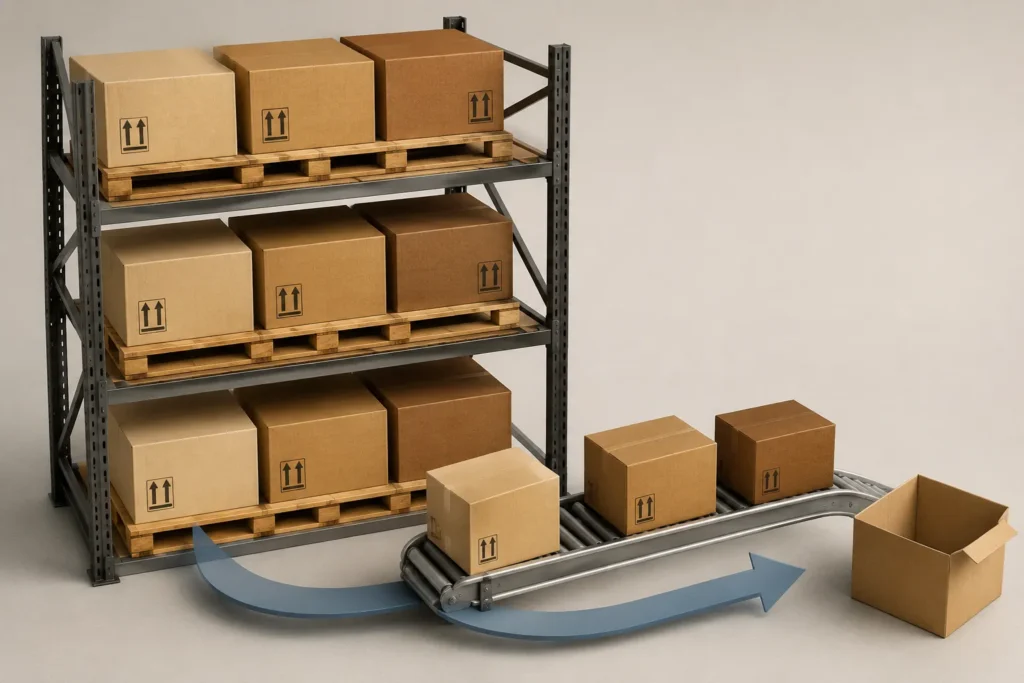
First-In, First-Out assumes the oldest inventory is sold first. In periods of rising prices, FIFO tends to show higher ending inventory value and lower COGS, which usually means higher reported profit.
2. LIFO
Last-In, First-Out assumes the newest inventory is sold first. It’s allowed under U.S. GAAP but not under IFRS, so companies operating internationally often steer clear of it. LIFO tends to show lower reported profit during inflation, which can reduce taxable income.
3. Weighted Average Cost
This method averages the cost of all units available during the period and applies that average to both COGS and ending inventory. It smooths out price swings and is simpler to apply than tracking specific cost layers.
Which Method Works Best?
There’s no universal answer. Retailers dealing with fast-moving, similar-cost goods often prefer weighted average for simplicity. Businesses wanting to match current costs to current revenue during inflation might lean FIFO. The choice also affects taxes, so it’s worth a conversation with an accountant before locking one in, and once chosen, switching methods later can trigger extra reporting requirements.
Advantages of a Periodic Inventory System
1. Lower Setup Costs
No inventory software, no barcode hardware, no integration work. For a business just getting started, that’s real money saved.
2. Easier for Small Businesses
A shop with a few hundred SKUs and low transaction volume can manage a monthly count without much disruption. The same approach would be a nightmare for a warehouse moving thousands of units a day.
3. Simpler Accounting
Fewer accounts to reconcile day-to-day means less bookkeeping overhead between counts. Purchases just get logged and left alone until period-end.
4. Less Technology Required
A spreadsheet and a clipboard are enough to run this system. That matters for businesses in areas with limited access to reliable software or IT support.
Disadvantages of a Periodic Inventory System
1. Inventory Shrinkage
Because there’s no ongoing tracking, theft, damage, or spoilage often gets buried inside the COGS figure instead of being identified separately. A business might think it sold more than it did, when in fact some inventory just disappeared.
2. Delayed Reporting
Managers don’t know their exact stock levels between counts. That makes it harder to catch a stockout or reorder in time, and it delays financial reporting until the count is finished.
3. Manual Counting Errors
Physical counts are done by people, and people miscount, mislabel, or skip items. A single counting mistake can throw off the COGS calculation for the entire period.
4. Limited Visibility
If a manager wants to know today’s inventory value, a periodic system simply can’t answer that question without a fresh count. That’s a real problem for businesses trying to make fast purchasing or pricing decisions.
Periodic vs Perpetual Inventory System
1. Feature Comparison Table
| Feature | Periodic Inventory | Perpetual Inventory |
| Inventory updates | At set intervals | In real time, after every transaction |
| Technology needed | Minimal | POS, barcode/RFID, inventory software |
| COGS calculation | Formula at period-end | Calculated per sale |
| Setup cost | Low | Higher |
| Accuracy | Lower, prone to shrinkage going unnoticed | Higher, discrepancies caught faster |
| Best suited for | Small businesses, low SKU count | High-volume retailers, ecommerce, warehouses |
2. Cost Comparison
Periodic systems cost less to set up but can cost more in the long run through undetected shrinkage and stockouts. Perpetual systems require an upfront investment in software and hardware but usually pay for themselves through tighter inventory control.
3. Accuracy Comparison
Perpetual inventory wins here by a wide margin. Every transaction updates the count automatically, so discrepancies show up almost immediately instead of sitting unnoticed for a month or a quarter.
4. Reporting Differences
A perpetual system gives management live inventory reports on demand. A periodic system gives accurate numbers only right after a physical count, and those numbers age quickly as new sales and purchases pile up.
5. Best Use Cases
Periodic inventory tends to fit businesses with a small number of products, low transaction volume, and tight budgets. Perpetual inventory fits businesses with high sales volume, multiple locations, or thin margins where knowing exact stock in real time actually changes decisions. For a deeper technical comparison, Wikipedia’s overview of inventory and inventory accounting methods is a solid starting reference.
Which Businesses Should Use a Periodic Inventory System?
1. Retail

Small boutiques and specialty stores with a manageable product range often stick with periodic counts, especially if they’re not running high transaction volume.
2. Wholesale
Smaller wholesalers dealing in bulk, low-SKU-count goods can track inventory periodically without much trouble, since the number of distinct items to count stays low.
3. Restaurants
Many restaurants count food and beverage inventory weekly rather than tracking every ingredient transaction, since ingredient-level perpetual tracking is often more effort than it’s worth for perishable goods.
4. Manufacturing
Small manufacturers with simple bills of materials sometimes use periodic inventory for raw materials, though larger manufacturers usually move to perpetual systems once production complexity grows.
5. Small Businesses
In general, if a business has a low volume of transactions and a limited product line, periodic inventory keeps accounting simple without sacrificing much accuracy. Once transaction volume climbs, most owners start looking at perpetual systems instead — a shift discussed often in small-business communities like smallbusiness and Bookkeeping on Reddit.
Real-World Example
1. Small Retail Store Example
An independent bookstore counts inventory every quarter. It starts Q1 with $25,000 in books, buys another $12,000 during the quarter, and counts $20,000 remaining at quarter-end. COGS comes to $17,000 for the period, the number the owner uses to price the next season’s orders.
2. Grocery Store Example
A neighborhood grocery counts shelf-stable goods monthly, since spoilage risk on those items is low. Perishables, on the other hand, often get tracked more frequently or even daily, because the cost of letting spoilage go unnoticed for a month is too high.
3. Warehouse Example
A small regional warehouse handling seasonal goods might do a full periodic count twice a year, paired with lighter spot checks in between to catch major discrepancies early.
How to Implement a Periodic Inventory System
1. Planning
Decide on the counting interval, monthly, quarterly, or annually, based on how fast inventory moves and how much risk the business can tolerate between counts.
2. Choosing Inventory Valuation
Pick FIFO, LIFO, or weighted average based on tax strategy, industry norms, and whether the business reports under GAAP or IFRS. LIFO isn’t an option for IFRS reporters.
3. Scheduling Physical Counts
Set a fixed schedule and stick to it. Counts done “whenever there’s time” tend to slip, and a skipped count throws off an entire period’s COGS calculation.
4. Training Staff
Whoever does the counting needs a clear process, count sheets, item codes, and a method for handling damaged or unsellable stock. Untrained counters are the single biggest source of shrinkage-related errors.
5. Maintaining Records
Keep purchase invoices, freight bills, and return documentation organized throughout the period. When count day arrives, disorganized records make reconciliation painful.
Common Mistakes to Avoid
1. Counting Errors
Double-counting, skipped shelves, and mislabeled SKUs are the most common issues. A second counter cross-checking totals catches most of these before they hit the books.
2. Poor Documentation
Missing purchase invoices or freight receipts make it impossible to verify the numbers going into the COGS formula. Keep documentation as tight as the count itself.
3. Missed Purchases
If a purchase gets recorded in the wrong period, the COGS calculation for both periods ends up wrong. Cut-off procedures around period-end matter more than most businesses realize.
4. Incorrect Valuation Method
Switching valuation methods without proper disclosure, or applying one method inconsistently across product lines, can distort both financial statements and tax filings.
Best Practices
1. Inventory Audits
Even with a periodic system, occasional surprise audits between scheduled counts help catch shrinkage before it grows into a bigger problem.
2. Barcode Support
Adding barcode scanning to the counting process, even without going fully perpetual, speeds up counts and cuts down on manual entry errors.
3. RFID Integration
For businesses with higher-value inventory, RFID tags can make physical counts faster and more accurate, without requiring a full perpetual system overhaul.
4. Internal Controls
Separate the person doing the counting from the person responsible for purchasing and record-keeping. That separation of duties is one of the simplest ways to reduce the risk of internal theft going unnoticed.
5. Inventory Reconciliation
Compare each period’s physical count against expected inventory based on purchases and estimated sales. Large, unexplained gaps are usually the first sign of a shrinkage problem worth investigating.
Inventory Software That Supports Periodic Inventory
Periodic inventory doesn’t have to mean pen and paper forever. Several platforms support periodic counting alongside broader accounting functions:
- QuickBooks: widely used by small businesses for basic inventory and accounting together.
- Zoho Inventory: a lightweight option for small teams needing periodic or light perpetual tracking.
- Odoo: modular software that can run periodic counts today and scale toward perpetual tracking later.
- Oracle NetSuite, SAP Business One, and Microsoft Dynamics 365: ERP systems generally aimed at larger businesses, though they can be configured to support periodic processes during a transition phase.
- Fishbowl Inventory and Cin7: inventory-focused platforms that bridge the gap between periodic and perpetual approaches.
Accounting and finance professionals frequently compare these tools in discussions on forums like Accounting, which can be a useful gut-check before committing to a platform.
Frequently Asked Questions
1. What is a periodic inventory system?
It’s a method of tracking inventory where stock levels and cost of goods sold are updated at fixed intervals, based on a physical count, rather than continuously after every transaction.
2. What is the periodic inventory formula?
Beginning Inventory + Purchases − Ending Inventory = Cost of Goods Sold.
3. How is COGS calculated?
By adding beginning inventory to purchases made during the period, then subtracting the ending inventory value determined by the physical count.
4. Which inventory system is better?
Neither is universally better. Periodic suits small, low-volume businesses; perpetual suits high-volume operations that need real-time stock visibility.
5. Can periodic inventory use FIFO?
Yes. FIFO, LIFO, and weighted average can all be applied under a periodic system, though LIFO isn’t permitted under IFRS.
6. Is periodic inventory still used today?
Yes, especially by small businesses, restaurants, and low-SKU retailers where the cost of perpetual tracking isn’t justified by the transaction volume.
Conclusion
A periodic inventory system is a choice for businesses that want to keep things simple. This is especially true for retailers, restaurants and low-volume wholesalers. The reason is that it does not cost a lot to set up and the accounting is easy to do. However it does have some downsides. For example you might not catch mistakes or missing items away.
When you are trying to decide between a perpetual inventory system you need to think about how many transactions you have, how much money you have to spend and what it would really cost you if you did not have up to date information about your stock. For a lot of businesses a periodic inventory system is a good place to start.. It is something you can look at again as your business gets bigger. You can use an inventory system and then switch to a different system later if you need to. This is because a periodic inventory system is a system for small businesses.
