
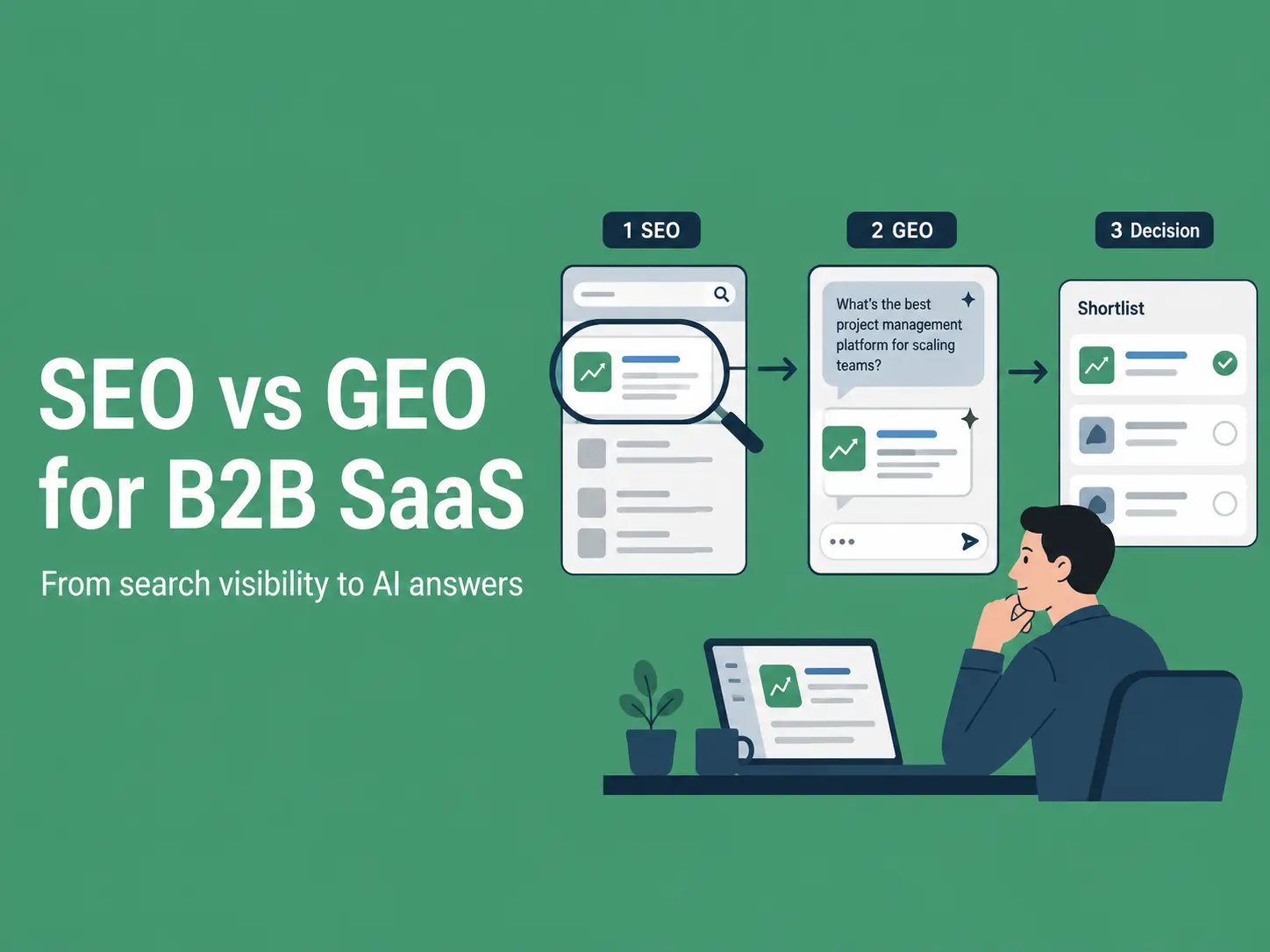

SEO and GEO influence different parts of B2B SaaS discovery. SEO aims to earn visibility in ranked search results, while Generative Engine Optimisation focuses on whether a SaaS brand is mentioned, cited or represented accurately inside an AI-generated answer.
SaaS companies need both because buyers now move between search engines, AI assistants, review platforms and vendor websites when evaluating software.
Key Takeaways
- SEO supports discovery through crawling, indexing, rankings and organic traffic.
- GEO supports answer visibility through mentions, citations and accurate brand representation.
- AI is changing software research, but it has not made technical SEO obsolete.
- GEO needs broader measurement, including prompt coverage, cited pages and answer accuracy.
- The right investment split depends on a company’s current search foundations and buyer behaviour.
Why Does AI Search Matter for B2B SaaS Buyers?
AI search can influence which software providers enter a buyer’s shortlist before they visit a vendor website.
B2B software research often begins with a problem rather than a product name. Buyers may ask how to automate a workflow, which tools integrate with their existing platform or which vendors suit their company size.
AI-generated answers can combine category education, product recommendations and comparison criteria in one response, compressing several traditional research steps.
G2’s 2026 Buyer Behavior Report found that eight in ten buyers use AI search to make software research more efficient. But, buyers still rely on search engines, review platforms and vendor websites to validate recommendations.
A SaaS company may rank well for a category keyword but remain absent from AI-generated comparisons. Another may appear because trusted third-party sources describe it clearly, even if its organic rankings are less established.
The challenge is therefore not choosing one discovery channel, but making the company understandable and credible across the entire research journey.
SEO vs GEO: What Does Each Optimise?
SEO improves a website’s ability to be crawled, indexed, understood and surfaced in search results. It covers areas such as technical SEO, site architecture, search-intent research, content creation, internal linking, digital PR and performance analysis.
GEO focuses on how a brand or source appears inside generated answers. That can involve being cited as a source, included in a comparison, mentioned as a relevant provider or represented accurately within an explanation.
Search engines usually present several results and allow the user to choose which pages to visit. A generative system can retrieve information from multiple sources and combine it into one response.
| Area | SEO | GEO |
| Primary outcome | Visibility in search results | Visibility inside generated answers |
| Main interface | Ranked links and search features | Synthesised answers and citations |
| Unit of analysis | Query, keyword and landing page | Prompt cluster, answer and cited source |
| Technical focus | Crawling, indexing and architecture | Retrieval access and entity clarity |
| Content focus | Search intent and relevance | Direct answers, evidence and context |
| Authority focus | Backlinks and topical authority | Credibility and third-party corroboration |
| Core metrics | Rankings, traffic and conversions | Mentions, citations, accuracy and AI referrals |
| Main risk | Ranking without commercial impact | Being omitted or represented inaccurately |
SEO helps a SaaS company become discoverable while GEO helps its information become retrievable, attributable and accurately represented inside AI-generated answers.
A clear, technically accessible and well-supported product page can perform in search while also giving generative systems useful information to retrieve.
GEO does not remove the need for SEO but it adds new questions about how information is selected, combined and presented.
Why Does SEO Still Matter in AI Search?
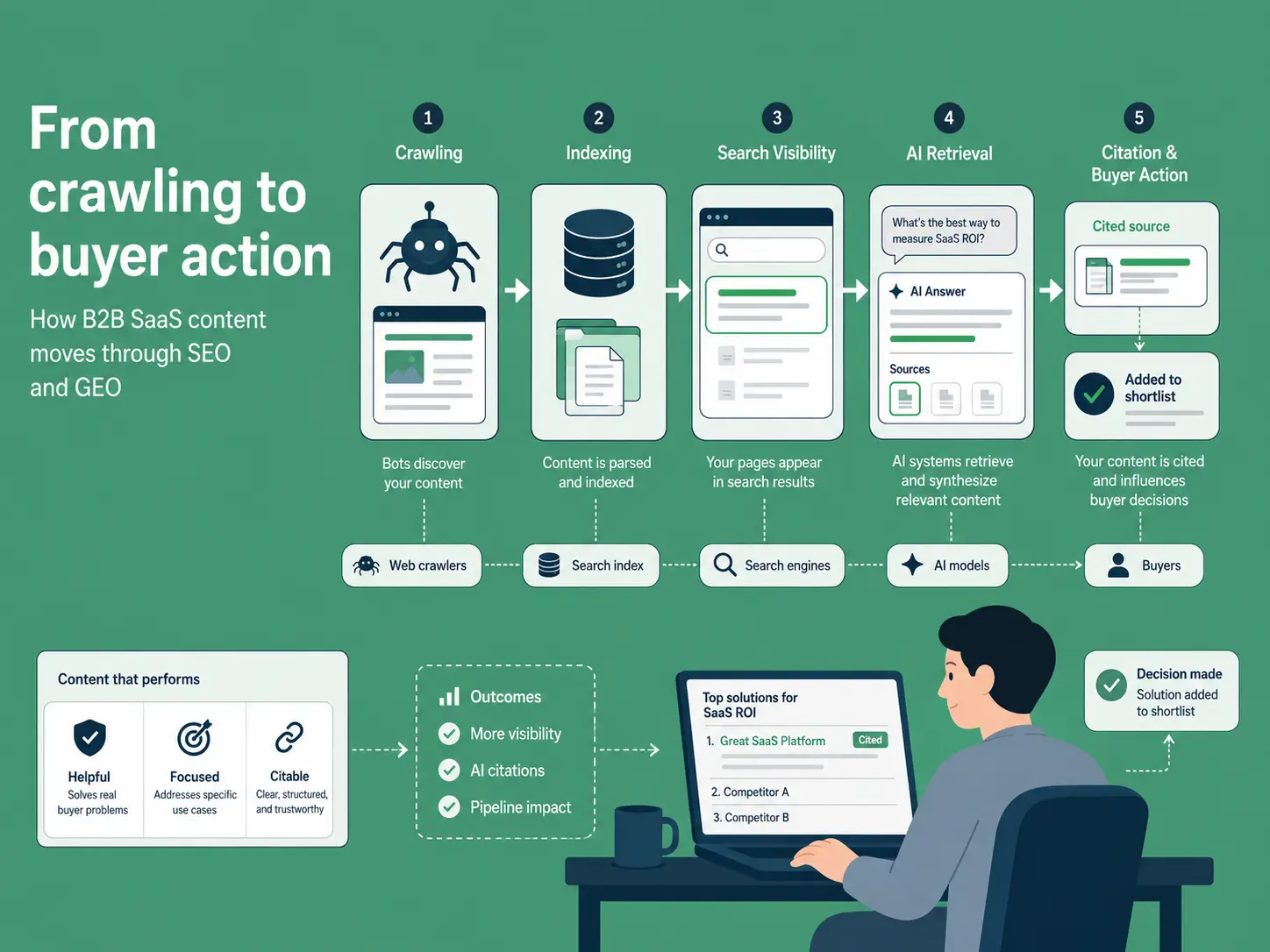
GEO cannot compensate for content that search and retrieval systems cannot reliably access or understand.
Google official guidance states that its generative AI features are rooted in its core Search ranking and quality systems. Pages still need to be indexed, eligible to appear with a snippet and accessible to Google’s crawlers.
The following established SEO practices stay relevant to both traditional and AI-supported discovery:
- Clear architecture: Product, use-case, integration and comparison pages should be connected through logical navigation and internal links.
- Reliable indexing: Canonicals, sitemaps and robots directives should point search engines towards the correct pages.
- Descriptive structure: Titles and headings should state what the page covers instead of relying on vague marketing language.
- Original information: Product evidence, practical examples and expert analysis are harder to replace than generic summaries.
- Consistent details: Product names, capabilities, pricing models and company information should agree across the website.
- Accessible content: Important information should appear in the rendered page rather than depend on broken scripts or inaccessible interactions.
These fundamentals reflect the broader relationship between SEO and business visibility: even a strong product can remain difficult to find when its website structure, content and technical performance are weak. Strong SEO does not guarantee an AI citation but it does create the conditions in which content can be discovered and assessed.
What Does GEO Add for B2B SaaS Companies?
GEO adds prompt-level research, citation monitoring and brand-representation checks to an existing organic growth programme.
Map Prompt Clusters, Not Isolated Keywords
Buyers can express the same software need in several ways: one might search for “subscription billing software” or “ask an AI assistant which billing platforms support usage-based pricing”. A useful GEO programme groups these questions by underlying intent rather than treating every wording variation as a separate content target.
Common SaaS prompt clusters include:
- Best software for a specific workflow
- Alternatives to an established product
- Product A versus Product B
- Tools for a company size or sector
- Platforms that integrate with an existing technology
- Products that meet a security or compliance requirement
The team can then review which brands are mentioned, which sources are cited and what evidence appears to influence the answer.
Make Product Information Easy to Interpret
Clear product information helps both buyers and retrieval systems. A product page should explain what the software does, who it serves and where it fits within a workflow. It should also make important limitations visible rather than burying them beneath broad claims.
Useful details include:
- Supported use cases
- Integrations and technical requirements
- Pricing context
- Implementation expectations
- Security and compliance information
- Customer examples
- Clear comparison criteria
Build Third-Party Corroboration
A SaaS company cannot establish its market position entirely through claims on its own website. AI-generated answers may draw on reviews, partner directories, trade publications, customer case studies and expert discussions. Consistent external evidence can help confirm what the product does and which customers it suits.
Useful corroboration might include a detailed customer review, an integration listing from a recognised partner or an editorial comparison that evaluates products against clear criteria.
The objective is not to manufacture mentions but to give independent sources accurate, defensible information worth including.
Monitor Accuracy, Not Only Inclusion
A brand mention is not automatically valuable. An AI answer may repeat outdated pricing, confuse two similarly named tools or suggest that a product supports an integration that does not exist. SaaS teams should therefore track accuracy alongside visibility.
This is especially important after a rebrand, acquisition, pricing change or significant product release.
How Does AI Search Change the SaaS Buyer Journey?
AI search can compress discovery, comparison and validation into one conversation, so SaaS content must support more than initial awareness.
| Buyer stage | Typical question | SEO priority | GEO priority |
| Problem discovery | “How can we automate recurring billing?” | Educational guides | Clear, citable explanations |
| Category research | “Which tools support usage-based billing?” | Category and use-case pages | Accurate category association |
| Comparison | “Platform A vs Platform B” | Comparison pages | Inclusion in generated comparisons |
| Validation | “Will this work for a 50-person SaaS?” | Case studies and industry pages | Evidence of customer fit |
| Purchase | “Which tools should we shortlist?” | Product and pricing pages | Accurate recommendations and citations |
This journey shows why broad category content is not enough. A company also needs pages that answer implementation, integration, pricing and suitability questions. Those details reduce uncertainty for the buyer and they also provide clearer evidence when an AI system attempts to distinguish between similar tools.
How Can B2B SaaS Teams Optimise for SEO and GEO Together?
The most efficient approach is one combined workflow; SEO creates the discovery foundation, while GEO expands the research, evidence and measurement around it.
1. Map Search and Prompt Demand
Combine conventional keyword research with the questions buyers ask in natural language.
Include educational queries, product comparisons, alternatives, integration questions and purchase-focused prompts. Do not assume search volume alone reflects commercial importance.
2. Group Demand by Buying Stage
Organise questions according to the decision they support.
A problem-solving query belongs near the start of the journey. A request for alternatives or implementation requirements indicates a buyer who may be closer to creating a shortlist.
3. Audit Existing Visibility
Review:
- Search rankings
- AI mentions
- Cited sources
- Competitor inclusion
- Brand accuracy
- Pages receiving organic and AI referral traffic
This establishes whether the problem is technical access, weak content, limited authority or poor representation. For teams that need support with this, AI SEO agencies can help align SEO and GEO efforts.
4. Identify the Information Gap
Find something useful that existing results do not explain well.
That might be a product limitation, implementation checklist, original benchmark, integration diagram or detailed customer example.
Repeating the same high-level advice as every competitor gives buyers little reason to trust or remember the page.
5. Create Answer-First Content
Answer the central question early, then expand with evidence, context, limitations and practical steps.
For example, a page targeting recurring billing software could begin by defining which billing model suits which SaaS business. It could then compare fixed subscriptions, tiered pricing and usage-based billing against implementation complexity, reporting needs and revenue predictability.
6. Strengthen External Evidence
Support owned content with credible reviews, partner references, expert commentary and customer proof.
The external evidence should agree with the product’s current positioning. Conflicting descriptions make it harder for buyers and AI systems to determine which claims are reliable.
7. Measure and Refresh
Track rankings and traffic alongside prompt coverage, citations, brand accuracy and commercial outcomes.
Update content when the product, market or cited-source landscape changes. SaaS pages become less useful when integrations, pricing and feature information are allowed to drift out of date.
How Should B2B SaaS Companies Measure GEO?
GEO should be measured through a stable set of prompts and business outcomes, not a screenshot of one favourable answer.
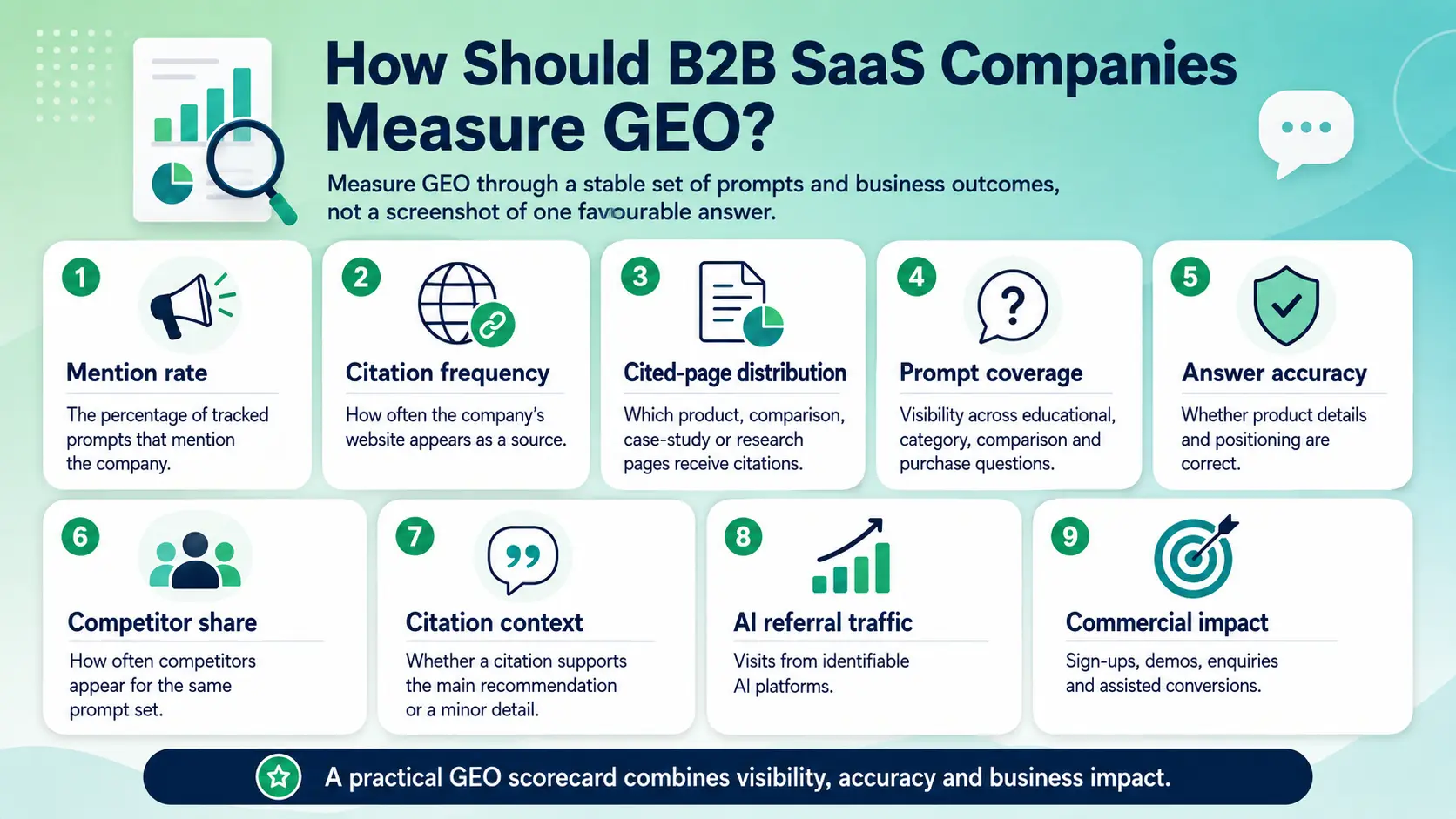
A practical scorecard includes:
- Mention rate: The percentage of tracked prompts that mention the company.
- Citation frequency: How often the company’s website appears as a source.
- Cited-page distribution: Which product, comparison, case-study or research pages receive citations.
- Prompt coverage: Visibility across educational, category, comparison and purchase questions.
- Answer accuracy: Whether product details and positioning are correct.
- Competitor share: How often competitors appear for the same prompt set.
- Citation context: Whether a citation supports the main recommendation or a minor detail.
- AI referral traffic: Visits from identifiable AI platforms.
- Commercial impact: Sign-ups, demos, enquiries and assisted conversions.
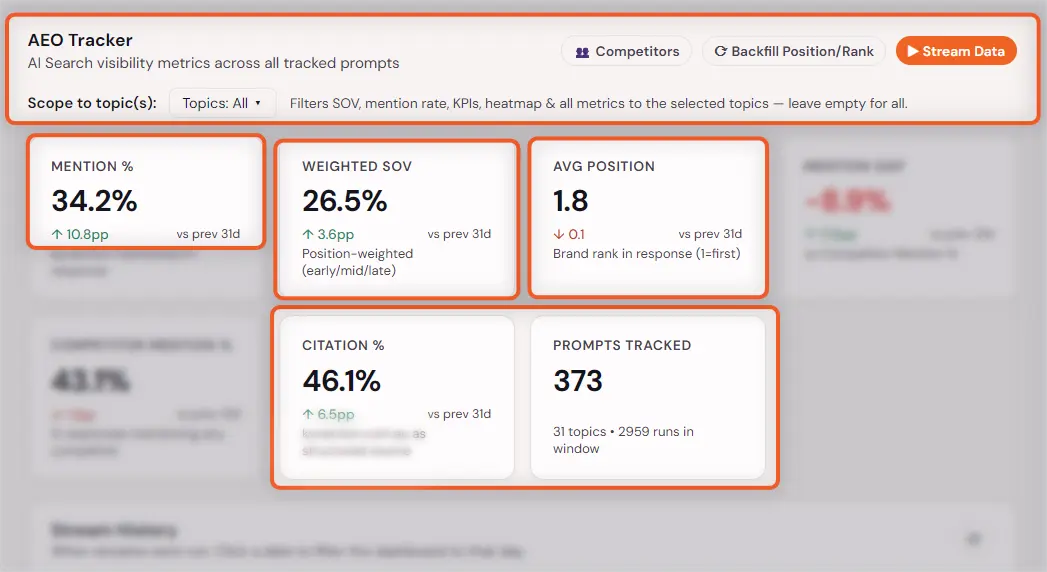
What those metrics look like in practice: a B2B management software and technology solutions provider running a structured GEO programme recorded a Citation Rate of 46.1% across 2,959 prompt runs in a 31-day window, with a Mention Rate of 34.2% and a Weighted Share of Voice of 26.5%.
These results show that a structured GEO programme can deliver measurable gains in citations, brand mentions and AI share of voice.
What Are the Most Common SEO and GEO Mistakes?
| Mistake | Why it causes problems |
| Treating SEO as obsolete | GEO cannot repair blocked pages, poor indexing or weak architecture. |
| Writing only for AI | Mechanical summaries and repetitive headings reduce value for human readers. |
| Testing one prompt | One generated answer does not establish a reliable trend. |
| Counting every citation as a win | A citation may be inaccurate, peripheral or commercially irrelevant. |
| Ignoring third-party sources | SaaS buyers and AI systems both use external evidence to validate claims. |
| Separating SEO and GEO completely | Isolated workflows duplicate research and create inconsistent messaging. |
| Publishing generic content | Material without original evidence or insight is easy to replace. |
Conclusion
AI search changes where B2B SaaS visibility is earned and how it should be measured, but it does not remove the need for SEO.
SEO provides the technical, content and authority foundations that make a company discoverable. GEO adds prompt research, citation monitoring, external corroboration and checks on how the product is represented inside generated answers.
The most practical starting point is a combined visibility audit. Review technical SEO, organic rankings, AI mentions, citations, answer accuracy and commercial outcomes. The results will show whether the next priority is fixing the foundation or expanding visibility across AI-supported buying journeys.
FAQs
Is GEO replacing SEO for B2B SaaS?
No. GEO extends visibility into AI-generated answers, while SEO continues to support crawling, indexing, relevance and search discovery. SaaS companies need both disciplines, although the balance of investment may change.
Can a SaaS page rank well but receive no AI citations?
Yes. Search rankings and AI citations are different outcomes. A page may rank strongly while other sources are chosen to support a generated answer.
Which SaaS pages are most useful for GEO?
Useful formats include detailed product pages, comparisons, integration guides, original research, case studies and use-case pages. The strongest pages provide clear information and credible supporting evidence.
How often should GEO visibility be measured?
Track a stable prompt set regularly, such as monthly, and conduct deeper quarterly reviews. Testing the same questions over time makes patterns easier to distinguish from normal answer variation.
Does structured data guarantee AI citations?
No. Structured data can support search understanding and eligibility for certain search features, but it does not guarantee retrieval, inclusion or citation in an AI-generated answer.
