


Starting a new job comes with a mix of excitement and uncertainty. One thing that affects nearly every new hire is the probation period, yet most people go through it without fully understanding what it means, what rights they hold, or what their employer can and cannot do.
This guide covers everything you need to know about probation periods in 2026, from their legal standing in India to how they work in the UK, US, and beyond. Whether you are a new employee trying to make sense of your contract, or an HR professional looking to set up a fair system, this article has you covered.
What Is a Probation Period?

Probation Period Definition
A probation period is a fixed window of time at the start of employment during which both the employer and the employee assess whether the job is a good fit. During this time, the employer evaluates the new hire’s performance, skills, and behaviour, while the employee decides whether the role and the company meet their expectations.
Probation Period Meaning in Employment
In employment terms, a probation period acts as a structured trial phase. The employee is on the payroll and carries out real job responsibilities, but their employment status remains provisional. Confirmation as a permanent employee typically comes after successfully completing this period.
It is worth noting that “probation” in an employment context has nothing to do with legal or criminal probation. It simply describes a monitored starting phase for new hires.
Why Companies Have Probation Periods
Hiring is expensive. Screening, interviewing, onboarding, and training a new employee costs significant time and money. A probation period allows companies to verify that the person they hired can actually do what they were hired for, before committing to long-term employment terms.
Beyond performance, probation also helps employers assess softer factors like how well someone works with a team, whether they adapt to the work culture, and how they handle pressure or feedback.
Is a Probation Period Mandatory?
No, probation periods are not legally mandatory in most countries, including India. They are a matter of company policy and contract terms. That said, most employers across industries do include one in their offer letters or employment agreements. If no probation period is mentioned in your contract, you are generally treated as a permanent employee from day one.
Purpose of a Probation Period
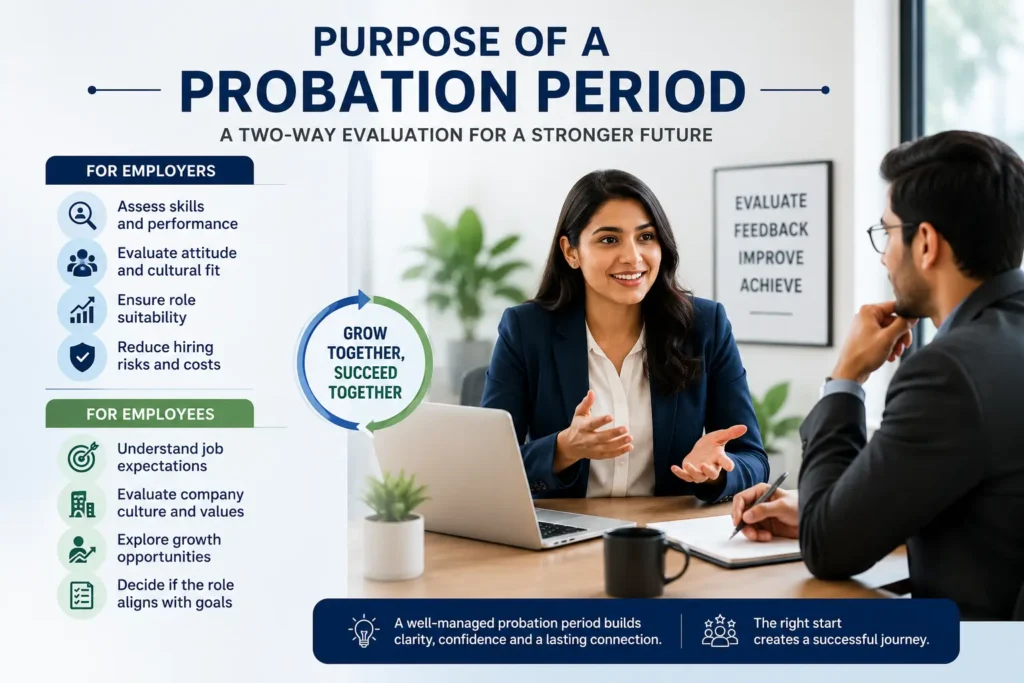
Benefits for Employers
The most obvious benefit is risk reduction. A probation period gives employers a structured way to exit a hiring mistake without the same legal exposure they would face when terminating a confirmed employee.
During this phase, employers can assess whether the new hire’s technical skills match what was presented in interviews, whether their productivity meets role expectations, and whether their attitude and conduct are appropriate for the workplace. It also gives managers the chance to course-correct early by providing feedback before small problems become serious ones.
Benefits for Employees
Probation is not a one-sided arrangement. New employees also use this time to evaluate whether the job lives up to what was promised. Does the day-to-day work match the job description? Is the management style something they can work with? Does the company culture feel right?
This period gives employees a relatively low-stakes window to ask questions, learn the ropes, and decide whether this is a role they want to stay in long term.
Why Probation Is a Two-Way Evaluation Process
It is common for employees to think of probation as something happening to them rather than something they are also participating in. In reality, resignation rates during probation are significant, precisely because employees are making their own assessments at the same time. A well-run probation process acknowledges this and encourages open dialogue from both sides.
How a Probation Period Works
Understanding the typical flow of a probation period helps both managers and employees stay on track.
Step 1: Employee Joins the Organisation. The probation period begins on the first day of employment. The offer letter or employment contract should state the duration and any specific conditions.
Step 2: Goal Setting and Expectations. In the first week or two, the manager and new hire should agree on clear, measurable goals for the probation period. What does success look like at the 30-day, 60-day, and 90-day marks?
Step 3: Training and Onboarding. The employee goes through whatever structured onboarding the company provides, learns internal tools and processes, and meets their team.
Step 4: Performance Monitoring. The manager tracks progress against the agreed goals, watches for behavioural or performance concerns, and documents observations.
Step 5: Review Meetings. Formal check-ins at regular intervals (commonly at 30, 60, and 90 days) give both parties a chance to discuss progress, flag issues, and recalibrate expectations.
Step 6: Final Assessment. At the end of the probation period, the employer makes one of three decisions.
Confirmation means the employee has met expectations and will continue as a permanent employee. A confirmation letter is issued, and additional benefits may kick in.
Extension means the employer needs more time to evaluate, often because of performance gaps or because the employee was absent for a significant stretch during the probation window.
Termination means the employment is ended because the employee did not meet the required standards.
Typical Probation Period Duration
There is no universal rule for how long a probation period must last. The most common durations are 30, 60, 90, 180, and 365 days, each suited to different types of roles.
30-Day Probation is relatively short and used mostly for entry-level, high-volume hiring roles where performance is easy to measure quickly, such as call centre staff or retail cashiers.
60-Day Probation gives a bit more room and is common in mid-level positions where the employee needs time to get up to speed but the role is not highly complex.
90-Day Probation (3 months) is the most widely used duration globally. It is long enough to assess performance across different work scenarios without dragging out the uncertainty unnecessarily.
6-Month Probation is standard in more senior or technically complex roles where deep evaluation is needed. Many Indian companies use six months as their default.
12-Month Probation is typically reserved for very senior positions, government jobs, or roles where integration takes a long time. It is less common in the private sector.
Factors That Determine Probation Length
Job Seniority plays the biggest role. Senior positions carry higher stakes, so companies want more time to assess.
Technical Complexity also matters. A software architect or a surgeon needs longer to demonstrate full competency than a data entry operator.
Industry Requirements can dictate norms, especially in sectors like banking, healthcare, or government where regulatory or compliance expectations shape HR policies.
Company Policy is the final factor. Many companies simply have a standard probation period written into their HR handbook regardless of role level.
Probation Period Duration by Industry
| Industry | Common Duration |
|---|---|
| IT and Software | 3 to 6 months |
| Banking and Finance | 3 to 6 months |
| Manufacturing | 3 to 6 months |
| Healthcare | 3 to 6 months |
| Retail | 1 to 3 months |
| Startups | 1 to 3 months |
| Government Jobs | 1 to 2 years |
Employee Rights During Probation
One of the most common misconceptions is that employees on probation have no rights. This is not accurate. While some benefits may vest only after confirmation, employees on probation retain important protections from day one.
Salary and Wage Rights
Employees on probation are entitled to the salary stated in their offer letter. Employers cannot pay below minimum wage, and any salary agreed upon in writing must be honoured. Some companies pay a slightly lower salary during probation with a revision promised upon confirmation, but this must be clearly documented in the contract.
Paid Leave Entitlements
Leave entitlement during probation varies by state in India and by company policy. Many companies restrict casual leave or earned leave during probation, but they are required to comply with applicable state Shops and Establishments Acts, which often grant leave rights regardless of employment status.
Sick Leave During Probation
Most state-level labour laws in India require employers to grant a minimum number of sick leave days regardless of whether an employee is on probation. Check the applicable state Shops and Establishments Act for the specific number.
Provident Fund (PF) Eligibility
Under the Employees’ Provident Funds and Miscellaneous Provisions Act, 1952, PF contributions are mandatory for all employees (including those on probation) whose basic salary is up to Rs. 15,000 per month if the employer has 20 or more employees. Probationary status does not exempt either party from this obligation.
ESIC Benefits
The Employees’ State Insurance Corporation (ESIC) scheme applies to employees earning up to Rs. 21,000 per month (Rs. 25,000 for persons with disabilities). If the establishment is covered under the ESI Act, probationary employees are eligible for medical, sickness, and maternity benefits from the start of employment.
Maternity Benefits
Under the Maternity Benefit Act, 1961, a woman employee is entitled to maternity leave if she has worked for the employer for at least 80 days in the 12 months preceding the expected delivery date. The probation period counts toward this 80-day threshold. An employer cannot deny maternity benefits on the grounds that the employee is on probation.
Paternity Benefits
India does not have a central law mandating paternity leave for private sector employees. However, some companies and several state governments do offer it. Central government employees are entitled to 15 days of paternity leave regardless of probation status.
Protection Against Discrimination
Employment laws prohibiting discrimination on grounds of gender, caste, religion, disability, and other protected characteristics apply equally during probation. An employer cannot terminate a probationary employee on discriminatory grounds and frame it as a performance issue.
Safe Workplace Rights
An employee on probation has the same right to a safe, non-hostile work environment as any permanent employee. Workplace safety regulations, anti-harassment policies, and grievance mechanisms apply from day one.
Probation Period Rules in India
India does not have a single central law that directly governs private sector probation periods. Instead, the rules are shaped by a combination of instruments.
Role of Employment Contracts
The employment contract is the primary document governing probation in India. It should spell out the duration, the conditions for extension or termination, and what happens upon confirmation. If probation terms are not in the contract, courts and tribunals may treat the employee as a permanent worker.
Standing Orders and Probation
For industrial establishments covered under the Industrial Employment (Standing Orders) Act, 1946, probation terms must be clearly stated in the certified standing orders. These standing orders are legally binding documents that govern the terms of employment for workmen.
Shops and Establishments Acts
Each state has its own Shops and Establishments Act that applies to commercial establishments. These Acts often contain provisions on notice periods, leave, and working hours that apply regardless of whether an employee is on probation.
Industrial Relations Code Considerations
The Industrial Relations Code, 2020, which consolidates several older labour laws, is in the process of implementation across states. Once fully implemented, it may affect how probationary employees classified as “workers” are treated, including rules around retrenchment and notice.
State-Level Variations
Because labour is a concurrent subject in India (both the Centre and states can legislate on it), probation rules can differ meaningfully from state to state. For example, the definition of “workman,” the applicable notice period, and leave entitlements all vary by state.
Can a Company Remove an Employee During Probation?
Yes, an employer can terminate an employee during their probation period, but not without constraints. For employees who qualify as “workmen” under the Industrial Disputes Act, 1947, even a probationary termination must not be arbitrary or mala fide. Courts have held that termination of a probationary workman without giving them a fair opportunity to respond to allegations can amount to an illegal dismissal.
For non-workmen (managers, executives, professionals), the contract governs, and the employer generally has more discretion, provided the termination is not discriminatory.
Is Notice Required During Probation?
Notice requirements during probation depend on what the employment contract says and what state law applies. Many contracts allow a shorter notice period during probation, sometimes as little as seven days. If the contract is silent, reasonable notice is expected. Immediate termination without notice is permissible in cases of gross misconduct.
Probation Period Laws Around the World
India
As covered above, India relies primarily on employment contracts, standing orders, and state-specific labour legislation. There is no central law setting a maximum probation duration for the private sector, though courts have sometimes treated very long probation periods as unconscionable if used to avoid employment protections.
United Kingdom
Probation periods in the UK are governed by contract law. Historically, employees needed two years of continuous service to claim unfair dismissal. The Employment Rights Act reforms being rolled out in 2026 and 2027 are changing this significantly.
2026-2027 Employment Rights Reforms: The UK is introducing statutory probation periods with a “light-touch” dismissal process for employers during a new hire’s first nine months. This replaces the old two-year qualifying period with a shorter, structured framework.
Day-One Employment Rights: Under the new framework, employees in the UK gain certain rights from their first day of employment, including protection from automatically unfair dismissal (for whistleblowing, pregnancy, etc.) regardless of how long they have worked.
Unfair Dismissal Qualifying Period Changes: The qualifying period for standard unfair dismissal claims is being reduced, but a defined statutory probation period will allow employers to dismiss more easily during the initial period, provided a fair process is followed.
United States
At-Will Employment: Most US states follow the at-will employment doctrine, meaning employers can terminate employees at any time, for any reason that is not illegal, and employees can leave at any time. Probation periods in US workplaces are largely symbolic in legal terms for private employers, though they matter for HR processes and benefit vesting schedules.
Montana’s Just-Cause Exception: Montana is the only US state that mandates just-cause employment. After completing an employer’s probationary period (or after 12 months if none is specified), employees in Montana can only be dismissed for good cause.
European Union
EU member states generally offer stronger employment protections than the US. Many have maximum statutory probation periods (for example, France limits probation to 4 months for executives), and dismissal during probation still requires some procedural compliance. The EU Transparent and Predictable Working Conditions Directive (2019) requires probation periods to be no longer than six months in most cases.
UAE
In the UAE, the Federal Decree-Law No. 33 of 2021 on the Regulation of Labour Relations caps probation periods at six months. If an employer dismisses an employee during probation, they must give the employee at least 14 days’ notice. If an employee resigns during probation to join another UAE employer, they must give one month’s notice.
Australia
In Australia, the Fair Work Act 2009 allows employers to dismiss employees during a minimum employment period (which acts as the probationary phase) without a claim for unfair dismissal. This period is one year for small businesses (fewer than 15 employees) and six months for larger ones. Employees can still claim general protections (such as discrimination) during this window.
Goals and Performance Expectations During Probation
What Employers Typically Evaluate
Most employers assess a consistent set of qualities during probation regardless of the specific role.
Technical Skills: Can the person do the core tasks the job requires? Are they up to speed on the tools, systems, and methods used?
Productivity: Are they delivering work at the pace and quality expected for someone at their stage?
Attendance: Are they showing up consistently and on time? Unexplained absences early in employment are a common red flag.
Communication: Do they communicate clearly with colleagues, managers, and (if relevant) clients? Do they escalate issues appropriately?
Teamwork: Do they collaborate well? Are they easy to work with, or do they create friction?
Adaptability: How do they respond to unexpected challenges or changes in direction?
Cultural Fit: Does their behaviour align with the company’s values and workplace norms?
SMART Goals During Probation
Goals set during probation should be Specific, Measurable, Achievable, Relevant, and Time-bound. Vague goals like “do well in your role” are useless. A good probation goal looks like: “Complete onboarding training by end of week two. Handle five customer calls independently by end of month one. Achieve a customer satisfaction score of at least 90% by the end of the probation period.”
Learning Goals vs Performance Goals
Especially in the first month, it is fair to set learning goals (understand our systems, shadow three client calls, read the product documentation) before shifting to pure performance goals. Expecting full output from a new hire on day one is unrealistic and sets everyone up for a poor experience.
Probation Reviews and Performance Assessments
Why Regular Reviews Matter
A probation period without structured reviews is a wasted opportunity. Without check-ins, problems fester and both sides end up surprised at the end of the period. Regular reviews allow the manager to give early feedback, the employee to adjust, and both sides to document the process.
The 30-60-90 Day Review Framework
This is the most widely used structure for probation evaluations.
First 30 Days focus on settling in. The review at this stage should ask: Has the employee completed onboarding? Do they understand their role? Have they built basic working relationships? Are there any early concerns?
First 60 Days shift toward early performance. The review checks whether the employee is delivering on initial tasks, whether they are asking the right questions, and whether there are any patterns of concern.
First 90 Days assess whether the employee is ready for confirmation or whether issues need to be addressed. At this stage, both the manager and the employee should have enough data to make informed decisions.
Common Evaluation Criteria
Most performance review forms during probation cover: quality of work, quantity of work, punctuality and attendance, communication skills, teamwork, initiative, and adherence to company policies.
Documentation Best Practices
Every review, verbal warning, or performance concern during probation should be documented in writing. If the employment is terminated at the end of probation and the employee disputes it, having a paper trail is essential. Documentation also protects the employee by creating a record of what was discussed and agreed upon.
Red Flags Managers Watch For
Common warning signs that appear in probation reviews include: missed deadlines, inability to receive feedback without becoming defensive, unexplained absences, failure to learn basic systems after reasonable time, conflict with colleagues, and dishonesty about skills or progress.
Probation Period vs Permanent Employment
| Feature | Probation Employee | Permanent Employee |
|---|---|---|
| Job Security | Lower; easier to dismiss | Higher; more legal protections |
| Notice Period | Usually shorter | Usually longer |
| Benefits | May be partial or deferred | Full benefits package |
| Performance Monitoring | Intensive | Periodic |
| Employment Status | Provisional | Confirmed |
Key Differences Explained
The most significant difference is job security. Permanent employees typically have more legal protection against dismissal and are entitled to the full benefits package the company offers. Probationary employees may have some benefits deferred (such as certain insurance cover or stock options) until confirmation.
Notice periods during probation are generally shorter for both parties, reflecting the provisional nature of the arrangement.
Notice Period During Probation
Typical Notice Period Rules
Most employment contracts specify a shorter notice period during probation than what applies after confirmation. A common arrangement is 7 to 30 days’ notice during probation, compared to 30 to 90 days after confirmation.
Resigning During Probation
An employee is free to resign during probation. They must give whatever notice their contract requires. In some cases, especially where the employee plans to join a competitor in India, the company may ask them to serve out the notice or pay in lieu. Some contracts require one month’s notice even during probation; others allow just one week.
Employer-Initiated Termination
If the employer terminates the employee during probation, the same contractual notice period applies unless the termination is for gross misconduct. Some companies issue a termination letter with the notice period already waived and pay out the equivalent salary (pay in lieu of notice).
Immediate Termination Scenarios
Gross misconduct such as theft, fraud, violence, harassment, or serious breach of company policy can lead to immediate termination without notice during probation (and after it). The employer should still follow a fair process, including giving the employee an opportunity to respond to the allegations.
What Employment Contracts Usually Say
A well-drafted employment contract will specify the notice period during probation separately from the notice period after confirmation, clarify whether pay in lieu of notice is permitted, and state the grounds on which immediate termination can occur.
Can a Probation Period Be Extended?
Yes, probation can be extended, but it must be done properly.
Common Reasons for Extension
Performance Concerns are the most common reason. If the employee has not yet demonstrated the level of work expected but the employer believes they can get there with more time, extension is a reasonable option.
Attendance Issues are also frequently cited. If an employee had extended sick leave or personal absence during probation, the employer may argue they could not make a proper assessment.
Incomplete Training sometimes delays evaluation. If mandatory training was not completed, the employer may extend to allow for it.
Extended Leave or Illness can effectively pause the probation clock. Many contracts state that the probation period excludes time taken on leave, so periods of illness or maternity leave may result in a proportional extension.
Legal Considerations
The extended probation must still comply with applicable laws. Courts in India have held that repeated or excessively long extensions used to keep an employee in permanent uncertainty may be challenged. The terms of extension should be documented in writing and communicated formally to the employee.
Employee Rights During Extension
An employee on an extended probation retains the same rights as during the original probation period. The extension is not a punishment in itself; it simply means the employer needs more time. The employee should receive a clear explanation of what needs to improve and what the new evaluation criteria are.
Best Practices for Employers
Always issue a formal extension letter before the original probation period ends. State the reason for extension, the new end date, and the specific goals the employee must meet. Conduct at least one formal review before the extended period ends.
Termination During Probation
Common Reasons Employees Fail Probation
Poor Performance is the most frequently cited reason. Failing to meet the basic output or quality standards expected of someone in the role is grounds for a probationary termination.
Attendance Problems are taken seriously because they affect team productivity and signal unreliability.
Behavioural Issues include repeated conflicts with colleagues, insubordination, or conduct that makes the workplace uncomfortable for others.
Skill Gaps are sometimes only discovered once someone is doing the actual job. If the gap between the candidate’s actual skills and the role’s requirements is too large to bridge, termination may follow.
Cultural Misalignment refers to situations where the employee’s values or work style are fundamentally at odds with those of the organisation, even if their technical work is acceptable.
Employer Responsibilities Before Termination
Even during probation, employers should not terminate an employee without following some basic process. This means documenting performance concerns, communicating them clearly to the employee, giving the employee a reasonable chance to improve, and only proceeding to termination if improvement does not occur or if the conduct is serious enough to warrant immediate action.
Documentation and Review Meetings
Any employer who terminates a probationary employee should have a paper trail: written records of performance reviews, any warnings issued, goals set and missed, and the final assessment. Verbal conversations alone are not sufficient.
Legal Risks of Improper Dismissal
In India, if a probationary employee falls under the definition of “workman” under the Industrial Disputes Act, improper termination during probation can expose the employer to claims of illegal retrenchment. Courts have reinstated probationary workmen and awarded back wages in cases where employers failed to follow a fair process. For non-workmen, the risk is a wrongful termination claim under the employment contract.
What Employees Can Do After Termination
A terminated probationary employee in India can file a complaint with the appropriate labour commissioner or industrial tribunal if they believe the termination was illegal, discriminatory, or in violation of their contract. They may also approach the civil courts for breach of contract. Collecting all written communications and the employment contract before leaving the company is important.
What Happens After Probation Ends?
Confirmation of Employment
Once the probation period ends and the employee has met expectations, the employer issues a confirmation. This formally converts the employment status from probationary to permanent (or confirmed).
Confirmation Letters
A confirmation letter should be in writing and state: the date of confirmation, the designation, any salary revision, changes to benefits (if any), and the applicable notice period going forward. Keep a copy of this letter; it is an important employment document.
Salary Revisions
Many companies build a salary revision into the confirmation. The offer letter may state a probationary salary and a confirmed salary, with the increase taking effect on confirmation. Not all companies do this, but it is common in sectors like IT and banking.
Additional Benefits
Benefits such as health insurance, group term life cover, performance bonuses, and stock option eligibility often vest or kick in only after confirmation. Review your employment contract to understand exactly when each benefit begins.
Career Development Opportunities
Confirmation also typically marks the point at which an employee becomes eligible for internal job postings, promotion cycles, and formal performance appraisals. Some companies have a separate “new hire” track for the first year that transitions to the standard appraisal cycle after confirmation.
What Happens If No Confirmation Letter Is Issued?
This is a genuinely grey area. If a probation period ends and the employer says nothing, courts in India have generally held that the continued employment of the worker implies confirmation, especially for workers covered under the Industrial Disputes Act. For non-workmen, the answer depends on the contract. If you have not received a confirmation letter after your probation ended, follow up in writing with your HR department and keep a record of the exchange.
How to Pass a Probation Period Successfully
Probation is not a test you pass by luck. Here are the things that actually make a difference.
Understand Expectations Early. In your first week, get crystal clear on what success looks like. Ask your manager to define the goals for your probation period in writing if possible. Do not assume you know what is expected.
Build Strong Working Relationships. Technical skills alone rarely get people through probation. The people who confirm are almost always those who are easy to work with. Invest time in building genuine relationships with colleagues and your manager.
Communicate Proactively. If you are struggling, say so before it becomes obvious. If you have a concern, raise it. If you are going to miss a deadline, flag it early. Managers almost always respond better to early honesty than to discovering problems on their own.
Seek Feedback Frequently. Do not wait for formal review meetings. After completing a piece of work, ask your manager what they thought. After a client call, ask a colleague if there is something you could have handled better. People who actively seek feedback usually improve faster and also signal self-awareness.
Document Your Achievements. Keep a simple running log of what you have done, what went well, and any metrics that show your contribution. This is useful in review meetings and gives you confidence that you are making progress.
Demonstrate Reliability. Be where you say you will be, do what you say you will do, and meet the deadlines you have committed to. Consistency matters more than any single impressive moment.
Show Initiative. Look for small opportunities to go slightly beyond your brief. Volunteer for tasks, suggest improvements to processes you have been trained on, or help a colleague who is under pressure. Initiative signals that you are invested in the organisation’s success, not just your own job security.
Common Mistakes Employees Make During Probation
Missing Deadlines is one of the fastest ways to raise concern. Even if the work itself is good, missing a deadline creates a perception of unreliability.
Poor Attendance during the very phase when you are supposed to be making a first impression tells employers something unfavourable, even if the absences are legitimate. If you do need to take leave, communicate clearly and ensure your work is covered.
Lack of Communication leaves managers guessing. If you are stuck on a problem and say nothing for three days, your manager does not see someone trying hard and failing. They see someone who has gone quiet.
Ignoring Feedback is a serious problem. Managers who give feedback that is then not acted on often lose interest in investing further in that employee.
Overconfidence trips up experienced hires who arrive assuming they already know how things should be done. Every workplace has its own ways of working, and dismissing them without understanding them first rarely ends well.
Failing to Learn Company Processes is a related trap. Jumping ahead with tasks before learning how the company actually does things creates rework and friction.
Real-World Probation Examples
Example 1: Successful Completion of Probation
Priya joined a mid-sized software company in Bengaluru as a product manager on a three-month probation. In her first week, she met with her manager to agree on clear goals: complete onboarding, shadow five customer calls, and deliver a competitive analysis document by month one. She hit each milestone, communicated any blockers early, and asked for feedback after each deliverable. At the 90-day review, she received a confirmation letter along with a salary revision. The key factors were her proactive communication and her willingness to ask questions rather than guess.
Example 2: Probation Extension Due to Performance Gaps
Rajan joined a banking operations team on a six-month probation. His technical knowledge was strong, but his accuracy on transaction processing was below the required threshold at the three-month review. Rather than terminating, his manager extended the probation by two months, issued him a performance improvement plan with specific targets, and assigned him additional coaching sessions. Rajan hit the targets within the extended period and was confirmed. The extension was handled fairly because the employer documented everything and gave Rajan a genuine path to improvement.
Example 3: Probation Termination Due to Role Mismatch
Ananya was hired as a senior analyst at a consulting firm with a three-month probation. Despite strong academic credentials, it became clear within two months that her working style was not suited to the fast-paced, client-facing nature of the role. She missed two client presentation deadlines, and feedback from the team was consistently that she needed significant supervision. The company terminated her employment during probation, providing the contractually required 30 days’ notice and a reference letter. The outcome was difficult but handled professionally: the company had documented its concerns in two formal review meetings, and Ananya had been told clearly what needed to change.
Why Probation Periods Matter for Businesses
Reducing the Cost of Bad Hires
A bad hire is expensive. Studies have estimated the cost of replacing an employee at anywhere from half to three times their annual salary when you account for recruitment, lost productivity, training, and the impact on team morale. Probation periods give businesses a structured, lower-cost exit route when they identify a mismatch early.
Improving Workforce Quality
When probation is managed well and used consistently, it improves the overall quality of the workforce. Employees who are retained are those who have genuinely demonstrated they can do the job.
Supporting Employee Development
A probation period, done right, is not just an assessment tool. It is also a development tool. The structured feedback and goal-setting process helps new employees grow faster than they would in a completely unstructured onboarding.
Improving Long-Term Retention
Counterintuitively, rigorous probation periods often improve long-term retention. When employees know they are being evaluated fairly against clear criteria, they engage more seriously. Those who pass feel they have genuinely earned their place, which increases commitment to the organisation.
The Financial Impact of Hiring Mistakes
Beyond replacement costs, a poor hire who stays past probation may damage client relationships, lower team morale, create HR issues, or produce substandard work for years. Avoiding this through an honest probation process protects the business’s bottom line.
Future Trends in Probation Periods
Increased Employee Protections
Globally, the direction of travel is toward stronger employee rights, even during probation. The UK’s 2026-2027 reforms are a prime example. India’s new labour codes, when implemented, may also bring greater consistency and protection for probationary workers.
Shorter Probation Periods
As hiring processes become more rigorous (structured interviews, skills tests, trial projects), companies are finding that they need less time to assess fit. The trend in some sectors, particularly technology startups, is toward shorter probation periods of 30 to 60 days.
Remote Employee Evaluations
Managing probationary employees who work remotely requires a fundamentally different approach from in-person evaluation. Companies are increasingly adapting their probation frameworks to account for digital communication patterns, output-based (rather than presence-based) assessment, and virtual onboarding.
AI-Assisted Performance Reviews
Some larger organisations are beginning to use AI tools to help standardise performance feedback and flag patterns (such as consistent deadline misses or communication gaps) during probation. While these tools can reduce bias in documentation, they also raise questions about fairness and transparency that HR teams are still working through.
Skills-Based Hiring and Assessment
As skills-based hiring replaces degree and credentials-based screening, probation assessments are also shifting toward demonstrated skills over traits or impressions. This makes the evaluation more objective and reduces the influence of unconscious bias.
Frequently Asked Questions About Probation Periods
- What is a probation period in a job? It is a defined period at the start of employment during which both the employer and the employee assess whether the role is a good match. Employment during this period is provisional.
- How long is a probation period? The most common duration in India is three to six months. Entry-level roles may have shorter periods; senior or government roles may have longer ones.
- Can probation be extended? Yes, employers can extend a probation period if there are legitimate reasons such as performance gaps, incomplete training, or extended absence. The extension must be communicated in writing before the original period ends.
- Can I resign during probation? Yes. You must give the notice period specified in your employment contract, which is often shorter during probation than it is after confirmation.
- Can my employer terminate me during probation? Yes, but the process must not be arbitrary, discriminatory, or in violation of your contract. Employees classified as workmen under Indian labour law have additional protections even during probation.
- Is leave allowed during probation? It depends on company policy and applicable state law. Statutory entitlements under the Shops and Establishments Act generally apply, but many companies restrict earned leave during probation.
- Do I receive PF benefits during probation? Yes, if your employer has 20 or more employees and your basic salary is up to Rs. 15,000, PF contributions are mandatory from day one of employment.
- Does probation count toward service length? In most cases, yes. The probation period is typically counted as part of continuous service for calculating gratuity, notice period eligibility, and other length-of-service benefits unless the contract explicitly states otherwise.
- Can probation exceed six months? Yes, there is no statutory maximum probation period for non-workmen in most Indian states. However, excessively long probation periods, when challenged in courts, have sometimes been found unconscionable.
- What happens if I do not receive a confirmation letter? In India, continued employment after the probation period typically implies confirmation, particularly for employees classified as workmen. Follow up in writing with HR and document your request.
- Is probation mandatory in India? No. It is a matter of contract and company policy, not a statutory requirement for private sector employers.
- Can salary increase after probation? Yes, and it is common. Many offer letters specify a probationary salary with a revision on confirmation. If your letter states this, the increase is contractually binding.
