Day: November 7, 2026

  • What Is Reedoor2.4.6.8 for Windows? Why Is It Important for Businesses?

    What Is Reedoor2.4.6.8 for Windows? Why Is It Important for Businesses?

    Reedoor2.4.6.8 is a security program that is made to find, stop and get rid of kinds of malware. It looks for viruses phishing attempts, ransomware and spyware.

    Reedoor2.4.6.8 gives protection in time. It makes sure every threat is stopped before it can harm the system.

    Cybercriminals use tricks to break security. With the system of Reedoor2.4.6.8 companies can improve their security and keep privacy and data safe.

    This guide splits what can be checked from what cannot. You will learn why Reedoor2.4.6.8 appears on Windows PCs if it is a virus, how to check it step by step and how to remove it safely.

    You will also see why Reedoor2.4.6.8 matters for businesses to look into of ignoring it. The advice is useful, for a home user, an office or a full IT department.

    What Is Reedoor2.4.6.8 for Windows?
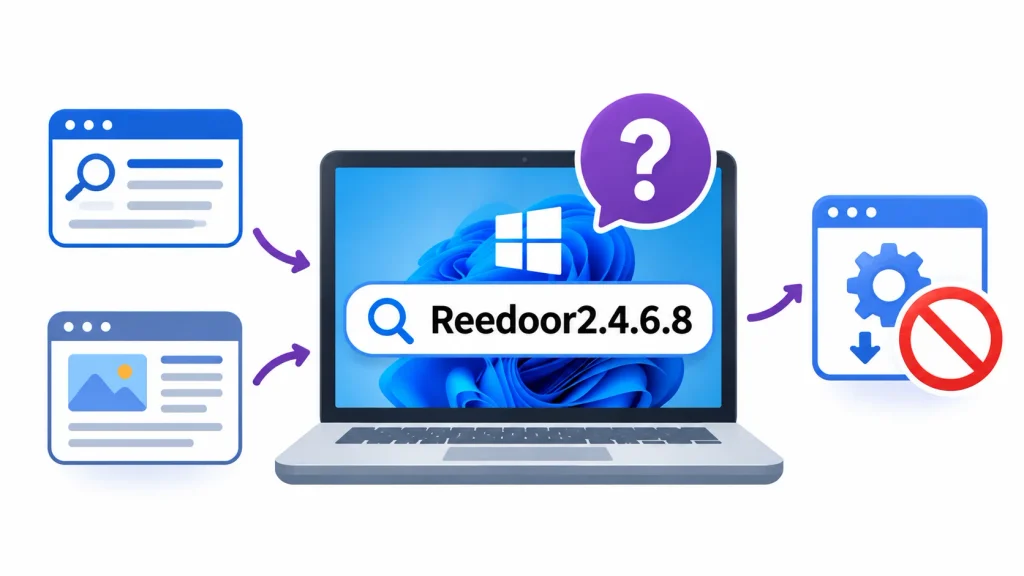
    Reedoor2.4.6.8 Windows overview showing search results, an unidentified software name, and the lack of verified software documentation or official publisher.

    In practical terms, Reedoor2.4.6.8 is a piece of text that appears in search results and on a few web pages, with no verifiable software behind it. Here is what that means, one question at a time.

    1. Understanding the Reedoor2.4.6.8 name

    Real Windows products come with a clear name, a named company and a website where you can download them. This one has none of those. The name also runs the product word and a version number together with no space, which looks more like a file label or search phrase than a brand.

    That oddity proves nothing on its own, but it is a reason to slow down. A search for the exact name turned up no publisher page, no product documentation and no Microsoft listing.

    2. Is Reedoor2.4.6.8 an official Windows component?

    There is no evidence that it is. Microsoft documents the parts of Windows that matter for security, such as Windows Security, Microsoft Defender Antivirus and SmartScreen. I found nothing from Microsoft that connects Reedoor2.4.6.8 to any of them.

    3. Does Reedoor2.4.6.8 have a verified publisher?

    Not that anyone has shown. A verified publisher is a company you can look up, with a support contact and a track record. Without one, nobody is answerable for bugs, data handling or malware.

    4. What does the 2.4.6.8 version number mean?

    Four-part version numbers are common in Windows software. They usually track a major release, a minor release, a build and a revision. So the format itself is normal.

    What stands out is the tidy run of even numbers. Real builds often carry larger, less regular numbers. Either way, a version number cannot tell you who made the program or whether it is safe.

    5. What do online sources claim about Reedoor2.4.6.8?

    The descriptions conflict. Some pages present it as antivirus software. Others call it a data tool. A few admit they cannot confirm what it is.

    When pages describe the same “product” in contradictory ways and none names a developer, treat the claims as guesses or search-traffic content, not facts.

    Why Is Reedoor2.4.6.8 Important for Businesses?

    Reedoor2.4.6.8 is not important because of anything it does. It matters because of what it represents: an unknown program that could land on a company computer. Verifying unfamiliar software protects five things:

    1. Company data, including customer, financial and employee records.
    2. Devices, by lowering malware exposure.
    3. Access, by keeping unknown programs away from accounts and shared drives.
    4. Compliance, by keeping data handling inside the rules you must follow.
    5. Uptime, by avoiding crashes and clean-up work.

    These are reasons to check the software, not benefits of Reedoor2.4.6.8 itself.

    1. Protecting sensitive business information

    A business PC often holds customer details, invoices, payroll files and saved logins. A program you cannot trace may read, copy or upload any of it. You only need one careless install for that to happen.

    Businesses should also maintain clear financial records and monitor operational risks through reliable systems, such as cloud accounting for business risk management, to improve financial visibility and support informed decisions.

    2. Preventing malware and security threats

    Unverified software is a common way for unwanted programs to get in. Wikipedia’s overview of potentially unwanted programs explains how bundled installers and misleading downloads put extra software on a PC without a clear opt-out. A business pays for that in lost time and exposed data.

    3. Maintaining business data privacy

    Some programs ask for access to files, browser data or cloud accounts. If you cannot say who runs the program, you cannot say where that data goes. That is a privacy problem before it is a technical one.

    Businesses can improve financial data visibility and management by using reliable cloud-based accounting software with appropriate access controls and security practices.

    4. Reducing operational disruptions

    Unapproved programs can slow machines, clash with business software and trigger security alerts. Someone then has to find the cause. For a small team, that can mean half a day of lost work.

    5. Supporting business IT governance

    Security people call software used without IT approval “shadow IT.” According to a summary by Forvis Mazars of UK National Cyber Security Centre guidance, the response looks like other cyber risks: train people, know what devices you have and set clear policies.

    Businesses should also evaluate operational tools such as inventory management software before adoption, checking their features, reliability, access permissions and data-handling practices.

    6. Protecting business reputation and customer trust

    Customers hand you their data on the assumption that you handle it carefully. A leak traced to a random program is hard to explain. Careful software habits are part of earning that trust.

    7. A realistic scenario

    Picture a 20-person accounting firm. An employee sees a pop-up telling them to install “Reedoor2.4.6.8” to speed up their PC, and they click through. The IT lead’s job is now to find out what was installed, who published it and whether client files were touched. The steps later in this guide are the ones that lead should follow.

    Why Are People Seeing Reedoor2.4.6.8 on Windows?
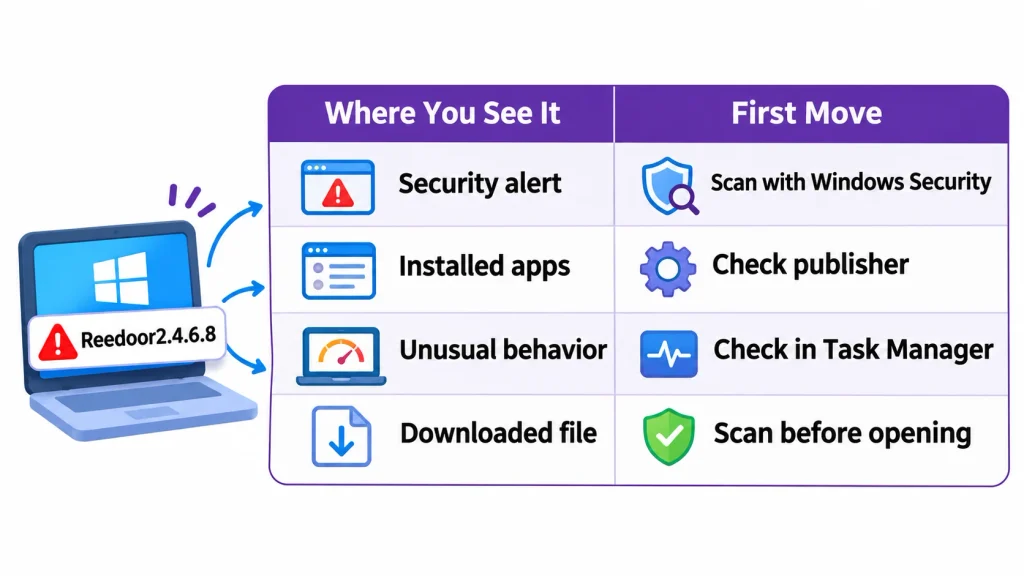
    Reedoor2.4.6.8 Windows troubleshooting infographic showing security alerts, installed apps, unusual behavior, and downloaded files with recommended safety checks.

    People run into the name in several places, and each one points to a different possible cause. None of them confirms a real program. Use the table to match what you saw to a sensible first move.

    Where you see itWhat it could meanFirst move
    Task ManagerA running process or file using that nameRight-click it, choose Open file location, then check the publisher
    Installed appsSomething installed under that name, perhaps bundled with another downloadNote the install date and publisher before uninstalling
    Browser notificationsA website you allowed to send alerts, not necessarily a programRemove that site’s notification permission
    Antivirus alertA detection label tied to a fileRead the alert details and do not add an exclusion
    Windows error messageA coincidence, or a leftover file or entryCheck Event Viewer for the real source
    Downloaded fileAn installer from an unknown siteDo not run it; scan it first

    Odd names like this one can spread because worried people search for them and publishers write pages to catch that traffic. That can create the impression of a product where there is only a label. So finding the name on your PC is a prompt to investigate, not proof of anything.

    Is Reedoor2.4.6.8 a Virus or Malware?

    Nobody has shown that it is, and nobody has shown that it is not. That is the honest answer. A name cannot make a program malicious. What a file does, and who built it, decides that.

    Why the name alone cannot confirm a threat

    Security tools judge files by behavior, code and reputation, not by what a web page calls them. A harmless file can have a scary name, and a dangerous one can look friendly. So do not trust a page that says “it is a virus” or “it is safe” without evidence tied to a specific file.

    Malware, unwanted programs and scareware: what is the difference?

    • Malware is software built to harm you or steal from you, such as ransomware or spyware.
    • Potentially unwanted programs are things you did not really want, often bundled into another download. Wikipedia’s page on potentially unwanted programs covers how this bundling works.
    • Scareware uses fake alerts to frighten you into buying or installing something. Wikipedia describes scareware as a social engineering trick that creates a sense of threat.

    The last two matter here, because a fake “your PC is at risk, install this” message is a classic way an unknown name reaches a computer.

    Common risks tied to unverified software

    • Unauthorized programs that run in the background and open the door to more.
    • Data theft, where files, passwords or browser data leave the machine.
    • Fake security alerts that push you toward a purchase or a download.
    • Unwanted browser notifications that deliver spam or scam links.
    • Suspicious download links that serve an installer from an unknown site.

    Pros and Cons of Reedoor2.4.6.8

    Normally a pros and cons list compares features you can test. Here, nothing can be tested, because no verified software sits behind the name. So the “pros” below are claims made by some web pages, not confirmed benefits. The cons are real risks that come from the lack of verification.

    Claimed pros (unverified)

    • Described as antivirus or malware protection. Some pages say it detects viruses, phishing, ransomware and spyware. No test results or vendor documentation back this up.
    • Described as real-time protection. The claim is that it stops threats before they cause harm. Nothing shows how, or whether, it does.
    • Described as a data or privacy tool. Other pages give it a different purpose, which shows the descriptions are not reliable.
    • Version number looks normal. The four-part format (2.4.6.8) is common in Windows software, but a version number says nothing about safety or who made the program.

    Cons

    • No verified publisher. No company is accountable for bugs, data handling or malware.
    • No official website or documentation. You cannot check what it does, what it collects or how to uninstall it properly.
    • Conflicting descriptions. Pages call it antivirus software, a data tool or “unknown.” Contradictory claims with no named developer should be treated as guesses.
    • No Microsoft connection. Nothing links it to Windows Security, Microsoft Defender or SmartScreen.
    • Possible data exposure. An untraceable program could read, copy or upload files, saved logins and browser data.
    • Possible scareware or bundled-software route. Unknown names often arrive through fake alerts, misleading downloads or notification prompts.
    • No support or updates. If something goes wrong, there is nobody to call and no security update channel.
    • Compliance and licensing risk. On company devices, unapproved software can break data-handling rules and create legal problems.
    • Unknown system requirements. Nobody can say whether it works on Windows 10 or 11, or whether it conflicts with other software.

    Is Reedoor2.4.6.8 Safe?

    Not to install, no. With no verified publisher, no official documentation and conflicting descriptions, there is nothing to base trust on. It is safe to investigate, as long as you do not run, open or approve anything while you do.

    Microsoft’s own tools give a useful signal here. Microsoft Defender SmartScreen checks downloaded apps and installers and warns when a file looks malicious or has an unknown reputation, as described in Microsoft’s documentation for Edge. If you see that warning, take it seriously.

    Warning signs businesses should never ignore

    • No named publisher, or a publisher you cannot find anywhere else.
    • No official website, or a site with no company details or privacy policy.
    • A pop-up or message pressuring you to install it right now.
    • A request for administrator rights with no clear reason.
    • A request to turn off your antivirus or add a security exclusion.
    • A “scan” that instantly finds dozens of problems and then asks for payment.
    • Download links that point to file-sharing sites or unfamiliar domains.

    Any one of these should stop an installation. Two or more mean you should escalate to IT or a security professional.

    How to Check What Reedoor2.4.6.8 Actually Is on Your PC
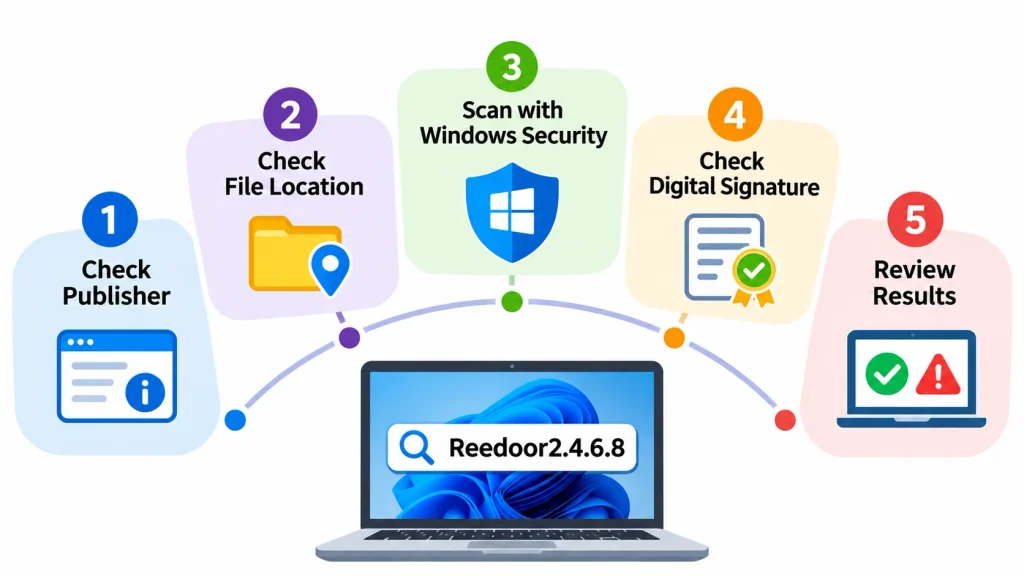
    Reedoor2.4.6.8 Windows verification process showing five steps: check publisher, file location, scan with Windows Security, verify digital signature, and review security results.

    You can check this yourself in about fifteen minutes with tools already built into Windows. The goal is to learn who made the file and whether security tools flag it. Work through these steps in order.

    1. Do not run anything. Write down exactly where you saw the name: a process, an installed app, a pop-up or a file.
    2. Find the file. Press Ctrl+Shift+Esc to open Task Manager, go to the Details tab, right-click the process and choose Open file location. Legitimate programs usually live in Program Files. A file sitting in Downloads, Temp or AppData deserves extra suspicion, but that alone is not proof.
    3. Check the publisher and signature. Right-click the file, choose Properties, and look for a Digital Signatures tab. No tab means the file is unsigned. Unsigned does not automatically mean malicious, and signed does not automatically mean safe. The signature just tells you who stands behind the file.
    4. Check installed apps. Open Settings, then Apps, then Installed apps (Apps & features on Windows 10). Look at the publisher and install date.
    5. Review Protection history. Open Windows Security, go to Virus & threat protection, then Protection history, and see whether Microsoft Defender flagged anything.
    6. Scan the file. Right-click it and choose Scan with Microsoft Defender (on Windows 11, you may need to select Show more options first). Microsoft explains this in its guide to scanning an item with Windows Security.
    7. Look up its fingerprint. In PowerShell, run the command below to get the file’s hash, then search that hash on VirusTotal. Searching a hash does not upload the file, which matters if the file might hold confidential data.
    8. Look for the official source. Search for the publisher’s website, privacy policy and support page. If you cannot find them, stop and ask your IT administrator before doing anything else.

    Get-FileHash “C:\path\to\the\file.exe”

    Treat any result as one signal, not a verdict. A clean scan on a file from an unknown publisher still leaves the publisher question unanswered.

    Reedoor2.4.6.8 in Browser Notifications: What to Do

    If the name pops up as a browser notification, the cause is almost always a website, not an installed program. At some point, a site asked for permission to send alerts and someone clicked Allow. Often the prompt is disguised as “click Allow to prove you are not a robot.”

    An alert you did not expect is a good reason to clean up. Follow these steps:

    1. Do not click the notification or any button inside it.
    2. Open your browser’s notification settings. In Microsoft Edge, go to Settings, then Cookies and site permissions, then Notifications. In Google Chrome, go to Settings, then Privacy and security, then Site settings, then Notifications.
    3. Remove or block every site you do not recognize. Removing a site lets it ask again if you revisit it. Blocking stops the prompt.
    4. Check your extensions. Remove any you did not install on purpose.
    5. Run a Windows Security scan to rule out an unwanted program behind the alerts.

    On business machines, do not rely on staff to do this alone. Administrators can block notification prompts across all browsers through policy in Microsoft Intune or Group Policy, so a single mistaken click cannot turn into a stream of scam alerts.

    How to Remove Reedoor2.4.6.8 Safely

    Remove it only after you have confirmed that something with that name is actually on your PC and that you did not install it on purpose. The aim is to take out what does not belong without damaging Windows.

    1. Contain it first. If the machine belongs to a business, tell IT before you touch anything. If you suspect active data theft, disconnect from Wi-Fi or unplug the network cable.
    2. Uninstall the app. If it appears under Settings, Apps, Installed apps, select it and choose Uninstall.
    3. Run a full scan. Open Windows Security, go to Virus & threat protection, choose Scan options, select Full scan, then Scan now.
    4. Try an offline scan if it keeps coming back. Microsoft Defender Offline restarts the PC and scans before Windows fully loads, which helps with stubborn programs. Microsoft describes the steps in its Defender Offline documentation.
    5. Check startup items. In Task Manager, open the Startup apps tab. Disable only entries you have identified as unwanted.
    6. Clean up the browser. Remove unknown extensions and notification permissions, as covered above.
    7. Protect your accounts. If the program may have run with access to your accounts, change passwords from a different, clean device and turn on multi-factor authentication where you can.

    A few things to avoid. Do not delete files from the Windows or System32 folders by hand. Do not download a “removal tool” from a pop-up or an ad. Both are common ways to turn a small problem into a big one.

    On a company computer, the safest path is to follow your incident process. IT may isolate the device, collect evidence and, if needed, reinstall Windows from a clean image. Home users who are stuck can ask for help in a moderated community such as Reddit’s cybersecurity_help, which publishes a posting guide. Never post passwords, client data or full file contents there.

    Should You Add Reedoor2.4.6.8 to Windows Defender Exclusions?

    No. An exclusion tells Microsoft Defender to stop checking a file, folder or process. For software you cannot identify, that blinds your main protection to the exact thing you are unsure about.

    Exclusions have a place, but only for software you have verified, when the vendor documents a conflict with antivirus scanning. Even then, an administrator should set them and record the reason.

    Be suspicious of any page, pop-up or “installer” that tells you to add an exclusion or switch off protection first. Real software rarely needs that to install.

    If an exclusion was already added, you can remove it. Open Windows Security, go to Virus & threat protection, select Manage settings, then Add or remove exclusions. Select the entry and remove it, then run a full scan.

    What If Reedoor2.4.6.8 Is Associated With a Windows Error?

    An error message that mentions the name does not prove it caused the problem. It might be a leftover file, a coincidence or a fake alert. Work from the evidence instead of the headline.

    1. Record the exact error. Write down the full text, any error code and what you were doing.
    2. Find the real source. Open Event Viewer, go to Windows Logs, then Application and System, and look for entries at the time of the error. The Source column shows which program or component raised it.
    3. Install Windows updates. Open Settings, then Windows Update, and install everything pending.
    4. Repair system files. Open Terminal as administrator and run the two commands below, restarting afterward.
    5. Re-check any named file. If the error points to a file path outside normal Windows folders, go back to the checking steps above.

    DISM /Online /Cleanup-Image /RestoreHealth

    sfc /scannow

    Ignore any pop-up that offers to “fix” the error by downloading a tool. A fake error that pushes you to install a fixer is a standard scareware pattern.

    Reedoor2.4.6.8 Troubleshooting Decision Tree

    Use this troubleshooting decision tree when you encounter Reedoor2.4.6.8 on a Windows computer and are unsure how to investigate it. 

    Start with the situation that best matches what you noticed, whether it is an unexpected security alert, an unfamiliar application, unusual system behavior, or a suspicious download.

    Follow the recommended action for your situation and check whether the issue is resolved. Pay particular attention to the application’s publisher, file location, digital signature, and security scan results. These details can help you determine whether the software is legitimate or requires further investigation.

    [embed: node/bf1e61c1-20e2]

    All four starting points eventually lead to the same verification check: Can you identify and verify the software’s publisher and confirm that the application is safe?

    If the publisher remains unknown, security alerts continue appearing, or your computer displays unusual behavior, avoid opening the application or granting it additional permissions.

     Businesses should involve their IT administrator or security team before taking further action. This helps prevent accidental data exposure, unauthorized software installations, and unnecessary changes to important Windows system files.

    Reedoor2.4.6.8 vs. Legitimate Windows Security

    The gap between an unverified name and established security software is mostly about accountability. With Microsoft Defender, you know who builds it, where the documentation lives and how it gets updated. With Reedoor2.4.6.8, you know none of that.

    Comparison factorReedoor2.4.6.8Microsoft Defender
    Verified publisherNot establishedMicrosoft
    Official documentationNone foundPublished by Microsoft
    Windows integrationNot verifiedBuilt into Windows 10 and 11
    Malware protectionNot verifiedReal-time protection
    Security updatesNo evidenceDelivered through Microsoft’s update channels
    Business deploymentNot verifiedManaged at scale with Microsoft’s business security tools

    A “not verified” in the middle column does not mean the software is broken. It means a business has nothing to rely on, and no one to call when something goes wrong. That alone rules it out for company devices.

    1. Microsoft Defender Antivirus

    It ships with Windows and is the baseline protection for most PCs. For a very small business with a few devices, it is a sensible starting point when paired with good habits.

    2. Microsoft Defender for Endpoint

    This is Microsoft’s business-grade endpoint security offering. It adds central management, alerting and investigation tools on top of basic antivirus, and it can be managed alongside Microsoft Intune.

    3. Bitdefender GravityZone

    GravityZone is Bitdefender’s business endpoint security platform, managed from a central console. It is one of several established options for companies that want a non-Microsoft vendor.

    4. CrowdStrike Falcon

    Falcon is CrowdStrike’s cloud-delivered platform for endpoint detection and response. It suits organizations with security staff or a managed security provider.

    Consumer antivirus protects one PC. Business endpoint protection also lets you see all devices, enforce policy and respond to incidents. Before buying any of these, read the vendor’s current documentation and look at independent test results from labs such as AV-TEST and AV-Comparatives.

    What Should Businesses Look for Before Installing New Software?

    Businesses can verify unfamiliar Windows software in seven steps. Run them before anyone clicks Install, and keep a note of the answers.

    1. Identify the publisher. Find a real company with a contact address and a history.
    2. Find the official website. Reach it from a trusted search, not from the download link you were given.
    3. Check the digital signature. A valid signature shows who signed the file. On Windows, SmartScreen builds reputation partly from code signing certificates that identify the author, so unsigned installers from new publishers are more likely to trigger warnings.
    4. Review its security reputation. Check the Defender scan, SmartScreen warnings and independent reviews.
    5. Verify Windows compatibility. Read the vendor’s stated system requirements for your Windows version.
    6. Read the privacy policy. Look at what data the software collects and where it goes.
    7. Get IT approval. Make sure someone accountable signs off and records it.

    The table shows how the two kinds of software usually differ:

    Verification factorVerified softwareUnverified software
    PublisherIdentifiable companyUnknown or hidden
    Official websiteAvailable and consistentCannot be confirmed
    Digital signatureVerifiable where applicableMissing or unknown
    Privacy policyPublished and specificMissing or vague
    Security documentationAvailableUnavailable
    SupportNamed providerNo confirmed provider

    Also ask about licensing. Business use often needs a different license from personal use, and an unlicensed copy can create legal problems of its own.

    If you have no IT team, keep the rule simple. Install only from the publisher’s own site, let one named person approve every new program, and ask a trusted IT provider whenever the answer to any step is “I could not find that.”

    Common Mistakes to Avoid

    Most damage from unknown software comes from the reaction, not the program itself. These are the slips that turn a small scare into a real incident.

    • Running a “free scan” or fixer from a pop-up. That is the scareware playbook.
    • Adding a Defender exclusion because a page told you to.
    • Deleting system files by hand after reading a forum post.
    • Trusting a verdict without evidence. A page that says “virus” or “safe” and cites no file, hash or publisher has told you nothing.
    • Uploading confidential files to online scanners. Search a file’s hash instead.
    • Giving everyone administrator rights, so one bad click can install anything.
    • Ignoring it because “nothing happened.” Quiet programs can still copy data.
    • Reusing passwords after a device may have been exposed. Change them from a clean device.

    How to Prevent Similar Security Problems

    You will keep meeting names like Reedoor2.4.6.8, so build habits and controls that work on any unknown program. This table lists the controls that matter most, roughly in order of effort.

    ControlWhat it doesHow to put it in place
    Keep Windows and apps updatedCloses known security holesWindows Update, or managed update policies in Microsoft Intune
    Keep SmartScreen onWarns about risky sites and downloadsOn by default in Microsoft Edge; admins can enforce it through Group Policy or Intune
    Restrict installationsStops unapproved software from runningStandard user accounts, plus App Control for Business (formerly WDAC) or AppLocker
    Use least privilegeLimits the damage if someone installs something badRemove local administrator rights from daily accounts
    Turn on multi-factor authenticationProtects accounts if a password leaksEnable it in Microsoft Entra ID or your identity provider
    Encrypt devicesProtects data if a laptop is lost or stolenBitLocker
    Back up dataLets you recover from malware or mistakesThe 3-2-1 rule: three copies, on two media types, with one stored offsite; test a restore
    Monitor endpointsShows threats across all devicesMicrosoft Defender for Endpoint or another endpoint detection and response tool
    Keep a software inventoryTells you what is installed whereIntune or another asset management tool

    Tools only go so far. Train staff with real examples, such as fake “click Allow to continue” prompts, fake virus scans and “your PC is slow, install this” pop-ups. People who have seen the trick once are much harder to fool.

    Finally, write a short incident response plan before you need one. It should say who to call, how to isolate a device from the network, and how to reset credentials. A one-page plan used calmly beats a perfect plan nobody can find.

    Reedoor2.4.6.8 FAQs

    What is Reedoor2.4.6.8 for Windows?

    It is an unverified name. No confirmed publisher, official site or documentation shows it is a genuine Windows application, so treat it as unknown software.

    Is Reedoor2.4.6.8 a real Windows program?

    That has not been shown. Online descriptions conflict, and nothing from Microsoft links the name to Windows.

    Is Reedoor2.4.6.8 safe to download?

    No. There is no verified source to download it from, so you cannot know what you would be installing.

    Is Reedoor2.4.6.8 a virus?

    It is unproven either way. What decides it is the behavior of the actual file, which is why scanning the file and checking its publisher matter more than the name.

    Why is Reedoor2.4.6.8 important for businesses?

    Not for any feature. It is a prompt to check unfamiliar software before it reaches company devices, which protects data, devices and compliance.

    Does Reedoor2.4.6.8 protect business data?

    There is no verified evidence that it does. Rely on documented tools such as Microsoft Defender or a managed endpoint platform.

    Can Reedoor2.4.6.8 run on Windows 10 and Windows 11?

    No verified system requirements exist, so nobody can say. If a vendor cannot state its requirements, that is a reason to walk away.

    How can I check whether Reedoor2.4.6.8 is installed?

    Open Settings, Apps, Installed apps and search the name. Then look in the Task Manager’s Details tab, and run a full Windows Security scan.

    Conclusion

    So, what is Reedoor2.4.6.8 for Windows? As of November 2026, it is a name with no verifiable publisher, website or documentation behind it, and no evidence that it is a genuine Windows application or business product. Pages that describe it as antivirus software or a data tool offer nothing to back those claims.

    That is exactly why Reedoor2.4.6.8 is important for businesses to take seriously. It is not a tool to adopt. It is a test of whether your team checks the publisher, the signature and the source before software reaches a company device.

    If you see the name on a PC, do not run, install or exclude anything. Check where it came from, scan it with Windows Security, and escalate to IT if the publisher stays unknown or the alerts return. For protection you can actually rely on, use documented tools such as Microsoft Defender or an established endpoint platform, and keep the habits from this guide: approve before you install, limit admin rights and back up your data.
  • Best Android Cloud Phones for eBay Sellers

    Best Android Cloud Phones for eBay Sellers

    If you sell on eBay for a living, your phone is part of your workplace. The eBay app lets you create and edit listings, scan barcodes, add photos, send tracking details and manage notifications. That works until your phone dies, a remote assistant needs access, or you want mobile tasks running while you sit at a desk. That is when reliable remote Android access starts to matter.

    An Android cloud phone is one way to get it. It is an Android device that runs on a provider’s servers, and you control it from a browser, a desktop app or another phone. Done well, it gives you a mobile environment for marketplace work without a drawer full of spare handsets. Done badly, it is a laggy screen where the eBay app refuses to open.

    That is why this guide is built to help you choose, not to sell you a plan. The best Android cloud phones for eBay sellers are the ones that run the official eBay app reliably, stay reachable from anywhere, and fit your team and budget. Here is what you will find:

    • A quick comparison of ten candidate providers
    • A plain-English explanation of cloud phones versus physical phones, emulators and remote desktop
    • Ten provider reviews with the same structure: features, compatibility, advantages, limitations, pricing and fit
    • Practical eBay workflows, a safety section built on eBay’s own policy, setup steps and fixes for common problems

    Five criteria drive every verdict: eBay app compatibility, performance and connection stability, team access, pricing model, and security.

    A note on method. We checked provider pages and independent reviews in November 2026. Many of those reviews are written by rival vendors, so we treat their claims as leads, not facts. We also found no provider that publishes eBay-specific app support. Test any option on a trial before you pay.

    Best Android Cloud Phones for eBay Sellers at a Glance

    Quick answer: there is no single winner. Multilogin and GeeLark are the most mobile-first and best documented. DuoPlus and MoreLogin suit flexible, usage-based setups. Redfinger and UgPhone lean toward always-on use. Confirm eBay app compatibility on a trial before choosing any of them.

    Cloud phoneMain evaluation focusPricing model (verify before buying)
    GeeLarkMobile-first workflowsSubscription plus per-minute usage
    MoreLoginAutomation capabilitiesPer-minute usage or monthly rental
    DuoPlusDevice environment flexibilityPer-device fee plus runtime fee
    VMOS CloudAndroid app workflowsModular, 30-day style rentals
    RedfingerRemote Android accessMonthly tiers (VIP to XVIP)
    MaxCloudPhoneTeam managementHourly rental, priced in VND
    BitCloudPhoneBudget-conscious setupDevice fee plus usage
    FlashIDMobile account managementNot confirmed in public sources
    UgPhoneContinuous device availabilityFree app with in-app purchases; plans not confirmed

    Editorial note: these are candidate products, not a ranked list. Pricing and plan details change often and several sources conflict. Verify current availability, eBay app compatibility and pricing on each provider’s own site before you decide.

    What Is an Android Cloud Phone?

    An Android cloud phone is a hosted Android device that runs on a provider’s servers instead of in your hand. You see and control its screen over the internet from a browser, an app or a computer. Apps install and run on that remote device, not on the hardware you are holding.

    How Does an Android Cloud Phone Work?

    The mechanics are simpler than they sound.

    1. The provider runs Android instances on its own server hardware. Several providers say their devices use ARM chips, the same family as real phones. That is their claim, so treat it as unverified.
    2. You open a dashboard or app. It streams the device screen to you.
    3. Your taps, typing and file uploads travel back to the remote device.
    4. Apps, logins and files stay on that device, so you can come back to the same state later.

    Billing follows one of two patterns. Some providers charge for the minutes a device is running. Others rent a device by the month or the day.

    Cloud Phone vs Traditional Android Phone

    A physical phone is hardware you own, charge and carry. A cloud phone is a rented slice of someone else’s hardware that you reach over the internet. The trade-offs on cost, maintenance and availability get their own table later, in the physical phone comparison below.

    Cloud Phone vs Android Emulator

    An emulator imitates Android on your own computer and borrows your CPU, RAM and storage. A cloud phone moves that work to the provider. The practical differences for eBay work are covered in the emulator section below.

    Cloud Phone vs Remote Desktop

    Remote desktop software shows you another computer’s screen. It does not give you an Android device. If you remote into a PC that runs an emulator, you stack two layers, and each one adds lag. A cloud phone skips the PC layer and gives you Android directly.

    Why Are eBay Sellers Considering Cloud Phones?

    Picture a seller of used camera gear. Her part-time assistant works in another time zone and photographs and lists items from a spare phone. When that phone’s battery dies or the assistant is offline, listings stall.

    A cloud phone addresses that kind of problem. The common reasons sellers look at one:

    • Reachable from anywhere. You control the same device from a laptop, a tablet or another phone.
    • No spare hardware. The provider handles the device and its power.
    • Mobile-only tasks. The eBay app’s camera and barcode tools live on the phone, not the website.
    • Remote teams. One device can be shared in a controlled way, though eBay’s own team permissions are usually the better route (see the safety section).

    One honest caveat. Most eBay selling runs fine in a browser through Seller Hub. A cloud phone earns its cost only when you truly need the mobile app. Sellers swap setups on communities, which is a good place to ask peers before you pay.

    Top Android Cloud Phones for eBay Sellers

    Every review below uses the same structure so you can compare like with like. Two cautions first.

    Several of these tools market “anti-detect” or device-fingerprint features for running many accounts. Those features do not make multiple accounts safe, and they cannot be used to dodge eBay restrictions. We judge each product as a remote Android tool and cover the policy side in the safety section.

    Also, most public reviews come from rival vendors or affiliates. We name the source where a claim comes from and flag what is unconfirmed.

    1. GeeLark – Best for Mobile-First Account Workflows

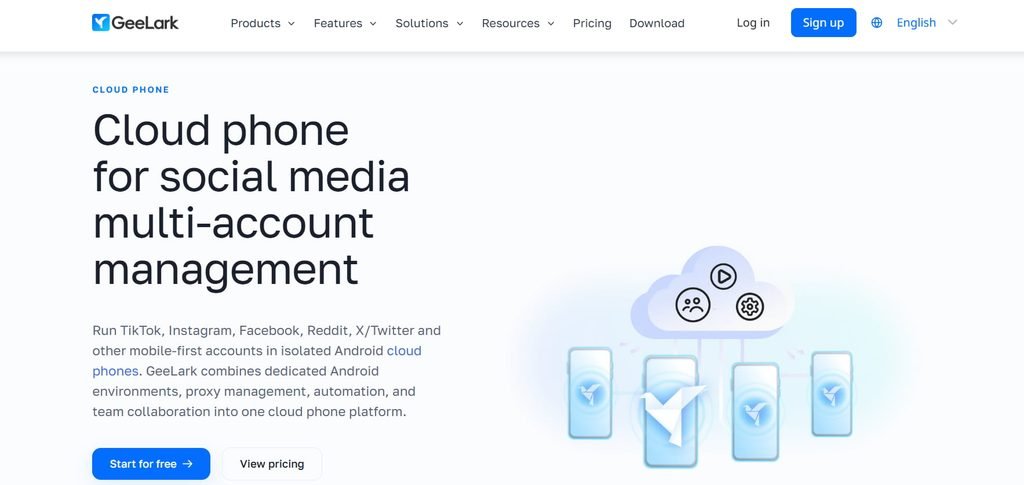
    geelark homepage

    Key Features

    • Cloud phones that GeeLark says carry their own device information
    • Automation templates, a synchronizer and ADB access, per an independent review
    • Team seats, and reusable “Parallels” slots described in GeeLark’s own cost guide

    Android App Compatibility

    GeeLark describes its cloud phones as Android devices hosted remotely that work like a real phone. One review mentions a built-in app store in the workspace. We found no eBay-specific claim, so verify the eBay app on the free plan.

    Advantages for eBay Sellers

    • Designed around mobile apps from the start
    • Pay-for-what-you-run billing suits sellers who only need the device during listing sessions
    • Team seats help if an assistant works alongside you

    Limitations

    • Two-part pricing (subscription plus usage) is hard to forecast, a point Gologin’s review raises
    • Public plan details conflict between sources
    • Positioned at social media marketers, so eBay is untested

    Pricing and Plans

    GeeLark’s own blog states cloud phone rental at $0.007 per minute with a $1 daily cap per device. A newer GeeLark release note lists plans from $19 a month with 20 profiles and $9 per extra seat. Free-plan minutes vary by source (30 or 60). Check the pricing page.

    Who Should Use GeeLark?

    Sellers who use the app in short bursts, such as batch listing sessions, and prefer paying by usage.

    2. MoreLogin – Best for Automation-Focused Workflows

    morelogin homepage

    Key Features

    • A “dual engine” setup that keeps browser profiles and cloud phones in one workspace, per AffMaven
    • Synchronized actions, API access and ADB-based workflows, per AiFlow Review

    Advantages for eBay Sellers

    • Automation hooks help if you build repeatable routines around your own tools
    • Browser and mobile in one place
    • Both usage-based and monthly options

    Limitations

    • Automation is only useful if someone on your team can set it up
    • The review notes that hosted Android does not remove the compliance side of marketplace work
    • Platform plan and cloud phone usage are billed separately

    Pricing and Plans

    Coronium’s comparison lists $0.006 a minute capped at $1.50 a day, or about $23 to $25 per 30 days. SpotSaaS shows platform plans from $9 a month as of May 2026.

    Who Should Use MoreLogin?

    Technical sellers or agencies that want API and ADB access and are comfortable scripting around their own listing and inventory tools.

    3. DuoPlus – Best for Flexible Device Environments

    Key Features

    • Scales from one device to hundreds in one interface, per Multilogin’s DuoPlus review (a competitor, so read with care)
    • A separate phone-farm product for larger fleets
    • Two-part billing: a device fee plus a runtime fee

    Advantages for eBay Sellers

    • Very low entry cost per device
    • Temporary and fixed options let you match cost to how often you use it
    • Easy to add a device for a new product line or assistant

    Limitations

    • Usage-based billing means you must estimate runtime, as Gologin notes
    • Proxies and similar add-ons cost extra
    • Android only, based on a 2025 review

    Pricing and Plans

    A G2 listing shows Cloud Mobile from $1.40, temporary computing power from $0.15 and fixed computing power from $19.90. GoodFirms lists a 30-day trial. Units and billing periods are not clear on every page, so confirm them before paying.

    Who Should Use DuoPlus?

    Budget-minded sellers who want to test several devices cheaply and can track usage.

    4. VMOS Cloud – Best for Android App Workflows

    Key Features

    • Several device tiers, from timed devices to higher-end real machines, per Gologin
    • A claim of Google-certified compatibility, covered in Multilogin’s review
    • Root access and an AI agent for task automation

    Advantages for eBay Sellers

    • Choice of Android versions and device types may help with app compatibility
    • Cloud storage add-ons help if you handle many product photos

    Limitations

    • A BitBrowser review cites low Trustpilot and Google Play ratings (2.8 and 1.9). The source is a competitor, so check current ratings yourself.
    • The pricing page is complex and there is no permanent free plan
    • VMOS has other products with similar names, so subscribe to the right one

    Pricing and Plans

    Coronium describes VMOS Cloud as a 30-day subscription. Total cost depends on device tier, duration and add-ons such as proxies.

    Who Should Use VMOS Cloud?

    Sellers who care most about picking a specific Android version or device tier and are happy to compare pricing options.

    6. Redfinger – Best for Basic Remote Android Access

    Key Features

    • Always-on cloud Android devices, with servers in the US, Taiwan and Singapore, per its app store listing
    • Four tiers: VIP, KVIP, SVIP and XVIP, per Gologin’s review
    • Apps for Windows, Android, macOS and iOS

    Advantages for eBay Sellers

    • A simple way to keep one Android device available around the clock
    • Long-running product, so there is more user feedback to read than for newer tools

    Limitations

    • Built for gaming first. Gologin’s tester also found that changing the location pin did not change the device’s IP, which is a reminder to test any location settings.
    • Reseller listings warn that redeeming codes depends on device stock
    • The same app listing shows a 3.4-star average from about 22,000 ratings

    Pricing and Plans

    Pricing varies by region and tier. One aggregator lists plans from $12.95 and a Thailand example of THB 319 per 30 days for a 4 GB plan. Buy from the official site rather than third-party code sellers.

    Who Should Use Redfinger?

    Sellers who want a basic, always-available Android device and are not planning team workflows.

    6. MaxCloudPhone – Best for Growing Teams

    Key Features

    • Real Android devices or emulators controlled from a web dashboard, per Coronium’s review
    • AI integration and an uptime figure of 99.99%, both vendor claims we could not verify

    Advantages for eBay Sellers

    • Hourly rental suits occasional use
    • Positioned for multi-account and team-style operations, though we could not confirm specific permission features

    Limitations

    • The interface is mainly in Vietnamese and support runs on Vietnamese hours
    • A newer platform with a shorter track record

    Pricing and Plans

    The review lists a cloud emulator at 4,500 VND per hour. Prices are shown in VND, so convert and confirm before buying.

    Who Should Use MaxCloudPhone?

    Teams in or near Vietnam, or sellers comfortable with limited English support, once team controls are confirmed in a trial.

    07. BitCloudPhone – Best for Budget-Conscious Users

    Key Features

    • A cloud phone product inside the BitBrowser app, offering Android and iOS profiles, per Gologin
    • Android 15 option plus ADB and root access, per BitBrowser’s own blog
    • A 40-second cold start in Gologin’s test

    Advantages for eBay Sellers

    • Pay-as-you-go style billing that pauses when the device shuts down
    • Fast startup compared with other phones that reviewer tested

    Limitations

    • Pricing is not transparent. Gologin found a one-time device fee plus about $0.07 per 15 minutes, while BitBrowser’s top-10 page lists $50 a month per device. Treat “budget” as unconfirmed.
    • Synchronizer and automation tools need more work, per Gologin
    • Gologin reports that Trustpilot flagged BitBrowser for fake reviews

    Pricing and Plans

    Conflicting figures are listed above. Get a written quote or check in-app pricing, since the website and app can show different currencies.

    Who Should Use BitCloudPhone?

    Sellers who like usage-based billing and will confirm the real monthly cost first.

    08. FlashID – Best for Mobile Account Management

    Key Features

    • An anti-detect browser and cloud phone in one product, aimed at cross-border teams, per GetApp
    • Workspaces, permission management and data synchronization on the feature list

    Advantages for eBay Sellers

    • Team permissions and workspaces are listed up front
    • Combines browser and Android tools

    Limitations

    • Little independent coverage, so real-world performance is unproven
    • No pricing found in the sources we could open

    Pricing and Plans

    Not confirmed. Request pricing from FlashID directly.

    Who Should Use FlashID?

    Small and mid-size cross-border teams that want one vendor for browser and mobile, after a trial.

    09. UgPhone – Best for Continuous Device Availability

    Key Features

    • 24-hour online running and low-spec devices using no local storage, per its App Store listing
    • Apps for Android and iOS, free with in-app purchases

    Advantages for eBay Sellers

    • A device that stays online without tying up your own phone

    Limitations

    • Coverage is almost entirely about gaming, such as in this VCGamers guide
    • No business, team or eBay information found

    Pricing and Plans

    Not confirmed. The app is free to download, with purchases inside it.

    Who Should Use UgPhone?

    Sellers who only need a cheap, always-on device for light monitoring, and who test it first.

    How to Choose the Best Cloud Phone for Your eBay Business

    Start with the criterion that can sink the whole idea, then work down to price. Nine factors matter.

    1. eBay Mobile App Compatibility

    This is the only factor you cannot assume. No provider in this guide publishes eBay-specific support, so the trial is your proof. Install the official app, sign in, open the listing camera, scan a barcode and send a test message. If any step fails, move on.

    2. Android Version and Device Performance

    eBay tells sellers to keep the app updated through the Google Play Store, and newer app versions can need newer Android. Check which Android versions each provider offers. Examples from this guide range from Android 12 on Redfinger’s VIP tier to Android 15 on BitCloudPhone.

    3. RAM, CPU, and Storage Requirements

    Listing work means switching between the camera, gallery and app, often with many photos. A basic tier can feel slow in that flow. Try a mid-range tier first, such as a 4 GB plan, and move up only if the app stutters. Delete photos from the device after upload so storage does not fill.

    4. Network Speed and Connection Stability

    You are streaming a screen, so your own connection matters as much as the provider’s. Pick a data center region near you and test during your normal working hours. Typing lag and dropped sessions are the early warning signs.

    5. Remote Access and Device Availability

    Ask whether the device stays on when you disconnect or only runs while you pay for minutes. Uptime figures such as 99.99% are vendor claims, so ask for a written commitment or read recent user reviews. Reseller notes about device stock (see Redfinger above) are a reminder to buy direct.

    6. Multiple Device Management

    Most sellers need one device. You need more only for separate legitimate stores or staff members, as covered in the workflow section below. If you do scale, look for folders, bulk actions and clear naming so you always know which device belongs to whom.

    7. Team Collaboration and Permissions

    Provider-level seats and roles decide who can open a device. They do not control what someone can do inside eBay. For staff, eBay’s own Team Access is the better control, which the safety section explains.

    8. Pricing and Scalability

    Providers bill in three broad ways. Match the model to how you work.

    Billing modelExamples in this guideWorks best whenWatch for
    Subscription plus per-minute usageGeeLark, MoreLogin (usage option)You use the device in short sessionsHard-to-forecast bills; daily caps ($1 at GeeLark, $1.50 at MoreLogin, per the sources above)
    Per-device rental (hourly, daily, monthly)DuoPlus, Redfinger, VMOS Cloud, MaxCloudPhoneYou want steady or always-on accessAdd-ons such as proxies and storage
    Bundled plan with included minutesMultiloginYou want one predictable monthly billOverage charges once minutes run out

    Here is a worked example using GeeLark’s published rate. Two hours a day on 22 working days is 120 minutes a day at $0.007, or $0.84 a day. That comes to about $18.50 a month in usage, before any subscription. A flat monthly rental near $23 to $25, as Coronium lists for MoreLogin, would cost slightly more at that usage but become cheaper for all-day use. Run your own numbers.

    9. Security and Authentication Support

    Your eBay login will live on hardware you do not own. Check whether the provider protects its own login with two-step verification, and ask where data is stored and who at the provider can access sessions. Then secure eBay itself, as explained in the safety section.

    A 30-minute trial test

    1. Install the official eBay app and sign in.
    2. Create a draft listing with photos and a scanned barcode.
    3. Send a message and check that notifications arrive.
    4. Leave the session idle, then reconnect and confirm you are still signed in.
    5. Try it at your busiest time of day and note any lag.

    How eBay Sellers Can Use Android Cloud Phones

    eBay’s app help page confirms what the mobile app covers: creating and editing listings, barcode scanning, photos, notifications and order-related tasks. A cloud phone can host that app. Below is where it helps, and where it does not.

    Managing eBay Listings

    The app lets you create, edit and monitor listings and relist items. Listings sync across devices, so you can start one in the app and finish it on a laptop.

    The weak point is the camera. A cloud phone has no lens in your hand. Providers handle photos differently: some let you push image files to the device, others offer a virtual camera. Test this first, because photo-led listing is the app’s biggest strength.

    • Best use: finishing, editing and relisting items that already have photos
    • Less suited: shooting new photos live

    Managing Orders and Shipping Updates

    The app can show order details and let you add tracking information. For bulk work such as printing many labels, Seller Hub on a desktop is usually faster. Use the cloud phone for quick updates, such as adding a tracking number while you are away from your desk.

    Responding to Buyer Messages

    Buyers expect quick answers, and messages arrive in the app. A cloud phone keeps that inbox reachable from any screen. If an assistant handles messages, check what permissions eBay lets you grant before sharing anything (see the remote employees section).

    Monitoring eBay Notifications

    In the app, open Settings in My eBay, then Notifications, and choose which alerts you want. On Android, also allow notifications for eBay in the device settings, per eBay’s help.

    One practical catch. Push alerts land on the cloud device, not on your own phone. Ask your provider whether it forwards notifications, or plan to check the device on a schedule. Treat the email alerts and Seller Hub as your backup.

    Managing Multiple Legitimate eBay Stores

    eBay’s multiple accounts policy allows separate accounts for buying and selling or for different product lines, such as auto parts and skin care. It also says buying and selling policies apply equally to every account.

    A cloud phone can help you keep each store’s app session organized, with one device per store and clear labels. It cannot protect a store from restrictions. eBay also has a duplicate listings policy, so read it before you list similar items across accounts.

    Managing Remote Employees

    Imagine a seller who gives two assistants one shared login on one device. Verification prompts go to a phone neither assistant holds, and the seller is locked out during a busy weekend. This is a common failure pattern.

    A better setup uses eBay’s own Team Access. Each assistant signs in with their own eBay account and password and only receives the permissions you grant. The cloud phone then becomes a workspace for the mobile app, not a way to share credentials.

    Product Research and Inventory Management

    The app’s barcode scanner can fill in product details when you scan a barcode to start a listing. That needs camera access, which many cloud phones handle awkwardly, so confirm it works before you rely on it.

    For research, Seller Hub has a Research area, and Team Access can include Terapeak Research as a permission. For inventory, keep stock counts in a dedicated tool or spreadsheet. A cloud phone is a window into the eBay app. It is not an inventory system.

    Cloud Phone vs Physical Android Phone for eBay Sellers

    A physical phone wins on camera, notifications and simplicity. A cloud phone wins on remote access and not owning hardware. Which matters more depends on whether your work is photo-led or desk-led.

    Comparison factorCloud phonePhysical Android phone
    Remote accessAvailable through supported remote accessRequires remote access configuration
    Hardware maintenanceProvider-managed infrastructureUser-managed
    Device availabilityDepends on provider uptimeDepends on device availability
    Initial hardware purchaseUsually not requiredRequired
    Internet dependencyRequiredRequired for online operations
    Long-term costSubscription-basedHardware and maintenance costs
    Camera and barcode scanningDepends on the provider; test firstBuilt in
    Push notificationsArrive on the cloud device unless forwardedArrive on the phone in your pocket

    If you shoot and list items by hand all day, a physical phone is hard to beat. If you mostly edit, relist and answer messages from a desk, or you work with remote staff, a cloud phone can be worth testing.

    Cloud Phone vs Android Emulator for eBay Management

    An emulator runs Android on your own computer. A cloud phone runs it on someone else’s servers. For eBay work, the choice mostly comes down to where you work and whether anyone else needs access. The table adds remote desktop, which we defined earlier, for completeness.

    FactorCloud phoneAndroid emulatorRemote desktop to a PC
    Where Android runsProvider’s serversYour own computerNot Android; it shows a PC screen
    CostSubscription or usage feesFree options exist, plus a capable PCPC plus remote access software
    Reach from another deviceYes, built inOnly through remote desktopYes
    Hardware you needAny device with a screenA reasonably powerful PCA PC left running

    Performance Differences

    A cloud phone’s speed depends on the provider’s server tier and your connection. An emulator’s speed depends on your PC. A modest laptop can make an emulator crawl, while a cloud phone leaves the heavy lifting to the provider.

    Application Compatibility

    Some apps behave differently on emulators, and a few check for them. One review of Redfinger also warns that some games block emulation or cloud detection. We found no statement from eBay on either option. Test the official eBay app on whichever you choose before you build a workflow around it.

    Hardware Requirements

    An emulator needs a computer with enough RAM and CPU to run Android alongside everything else. A cloud phone needs only a stable connection and a screen to view it on.

    Remote Accessibility

    An emulator stays on the machine where it was installed. To reach it from elsewhere you need remote desktop, which adds a layer and more lag. A cloud phone is reachable directly, which is its main advantage for teams.

    Which Option Should eBay Sellers Choose?

    • Choose an emulator if you work from one desk, have a decent PC, and want to spend nothing while you test.
    • Choose a cloud phone if you work from several places, share the mobile app with staff, or do not want an always-on PC.
    • Choose neither if the browser version of Seller Hub already covers your tasks.

    Are Android Cloud Phones Safe for eBay Sellers?

    Android cloud phones are not unsafe by themselves, but they are not a safety feature either. Your eBay account follows eBay’s rules whichever device you use. The real risks are shared logins, weak authentication and using extra accounts to get around restrictions. Used openly for legitimate work, a cloud phone carries the same rules as any phone.

    Important: a cloud phone does not guarantee account safety, prevent account linking or bypass eBay enforcement. Separating devices is not a way around platform restrictions, and nothing in this guide should be used that way.

    Understanding eBay’s Multiple Accounts Policy

    eBay’s multiple accounts policy says users can hold more than one account, for example separate accounts for buying and selling or for different product lines. The policy page we found was updated on 9 July 2026 with minor wording changes.

    The limits matter more than the permission:

    • Registering new accounts, or using other existing accounts, to avoid buying or selling restrictions or other policy consequences is not allowed.
    • The same is true of using accounts to avoid paying eBay fees.
    • Buyer and seller standards apply to every account you use, not just one.

    Can eBay Detect Different Devices and IP Addresses?

    Assume it can. eBay does not publish how it connects accounts, so nobody outside eBay can promise that a device or network setup is invisible. A seller-focused guide makes the same point.

    The safe approach is not to hide anything. Run only accounts you are allowed to run, in good standing, and keep each store’s business details accurate.

    Protecting Your eBay Login Credentials

    Your eBay password will sit on hardware you do not own, so treat it with care.

    • Use a unique, strong password stored in a password manager.
    • Never share your login with staff. Use Team Access instead.
    • Choose a provider that protects its own login with two-step verification.
    • Remove the eBay session from the cloud phone when you stop using the device.

    Using Two-Factor Authentication

    Turn on 2-step verification. eBay’s account safety page lists options including the eBay app, SMS, an authenticator app and passkeys, and notes that up to 100 trusted devices can be added.

    Here is the catch with cloud phones. If your approval prompt goes to the eBay app on the cloud device, you can lock yourself out whenever that device is off or the provider has an outage. Prefer an authenticator app or SMS on a phone you hold, and keep your recovery options current.

    Managing Employee Access Securely

    eBay’s Team Access lets you grant other eBay users specific permissions in Seller Hub. They use their own eBay accounts and passwords, and you can review activity logs of what they did. You must be opted in to Seller Hub first.

    1. Opt in to Seller Hub.
    2. Open Team access under Account Preferences in My eBay.
    3. Invite each person and grant only the permissions their job needs.
    4. Review the activity log regularly.
    5. Remove access when someone leaves.

    Avoiding Account Restrictions and Policy Violations

    • Never open a new account to continue selling after a restriction. Resolve the original account’s issue first.
    • Meet seller standards on every account, not only your main one.
    • Read eBay’s duplicate listings policy before listing similar items across accounts.
    • Keep records of which device and person handles each store.
    • If eBay flags an account, contact eBay support. Do not work around it.

    How to Set Up an Android Cloud Phone for eBay

    Setup takes about 20 minutes. Screens differ by provider, so these steps stay general. Editor’s note: the outline calls for original screenshots. We cannot capture provider dashboards from here, so add your own under each step from a real trial.

    Step 1: Choose a Suitable Cloud Phone Provider

    Shortlist two providers from the comparison above and sign up on their official sites. Start with a free plan or low-cost trial. Do not pay for a long plan until the eBay app has passed the trial test in the selection section.

    Screenshot to add: the provider’s plan or trial page.

    Step 2: Create Your Cloud Android Device

    Create a new device from the dashboard. Pick the newest Android version offered, a data center region near you and a mid-range tier. Give the device a clear name, such as the store or the task it handles.

    Screenshot to add: the device creation screen.

    Step 3: Configure the Android Environment

    Open the device and set it up like a new phone.

    1. Set the language and time zone to match where you actually work.
    2. Run any system or store updates.
    3. Find out how to transfer files, since you will need it for product photos.
    4. Check the storage available.

    Screenshot to add: the device home screen and settings.

    Step 4: Install the Official eBay App

    Install eBay from Google Play if the device has it, or from the provider’s own app store. Avoid modified or third-party app files, since your login is at stake. If the app will not install, see the problems section below.

    Screenshot to add: the eBay app page during install.

    Step 5: Sign In Using Your Existing Account

    Sign in with your own eBay account. Have your verification method ready before you start, as covered in the safety section. Do not create extra accounts to complete this step.

    Screenshot to add: the eBay sign-in screen on the device (blur any personal details).

    Step 6: Configure Notifications and Security

    1. In the eBay app, go to Settings in My eBay, then Notifications, and choose your alerts.
    2. In the Android settings, allow notifications for eBay.
    3. Allow camera access if your provider supports it, so the barcode scanner can work.
    4. Turn on 2-step verification if it is not already on, using a method you can reach without the cloud phone.

    Screenshot to add: the notification settings screen.

    Step 7: Test Listing and Order Management

    Run the 30-minute trial test from the selection section. Create a draft listing with a photo, try a barcode scan, open an order, and send a test message. Note any lag and decide whether the device is good enough to keep.

    Screenshot to add: a draft listing created on the device.

    Common Android Cloud Phone Problems and How to Fix Them

    Most problems trace back to the app version, the device tier or your connection. Use the table to find your starting point, then read the matching fix.

    SymptomMost likely causeFirst thing to try
    eBay app will not install or launchOutdated app, low storage or unsupported Android versionUpdate from the store and free up space
    Device feels slowTier too small or too many apps openClose apps, then move up one tier
    Cannot sign in or verifyVerification prompt sent to an unreachable deviceUse a verification method you can reach
    No notification alertsNotifications off in the app or AndroidCheck both settings
    Photos will not uploadStorage full or permission missingFree space and allow photo access
    Lag or dropped sessionsDistant data center or weak connectionTest another region and your own network

    eBay App Installation Problems

    eBay’s own troubleshooting tip for an app that will not launch is to check for updates and install the latest version. On a cloud phone, also check free storage and the device’s Android version, then restart the device. Install only from an official store, never from a random file site.

    Slow Cloud Phone Performance

    Close apps you are not using, since cloud tiers have limited RAM. If it stays slow, move up one tier rather than two. Try a data center closer to you, and avoid running several heavy apps on one device.

    Login and Verification Problems

    Stop retrying after two failed attempts, since repeated tries can trigger more checks. Make sure the verification code or approval can actually reach you. If your approval goes to an app on the cloud phone itself, use an authenticator app or SMS on a phone you hold. If you are still stuck, contact eBay support.

    Notifications Not Working

    Check both layers: the app’s notification settings in My eBay, and the Android setting that allows notifications for eBay. Release notes for one eBay app version mention a notification diagnostic tool under notification settings, so look for it in yours. Remember that alerts land on the cloud device, so ask your provider about forwarding.

    Product Image Upload Failures

    First check free storage on the device. Then confirm the eBay app has permission to read photos, and re-send a smaller copy of the file through your provider’s transfer tool. If uploads still fail only on the cloud phone, the transfer method may be the weak link. Ask the provider’s support.

    Remote Connection and Latency Issues

    Test your own connection first, ideally on a wired network. Then try a different data center region. If lag persists at your busiest hours, the provider’s servers may be overloaded, and that is a good reason to switch.

    Who Should Use an Android Cloud Phone for eBay?

    Most sellers do not need one. A few profiles get real value from it.

    Individual eBay Sellers

    If you list a few dozen items a month, your own phone and a browser are enough. A cloud phone makes sense only if your phone is unreliable or you want the mobile app from a desk. Verdict: try a free plan, but do not pay long term.

    High-Volume Marketplace Sellers

    If you relist and answer messages for most of the day, a stable, always-available device saves real time. Look at bundled-minute or always-on plans, and keep stock counts in a dedicated tool. Verdict: a good candidate, once the camera and notification tests pass.

    Multi-Store Business Owners

    If you run separate legitimate stores for different product lines, one clearly labelled device per store keeps sessions tidy. Policies still apply to every account, as the safety section explains. Verdict: useful for organization, not for protection.

    eCommerce Agencies

    An agency should not hold client passwords. Ask clients to invite your team through Team Access, with the permissions you need. The cloud phone then serves as your shared workspace. Verdict: a fit when provider seats and eBay permissions work together.

    Remote eCommerce Teams

    Teams spread across time zones benefit most. A shared workspace lets one shift hand off to the next, while eBay’s activity logs show who did what. Verdict: the strongest use case, if each person signs in with their own eBay account.

    Frequently Asked Questions About Android Cloud Phones for eBay Sellers

    What is the best Android cloud phone for eBay sellers?

    There is no single best option. Multilogin and GeeLark are the most mobile-first and best documented in our research, while DuoPlus and MoreLogin suit usage-based setups. No provider confirms eBay app support, so run the trial test on your shortlist before paying.

    Can I use the eBay app on a cloud phone?

    Probably, if the device can install Android apps, since eBay publishes an app for Android. But we found no provider that documents eBay compatibility. Install the official app during a trial and test the camera, barcode scanner and notifications.

    Can I manage multiple eBay seller accounts on cloud phones?

    eBay allows more than one account for legitimate reasons, such as separate product lines, and each account must meet its standards. It does not allow extra accounts to avoid restrictions or fees. A cloud phone only organizes your sessions. It does not protect accounts or change these rules.

    Does eBay allow sellers to use multiple devices?

    Yes. eBay says listings sync across your devices, and its account safety page notes that up to 100 trusted devices can be added. Using several devices is normal. What matters is following the account policies.

    Can I upload product images using an Android cloud phone?

    Often yes, but it depends on how the provider moves files or handles the camera. Test with a real photo first. The problems section covers upload failures.

    Can I manage eBay orders remotely?

    Yes. The app lets you monitor orders and add tracking information, and Seller Hub works from any browser. A cloud phone adds one more way to reach the mobile app.

    Are Android cloud phones better than physical phones?

    Not generally. They are better for remote access and teams, and worse for live photography and push alerts. See the comparison table above.

    Do cloud phones support Google Play Store?

    It varies. VMOS Cloud claims Google-certified compatibility, according to a competitor’s review, and other providers say little. Ask each provider and check during the trial.

    How much does an Android cloud phone cost?

    From about $1.40 to $25 or more per device per month, depending on the billing model, based on the figures in this guide. Some tiers cost more, and proxies or storage add to the total. Prices conflict across sources, so check each provider’s site.

    Can employees access eBay through cloud phones?

    They can, but do not share your login. Use eBay’s Team Access so each person signs in with their own account and limited permissions.

    Final Verdict: Which Android Cloud Phone Should eBay Sellers Choose?

    There is no universal winner. The best Android cloud phones for eBay sellers are the ones that pass your own test: the official app runs, the connection holds, the team setup is safe and the price fits. No provider in this guide has proven eBay support, so your trial is the deciding evidence.

    Best options by use cases

    • Short, usage-based sessions: GeeLark
    • Automation through API and ADB: MoreLogin
    • Cheapest per-device testing: DuoPlus
    • Choice of Android versions and device tiers: VMOS Cloud
    • Basic always-on access: Redfinger or UgPhone
    • Team-oriented tools to verify in a trial: MaxCloudPhone and FlashID
    • Low cost, once pricing is confirmed: BitCloudPhone