

Today’s businesses must create software products that need to meet two requirements which demand high-quality performance and flexible expandable capabilities. The development process needs to implement DevOps and Agile in software development methodologies. The combination of Agile’s iterative process with DevOps’ collaborative automated system and continuous integration method enables organizations to shorten development time and eliminate development flaws while meeting market demands.
These two methods work together to deliver products more quickly while making products more stable and improving teamwork efficiency throughout the organization. Businesses need to invest in more than just ready-made solutions if they want to maintain their market position.
An early Custom software development services help businesses create specific software solutions which meet their operational requirements and support their future business objectives. Through the combination of DevOps and Agile methods into custom systems businesses gain the ability to expand their operations while developing new capabilities which will help them succeed in the rapidly changing technology environment.
Understanding DevOps and Agile in Software Growth
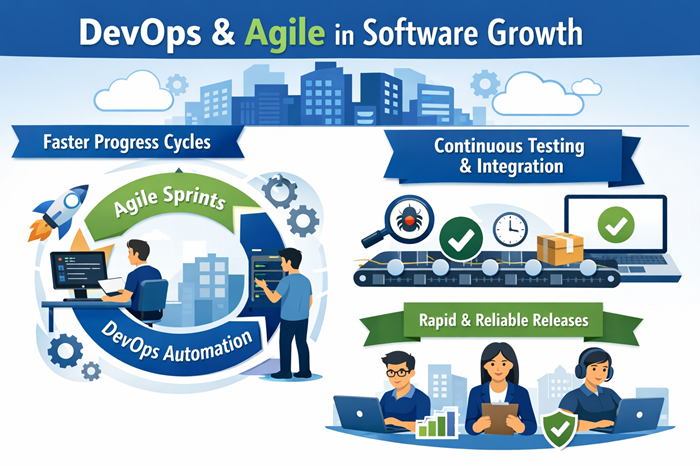
Modern DevOps and Agile in software development methods as essential building blocks for their development processes. Agile development uses iterative processes together with ongoing feedback and flexible methods while DevOps development requires development teams and their operational partners to work together through automated systems and continuous integration. The two methods create an unbroken workflow which enables faster product delivery without sacrificing quality or trustworthiness.
Organizations that implement Agile DevOps practices, along with Cloud Software Solutions, will experience increased efficiency and project scalability across their software development work particularly when supported by a SaaS Development Company. The system provides its main benefits through three different advantages which it delivers to users..
Faster Progress Cycles: The mixture of Agile sprints with DevOps automated processes allows teams to release features and updates at high speed.
Continuous Testing and Integration: The combination of automated testing with CI or CD pipelines enables early error detection which leads to dependable software results.
The Growing Popularity Of Agile DevOps Practices In Business Operations
Organizations today experience increasing success through their implementation of DevOps and Agile in Software Development to achieve faster product delivery and better software quality. Businesses that implement Agile DevOps methods gain the ability to adapt to new market conditions while they improve team collaboration and decrease deployment errors. The integrated approach establishes direct communication between development teams testing teams and operations teams which enables their work to progress without interruptions while building a system that continuously generates feedback to achieve greater innovation and efficiency.
The key advantages that organizations gain from implementing Agile DevOps practices include the following benefits –
The implementation of iterative development cycles enables companies to achieve quick feature releases which results in faster time-to-market.
The synchronization between developers and testers and operations teams improves their work efficiency by eliminating operational boundaries.
The main benefits of Agile DevOps practices frameworks are listed below
1. Faster Time-to-Market
The companies must deliver software updates because their development process requires extended time periods for completion.
2. Regulatory Improvement
The teams use ongoing user feedback to create improved products through their continuous feedback process.
3. Better Collaboration
Developers and testers and operations teams work together instead of using separate operational boundaries.
4. Improved Software Quality
Continuous checking ensures that bugs and performance problems are addressed early.
5. Increase Customer fulfillment
Common updates allow companies to deliver features that customers actually want.
Organizations that use DevOps for enterprise software development experience better development productivity and improved business results.
The Role of DevOps in Scalable Software Growth
As businesses grow their software systems need to manage higher demands which include more users and additional data. This is where scalable software development becomes critical.
DevOps enables organizations to scale their operations through its three core functions which include automation and monitoring and infrastructure management.
Key ways DevOps supports scalability include:
Automation of Development Processes
Automated testing and integration and deployment processes eliminate the need for manual work while they also decrease the possibility of errors.
Continuous Integration and Continuous Delivery(CI or CD)
Developers use CI/CD pipelines to frequently combine their updated code which enables them to release new software versions within a short time period.
Infrastructure as Code (IaC)
Organizations can use programming to manage and expand their infrastructure which enables them to maintain operational uniformity throughout their different computing environments.
Real-Time Monitoring
DevOps tools provide teams with application performance monitoring capabilities which help them find application issues before these problems impact user experience.
The Key Technologies Which Define DevOps Future Development
Emerging technologies which improve automation capabilities and intelligent systems and operational effectiveness will determine the future of DevOps and Agile in Software Development.
The most important technologies which shape the present and upcoming future include the following technologies:
AI and Machine Learning
AI-powered tools can analyze code quality, predict system failures and automate testing processes. Teams extending this automation into agent behavior can also use RL environments to evaluate whether iterative changes improve task performance.
Cloud-Native Development
Cloud platforms enable developers to create applications with instant access to scalable infrastructure resources.
Containerization and Microservices
Developers use container and microservice technologies to create applications that can grow and function independently through their component parts.
Infrastructure Automation
Deployments become more efficient and dependable through the use of tools that handle infrastructure management tasks automatically.
The Growing vital of Custom Software Development
Custom software development services & Solutions have become increasingly vital because businesses need specialized software solutions that match their particular working needs and corporate goals.
This is where custom software development services become essential.
Custom solutions offer several advantages.
Software designed specifically for business processes.
The system provides organizations with increased flexibility to expand their operations and control their software resources. The system enables organizations to connect their current software solutions.
The system protects data while delivering superior operational capabilities. The system delivers cost benefits to organizations throughout their entire operational lifespan.
Challenges in Performing DevOps and Agile
Organizations face difficulties when they try to implement method DevOps and Agile for software development work even though these methods provide advantages.
Common challenges include:
Cultural Resistance
Traditional development teams will oppose any new collaborative methods which they have not previously used.
Skill Gaps
DevOps professionals need to learn three specific areas which include automation tools, cloud platforms and CI/CD pipeline implementation. For businesses that face these skill gaps, the most practical solution is to Hire DevOps Engineers, experienced professionals who bring ready-made expertise in CI/CD pipelines, cloud infrastructure, and automation tools from day one.
Integration Complexity
The process of integrating new DevOps tools with existing legacy systems creates major challenges.
Security Concerns
Fast development processes need complete security measures which stop potential weaknesses from emerging.
Upcoming Trends in Agile and DevOps
The upcoming trends in Agile and DevOps will determine the future development of software creation. The upcoming software development process will rely on changing DevOps and Agile work methods.
The following trends are currently developing in the market:
DevSecOps Integration
Development pipelines will achieve full security integration through security practices.
AI-Powered Development Automation
The development process will receive automated testing and code review and deployment through AI tools.
Platform Engineering
The engineering teams will utilize internal development platforms to enhance their work management process.
Low-Code and No-Code Growth
These platforms will enable application development through their low coding requirements which allow users to build applications.
Continuous Everything
All development and testing and monitoring and security functions will become permanent processes.
The new innovations will improve scalable software development capabilities which enable businesses to develop new products at a faster pace while providing superior digital customer experiences.
Conclusion
Businesses that want to achieve efficient operations and create new products should adopt both DevOps and Agile methods in software development processes. The implementation of Agile DevOps practices enables organizations to deliver products faster because their teams work together better while maintaining software quality. Companies that work with professionals from custom software development services can create flexible software solutions which adapt to changing market needs, enabling them to succeed in the current digital business environment.
