Day: September 21, 2026

  • Fund Reporting Software: Features, Comparison & Buying Guide

    Fund Reporting Software: Features, Comparison & Buying Guide

    If you’ve ever spent a Friday night reconciling capital account spreadsheets before an LP call on Monday, you already know why fund reporting software exists. 

    It’s the category of tools that pulls fund data together, runs the calculations, and turns all of it into reports your investors, auditors, and regulators can actually use, without you rebuilding the same workbook every quarter.

    This guide walks through what fund reporting software actually does, how it’s different from fund accounting and fund administration tools, which platforms are worth a look, and how to pick one that fits your fund’s size, strategy, and stack. 

    We’ll also cover pricing, integrations, security, and where AI genuinely helps versus where it’s just marketing.

    What Is Fund Reporting Software?
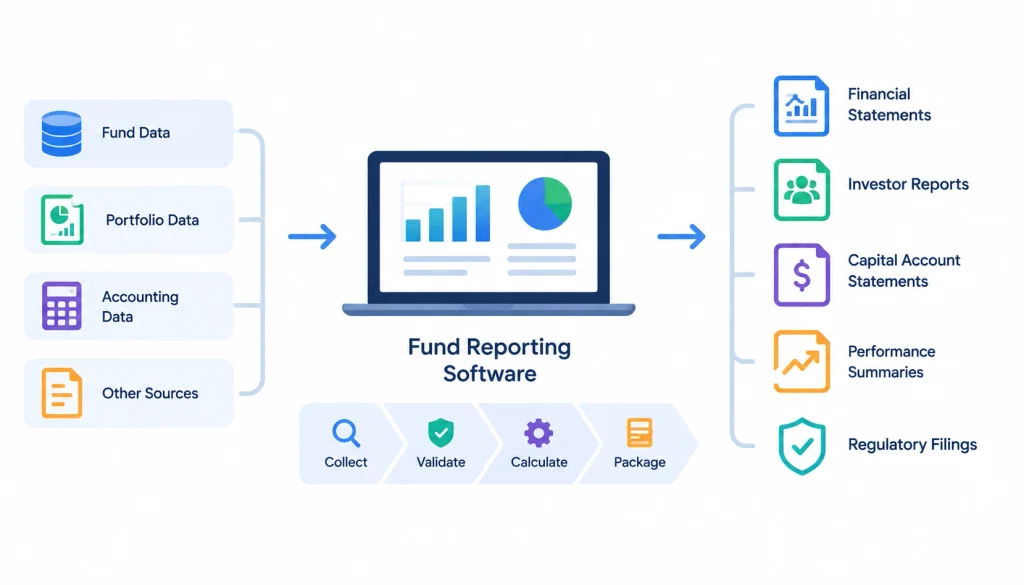
    Fund reporting software processing fund, portfolio, and accounting data into financial statements, investor reports, capital account statements, performance summaries, and regulatory filings.

    Fund reporting software is a platform that takes raw fund and portfolio data and turns it into finished reports (financial statements, investor letters, capital account statements, performance summaries, and regulatory filings) with far less manual work than spreadsheets require.

    Some platforms handle reporting on top of a general ledger they also maintain. Others sit above your existing accounting system and just handle the reporting layer. Either way, the job is the same: collect data, check it, calculate the numbers that matter, and package everything for the people who need to see it.

    1. What fund reporting software does

    At a practical level, these tools:

    • Pull data from accounting systems, portfolio trackers, and custodians
    • Consolidate numbers across multiple funds, entities, and currencies
    • Run standard calculations like NAV, IRR, and capital account rollforwards
    • Generate reports in the formats LPs, auditors, and regulators expect
    • Route drafts through review and approval before anything goes out
    • Deliver finished reports securely, often through an investor portal
    • Keep a record of who changed what and when, for audit purposes

    2. Who uses fund reporting software

    The buyers are usually general partners, fund controllers, and finance teams at investment firms, plus the fund administrators who handle back-office work on their behalf. Investor relations teams rely on it for LP communications, and compliance staff use it when regulatory filings are involved. A CFO at a mid-size PE firm and a one-person controller function at an emerging VC fund will use the same category of software very differently, but the underlying need, accurate reports with less manual effort, is the same.

    3. What types of funds use it

    Private equity, venture capital, private credit, real estate, hedge funds, and fund-of-funds vehicles all use some version of this software. So do family offices managing multiple entities and fund administrators serving several clients at once. The reporting requirements differ by strategy (a real estate fund cares about property-level rent rolls in a way a VC fund doesn’t), which is part of why fund-type fit matters so much in vendor selection, a point we’ll come back to.

    What Does Fund Reporting Software Actually Report?

    It helps to know what’s actually coming out the other end before you evaluate vendors on features. Reports generally fall into four buckets.

    Fund financial reports cover balance sheets, income statements, cash flow statements, general ledger detail, and net asset value (see Wikipedia’s overview of net asset value for the accounting mechanics). These are the books-and-records side of reporting.

    Investor and LP reports include capital account statements, capital call notices, distribution notices, and quarterly investor letters. This is the reporting LPs actually read, so formatting and clarity matter as much as accuracy.

    Portfolio reports track portfolio company or asset-level performance: valuations, KPIs, exposure by sector or geography, and investment-level returns like IRR and MOIC.

    Regulatory and compliance reports cover filings and disclosures required by regulators, along with the documentation auditors need at year-end. Depending on your jurisdiction and fund structure, this might mean Form PF, Form ADV, or other filings your compliance team tracks closely.

    Fund Reporting Software vs. Fund Accounting vs. Fund Administration
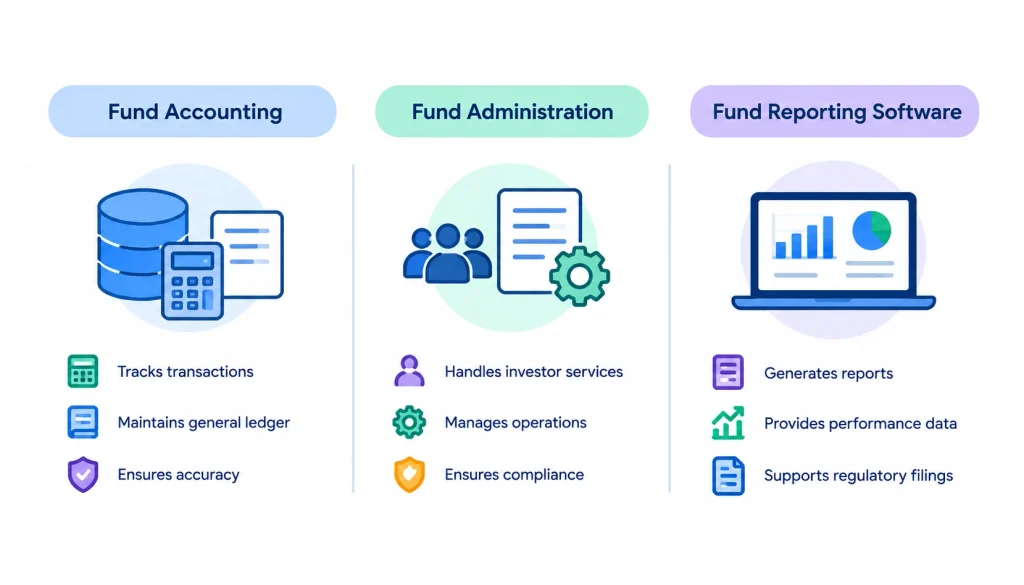
    Fund accounting vs fund administration vs fund reporting software comparison showing key functions and responsibilities.

    This is where a lot of buyers get confused, and honestly, vendors don’t always help. Many blur these categories in their own marketing because their products span more than one.

    CapabilityReporting SoftwareFund AccountingFund Administration
    Financial booksSometimesCore functionUsually
    Investor reportingCore functionOften includedOften included
    Portfolio monitoringVariesLimitedVaries
    LP portalOften includedSometimesOften included
    Regulatory reportingOften includedOften includedOften included
    Data consolidationCore functionCore functionCore function
    Administration workflowsLimitedLimitedCore function

    Fund accounting software keeps the books, while strong bookkeeping and accounting processes provide the underlying financial records that reporting systems rely on. Fund administration covers the broader operational work a back office does: accounting plus investor onboarding, capital calls processing, and more. Fund reporting software is the layer that turns whatever’s in the books into something a human can read and act on.

    When do you need one platform instead of multiple systems?

    If your fund is small and your data lives in one clean general ledger, a single combined platform usually makes sense: less integration work, one vendor relationship, one login for your team. Once you’re running several funds, multiple entities, or a mix of asset classes, the calculus changes. At that point, a dedicated reporting layer that pulls from whatever accounting system you already trust can be less disruptive than ripping out your books to adopt an all-in-one platform. Threads on privateequity and AccountingPE regularly cover this exact debate from people who’ve lived through both setups. Worth a read if you want unfiltered opinions before a vendor call.

    Key Features to Look for in Fund Reporting Software

    A few features separate genuinely useful platforms from glorified spreadsheet replacements.

    Automated report generation. The software should build reports from a template and live data, not require someone to copy numbers into a Word doc every quarter.

    Multi-fund and multi-entity reporting. If you run more than one fund or have SPVs and blockers in your structure, the platform needs to consolidate across all of them without manual workarounds.

    Investor and LP reporting. This includes capital account statements, capital call and distribution notices, and the ability to customize what each LP sees based on their commitment and side letter terms.

    Portfolio reporting. For PE and VC funds especially, you’ll want portfolio company KPI tracking and valuation support built in or well integrated.

    Financial consolidation. The system should combine data across entities and currencies correctly, including intercompany eliminations where relevant.

    Custom report builder. Templates rarely fit every LP’s requested format exactly, so the ability to adjust layout and content without an engineering ticket matters.

    Workflow and approval automation. Reports should route through review before they go out the door, with a clear record of who approved what.

    Audit trails and version control. Every change should be logged. This isn’t optional if you’re dealing with institutional LPs or auditors.

    Investor portal. A secure place for LPs to log in and retrieve their own documents, rather than everything going out over email.

    Regulatory reporting. Built-in support for the filings your fund type requires saves real time at deadline.

    Data validation and reconciliation. The software should flag numbers that don’t tie out, not just accept whatever gets fed in.

    APIs and integrations. Connections to your general ledger, portfolio monitoring tool, CRM, and data warehouse determine how much manual data entry survives implementation.

    Role-based access controls. Not everyone on your team, or at your fund administrator, should see everything.

    AI-powered reporting and analytics. Increasingly common, though the maturity varies a lot by vendor. More on this later.

    Best Fund Reporting Software Platforms to Consider

    A quick note on methodology before the list: this comparison is based on publicly available vendor documentation and product pages as of 2026. Where a claim comes directly from a vendor, we’ve noted it as such rather than presenting it as independently verified. Pricing and feature depth change often in this space, so confirm current details directly with each vendor before you commit.

    1. Quick comparison

    PlatformBest suited forAccountingInvestor reportingPortfolio reportingPortalIntegrationsPricing
    WorkivaEnterprise financial & regulatory reportingPartialYesVariesYesStrongCustom
    FISInvestment accounting across asset classesYesYesLimitedVariesStrongCustom
    EntriliaPE/VC firms wanting an integrated platformYesYesYesYesGrowingCustom
    AllvueMulti-strategy funds needing deep fund accountingYesYesYesYesStrongCustom

    2. Workiva

    Workiva positions itself around connected data and automated financial reporting for investment firms, with features for investor communications, regulatory filings, audit trails, and reporting across multiple funds. It’s built for organizations that need reporting to tie tightly into broader financial and regulatory workflows, not just LP-facing documents.

    3. FIS

    FIS markets its Investment Accounting Manager as a modular, SaaS-based platform that supports multiple investment types, asset classes, and accounting methodologies. It leans more heavily into the accounting side of the equation, which makes it a common choice for firms that need robust investment accounting first and reporting layered on top.

    4. Entrilia

    Entrilia takes a broader approach aimed at private equity and alternative asset managers, combining fund accounting with investor insights, an investor portal, portfolio monitoring, and data integrations. The company has also been building out agentic AI features for reporting workflows, which is worth asking about directly if that’s a priority for your team.

    5. Allvue

    Allvue combines fund accounting (including partnership accounting and a multi-currency general ledger) with investor reporting, cash management, and portfolio monitoring. According to the vendor, the platform runs on Microsoft Azure and Dynamics infrastructure with SOC 1 and SOC 2 alignment, and it explicitly supports PE, VC, private debt, CLOs, and fund-of-funds structures.

    6. Other platforms worth evaluating

    Depending on your fund type and size, it’s worth putting these on your shortlist too: eFront, Dynamo, Investran (now part of FIS’s Private Capital Suite), Juniper Square, Carta, FundCount, Chronograph, Visible, Cobalt, and Qapita. Some of these are full fund-accounting platforms; others are lighter-weight LP-reporting layers meant to sit on top of accounting data you already have elsewhere. Don’t assume two vendors in the same shortlist are solving the same problem; check which layer of the stack each one actually covers.

    Best Fund Reporting Software by Use Case

    Private equity funds typically need strong waterfall calculations, capital account tracking across multiple share classes, and portfolio company KPI reporting for their investment committee.

    Venture capital funds usually prioritize a simpler cap table and capital account structure but want fast, clean quarterly reporting and portfolio valuation tracking that doesn’t require a finance team the size of a PE shop.

    Private credit funds need reporting built around loan-level data (interest accruals, covenant tracking, and payment schedules), which not every platform handles well out of the box.

    Real estate funds need property-level reporting, rent rolls, and often more granular cash flow tracking than a typical PE platform is built for.

    Fund administrators managing multiple client funds need multi-client architecture, strict data segregation, and the ability to apply different reporting templates per client without duplicating work.

    Emerging fund managers are usually price-sensitive and need something they can implement quickly without a large operations team. This is where lighter LP-reporting tools sometimes beat full accounting platforms.

    Enterprise investment firms running many funds and entities need deep consolidation, strong API access, and enterprise-grade security more than they need simplicity.

    How Fund Reporting Software Fits Into Your Technology Stack
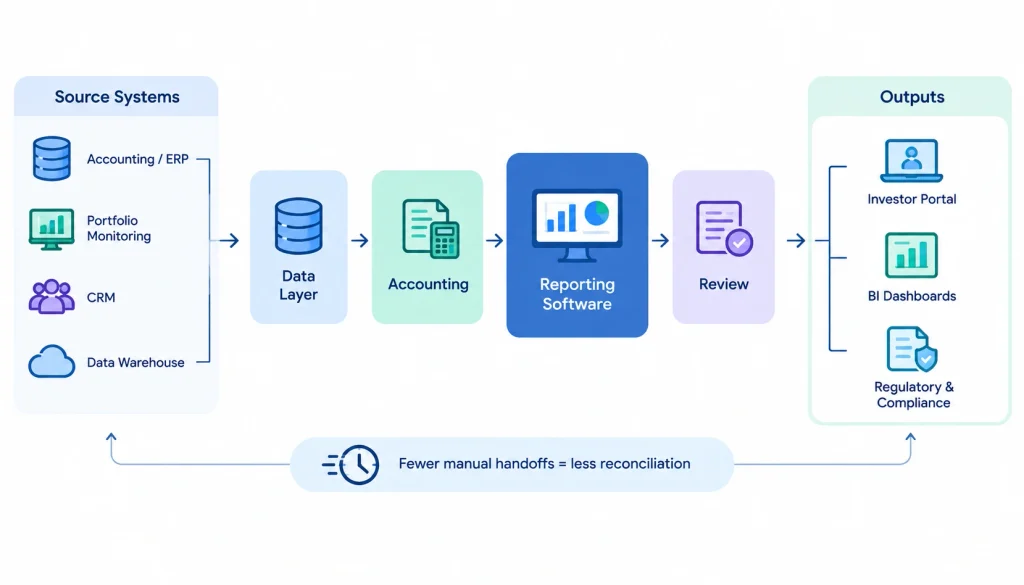
    Fund reporting software technology stack showing data flowing from source systems through accounting and reporting software to review, investor portals, BI dashboards, and regulatory compliance.

    Reporting software rarely works alone. It usually sits between your source systems and the reports that leave the building:

    Source systems → data layer → accounting → reporting engine → review → investor portal

    On the input side, It typically connects to your accounting or ERP system, including accounting software with analytics capabilities, a portfolio monitoring tool, your CRM for investor contact and commitment data, and sometimes a data warehouse if you’re consolidating from several sources. On the output side, it feeds your investor portal and, in some cases, your business intelligence tools for internal dashboards. Regulatory and compliance systems may also need a feed, depending on what you’re required to file.

    The fewer manual handoffs between these systems, the less time your team spends reconciling numbers that should already match.

    How Automated Fund Reporting Works

    Here’s the process most platforms follow, whether or not they market it this way:

    1. Collect fund and portfolio data from accounting systems, custodians, and portfolio trackers.
    2. Validate and reconcile data to catch mismatches before they end up in a report.
    3. Consolidate funds and entities, including intercompany eliminations where needed.
    4. Calculate performance and investor metrics, NAV, IRR, MOIC, capital account balances, and similar figures.
    5. Generate reports using templates mapped to the calculated data.
    6. Review and approve drafts internally before anything is finalized.
    7. Distribute reports securely, usually through an investor portal rather than email attachments.
    8. Preserve the audit trail so every number can be traced back to its source.

    Skipping steps 2 and 6 is how bad numbers end up in an LP’s inbox. Good software makes those steps hard to skip, not just possible to do.

    What Reports Should Your Fund Reporting Software Generate?

    ReportAudienceFrequencyPurpose
    NAV reportFinance, LPsMonthly or quarterlyFund valuation
    Capital account statementLPsQuarterlyInvestor position tracking
    Capital call noticeLPsAs neededFunding requests
    Distribution statementLPsAs neededDistribution details
    Portfolio reportGP, investment committeeMonthly or quarterlyInvestment monitoring
    Financial statementsFinance, auditorsQuarterly or annualFinancial reporting
    Performance reportGP, LPsQuarterlyFund performance
    Regulatory filingRegulatorsPeriodicCompliance

    How Much Does Fund Reporting Software Cost?

    Almost no vendor in this space publishes pricing on their website, which is frustrating but common for enterprise financial software. Expect a sales call before you see a real number.

    1. Common pricing models

    Pricing tends to follow one of a few patterns: custom enterprise quotes, per-user licensing, fees based on assets under management, fees based on the number of funds or entities managed, or modular pricing where you pay separately for accounting, reporting, and portal access.

    2. Additional costs to budget for

    The license fee is rarely the whole story. Budget for implementation, data migration from your existing spreadsheets or legacy system, integration setup with your accounting and portfolio tools, custom report template design, training, and ongoing support. On a mid-size implementation, these costs can add up to a meaningful fraction of year-one license spend.

    3. How to compare total cost of ownership

    Ask each vendor for a full first-year cost estimate, not just the license fee, and get a sense of what year two looks like once implementation is behind you. A cheaper license with expensive implementation can end up costing more than a pricier platform that’s faster to stand up.

    How to Choose Fund Reporting Software

    1. Define your reporting requirements. List the exact reports you need to produce today, plus any you expect to need as the fund grows.
    2. Map your current data sources. Know where your fund’s data actually lives before you evaluate anyone’s integration claims.
    3. Identify required reports. Match your list against what each vendor can actually generate out of the box versus what needs custom work.
    4. Define integrations. Confirm the platform connects cleanly to your accounting system, portfolio tools, and CRM.
    5. Evaluate security and compliance. Ask for SOC 1 or SOC 2 reports directly rather than taking a marketing page at face value.
    6. Test reporting workflows. Have your finance team walk through an actual quarterly close cycle in a demo environment, not just a canned presentation.
    7. Compare implementation requirements. Ask how long a comparable client took to go live, not just the vendor’s best-case timeline.
    8. Run a vendor demo using your own data. This is the single best way to catch problems before you sign a contract.

    Fund Reporting Software Demo Checklist

    Bring these questions to every vendor call:

    Data and integrations: Which systems does this connect to out of the box? What does a custom integration cost and how long does it take? Can it handle multi-currency data?

    Reporting: Can we build a custom report template ourselves, or does every change go through support? How are capital account statements generated per LP?

    Investor communications: Does the portal support side-letter-specific reporting? Can we control what each LP sees?

    Automation: What parts of the process still require manual data entry? How does the system flag data that doesn’t reconcile?

    Security: What certifications does the platform hold? Where is data hosted and stored?

    Scalability: How does pricing change as we add funds or entities? Has this platform been tested at our target scale?

    Administration: Can our fund administrator access the system directly if we use one?

    Support: What does onboarding look like, and who do we call when something breaks at 11pm before an LP call?

    Common Fund Reporting Challenges and How Software Solves Them

    Too many spreadsheets. When every fund, entity, and report lives in its own workbook, errors multiply fast. Reporting software consolidates that into one system of record.

    When financial data is scattered across systems, better financial management and reporting processes can help consolidate information and reduce manual work

    Duplicate data entry. Manually re-entering numbers between accounting and reporting tools wastes time and introduces mistakes. Integrations remove that step.

    Reconciliation problems. Numbers that don’t tie out between systems are one of the most common sources of delayed reporting. Built-in validation catches these earlier.

    Inconsistent investor reports. Without templates, report formatting drifts over time and between team members. A shared template library keeps things consistent.

    Manual report formatting. Copying numbers into a Word or PDF template by hand is slow and error-prone. Automated generation removes that bottleneck.

    Slow quarter-end close. Manual processes stretch out over weeks. Automated data collection and calculation can compress that meaningfully.

    Lack of auditability. Spreadsheets don’t track who changed what. Reporting software logs every edit.

    Data scattered across systems. Consolidation tools pull everything into one place instead of forcing your team to hunt across five logins.

    Growing fund and entity complexity. What works for one fund breaks down at five. Purpose-built software scales in a way spreadsheets don’t.

    Fund Reporting Software Implementation

    Implementation is where good software either pays off or turns into a headache. Expect these phases:

    Data migration:  moving historical fund data from spreadsheets or a legacy system into the new platform, and checking it matches. 

    System configuration: setting up your fund and entity structure correctly. 

    Integration setup:  connecting your accounting system, portfolio tools, and CRM. 

    Report template creation: building the templates your LPs and internal team actually need. 

    User permissions: setting role-based access for your team and any external stakeholders. 

    Testing and reconciliation:  running a full cycle against known numbers before going live. 

    Training and rollout: making sure your team can actually use the system day to day. 

    Ongoing optimization: refining templates and workflows as reporting needs change.

    Rushing the testing and reconciliation phase is the most common implementation mistake. It’s tempting to go live fast, but a platform that produces wrong numbers quickly is worse than a spreadsheet that produces right numbers slowly.

    Can Fund Reporting Software Replace Excel?

    1. Where Excel still works

    For a very small fund with one entity and a handful of LPs, a well-built spreadsheet can still get the job done. There’s no shame in that, and plenty of emerging managers run this way successfully for their first fund.

    2. Where Excel becomes risky

    Once you’re managing multiple funds, multiple entities, or a growing LP base, spreadsheets start breaking in predictable ways,  broken formulas, version control chaos, and no real audit trail. Institutional LPs also increasingly expect a level of reporting polish and security that a shared Excel file can’t provide.

    3. How software and Excel can coexist

    Most funds don’t do a clean cutover. It’s common to keep Excel for ad hoc analysis and modeling while moving the recurring, LP-facing reporting into dedicated software. That split keeps flexibility where you need it and control where it matters most.

    AI in Fund Reporting Software

    AI is showing up in most fund reporting platforms now, with varying degrees of actual usefulness.

    Automated report narratives: drafting the written commentary sections of an LP letter based on the underlying numbers, which a human then edits. 

    Data anomaly detection: flagging numbers that look off compared to historical patterns before a human catches them manually.

    Natural-language data queries: letting a finance team ask a question about fund data in plain English instead of writing a query. 

    Automated reconciliation assistance: speeding up the matching process between systems, though rarely replacing human review entirely. 

    Report generation: pulling data into a draft report faster than a manual process would.

    Risks and controls for AI-generated financial outputs

    None of this should replace financial controls. AI-generated numbers still need human review before they go to an LP or a regulator, the same way a junior analyst’s work would. If a vendor pitches AI as a way to skip review steps rather than speed them up, that’s worth pushing back on directly.

    Security and Compliance Requirements

    Fund data is sensitive, and LPs increasingly ask about security before they’ll even engage with a new fund. At minimum, look for SOC 1 and SOC 2 attestations, data encryption at rest and in transit, role-based permissions, detailed audit trails, version control on documents, clear data residency policies, support for the regulatory reporting your fund type requires, and a documented disaster recovery plan. Ask vendors for their actual SOC reports rather than accepting a badge on a marketing page, a real audit report will tell you exactly what was tested and when.

    Frequently Asked Questions

    1. What is fund reporting software? 

    It’s software that collects fund and portfolio data, runs the standard calculations, and generates the reports investors, auditors, and regulators need, replacing manual spreadsheet-based reporting.

    2. What is the difference between fund accounting and fund reporting software? 

    Fund accounting software maintains the financial books. Fund reporting software turns that financial data into finished, distributable reports. Many platforms today do both, but the two functions are conceptually distinct.

    3. What features should fund reporting software have? 

    At minimum: automated report generation, multi-fund consolidation, investor reporting, an audit trail, and integrations with your accounting and portfolio tools.

    4. How much does fund reporting software cost? 

    Most vendors use custom pricing based on fund size, number of entities, or user count, so expect a sales conversation rather than a published price.

    5. Can fund reporting software automate LP reporting? 

    Yes. Most platforms automate capital account statements, capital calls, distributions, and quarterly letters, though templates still need human review before distribution.

    Conclusion

    Choosing fund reporting software isn’t about finding the vendor with the longest feature list; it’s about finding a platform that fits your fund structure, reporting requirements, existing systems, and growth plans. 

    Look for strong accounting integrations, investor and LP reporting, multi-entity support, automation, security, audit trails, and reliable scalability, while considering the full cost of implementation and ongoing support. Before making a decision, run demos using your own data, test the workflows your team relies on, and ask detailed questions about pricing, integrations, implementation timelines, and support. 

    The right software should reduce manual work, improve reporting accuracy, and make every reporting cycle more efficient, not simply replace one complicated process with another.
  • Private Equity Software: Platforms, Features, Categories & How to Choose

    Private Equity Software: Platforms, Features, Categories & How to Choose

    If you’ve started researching private equity software, you’ve probably noticed something frustrating: there’s no single product that does everything. One vendor handles deal sourcing. 

    Another handles fund accounting. A third handles LP reporting. Nobody tells you this up front, so a lot of firms end up buying the wrong thing and rebuilding their stack eighteen months later.

    Private equity software isn’t one category of product. It’s a collection of tools that cover different parts of the investment lifecycle, sourcing, diligence, portfolio monitoring, fund accounting, fundraising, and investor reporting. 

    Some platforms cover two or three of these. None cover all of them well. Understanding that upfront will save you a lot of wasted demos.

    This guide walks through the full landscape: what private equity software actually does, the main categories, the platforms worth knowing in each one, and a practical framework for figuring out what your firm actually needs.

    What Is Private Equity Software?

    1. Private equity software definition

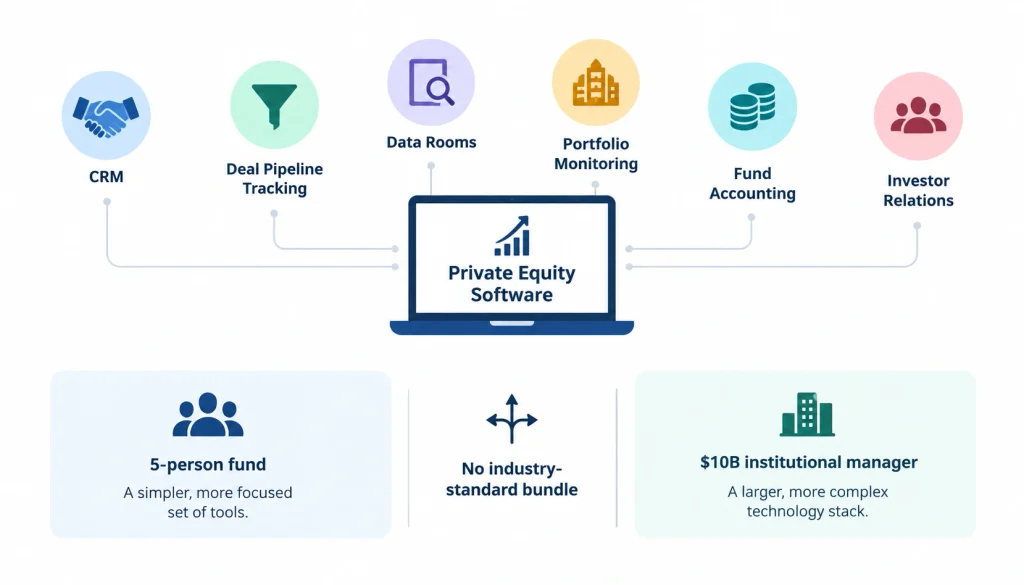
    Private equity software infographic showing CRM, deal pipeline tracking, data rooms, portfolio monitoring, fund accounting, and investor relations tools, with different technology needs for small and institutional PE funds.

    Private equity software is a general term for the technology PE firms use to run their investment operations, everything from finding deals to reporting results to LPs. It typically includes some mix of CRM, deal pipeline tracking, data rooms, portfolio monitoring, fund accounting, and investor relations tools.

    There’s no industry-standard bundle. A five-person fund and a $10 billion institutional manager will describe “our PE software” very differently, because they’ve assembled different pieces for different reasons.

    2. What problems does PE software solve?

    Most firms adopt this kind of software because spreadsheets stop working once the firm grows past a certain size. Common pain points include:

    • Deal information scattered across inboxes and personal notes
    • No visibility into where deals stand in the pipeline
    • Portfolio company KPIs collected manually, quarter after quarter
    • LP reports built by hand in Excel, prone to errors
    • No audit trail on who changed what, and when
    • Compliance and data security gaps as the firm scales

    Software doesn’t fix a broken process on its own, but it does give a firm a shared, searchable record instead of tribal knowledge living in one associate’s inbox.

    3. How private equity software fits into the investment lifecycle

    It helps to think of PE software in terms of the stages a deal and a fund pass through:

    Sourcing → Screening → Due diligence → Investment → Portfolio monitoring → Value creation → Exit → Investor reporting

    Different tools sit at different points on that line. A CRM lives at the sourcing stage. A data room lives at diligence. Fund accounting software lives at the back office, running continuously underneath the whole thing. Keeping this lifecycle in mind is the fastest way to figure out what category you’re actually shopping for.

    15 Private Equity Software Platforms to Know

    Private equity firms rarely rely on one application for every stage of the investment lifecycle. The software landscape spans CRM and deal sourcing, due diligence, portfolio monitoring, fund management, investor relations, and market intelligence.

    The platforms below are best understood by their primary use case, rather than as a single “best-to-worst” ranking.

    1. 4Degrees, CRM & Deal Sourcing

    4Degrees is a private-capital CRM focused on relationship intelligence, deal sourcing, and pipeline management. Its platform can help investment teams identify relationship paths to potential opportunities, organize deal pipelines, and reduce manual CRM data entry.

    Best suited for: PE firms focused on relationship-driven sourcing and deal-flow management.

    Key capabilities:

    • Relationship intelligence
    • Deal pipeline management
    • Contact and company management
    • Workflow automation
    • AI-assisted CRM workflows

    2. Affinity, Private Capital CRM

    Affinity is a CRM built specifically for private capital firms. Its PE offering covers relationship intelligence and deal workflows, while its current platform also emphasizes AI agents for tasks such as meeting preparation, conversation capture, pipeline updates, and investment-memo drafting.

    Best suited for: PE teams that want CRM, relationship intelligence, and automated deal-team workflows.

    Key capabilities:

    • Relationship intelligence
    • Deal sourcing
    • Pipeline management
    • Automatic activity capture
    • AI-assisted workflows
    • Multi-fund deal management

    3. Intapp DealCloud,  Deal Management & CRM

    Intapp DealCloud is an enterprise-oriented platform for investment and deal management. It is particularly relevant to firms with complex workflows that require extensive configuration and integration with broader operational systems.

    Best suited for: Larger or more complex investment organizations.

    Key capabilities:

    • Deal management
    • CRM
    • Pipeline tracking
    • Relationship management
    • Workflow customization
    • Reporting and analytics

    4. Allvue,  Fund Accounting & Portfolio Management

    Allvue provides private equity software combining fund accounting, portfolio monitoring, and investor-portal capabilities. Its private-equity offering is designed to connect front-, middle-, and back-office workflows.

    Best suited for: GPs and fund administrators needing integrated fund and portfolio operations.

    Key capabilities:

    • Fund accounting
    • Portfolio monitoring
    • Investor portal
    • Fund management
    • Reporting
    • Data management

    5. eFront,  Private Markets Investment Management

    eFront, part of BlackRock, provides technology covering areas such as deal sourcing, fundraising, portfolio monitoring, valuations, fund management, fund administration, accounting, investor reporting, and investor relations.

    Best suited for: Investment organizations requiring broad private-markets functionality.

    Key capabilities:

    • Deal sourcing
    • Portfolio monitoring
    • Valuation
    • Fund accounting
    • Fund administration
    • Investor reporting
    • Investor relations
    • Performance analytics

    6. S&P Global iLEVEL,  Portfolio Monitoring & Analytics

    iLEVEL is positioned around portfolio data collection, monitoring, and investment analytics. It can be used to consolidate portfolio-company information and provide investment teams with structured performance data.

    Best suited for: PE firms that need deeper portfolio monitoring and analytics.

    Key capabilities:

    • Portfolio monitoring
    • Data collection
    • KPI tracking
    • Performance analytics
    • Reporting
    • Portfolio-company data management

    7. Chronograph, Portfolio Monitoring

    Chronograph focuses heavily on portfolio monitoring and private-market data workflows.

    Best suited for: Investment teams that need centralized visibility into portfolio-company performance.

    Key capabilities:

    • Portfolio monitoring
    • KPI tracking
    • Investment data
    • Reporting
    • Performance analysis
    • Data management

    8. Juniper Square,  Fundraising & Investor Management

    Juniper Square is focused on private-market fund operations and investor management, including fundraising, investor onboarding, communications, and reporting.

    Best suited for: GPs looking to streamline investor-facing fund operations.

    Key capabilities:

    • Investor onboarding
    • Fundraising
    • Investor communications
    • Reporting
    • Investor management
    • LP experience

    9. Dynamo Software, Fund & Investor Management

    Dynamo provides a broader alternative-investment management platform spanning areas such as CRM, fund administration, investor relations, and reporting.

    Best suited for: Multi-asset investment organizations seeking broader operational coverage.

    Key capabilities:

    • CRM
    • Fund management
    • Investor relations
    • Fund administration
    • Reporting
    • Portfolio management

    10. PitchBook, Private-Market Intelligence

    PitchBook is primarily a private-capital data and research platform rather than a traditional fund-accounting or fund-administration system. Its platform covers company, deal, fund, and market intelligence and includes screening, fund analysis, market research, AI-enabled tools, and integrations.

    Best suited for: PE professionals conducting market research, sourcing, benchmarking, and investment analysis.

    Key capabilities:

    • Company research
    • Deal research
    • Fund research
    • Market intelligence
    • Screening
    • Benchmarking
    • Data/API integrations
    • AI-assisted research

    11. Preqin, Private-Markets Data & Research

    Preqin provides private-markets data, benchmarks, and research used for activities such as manager research, fund analysis, benchmarking, and portfolio evaluation. Preqin is now part of BlackRock and is also integrated into eFront Insight.

    Best suited for: Investment professionals and LPs requiring private-markets research and benchmarking data.

    Key capabilities:

    • Fund data
    • Manager research
    • Performance benchmarks
    • Market intelligence
    • Portfolio analysis
    • Private-markets research

    12. Datasite,  Virtual Data Rooms

    Datasite is primarily relevant to transactions and due diligence rather than fund accounting or portfolio monitoring.

    Best suited for: PE firms requiring secure document exchange during transactions.

    Key capabilities:

    • Virtual data rooms
    • Secure document sharing
    • Due-diligence workflows
    • User permissions
    • Document tracking
    • Transaction collaboration

    13. iDeals, Virtual Data Room & Due Diligence

    iDeals provides virtual data-room technology for secure document management and transaction workflows.

    Best suited for: Deal teams that need controlled document sharing during due diligence.

    Key capabilities:

    • Virtual data rooms
    • Secure document sharing
    • Access controls
    • Due-diligence management
    • Document analytics
    • Collaboration

    14. Ansarada, Deal & Data Room Management

    Ansarada focuses on secure transaction environments and data-room workflows.

    Best suited for: PE and M&A teams managing sensitive transaction information.

    Key capabilities:

    • Virtual data rooms
    • Due diligence
    • Document management
    • Permissions
    • Workflow management
    • Transaction collaboration

    15. S&P Capital IQ Pro,  Financial & Market Research

    S&P Capital IQ Pro provides financial and market intelligence that investment teams can use for company research, financial analysis, screening, and market evaluation.

    Best suited for: PE professionals who need broader financial and market data alongside their investment workflow.

    Key capabilities:

    • Company research
    • Financial data
    • Market intelligence
    • Screening
    • Comparable-company analysis
    • Industry research

    What Software Do Private Equity Firms Use?

    Here’s a quick look at the main categories before we go deeper on each.

    1. Private equity CRM and relationship intelligence

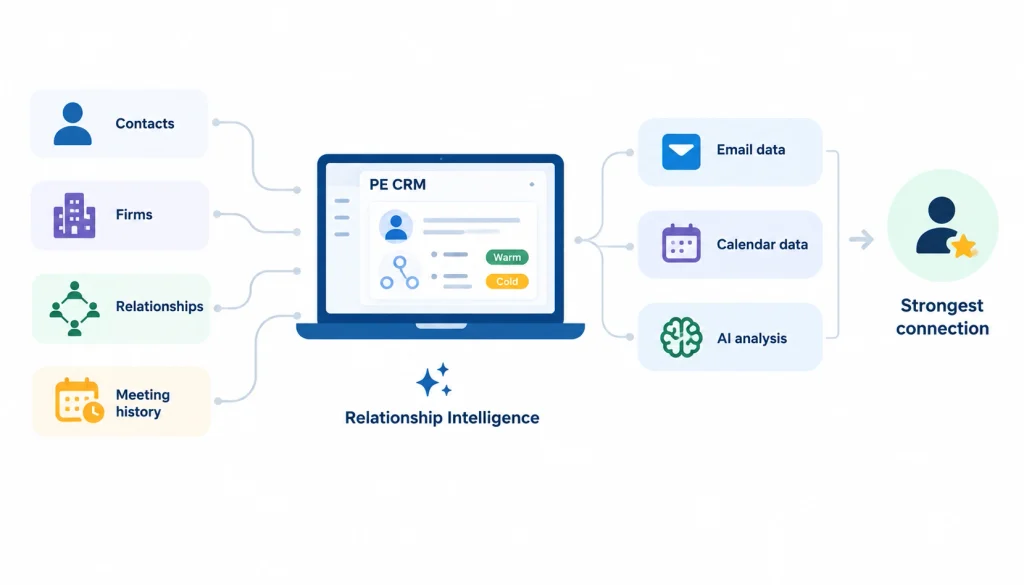
    Private equity CRM infographic showing contacts, firms, relationships, and meeting history connected with email, calendar, and AI analysis to identify the strongest business connection.

    A PE CRM tracks contacts, firms, and the relationships between them, who introduced whom, when a partner last spoke to a target company’s CEO, which deals are warm versus cold. Generic CRMs like Salesforce can technically be configured to do this, but purpose-built PE CRMs (4Degrees, Affinity, DealCloud) add relationship intelligence: they mine email and calendar data to surface who at your firm actually has the strongest connection to a given contact.

    2. Deal sourcing and deal management software

    Deal management software tracks the pipeline itself, stage, deal team, key dates, diligence status. In many products this overlaps heavily with CRM, which is why firms often buy one tool that does both rather than two separate systems.

    3. Virtual data room and due diligence software

    A virtual data room (VDR) is a secure, permissioned document repository used during diligence and deal execution. Datasite, iDeals, and Ansarada are the names that come up most often here. The core job is controlling who sees what, tracking who’s looked at which document, and managing Q&A between buyer and seller teams.

    4. Market intelligence and research platforms

    These tools, PitchBook, Preqin, S&P Capital IQ Pro, provide company, market, and fund data for sourcing and benchmarking. They’re research tools, not workflow tools, but most deal teams treat them as part of the daily stack.

    5. Portfolio monitoring software

    Once a deal closes, portfolio monitoring software collects operating and financial KPIs from portfolio companies on a recurring basis. Instead of chasing spreadsheets from each CFO every quarter, the GP gets a standardized dashboard.

    6. Fund accounting software

    This is the financial backbone: general ledger, capital call and distribution tracking, NAV calculation, allocations across LPs. Because financial workflows vary by industry and organizational structure, industry-specific accounting software can also be useful when evaluating specialized reporting and compliance requirements.

    It’s specialized accounting software, not a general ERP, because fund structures (carried interest, waterfalls, multiple share classes) don’t map cleanly onto standard business accounting.

    7. Fund administration software

    Related to fund accounting but broader, it covers the operational side of running a fund: investor records, compliance filings, capital account statements. Larger firms often run this in-house; smaller and mid-sized firms frequently outsource it to a third-party fund administrator who uses their own software.

    8. Investor relations and LP portal software

    An LP portal gives investors self-service access to their capital account statements, K-1s, fund documents, and performance reports. Juniper Square and Dynamo Software are common names here.

    9. Fundraising and investor onboarding software

    Some of the tools above extend into fundraising: tracking prospective LPs through a pipeline, managing subscription documents, and handling KYC/AML onboarding.

    10. Reporting and analytics software

    Dashboards and reporting layers that pull data from accounting, portfolio monitoring, and CRM systems into LP-facing or internal reports.

    11. Compliance and risk management software

    Tools for tracking regulatory obligations, conflicts of interest, and internal policy compliance, more common at larger, institutional firms with dedicated compliance staff.

    12. AI and workflow automation tools

    Increasingly, PE-specific AI features are showing up inside the categories above rather than as standalone products, think AI-assisted CIM summarization inside a deal management tool, or AI-generated first-draft portfolio company updates.

    Private Equity Software Categories at a Glance

    CategoryMain JobKey FeaturesPrimary Users
    CRMRelationshipsContacts, activity tracking, relationship intelligenceDeal teams
    Deal managementTransactionsPipeline, workflow, diligence checklistsInvestment teams
    Data room (VDR)DocumentsPermissions, Q&A, activity logsDeal teams, advisors
    Portfolio monitoringKPIsFinancial and operating metrics collectionPortfolio ops teams
    Fund accountingFund financesGeneral ledger, NAV, allocationsFinance
    Fund administrationOperationsInvestor records, filings, statementsOperations
    LP portalInvestor accessStatements, K-1s, document accessLPs, IR teams
    Market intelligenceResearchCompany, fund, and market dataDeal teams

    Private Equity Software Comparison

    When you’re actually comparing vendors, put them side by side on the same criteria instead of reading feature pages in isolation. A comparison table should cover: primary category, CRM depth, deal management, portfolio monitoring, fund accounting, investor reporting, LP portal, AI features, integration options, typical best-fit firm size, and rough implementation complexity.

    There’s a reason no credible comparison declares one overall winner: a tool that’s excellent for a 5-person emerging manager (like Juniper Square for investor communication) is the wrong purchase for a multi-fund institutional platform that needs eFront-level accounting depth. Filter by your own requirements rather than someone else’s “best of” list.

    All-in-One vs. Specialized Private Equity Software

    1. What is an all-in-one PE platform?

    An all-in-one platform tries to cover several stages of the lifecycle in a single product, say, CRM, deal management, and portfolio monitoring together. Allvue and eFront lean in this direction.

    2. What is a specialized PE software stack?

    A specialized stack means picking the best tool for each individual job and connecting them, a CRM from one vendor, a data room from another, fund accounting from a third. This is more common at firms with strong opinions about specific workflows, or firms that have outgrown a generic tool in one area but not others.

    3. Hybrid approach

    Most mid-sized firms end up somewhere in between: one core platform for two or three connected functions, plus a couple of best-of-breed tools bolted on for things the core platform doesn’t do well.

    4. All-in-one vs specialized comparison

    FactorAll-in-oneSpecialized stack
    IntegrationSimpler, since it’s one systemRequires connecting multiple tools
    FlexibilityLimited to what the suite offersUsually higher per function
    Vendor managementFewer vendor relationshipsMore vendors to manage
    Best forFirms wanting one throat to chokeFirms with specific, strong workflow needs
    ImplementationCan be a bigger single projectSpread across smaller rollouts

    Neither approach is objectively better. A firm with a lean ops team often prefers fewer vendors, even if each module is only “good enough.” A firm with a dedicated finance and ops function can usually get more value out of best-in-class specialized tools, because they have the staff to manage the integrations.

    Private Equity Software by Firm Size

    1. Software for emerging managers

    A five-person emerging manager raising their first or second fund typically prioritizes CRM for relationship tracking, LP onboarding, basic fund administration (often outsourced), and reporting. Trying to buy a full institutional-grade stack this early usually means paying for modules nobody on the team has time to configure.

    2. Software for middle-market PE firms

    As firms grow into middle-market territory, deal sourcing tools, portfolio monitoring, and more advanced analytics start to earn their keep. This is usually the stage where firms move off spreadsheet-based portfolio reporting.

    3. Software for institutional PE firms

    Larger institutional managers running multiple funds need multi-fund accounting architecture, dedicated portfolio analytics, formal security and governance controls, and reporting that can handle complex allocation structures across many LPs. This is where platforms like eFront and iLEVEL tend to show up.

    4. Software for fund administrators

    Third-party fund administrators serving multiple GP clients need software built for multi-client, standardized workflows rather than a single fund’s specific needs, reporting consistency across clients matters more than deep customization for any one of them.

    Key Features to Look for in Private Equity Software

    Rather than chasing a long feature checklist, focus on the ones that actually change day-to-day work:

    • Deal pipeline management: visibility into where every deal stands and who owns the next step
    • Relationship intelligence: surfacing who at the firm has the strongest connection to a target
    • Portfolio KPI tracking: standardized, recurring data collection from portfolio companies
    • Financial and valuation modeling: support for the models your team actually builds. Firms evaluating reporting and analytics capabilities may also benefit from understanding how accounting software with strong analytics supports dashboards, KPI tracking, and financial reporting.
    • Fund accounting: accurate handling of capital calls, distributions, and carried interest waterfalls
    • Investor reporting: automated generation of LP-facing reports rather than manual rebuilding each quarter
    • LP portal and onboarding: self-service document access for investors
    • Document management: version control and permissioning for deal and fund documents
    • Workflow automation: reducing repetitive manual steps in diligence and reporting
    • API and integrations: the ability to connect with your existing accounting, email, and BI tools
    • Permissions and audit trails: control over who can see and edit what, with a record of changes
    • AI capabilities: genuinely useful assistance, not a feature added for the sake of a marketing bullet point

    How Private Equity Software Connects to Your Existing Tech Stack

    A lot of the frustration firms run into isn’t about any single tool. It’s about tools that don’t talk to each other. Picture the ideal flow:

    CRM → Deal management → Data room → Accounting → Portfolio monitoring → Reporting → LP portal

    This type of connected workflow also depends on effective business data analytics, particularly when firms need to turn information from multiple systems into usable reporting and insights.

    If a deal moves from CRM into execution, the data room should be able to reference the same deal record. Once the deal closes, portfolio monitoring should pick up the company without anyone re-entering it by hand. Financial data from accounting should feed reporting and the LP portal automatically.

    In practice, this rarely happens end-to-end. Most firms maintain a “single source of truth” for deal data in one system, and accept that some manual reconciliation between systems is unavoidable. The goal isn’t a perfectly connected stack. It’s minimizing how much gets typed twice.

    AI in Private Equity Software

    AI has moved from a marketing buzzword to a genuinely useful feature in several parts of the PE workflow, though it’s worth being specific about where it actually helps:

    • Deal sourcing: surfacing companies that match a thesis based on data patterns rather than manual screening
    • Company and market research: summarizing public information on a target faster than an analyst reading ten sources
    • Document and CIM analysis: pulling key figures and flags out of long documents
    • Data extraction: converting portfolio company financials from PDFs or emails into structured data
    • Portfolio monitoring: flagging anomalies in reported KPIs
    • Investor reporting: drafting first-pass LP updates for a human to review and edit

    A McKinsey research note on private markets has pointed to growing planned investment in predictive AI tools among PE firms, which lines up with what’s showing up in vendor roadmaps. That said, AI in this space is still best treated as a drafting and flagging tool. Investment judgment and final sign-off on anything LP-facing still needs a human in the loop.

    Security and Compliance Considerations

    PE firms handle sensitive financial data, LP personal information, and confidential deal documents, so security isn’t optional. When evaluating a vendor, check for:

    • Role-based permissions, so access matches job function
    • Encryption in transit and at rest
    • Single sign-on (SSO) and multi-factor authentication (MFA)
    • Audit logs that record who accessed or changed what
    • Regular data backups and a documented recovery process
    • SOC 2 certification or equivalent security documentation
    • Clear answers on data residency and privacy compliance (relevant under regulations like GDPR for firms with European LPs)
    • A documented process for vendor security reviews, not just a sales rep’s verbal assurance

    Ask for the actual SOC 2 report, not just a badge on the website. Any serious vendor will provide one under NDA.

    Private Equity Software Pricing and Total Cost of Ownership

    1. What determines software pricing?

    Pricing usually scales with number of users, AUM, number of funds under management, which modules you license, data volume, and how much integration or customization you need.

    2. Costs beyond the subscription

    The license fee is rarely the full story. Budget for implementation, data migration from your old systems (or spreadsheets), training time for the team, integration work to connect with existing tools, any custom development, and ongoing administration once it’s live.

    A tool that looks cheaper on the subscription line can end up costing more once you add a six-month implementation and a part-time admin to keep it running. Ask vendors for a realistic total first-year cost, not just the license price.

    3. Questions to ask vendors about pricing

    • What’s included in the base license versus paid as an add-on module?
    • What does implementation typically cost and how long does it take for a firm our size?
    • Is data migration included, or billed separately?
    • What happens to pricing as we add users or funds?

    How to Choose Private Equity Software

    1. Map your investment lifecycle. Write down every stage from sourcing to exit and note where the current process breaks down.
    2. Identify manual processes. Where is the team still using spreadsheets or email as the system of record?
    3. Define must-have features. Separate what you actually need from what sounds nice in a demo.
    4. Decide between all-in-one and specialized systems. Base this on your team’s capacity to manage integrations, not just feature lists.
    5. Audit integrations. Confirm the tool actually connects to what you already use, accounting software, email, calendar.
    6. Evaluate security and compliance. Request documentation, not just a verbal assurance.
    7. Test with real workflows. Run an actual deal or reporting cycle through the demo environment instead of watching a canned walkthrough.
    8. Compare implementation requirements. Ask how long rollout typically takes for firms your size.
    9. Calculate total cost of ownership. Add license, implementation, migration, training, and ongoing admin.
    10. Check scalability and exit options. Understand what it costs, in time and money, to leave this vendor if it doesn’t work out in two years.

    Private Equity Software Demo Checklist

    Before or during a vendor demo, come prepared with specific questions rather than letting the sales team run a generic script:

    • Data: Can we bring a sample of our real deal or portfolio data into the demo?
    • Integrations: Which accounting, email, and BI tools does this connect to out of the box?
    • Security: Can you provide a current SOC 2 report and describe your incident response process?
    • Reporting: Can we see an actual LP report built in this system, not a mockup?
    • Implementation: What does a realistic timeline look like for a firm our size, and who owns the project on your side?
    • Support: What’s the support model after go-live, dedicated rep, ticket system, response time SLA?
    • AI: Which AI features are actually shipped today versus on the roadmap?

    Common Private Equity Software Mistakes

    • Choosing based on the longest feature list rather than the features you’ll actually use
    • Buying an all-in-one platform before mapping your own workflows
    • Ignoring integration requirements until after the contract is signed
    • Underestimating how long implementation will really take
    • Never clearly defining who owns the data if you switch vendors later
    • Skipping a real conversation about reporting requirements with the team that builds LP reports
    • Picking a tool that can’t grow with fund complexity, forcing a re-buy in two or three years
    • Treating AI output as a finished answer instead of a first draft

    Private Equity Software vs. Related Systems

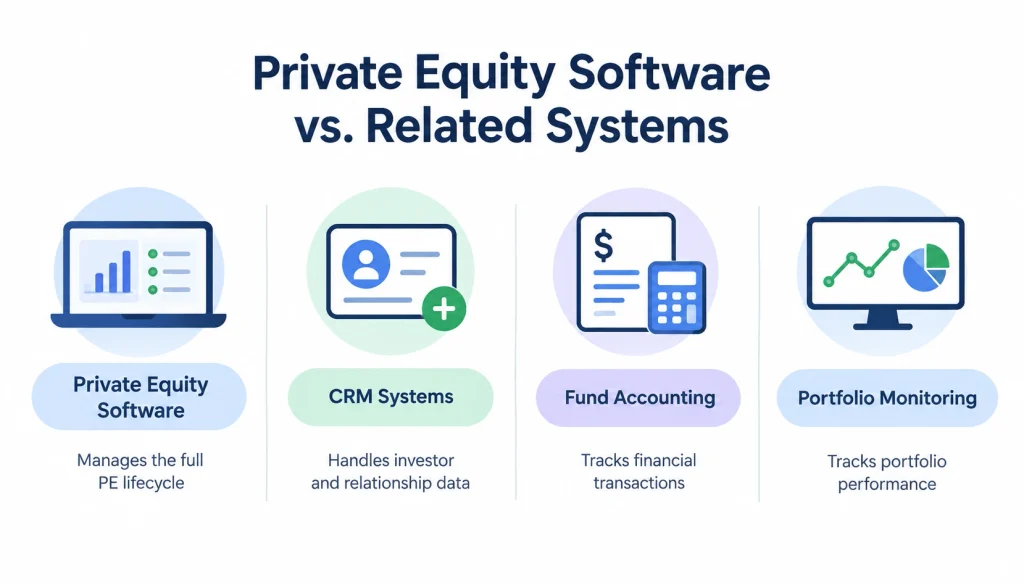
    Private equity software compared with CRM systems, fund accounting, and portfolio monitoring, showing their different roles across the private equity lifecycle.

    It’s easy to conflate PE software with adjacent categories. Here’s the quick distinction:

    • PE software vs CRM: a generic CRM (like base Salesforce) tracks contacts and deals broadly; PE-specific CRMs add relationship intelligence and deal-stage workflows built for the asset class.
    • PE software vs fund accounting software: fund accounting is one component of the broader PE software category, focused specifically on the general ledger, NAV, and capital accounts.
    • PE software vs fund administration: administration is operational (investor records, filings); accounting is financial (the books themselves). Many firms outsource the former, keep the latter closer in-house.
    • PE software vs portfolio management: “portfolio management” in a PE context usually means monitoring KPIs across portfolio companies, which is a narrower slice of the full PE software stack.
    • PE software vs ERP: a general ERP handles a company’s own operations; fund accounting software handles the fund’s investors and investments, which don’t map onto standard ERP structures.
    • PE software vs virtual data room: a VDR is a document-sharing tool for a specific deal or transaction, not an ongoing system of record.
    • PE software vs investor portal: the portal is the investor-facing window into data that lives in fund accounting and administration systems behind it.

    Frequently Asked Questions

    What is private equity software? 

    It’s the set of tools PE firms use to manage the investment lifecycle, deal sourcing, diligence, portfolio monitoring, fund accounting, and investor reporting. It’s not one product; most firms run several.

    What software do private equity firms use? 

    Commonly some combination of a PE CRM (4Degrees, Affinity, DealCloud), a data room (Datasite, iDeals), portfolio monitoring (iLEVEL, Chronograph), fund accounting (eFront, Allvue), and an LP portal (Juniper Square, Dynamo).

    What is the best private equity software? 

    There isn’t a single best option, it depends on firm size, fund complexity, and which stage of the lifecycle you’re solving for. A tool that’s ideal for a 5-person emerging manager is usually the wrong fit for a multi-fund institutional platform.

    What CRM do private equity firms use? 

    4Degrees, Affinity, and Intapp DealCloud are the most common purpose-built options; some firms also configure Salesforce, though it usually needs heavy customization to fit PE workflows.

    What does private equity software do? 

    Depending on the category, it can track deal pipeline, manage due diligence documents, collect portfolio company KPIs, run fund accounting, and generate investor reports.

    Final Takeaway

    Don’t pick private equity software based on which vendor has the longest feature list or the flashiest demo. The better approach is to start with how your firm actually works: how you source deals, manage diligence, track portfolio companies, handle fund accounting, communicate with LPs, and produce reports.

    From there, evaluate whether you need an all-in-one platform, a specialized tool for a specific workflow, or a combination of connected systems. Look closely at integrations, data migration, security controls, reporting capabilities, scalability, implementation requirements, and total cost of ownership, not just the features shown during a sales demo.

    For many firms, the practical answer won’t be one system that does everything. You may end up with two or three connected platforms, each handling a different part of the investment lifecycle. The goal is to build a technology stack that reduces manual work, keeps data consistent, gives your team better visibility, and can scale as your funds and portfolio grow.