
Day: August 31, 2026

  • How to Scale a Marketplace Business: A Practical Growth Strategy

    How to Scale a Marketplace Business: A Practical Growth Strategy

    Scaling a marketplace business isn’t the same as scaling a normal online store or a SaaS product. When you grow an ecommerce brand, you’re mostly solving one problem: get more people to buy. A marketplace has two customers to satisfy at once, buyers and sellers,  and growth on one side without the other just breaks things.

    Add more buyers without enough sellers, and people show up to an empty shelf. Add more sellers without enough buyers, and your best sellers leave for somewhere they can actually make sales. This is why so many marketplace founders hit a wall: they treat “scale” as a traffic problem when it’s really a balance problem.

    The short answer: scale a marketplace by first proving liquidity and unit economics, then strengthening whichever side of the marketplace is holding you back, building acquisition channels you can repeat, and expanding into new locations, categories, or customer segments one at a time, not all at once.

    The rest of this guide walks through that process step by step, from figuring out if you’re actually ready to grow, to picking your next market, to the operational and trust systems that keep a bigger marketplace from falling apart.

    What Does It Mean to Scale a Marketplace Business?

    Scaling means growing transactions, revenue, and reach without losing the thing that made the marketplace work in the first place: a reliable match between buyers and sellers.

    1. Marketplace scaling vs. ordinary e commerce growth

    E-commerce store compared with a two-sided marketplace connecting buyers and sellers.

    An e commerce store scales by increasing traffic and conversion rate. A marketplace has to grow supply and demand together, in roughly the right proportion, or the whole thing gets worse instead of better. More listings with no buyers is just clutter. More buyers with no listings is a bounce rate problem.

    2. Why two-sided marketplaces are harder to scale

    Every growth decision touches two different groups with different motivations. A pricing change that pleases buyers might push sellers out.

    A push to add sellers fast might dilute quality and scare buyers away. You’re not managing one funnel,  you’re managing two, and they depend on each other.

    3. The marketplace flywheel

    Most healthy marketplaces run on a loop like this: more supply leads to better selection, better selection brings in more demand, more demand creates more transactions, more transactions attract more sellers, and the cycle repeats.

    Scaling well means putting your energy into whichever part of that loop is currently weakest, rather than pushing marketing spend into a system that isn’t ready to absorb it.

    When Is a Marketplace Ready to Scale?

    This is the question most articles skip, and it’s the one that matters most. Traffic growth doesn’t mean you’re ready to scale, it just means more people are looking.

    Readiness is about whether your marketplace can actually deliver on what those people are looking for.

    1. You have repeatable transactions

    If most of your transactions come from one-off pushes, a founder emailing their network, a discount code, a press mention, you don’t have a repeatable engine yet. You have a series of favors.

    2. Supply and demand are sufficiently liquid

    Liquidity means a reasonable share of buyer requests actually turn into completed transactions, and a reasonable share of listings actually get bought or booked. If most searches come up empty, or most listings never sell, scaling will only multiply the frustration.

    3. Sellers are staying active

    Sellers who list once and disappear are a warning sign, not a growth number. Active, returning sellers are what make a marketplace feel alive to buyers.

    4. Buyers are returning

    New buyer acquisition is expensive. If people transact once and never come back, you’re running a leaky bucket, and pouring more traffic in just means pouring more out.

    5. Unit economics are becoming predictable

    You should have a rough, working sense of what it costs to acquire a buyer or seller and what they’re worth over time. “We’ll figure out the economics once we’re bigger” is how marketplaces run out of money while growing.

    6. Operations can handle higher volume

    If your support inbox, dispute resolution, or seller onboarding is already stretched thin at your current volume, doubling that volume won’t just be uncomfortable, it can break the trust you’ve built.

    7. Trust and quality systems are working

    Reviews, verification, and dispute handling need to be functioning before you scale, not bolted on after problems show up at a larger scale.

    8. Marketplace scale-readiness checklist

    Before pushing hard on growth, check these:

    • Transactions happen weekly without manual intervention
    • A meaningful share of searches or requests result in a transaction
    • Sellers who join are still active after 60–90 days
    • A meaningful share of buyers make a second purchase
    • You know your rough CAC and LTV for both sides
    • Support and operations aren’t already at capacity
    • Reviews, verification, and dispute processes exist and work
    • You’ve identified which side (supply or demand) is currently the constraint

    If most of these are shaky, the priority is fixing the core marketplace, not adding fuel to it.

    Solve the Marketplace Chicken-and-Egg Problem First

    1. What is the chicken-and-egg problem?

    Buyers won’t come without good selection, and sellers won’t join without buyers. Every marketplace starts here, and it resurfaces every time you enter a new market or category,. it’s not a problem you solve once and forget.

    2. Should you grow supply or demand first?

    There’s no universal rule. It depends on your category. Research from Lenny Rachitsky’s interviews with marketplace operators found that many well-known marketplaces leaned heavily on building supply first, though a number of them were actually demand-constrained rather than supply-constrained (Lenny’s Newsletter).

    The point isn’t “supply always wins”,  it’s that you need to check which side is actually the bottleneck for your specific marketplace before deciding where to put your energy.

    3. How to identify your constrained side

    Use a simple diagnostic. If buyers search but don’t find enough relevant listings, you’re supply-constrained.

    If sellers have listings but aren’t getting transactions, you’re demand-constrained. Look at your own data,  search-to-result rates on one side, listing-to-sale rates on the other,  instead of guessing.

    4. When supply should come first

    Categories where selection and variety drive the decision,  rentals, freelance services, unique goods — usually need a critical mass of supply before demand will stick around.

    5. When demand should come first

    Categories with more standardized listings, or where sellers are professionals who’ll join as soon as there’s proven buyer interest, can sometimes justify demand-first growth.

    Sellers with existing sales channels are often willing to test a new platform if you can show them real buyer intent.

    6. How marketplaces approached the problem

    Airbnb famously grew supply by helping early hosts take better listing photos,  a manual, unscalable tactic that solved a very specific supply-quality problem before the company ever tried to scale demand. Uber launched city by city, deliberately seeding driver supply before marketing to riders in a new city.

    Etsy built its early growth around a community of independent sellers, which created selection before demand was pushed hard. These aren’t templates to copy directly,  they’re evidence that the right sequencing depends on the category, not a fixed playbook.

    Improve Marketplace Liquidity Before Expanding

    1. What is marketplace liquidity?

    Liquidity is how reliably a marketplace turns interest into a completed transaction. A search that returns good options and ends in a booking is liquid. A search that returns nothing relevant is not, no matter how much traffic you’re getting.

    2. Why liquidity matters more than raw traffic

    You can double your traffic and end up with the same number of transactions if liquidity doesn’t improve. Traffic without liquidity just means more disappointed visitors, which quietly raises your acquisition costs because fewer of them convert or come back.

    3. How to measure buyer liquidity

    Look at the share of buyer searches or requests that end in a completed transaction within a reasonable window. Business data analytics can help you identify these patterns and determine where buyers are dropping out of the marketplace.

    4. How to measure seller liquidity

    Look at the share of listings that get at least one transaction within a set period. A high number of dead listings,  things posted and never sold or booked, signals weak seller-side liquidity.

    5. How to reduce time-to-match

    Faster matching keeps both sides engaged. This might mean better search filters, automated matching, or simply having enough density of supply that buyers don’t have to wait.

    6. How to improve search-to-transaction conversion

    Look at where buyers drop off between searching and completing a transaction. Often it’s unclear pricing, too few relevant results, or friction in checkout, all fixable without adding a single new user.

    7. How to increase supply density

    Density matters more than total supply count. A marketplace with 10,000 sellers spread across 50 cities can feel emptier to a buyer than one with 500 sellers concentrated in a single city. Concentrate before you spread out.

    8. How to improve marketplace matching

    Better filters, smarter default sorting, and (where it makes sense) recommendation logic all help buyers find relevant listings faster, which directly improves conversion.

    Build a Strong Marketplace Foundation Before Scaling Acquisition

    Don’t scale acquisition faster than your marketplace can deliver value. If the core transaction experience is shaky, spending more on growth just means more people experiencing that shakiness,  and telling their friends about it.

    1. Improve search and discovery

    Buyers need to find relevant listings quickly. If your search results are noisy or your filters don’t match how people actually shop, fix that before buying more traffic.

    2. Optimize listing quality

    Clear photos, honest descriptions, and consistent pricing formats reduce buyer hesitation. This often matters more than adding more listings.

    3. Simplify transactions and checkout

    Every extra step in booking or purchasing is a place someone can abandon. Watch your funnel for drop-off points.

    4. Build seller onboarding

    A confusing onboarding process is often the real reason sellers “don’t stick around.” Make it fast to list something and start getting visibility.

    5. Create reliable payments and payouts

    Sellers need to trust that money will actually arrive, on time, without confusion. Marketplace-specific payment infrastructure,  split payments, escrow-style holds, scheduled payouts,  is core plumbing, not a nice-to-have.

    Sharetribe’s marketplace-building guide treats payments, seller verification, and payout systems as foundational rather than optional.

    6. Establish reviews and ratings

    Reviews reduce the trust gap for new buyers deciding whether to transact with an unfamiliar seller. Without them, every transaction feels riskier than it needs to.

    7. Build verification and moderation

    Basic identity or listing checks catch bad actors before they damage trust across the whole platform.

    8. Create dispute and refund processes

    Disputes will happen. What matters is whether there’s a clear, fair process, so one bad transaction doesn’t turn into a public trust problem.

    Prove Marketplace Unit Economics

    Metrics like GMV, CAC, and LTV get mentioned everywhere, but the number itself doesn’t matter as much as what decision it helps you make.

    1. GMV (Gross Merchandise Value)

    Total value of transactions flowing through the marketplace. It tells you about volume, not profitability — a marketplace can have huge GMV and still lose money on every transaction.

    2. Revenue

    What the marketplace actually keeps, usually a percentage of GMV (the take rate) or a flat fee.

    3. Take rate

    Revenue divided by GMV. This tells you how much of the transaction value you’re capturing, and whether that’s sustainable given your costs.

    4. Customer acquisition cost (CAC)

    What it costs, in marketing and sales spend, to acquire one paying buyer or one active seller. Customer acquisition cost (CAC) is especially important for marketplaces because buyer and seller acquisition can behave very differently.

    5. Customer lifetime value (LTV)

    The expected revenue from a customer over the time they stay active. This tells you how much CAC you can afford before growth becomes unprofitable.

    6. Contribution margin

    Revenue minus the variable costs of serving a transaction, payment processing, support, fraud losses. This tells you whether growth actually improves your financial position or just moves more money through a leaky system.

    7. Payback period

    How long it takes to recover the cost of acquiring a customer. Shorter payback periods mean you can reinvest in growth faster.

    8. Seller acquisition cost

    Often overlooked, but seller-side CAC can be just as important as buyer CAC, especially in categories where good sellers are scarce.

    9. Repeat purchase rate

    The share of buyers who transact more than once. This is often the clearest early signal of whether the marketplace is actually delivering value.

    10. How CAC, LTV, and take rate work together

    If your take rate is 15%, your LTV needs to reflect that,  a buyer who spends $1,000 over their lifetime is only worth $150 in revenue to you, not $1,000.

    Compare that $150 against your CAC. If CAC is $180, you’re losing money on every buyer you acquire, no matter how good your GMV numbers look on a dashboard.

    11. Example marketplace unit economics calculation

    A home services marketplace has a 12% take rate, average buyer LTV of $2,000 in GMV over two years, and buyer CAC of $60.

    Revenue per buyer works out to $240 (12% of $2,000), against a $60 acquisition cost, a healthy 4x return before accounting for support and processing costs. That’s the kind of math worth doing before scaling acquisition spend, not after.

    Choose How You Want to Scale

    Sharetribe’s marketplace scaling framework identifies location, category, and customer segment as the main vectors marketplaces use to grow. Each comes with different trade-offs.

    1. Scale by geography

    Take your proven model into a new city, region, or country. This works well when your existing market has strong liquidity and the model doesn’t depend heavily on local relationships that don’t transfer.

    .2. Scale by category

    Add adjacent product or service categories that your existing buyers are already asking for. This can work well if your existing supply base can stretch into the new category without diluting quality.

    3. Scale by customer segment

    Serve a new type of buyer or seller with your existing infrastructure,  for example, moving from individual consumers to small businesses.

    This can unlock a much larger addressable market, but the new segment often has different needs than the one you built for.

    4. Scale through adjacent products or services

    Similar to category expansion, but usually smaller in scope,  adding a complementary offering rather than a whole new vertical.

    5. Scale internationally

    The highest-risk, highest-reward option. It usually means dealing with new regulations, payment systems, and buyer behavior all at once.

    6. How to choose the right scaling vector

    Expansion routeBest whenMain advantageMain risk
    New locationLocal liquidity is strong and repeatableReplicates a proven modelLaunch cost in each new market
    New categoryExisting users are already asking for itCross-sell into an existing baseSupply gets fragmented
    New segmentExisting infrastructure fits new usersBigger addressable marketDifferent needs, different expectations
    InternationalModel is highly repeatableLarge growth ceilingRegulation and localization work

    Pick the one that plays to your current strength, not the one that sounds most exciting in a pitch deck.

    How to Choose Your Next Market

    If you’re expanding geographically, score potential markets rather than picking based on gut feel or which city a team member happens to live in.

    Consider market size, existing demand signals, whether supply is available locally, how much competition already exists, local customer behavior, cultural differences that might affect adoption, how comfortable the local population is with the underlying technology, relevant regulation, available payment infrastructure, and your realistic cost of launching there.

    New-market scoring framework
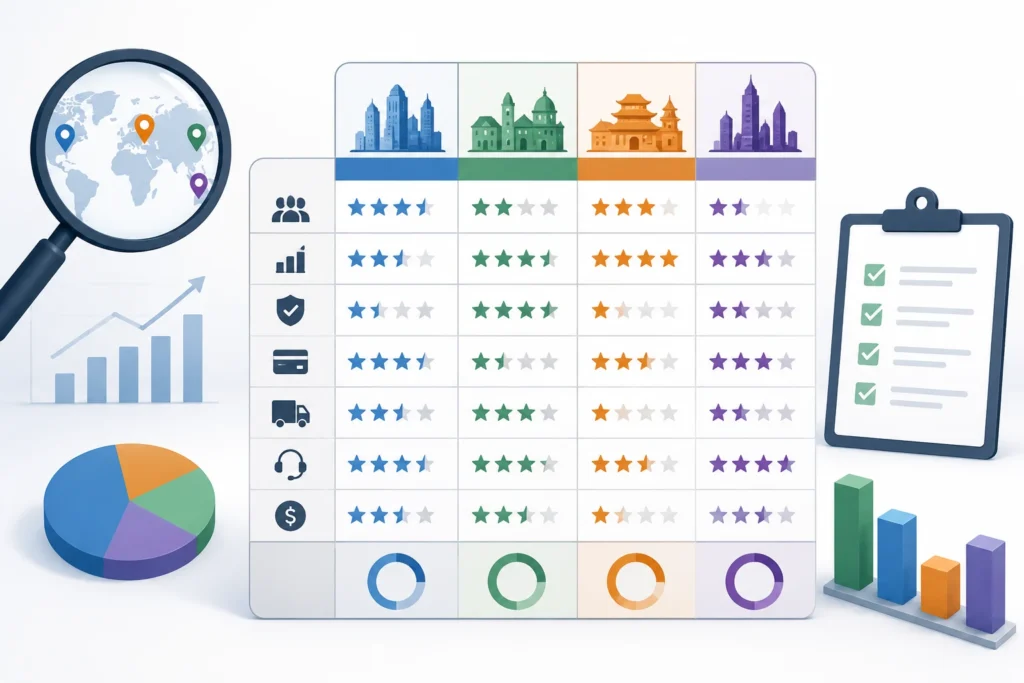
    Market scoring framework comparing potential markets using ratings, charts, growth data, and evaluation factors.

    Score each factor from 1 to 5 for every candidate market, then compare totals. A market that scores well on size but poorly on regulation and payment infrastructure might actually be a worse bet than a smaller market where launch friction is low.

    The scoring exercise is less about the exact number and more about forcing an honest comparison instead of picking the market that feels most familiar.

    Build a Repeatable Marketplace Expansion Playbook

    The goal after your first successful expansion is to turn it into a repeatable process, not a one-off project.

    Document what actually worked in your first successful market and be honest about which parts can be standardized versus which parts had to be handled locally, things like partnerships, regulation, or customer expectations rarely transfer as-is. Launch new markets small, as real tests rather than full rollouts.

    Focus early effort on establishing supply, then demand, and measure liquidity before spending more on that market. Improve the local experience based on what you learn, and set a clear point at which you decide to keep investing or pull back.

    Example 90-day marketplace expansion plan

    Days 1–30: recruit an initial base of sellers manually, focusing on quality over quantity. Days 31–60: introduce demand carefully, ideally through channels that convert well without much spend — referrals, existing-market cross-promotion, local partnerships.

    Days 61–90: measure liquidity and transaction repeat rate, then decide whether to keep investing in that market or shift resources elsewhere.

    Use SEO to Scale Marketplace Demand

    For a lot of marketplaces, SEO for business is one of the most durable demand channels available because organic search can scale without a matching increase in paid spend.

    Category landing pages and location landing pages give search engines (and buyers) a clear entry point for specific intent,”cleaning services in Austin” needs its own page, not just a filter buried in a search bar. Combining category and location (“plumbers in Denver”) often captures long-tail searches that are highly specific and easier to rank for.

    Individual seller or listing pages, when well-optimized, can also capture search traffic on their own. Programmatic SEO,  generating pages at scale from structured data, can work well for marketplaces with many locations or categories, but it needs careful handling of thin or duplicate content, or it does more harm than good.

    Comparison content, genuine user-generated reviews, strong internal linking between related category and location pages, and clean indexation control all support this.

    A marketplace-growth analysis from Journey Horizon specifically points to category, subcategory, and location page combinations as a meaningful SEO opportunity for marketplaces that haven’t built them out yet.

    Build Growth Loops Instead of Relying Only on Paid Acquisition

    Paid acquisition gets expensive fast, especially on both sides of a marketplace at once. Growth loops — where usage itself generates new usage, are more sustainable over time.

    Sellers who succeed on your platform often refer to other sellers. Buyers who have a good experience refer to other buyers. Organic search compounds over time instead of resetting with every ad budget cycle.

    Content built around real buyer or seller questions keeps working long after it’s published. Network effects mean each new user makes the marketplace slightly more valuable to everyone already on it.

    Partnerships with complementary businesses can bring in users who already trust the referring brand. Retention work, keeping existing users active, reduces how much new acquisition you need in the first place. And cross-selling into adjacent categories lets you grow revenue from users you already have.

    Increase Seller Supply Without Sacrificing Quality

    Marketplace seller supply strategy showing verified sellers, outreach, partnerships, onboarding, and growth tracking.

    Growing supply too fast, without a quality bar, is one of the fastest ways to damage buyer trust.

    Direct outreach, personally recruiting the right sellers rather than waiting for them to find you, still works well in the early stages of any new category or market. Referral programs and targeted incentives can accelerate this once you have a base of happy sellers to draw from.

    Partnerships with associations, agencies, or other platforms can bring in vetted supply faster than cold outreach.

    Automating onboarding reduces friction for legitimate sellers, and tracking activation (are new sellers actually getting their first sale quickly?) and retention (are they still active after a few months?) tells you whether your supply growth is healthy or just noisy.

    Increase Buyer Demand and Repeat Transactions

    Acquiring a new buyer is usually far more expensive than keeping an existing one active, which is why repeat transaction rate deserves as much attention as new buyer growth.

    Improving discovery and search relevance helps buyers find what they want faster. Reducing friction at checkout improves conversion without adding a single new visitor.

    Personalized recommendations, where you have enough data to support them, can lift repeat engagement.

    Referral programs turn happy buyers into an acquisition channel. And simply reducing friction throughout the experience, fewer required fields, clearer pricing, faster load times, often moves the needle more than any single growth tactic.

    Scale Marketplace Technology and Operations

    Growth creates operational load that doesn’t show up on a growth chart until it becomes a problem. Search and matching systems need to keep performing as listing volume grows.

    Payments and payouts need to stay reliable as transaction volume increases. Seller management, customer support, fraud prevention, and moderation all need systems, not just more people doing the same manual work.

    AppDirect’s guidance on marketplace ecosystems highlights integrations, automated vendor onboarding, compliance handling, and self-service tools as what let marketplaces support more sellers and partners without support headcount growing at the same rate.

    Analytics dashboards and automated alerts help you catch liquidity or quality problems in a specific market or category before they show up as churn.

    Where it fits your category, AI-assisted matching or recommendations can improve relevance as your catalog grows too large for simple filters to handle well.

    Protect Trust and Quality While Scaling

    Trust is the hardest thing to rebuild once it’s damaged, and scaling puts more stress on trust systems than anything else.

    Seller and buyer verification reduce fraud and give both sides confidence. Reviews and ratings help buyers make decisions without needing to know a seller personally. Fraud detection and content moderation catch problems before they spread.

    Clear dispute resolution and refund policies mean one bad transaction doesn’t turn into a trust crisis across the platform.

    Service-level standards give sellers something concrete to meet, and basic marketplace governance, rules about what’s allowed and how they’re enforced,  keeps the whole system fair as it grows past the point where you can personally know every seller.

    The Most Important Marketplace Metrics to Track

    KPIHow it’s measuredWhat it tells you
    GMVTotal transaction valueOverall marketplace volume
    Take rateRevenue ÷ GMVHow much value you’re capturing
    CACAcquisition spend ÷ new customersGrowth efficiency
    LTVExpected customer value over timeLong-term economics
    LiquiditySuccessful matches ÷ relevant opportunitiesMarketplace health
    Conversion rateTransactions ÷ relevant visitsDemand-side efficiency
    Repeat purchase rateRepeat buyers ÷ total buyersRetention strength
    Seller activationActive sellers ÷ onboarded sellersSupply quality
    Seller retentionRetained sellers ÷ total sellersSupply-side health
    Time-to-matchTime from request to completed transactionMatching efficiency
    Contribution marginRevenue minus variable costsWhether growth is actually profitable

    How to Know When Not to Scale Yet

    Sometimes the right move is to slow down and fix what you have, not push harder on growth.

    Signs it’s not time yet: liquidity is still weak in your core market, one side of the marketplace (usually supply) is largely inactive, CAC is climbing faster than LTV, sellers are churning faster than you’re replacing them, buyers aren’t coming back after their first transaction, quality complaints are trending up, your operations are still mostly manual and already stretched, or your existing market hasn’t reached enough density to feel reliable to either side.

    This is the section founders tend to skip, but it might be the most useful one. The question worth asking isn’t “how do I grow faster”,  it’s “what’s currently stopping me, and is it actually fixed yet.”

    Common Marketplace Scaling Mistakes

    Expanding into too many markets at once, before any single one has proven itself. Adding new categories before the core marketplace has real liquidity. Buying traffic before fixing a broken conversion funnel. 

    Growing supply aggressively without matching demand, or the reverse. Ignoring seller-side economics while focusing only on buyer growth. Letting buyer retention slide while chasing new buyer acquisition. 

    Optimizing for GMV while quietly losing money on every transaction. Automating a process that was already broken, which just breaks it faster and at higher volume. And sacrificing quality standards for growth speed, a mistake that’s cheap to make and expensive to undo.

    Marketplace Scaling Examples

    Airbnb grew by building density in specific cities and neighborhoods first, rather than spreading thin across many markets at once. Their early focus on host photo quality solved a specific supply problem before broader growth.

    Uber launched market by market, seeding driver supply in each new city before marketing hard to riders, a repeatable playbook built city by city rather than all at once.

    Etsy grew around an ecosystem of independent sellers and craft categories, letting the seller community itself become part of the demand story.

    Thumbtack took a broader, less category-specific approach, covering a wide range of local services rather than specializing narrowly.

    DoorDash focused heavily on expanding restaurant supply and delivery reliability, treating selection and fulfillment speed as the core growth lever rather than just marketing spend.

    What founders should actually learn from these examples

    These aren’t blueprints to copy directly. The categories, timing, and competitive landscape were all different from whatever you’re building now. 

    What’s actually useful here is the pattern: each of these companies identified their real constraint and focused resources there before pushing broader growth.

    A discussion thread on r/startups makes a similar point, founders repeatedly note that copying a well-known company’s specific tactics without their underlying market conditions tends to backfire (startups, Reddit).

    A Practical Marketplace Scaling Framework

    Putting it all together, here’s a repeatable sequence:

    1. Validate: confirm buyers and sellers actually want what you’re offering, beyond a small initial group.
    2. Measure: get real numbers on liquidity, CAC, LTV, and retention.
    3. Diagnose: figure out honestly whether supply or demand is your constraint.
    4. Fix liquidity: improve matching and conversion before adding more volume.
    5. Prove economics: confirm the unit economics work at your current scale.
    6. Build growth loops: reduce dependence on paid acquisition.
    7. Choose one expansion vector: location, category, or segment, not all three at once.
    8. Launch a controlled expansion: treat it as a test, not a full commitment.
    9. Automate operations: build systems before volume forces you to.
    10. Repeat what works: turn your first successful expansion into a playbook for the next one.

    Frequently Asked Questions

    How do you scale a marketplace business? 

    Prove liquidity and unit economics in your core market first, fix whichever side (supply or demand) is holding you back, build acquisition channels you can repeat without constantly increasing spend, then expand into one new location, category, or segment at a time.

    How do you increase liquidity in a marketplace? 

    Improve search and matching so buyers find relevant listings faster, increase supply density in your existing market before spreading geographically, and fix friction points in the transaction flow itself.

    Should a marketplace focus on supply or demand? 

    It depends on the category. Check your own data, if searches return too few relevant results, you’re supply-constrained; if listings aren’t converting into transactions, you’re demand-constrained.

    When should a marketplace expand to a new city? 

    Once your current market has strong liquidity, repeatable transactions, and a playbook you can document and hand to a team launching the next market.

    Is it better to expand by geography or category? 

    Neither is universally better. Geography works well when your model is highly repeatable; category works well when existing buyers are already asking for it and your supply base can stretch to meet it.

    What metrics should a marketplace track? 

    GMV, take rate, CAC, LTV, liquidity, conversion rate, repeat purchase rate, seller activation and retention, time-to-match, and contribution margin.

    Conclusion

    A marketplace shouldn’t be judged on how many users, sellers, categories, or markets it has. The real goal is more successful transactions, delivered efficiently, without losing liquidity, trust, retention, or healthy economics along the way.

    There’s no single scaling playbook that fits every marketplace,  a local services platform, a B2B software marketplace, and a rental marketplace all have different liquidity dynamics and different constraints. 

    What holds across all of them is the discipline to check readiness before pushing growth, diagnose the real constraint instead of guessing, and expand in controlled steps you can actually learn from. 

    That discipline, more than any single tactic, is what separates marketplaces that scale well from ones that just get bigger and messier.

    For further reading on marketplace mechanics and network effects, Wikipedia’s overview of two-sided markets is a useful primer, and marketplace-focused discussions on LinkedIn often surface real operator experience worth following.


  • Taxation Without Representation: What It Means and Why It Still Matters for Businesses Today

    Taxation Without Representation: What It Means and Why It Still Matters for Businesses Today

    At its simplest taxation without representation means being forced to pay taxes to a government without having a say in the politics that create those taxes. 

    The phrase became one of the famous complaints of American colonists in the 1760s and 1770s. Their problem was not just that taxes were there. 

    Their problem was being taxed by the British Parliament while not having any elected people from their area in Parliament. (PBS). That difference is important.

    Taxes are a part of running a modern economy. Businesses might have income taxes, employment taxes, excise taxes, sales or use taxes, property taxes and other state or local requirements based on how they’re set up and where they are located. 

    The IRS says that the type of business a company has determined which taxes it might need to pay and how those taxes are managed. (IRS)

    So why link a slogan from the 1700s with businesses today?

    Because taxes are not about money. They are also about having a say in being held responsible, being open and being able to take part in decisions that influence the economy.

    For business owners, knowing about the idea behind taxation without representation can help them understand why tax policy gets much attention, how governments get the power to tax and why businesses often support or oppose changes to taxes.

    What Does Taxation Without Representation Mean?

    Colonial-era illustration showing British authorities collecting taxes from American colonists protesting a lack of political representation.

    Taxation without representation is when the government takes your money without you having a say in how it’s spent. You do not get to choose the people who make the decisions about taxes.

    The American colonies did not like it when the British government taxed them without giving them a voice.

    The main point was simple: if you have to pay taxes you should have a say in how the government spends your money. The problem was not about how much money people had to pay in taxes.

    Taxation without representation is really about having a say in the government and being able to agree or disagree with the decisions they make. It is about being heard and having control over the money you earn.

    The issue of taxation without representation is more about being treated and having representation in the government.

    During the colonial period, Parliament passed measures that affected the American colonies. Colonists objected because they did not elect representatives to Parliament.

    The dispute became particularly intense following measures such as the Stamp Act and Townshend Acts, contributing to protests, boycotts, and eventually the revolutionary movement.

    The principle eventually became closely associated with the broader American argument for representative government.

    Taxation vs. Taxation Without Representation

    Taxation comparison showing representative government on one side and taxation without political representation on the other.

    It is important not to confuse these two concepts.

    Taxation simply means a government requires individuals or businesses to make payments to fund public purposes.

    Taxation without representation refers specifically to the relationship between taxation and political representation.

    A person or business can disagree with a tax rate without necessarily experiencing taxation without representation.

    For example, a business owner might believe that a 30% tax rate is too high. That is a disagreement about tax policy.

    By contrast, taxation without representation raises a different question:

    Does the taxpayer have a meaningful political mechanism to participate in the government that imposes the tax?

    That distinction is essential when discussing the historical meaning of the phrase.

    The History of Taxation Without Representation

    1. Why Did the Colonists Object to British Taxes?

    After the French and Indian War finished in 1763 Britain had a lot of debts and costs to deal with. The British government tried to get money from the American colonies by using different taxes and charges.

    The colonists already paid taxes at the colonial level. Their main issue was not the idea of being taxed.

    The real issue was that Parliament made rules for the colonies even though the colonies did not choose members of Parliament.

    Because of this the colonists said that taxing them without letting them vote was breaking their rights.

    This disagreement turned the topic of taxes into a conversation, about who had power and what it meant to govern yourself.

    2. The Stamp Act

    The Stamp Act of 1765 was a law that made printed things in the colonies have a special stamp. The stamp was linked to a tax that people had to pay. This law affected papers like papers, newspapers, licenses and other printed things. 

    Soon after the law was passed people in the colonies started to object. People who did not like the law said that Parliament did not have the right to make them pay taxes. They said this because they did not have any representatives in Parliament. 

    The argument over the Stamp Act helped make the idea of “no taxation, without representation” well known. 

    3. The Boston Tea Party

    The argument finally got worse.

    The Tea Act from 1773 played a role in the events that led to the Boston Tea Party, when people in the colonies showed their anger about taxes and the special treatment given to the East India Company.

    The Boston Tea Party turned into a sign of resistance from the colonies. It also showed that arguments about taxes could grow into bigger issues than just money. 

    Discussions about taxes started to mix with questions about power in politics, control over the economy, having a voice in government and whether the government was fair.

    4. The Declaration of Independence

    The Declaration of Independence had a list of complaints against the British Crown and the government of Britain.Taxation was one of the issues that the American colonies had with  Britain.

    However the American Revolution was about more than high taxes. The American Revolution was really about who had the power to make decisions, how the colonies were represented in the government of Britain, what laws were passed and whether the colonies could govern themselves.

    The American colonies and Britain did not see eye to eye on these issues. Historians today say that the American Revolution was mainly about the colonies wanting to have a say in how they were governed and who had the power to make decisions, not just about the amount of taxes they had to pay according to PBS.

    Why Representation Matters When Governments Tax

    The principle behind taxation without representation is based on a simple democratic idea:

    People affected by government decisions should have a voice in choosing the people who make those decisions.

    Taxes influence almost every part of an economy.

    They can affect:

    • Business profits
    • Consumer prices
    • Employee compensation
    • Investment decisions
    • Hiring
    • Business formation
    • Property ownership
    • Imports and exports
    • Corporate expansion
    • Entrepreneurial risk
    • Government spending

    Because taxation can have such broad consequences, taxpayers have an interest in how tax laws are created.

    In a representative system, citizens elect lawmakers who create legislation, including tax legislation.

    The U.S. Constitution gives Congress the authority to impose federal taxes. Article I, Section 8 gives Congress power to lay and collect taxes, duties, imposts, and excises for purposes including paying debts, providing for the common defense, and promoting the general welfare.

    This creates an important difference between the colonial situation and the modern federal system.

    The modern U.S. system is built around representative institutions rather than taxation imposed by an unelected Parliament over a population lacking elected representation in that body.

    Does Taxation Without Representation Still Exist Today?

    The phrase Taxation Without Representation is still important today even though it needs to be explained in a way that makes sense for times. In the United States a good example of this is what happens in Washington, D.C.

    The people who live in Washington, D.C. Pay taxes to the government but they do not get to vote for people to represent them in the Senate and they do not have a voting member in the House like people who live in the other states do.

    The city of Washington, D.C. It itself has used the phrase Taxation Without Representation to talk about this situation for a time. You can find information about this on the website ocp.dc.gov.

    Just because a business does not like a tax that does not mean it is an example of Taxation Without Representation.

    Most people and businesses today. Work in a system where they have representatives who make laws about taxes. This is very different from what happened a time ago when the colonies disagreed with the government about taxes and representation.

    Taxation Without Representation is not about paying taxes that you do not like, it is about not having any say in how you are governed and that is what makes the situation in Washington, D.C. A good example of Taxation Without Representation.

    What Does Taxation Without Representation Mean for Businesses?

    For businesses, the concept becomes especially interesting because companies are affected by tax policy even though businesses themselves are not individual voters.

    A business may be affected by decisions involving:

    • Corporate income taxes
    • Pass-through taxation
    • Payroll taxes
    • Sales taxes
    • Excise taxes
    • Property taxes
    • Business licensing fees
    • Import duties
    • Local taxes
    • Tax credits
    • Industry-specific taxes

    The IRS identifies several major categories of federal business taxes, including income tax, estimated tax, self-employment tax, employment taxes, and excise tax. (IRS)

    The tax consequences also depend heavily on the structure of the business.

    A sole proprietorship, partnership, corporation, S corporation, and LLC can have different federal tax treatment and filing requirements.

    This is why business owners should not think of “business tax” as a single tax.

    How Businesses Have Representation in the Tax System

    Businesses have several ways to participate in the political and policy process.

    1. Voting

    Business owners and employees can vote for candidates whose tax and economic policies align with their interests.

    Voting is one of the most direct forms of political representation.

    2. Contacting Legislators

    Business owners can communicate with elected representatives about proposed legislation.

    For example, a small-business owner could explain how a proposed tax increase might affect:

    • Hiring
    • Expansion
    • Cash flow
    • Prices
    • Capital investment

    This allows lawmakers to hear from people directly affected by tax policy.

    3. Industry Associations

    Businesses often participate in industry associations that advocate for particular policy positions.

    These organizations may conduct research, communicate with legislators, submit comments, and educate members about proposed legislation.

    4. Public Policy Advocacy

    Companies can participate in lawful advocacy and public policy discussions.

    Large corporations may have dedicated government-relations teams, while small businesses may rely on chambers of commerce or industry groups.

    5. Public Comment and Regulatory Participation

    Not every business-related rule comes directly from Congress.

    Government agencies also create regulations under authority granted by law.

    Businesses may have opportunities to participate in regulatory processes through comments, hearings, industry consultations, and other lawful channels.

    This means representation is broader than simply voting every few years.

    Why Tax Representation Matters to Small Businesses

    Small business owner reviewing tax documents and calculating expenses at a desk with a laptop, calculator, paperwork, and tax-related business icons.

    Large corporations often have dedicated accounting, legal, tax, and government-relations departments.

    Small businesses usually do not.

    A small business owner may personally handle:

    • Bookkeeping
    • Payroll
    • Taxes
    • Hiring
    • Sales
    • Customer service
    • Compliance
    • Operations

    That makes changes in tax policy particularly important.

    For example, a change in payroll taxation could affect employment costs.

    A change in business deductions could alter taxable income.

    A change in sales-tax requirements could affect pricing and compliance.

    A change in local property taxes could increase the cost of operating a physical location.

    TThe IRS emphasizes that businesses can have federal, state, and local tax responsibilities, particularly when they have employees or operate across jurisdictions.

    For small businesses, therefore, understanding tax policy is not merely a political exercise. It can become a practical business management issue, which is where understanding what a business controller does can be useful.

    Taxation Without Representation vs. High Taxes

    These concepts are often confused.

    A high tax is not automatically taxation without representation.

    Consider two hypothetical businesses.

    Business A

    Business A operates in a state where lawmakers are elected by residents. The state legislature increases the corporate tax rate.

    The owner disagrees with the increase and believes it will hurt the company.

    That is a tax-policy disagreement, not necessarily taxation without representation.

    Business B

    Business B operates under a governing authority where taxpayers have no meaningful elected representation in the legislative body imposing the tax.

    That situation is much closer to the historical concept of taxation without representation.

    The distinction matters because the phrase describes a political relationship, not simply the size of the tax bill.

    How Tax Policy Can Affect Business Decisions

    Taxes influence business decisions in ways that go beyond the amount paid to the government.

    1. Hiring Decisions

    Businesses consider total employment costs when deciding whether to hire.

    Employment taxes can form part of that cost.

    The IRS notes that employers may have responsibilities involving federal income-tax withholding, Social Security and Medicare taxes, and federal unemployment taxes.

    2. Investment Decisions

    Tax rules can influence whether a company purchases equipment, expands facilities, or invests in new technology.

    Tax deductions and credits may change the financial calculation, while sales tax compliance can also affect the overall cost of business purchases and investments.

    3. Pricing

    Businesses may incorporate certain taxes into their pricing decisions.

    For consumer-facing companies, changes in sales or excise taxes can affect final prices and demand.

    4. Business Location

    State and local tax differences can influence where businesses establish operations.

    However, taxes are only one factor. Businesses may also consider labor availability, infrastructure, customers, regulations, transportation, and real estate costs.

    5. Cash Flow

    Tax obligations can affect when money leaves a business.

    Federal income tax is generally structured as a pay-as-you-go system, meaning businesses may need to make payments during the year rather than waiting until the annual return is filed. (IRS)

    Representation, Accountability, and Business Confidence

    A healthy tax system requires more than simply collecting revenue.

    Businesses also need predictability.

    Imagine a company planning a five-year expansion.

    It may invest millions of dollars in:

    • Equipment
    • Buildings
    • Employees
    • Technology
    • Inventory
    • Training

    If tax laws change unpredictably, the company’s financial projections can become less reliable.

    This is one reason businesses pay attention not only to tax rates but also to:

    • Legislative proposals
    • Tax incentives
    • Deduction rules
    • Compliance requirements
    • Filing deadlines
    • Regulatory changes
    • State and local policies

    Representation provides a mechanism for taxpayers to communicate concerns about these policies.

    Taxation and the U.S. Constitution

    The modern U.S. tax system is built on constitutional authority.

    Article I, Section 8, Clause 1 gives Congress the power to lay and collect federal taxes. The Constitution also places limits and conditions on that power. (Constitution.gov)

    The Constitution’s Origination Clause is another important part of the system.

    Revenue bills must originate in the House of Representatives, although the Senate can propose or agree to amendments. (Congress.gov)

    This structure reflects the broader constitutional principle that taxation should occur through established representative institutions.

    In other words, modern U.S. taxation is not based on the British colonial model that inspired the original protest.

    Taxation Without Representation and Washington, D.C.

    Washington, D.C. Offers one of the modern examples of why the phrase keeps coming up.

    People who live in the District pay taxes but do not have voting representation in Congress like people who live in a state.

    The government of the District has actually used the phrase “Taxation Without Representation” in its efforts. (Ocp.dc.gov) For companies that are based in Washington, D.C. this issue can therefore be seen as part of the political environment where local businesses work.

    It is important to make a difference between the political representation of residents and the separate legal and tax responsibilities that are placed on businesses.

    A business does not stop paying a tax just because its owners do not agree with the system.

    Tax responsibilities still apply unless a real law or an exemption says something.

    Can a Business Refuse to Pay Taxes Because It Claims There Is No Representation?

    No.

    Disagreeing with taxation policy does not automatically provide a legal basis for refusing to pay taxes.

    Businesses are generally required to comply with applicable federal, state, and local tax laws.

    The IRS provides businesses with systems for filing and paying taxes, including electronic filing and payment options. (IRS)

    A business that believes a tax is incorrect should use appropriate legal and administrative processes rather than simply stop paying.

    Depending on the situation, legitimate options may include:

    • Filing an amended return
    • Requesting an administrative review
    • Challenging an assessment
    • Appealing through the appropriate process
    • Seeking professional tax advice
    • Pursuing litigation when legally appropriate

    The historical slogan should therefore be understood as a principle concerning political representation, not as a general excuse for tax noncompliance.

    Why Tax Transparency Matters to Businesses

    Representation works best when taxpayers can understand what governments are doing.

    Businesses benefit when tax systems are:

    1. Transparent

    Companies should be able to determine what they owe and why.

    2. Predictable

    Businesses need reasonable stability when making long-term investments.

    3. Administratively manageable

    Complex tax requirements can create significant compliance costs, especially for small businesses.

    4. Accountable

    Taxpayers should have avenues to challenge incorrect assessments and participate in policy debates.

    5. Consistent

    Similar businesses should generally be able to understand how rules apply to them.

    These principles are closely connected to the broader idea behind taxation without representation: taxpayers should not be treated as passive sources of revenue without meaningful avenues for accountability.

    How Business Owners Can Stay Informed About Tax Policy

    You do not need to become a constitutional scholar to understand how tax policy affects your company.

    A practical approach can include the following.

    1. Monitor Legislative Changes

    Keep track of federal and state proposals that could affect your industry.

    2. Follow Official Tax Authorities

    The IRS provides business tax information covering filing, payment, employment taxes, estimated taxes, and other obligations. (IRS)

    State and local tax authorities are also important sources of information.

    3. Work With Tax Professionals

    An accountant, CPA, enrolled agent, or tax attorney can help interpret complicated tax rules.

    4. Understand Your Business Structure

    Your business structure can influence how taxes are calculated and reported. The IRS specifically notes that business structure affects the taxes a business must pay and how those taxes are handled. (IRS)

    5. Participate in Business Organizations

    Industry groups and local business organizations can help business owners understand policy developments and participate in public discussions.

    6. Keep Accurate Records

    Good records make it easier to calculate tax liabilities, claim legitimate deductions, respond to tax authorities, and make informed financial decisions.

    Accounting software can also help businesses organize financial data, track expenses, manage taxes, and maintain accurate records

    Taxation Without Representation in the Digital Economy

    The idea becomes even more interesting as businesses increasingly operate across borders.

    A digital company might have:

    • Customers in multiple states
    • Employees working remotely
    • Contractors in different jurisdictions
    • International customers
    • Digital products
    • Online advertising revenue
    • Cloud infrastructure spread across regions

    This creates complicated questions about which governments have authority to tax particular activities.

    The business may feel economically connected to multiple jurisdictions at once.

    As commerce becomes more digital, businesses increasingly need to understand not only how much tax they owe, but also which government has the authority to impose it and under what legal framework.

    That does not mean every cross-border tax is taxation without representation.

    Rather, it highlights why jurisdiction, legal authority, transparency, and political accountability remain important concepts in modern taxation.

    Common Misconceptions About Taxation Without Representation

    Myth 1: It Means Any Tax Is Unfair

    False.

    The phrase specifically concerns taxation imposed without meaningful political representation.

    Myth 2: The American Revolution Happened Only Because Taxes Were Too High

    Oversimplified.

    Taxation was part of the conflict, but representation, constitutional authority, political rights, trade restrictions, and self-government were also central issues.

    Myth 3: Businesses Can Stop Paying Taxes If They Disagree With Government

    False.

    Businesses generally remain legally responsible for applicable taxes.

    Myth 4: Representation Only Means Voting

    Not necessarily.

    Representation can involve elections, legislative advocacy, public participation, industry organizations, regulatory processes, and other lawful mechanisms.

    Myth 5: The Concept Is Only Historical

    Not entirely.

    The phrase remains part of modern political debate, including discussions surrounding Washington, D.C. and federal representation. (ocp.dc.gov)

    Why Taxation Without Representation Still Matters in 2026

    The phrase remains relevant because the underlying question has not disappeared:

    Who gets to make decisions that require people and businesses to contribute money to the government?

    Modern economies are much more complicated than the colonial economy, but the fundamental relationship between taxation and political authority remains important.

    Businesses today operate within tax systems created through federal, state, and local governments.

    They must understand:

    • Who imposes the tax
    • What authority supports the tax
    • Who makes the rules
    • How tax changes are proposed
    • How taxpayers can participate
    • What compliance obligations apply
    • What legal remedies are available

    The IRS’s current business guidance illustrates just how extensive these obligations can be. Depending on the business and circumstances, federal responsibilities can include income taxes, employment taxes, estimated taxes, self-employment taxes, excise taxes, and information reporting. (IRS)

    This makes tax literacy an important business skill.

    Taxation Without Representation: Key Takeaways for Businesses

    For business owners, the most important lessons are straightforward:

    1. Taxation without representation is primarily a political concept, not simply a complaint about high taxes.
    2. The phrase originated in the colonial conflict with Britain, when colonists objected to taxation by a Parliament in which they lacked elected representation. (PBS)
    3. Modern U.S. taxation operates through constitutional and representative institutions. Congress has constitutional authority to impose federal taxes, subject to constitutional limitations. (Constitution.gov)
    4. Businesses have numerous tax obligations, and those obligations vary according to business structure and circumstances. (IRS)
    5. Political participation matters to businesses because tax policies can affect hiring, investment, pricing, expansion, and cash flow.
    6. Disagreement with a tax does not eliminate a legal obligation to pay it.
    7. Tax representation is ultimately about accountability and political voice, not about eliminating taxes altogether.

    Frequently Asked Questions

    What is taxation without representation in simple terms?

    Taxation without representation means being required to pay taxes to a government without having meaningful elected representation in the body that imposes those taxes.

    Why did the colonists say “no taxation without representation”?

    American colonists objected to British taxes because they believed Parliament was imposing taxes on them even though the colonies did not elect representatives to Parliament. The dispute therefore concerned political representation and authority, not simply the amount of tax. (PBS)

    What is an example of taxation without representation today?

    Washington, D.C. is a commonly cited modern example because District residents pay federal taxes but lack voting representation in Congress equivalent to residents of the states. (ocp.dc.gov)

    Does taxation without representation apply to businesses?

    The historical principle primarily concerns political representation of taxpayers. Businesses are affected by tax laws and can participate in the political and policy process through owners, employees, associations, advocacy, and other lawful channels.

    Can businesses refuse to pay taxes because they disagree with tax policy?

    No. A disagreement with tax policy does not normally eliminate a business’s legal tax obligations. Businesses should use appropriate administrative or legal procedures to challenge taxes they believe are incorrect.

    What taxes do businesses typically pay?

    Depending on their structure and activities, businesses may have federal income tax, estimated tax, employment tax, self-employment tax, excise tax, and other state or local tax obligations. (IRS)

    Why is taxation important to businesses?

    Taxes can affect profitability, cash flow, hiring, investment, pricing, expansion, and business location. Understanding tax policy can therefore help businesses make better financial and strategic decisions.

    Conclusion

    Taxation without representation is more than a phrase from an American history textbook. It captures a fundamental question about the relationship between taxpayers and government: if people and businesses are required to contribute money to the government, what mechanisms give them a voice in the decisions that create those obligations?

    For American colonists, the question became a major source of conflict with Britain and helped fuel the movement toward independence.

    For businesses today, the issue looks different. Modern companies operate within a constitutional system where elected lawmakers establish tax laws and government agencies administer them. 

    Businesses can vote through their owners and employees, communicate with representatives, participate in industry organizations, engage in public policy discussions, and use established legal processes to challenge government decisions.

    At the same time, the underlying principle remains valuable.

    Tax systems work best when taxpayers understand what they are paying, why they are paying it, who created the rules, and how they can participate in the political process.

    For business owners, that makes taxation without representation more than a historical slogan. It is a useful starting point for thinking about tax policy, accountability, transparency, representation, and the economic decisions that shape the business environment.