
Day: January 14, 2026

  • Avoid These Mistakes While Setting Up Your Shopify Store 

    Avoid These Mistakes While Setting Up Your Shopify Store 

    Launching a Shopify store is one of the fastest ways to start selling online, but many new store owners make simple setup mistakes that hurt traffic, conversions, and customer trust. From poor store design and missing SEO basics to confusing navigation and weak product pages, these errors can silently reduce sales before your business even gains momentum. Understanding what to avoid during the setup stage helps you build a professional, high-performing Shopify store that ranks better on search engines and converts visitors into loyal customers.

    Starting with the right foundation is essential because your store’s structure, speed, and user experience directly affect how customers perceive your brand and how Google ranks your site. By identifying and fixing common Shopify setup mistakes early, you can save time, reduce future redesign costs, and create a smoother shopping experience that supports long-term growth.

    Here are some common mistakes to avoid, ensuring your store starts strong.

    shopify logo and mobile phone

    1. Ignoring Domain Configuration and DNS Setup

    When setting up your Shopify store, one common rookie mistake is skipping proper DNS configuration when connecting your custom domain. Always check DNS records to ensure they point correctly to Shopify’s servers.

    A custom domain hosting a Shopify store must point to Shopify’s servers. To do that, proper DNS records need to be set up. If that’s not done correctly, your store may appear to be offline or give SSL errors. 

    The real problem here is that it’s easy to miss improper records. To verify that your records are correct, you need to do a DNS lookup. This is possible with free online tools that can check any public domain’s records. 

    The critical records to check here are the following:

    • A/AAAA records (map domain names to IP addresses)
    • CNAME records (responsible for pointing your domain to Shopify)
    • TXT records (used for domain verification)

    So, don’t overlook this crucial step.

    2. Using Default or Unbranded Themes

    A store should look professional and well-made. That’s because impressions can make or break your store’s reputation. When launching a new store, you lack credibility, so you must win your customers’ trust through your store’s presentation and technical prowess.

    A common mistake many people make is using the default Shopify theme for their store. Or, they use one of the many generic themes available for free.

    This is a mistake because it makes your store appear like a knockoff, which in turn reduces its trustworthiness. Alternatively, building a custom Shopify theme allows you to create a truly unique experience tailored specifically to your brand.

    That’s why you should always make the following changes to your theme:

    • Customize the colors to match those of your brand
    • Add your logo to various places
    • Refine the product page layouts to better suit your brand.
    • Remove elements from the theme that you don’t need

    In this way, you can make your store look unique and professional instead of generic and uninspired.

    3. Forgetting to Optimize Product Images

    Setting up a store is hard work. There are so many product pages to create, so many images to upload, and so many descriptions to write. At the end of it all, you are just happy that it’s over. But it’s not over. You still have to optimize the product images for loading.

    Many people forget this step and upload uncompressed FHD images that take longer to load. The increased loading times can lead to a higher bounce rate of your store and reduce the number of conversions you can get. 

    So, don’t forget to optimize the images. You can achieve this by using an image compressor that reduces the size without compromising too much detail. There are plenty of free options, and you can search for specific tools with queries like “compress JPG,” “compress PNG,” etc.

    Although Shopify offers some image optimization features, manually compressing images is still preferable, as it provides more control.

    4. Neglecting SEO and Meta Details

    A store is only successful if it can be found via search engines. This means that SEO is important for your Shopify store to succeed. However, new store owners often overlook this crucial detail, only to wonder why their store isn’t generating any traffic or conversions.

    Some key strategies to make your products more discoverable are outlined below.

    • Create descriptive URLs for product pages.
    • Use keywords in the product page so that they can be indexed and found on the SERPs.
    • Avoid using numbers and random strings in product names
    • Add meta titles and meta descriptions to each product page

    Doing so will dramatically increase the likelihood of your products being featured on the SERPs.

    5. Not Setting Up Analytics and Tracking

    A key part of running a successful store is analytics. When you can track user behaviour in your store, you can draw valuable insights about which products work, which ones are performing poorly, and even bottlenecks in your sales funnel. 

    However, many people forget this due to either ignorance or forgetfulness. To address this issue, consider integrating Google Analytics and Facebook Pixel from the outset. 

    These tools help track visitor behavior, identify high-performing products, and understand where your traffic comes from, allowing you to modify your marketing efforts accordingly.

    6. Overlooking Mobile Optimization

    Since Shopify stores are primarily created on PCs and laptops, beginners often overlook the need to optimize their stores for mobile devices. After all, in 2025, more than half of the internet’s traffic comes from mobile devices.

    That’s why you should test your store’s responsiveness, check how buttons look on smaller screens, and see how elements are rearranged from desktop view.

    Don’t forget to test on multiple devices before launch to nail the correct look.

    7. Failing to Create Essential Pages

    Never forget about important pages on your store like “About Us,” “Contact,” “Return And Exchange Policy,” and “Privacy Policy.” These pages are central to creating trust among your audience. If you miss them for any reason, people will be hesitant to shop from you, and your store’s performance will suffer.

    It’s not that hard to create these pages; Shopify provides templates that you can personalize. Just ensure they are easily accessible to gain trust quickly.

    8. Not Backing Up Store Data

    Store data needs to be backed up because you always want to have a stable version of your store to fall back on. 

    You may be trying out different versions and themes to see what sticks, but such massive changes can accidentally break your store. In such cases, having a backup is a huge time saver.

    Shopify doesn’t provide backup services, so you will have to arrange for your own. You can back up your data in a variety of ways using different apps. So, use something that works for you and keep your store data safe.

    9. Launching Without Testing Everything

    Finally, before you launch, you must do a test run and a full pre-launch audit. You must check for things like:

    • Page navigation
    • Test hyperlinks
    • Validate DNS propagation
    • Email sender tests
    • Payment gateways
    • Product pages
    • Cart and checkout menus

    Perform test transactions and complete multiple passes of your buying cycle to verify that everything works correctly. Do so on different devices and various kinds of OS to find errors beforehand. 

    If you don’t do this, you will run into customer complaints and issues on day one, and that is terrible for business. So, get that out of the way before launch. 

    online store icons

    Conclusion

    Setting up a Shopify store involves more than just uploading products and going live. There are several things you need to check. 

    In this article, we covered some of the most common mistakes made by new store owners. These include overlooking technical factors like DNS accuracy, SEO, and testing. All of these contribute to building trust and ensuring smooth operations from day one; neglecting them will hinder your store’s success.
  • SEO for Manufacturers: Overcoming Common Challenges and Gaining an Edge in the Market

    SEO for Manufacturers: Overcoming Common Challenges and Gaining an Edge in the Market

    Most manufacturers don’t doubt SEO because they think it doesn’t work. They doubt it because they can’t see where it fits. It sits somewhere between marketing, sales, and operations, owned by no one and questioned by everyone. Traffic goes up, reports look fine, yet nothing changes on the shop floor.

    The problem is not effort. It’s direction. Manufacturing SEO breaks down when it follows generic rules instead of real buying behavior. When done with intent, SEO for manufacturers becomes less about rankings and more about control over how your company is understood before the first conversation.

    This piece looks at the challenges that get in the way of that control and how manufacturers can turn SEO into a real advantage instead of a lingering question mark.

    Understanding Why SEO Is Harder for Manufacturers

    Manufacturing SEO fails when it is treated like any other industry. The buying process, search behavior, and evaluation criteria are different. Before solving the challenges, it is important to understand why they exist in the first place.

    Long And Complex Buying Cycles

    Manufacturing decisions rarely happen quickly. A single project can involve engineers, procurement teams, operations, and management.

    • Buyers spend weeks or months researching before contacting a supplier. During that time, they revisit multiple pages, compare suppliers, and narrow options.
    • SEO content must support this extended research process. Pages that only aim to rank but fail to inform get ignored.
    • If your site does not help buyers move forward mentally, it will not convert, even if traffic improves.

    SEO in manufacturing has to support decision-making, not just discovery.

    Technical Audiences With Low Tolerance For Fluff

    Manufacturing buyers are trained to spot vague claims. They read critically and quickly.

    • Engineers look for accuracy, not persuasion. If terminology is loose or unclear, trust drops immediately.
    • Procurement teams scan for proof that a supplier can deliver consistently and at scale.
    • Marketing-heavy language creates friction rather than interest.

    SEO content must sound like it was written by someone who understands the work, not someone trying to sell it.

    Narrow Search Demand And High Specificity

    Unlike consumer markets, manufacturing keywords are often low volume and highly specific.

    • Many valuable searches may only happen a few dozen times per month.
    • Generic SEO strategies often dismiss these keywords as too small to matter.
    • In reality, these searches often represent real projects with high contract value.

    Manufacturing SEO rewards precision more than scale.

    Core Challenges That Hold Manufacturing SEO Back

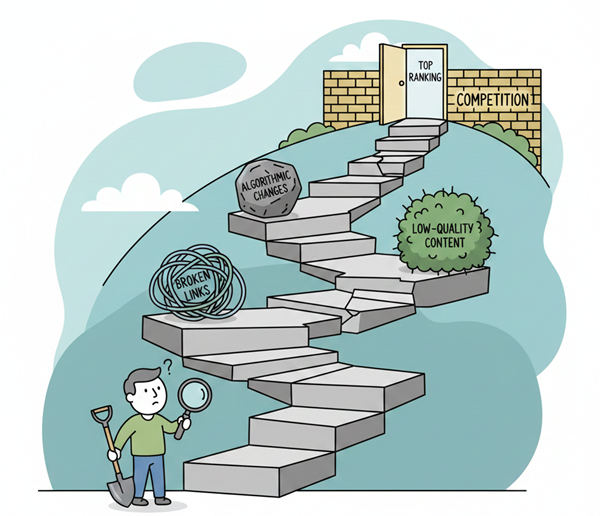
    Manufacturing SEO usually stalls for the same few reasons. These are not surface-level mistakes like missing keywords or weak metadata. They are deeper issues tied to how manufacturers describe their work, structure their sites, and connect SEO with real buying behavior. Until these are fixed, rankings might move, but lead quality won’t.

    Lack Of Clear Capability Definition

    Many manufacturing websites talk about what they do in broad terms, hoping to appeal to everyone. This creates confusion instead of interest.

    • Capability pages often skip over specifics like materials, tolerances, volumes, or constraints. Buyers are left guessing whether you can actually handle their requirements. When there’s doubt, they don’t reach out.

    • SEO also suffers because search engines can’t clearly understand what you specialised in. Pages that lack clarity struggle to rank for meaningful, high-intent searches, which ultimately weakens your ability to support effective link acquisition from authoritative industry sites.

    Clear definition is the foundation. Without it, every SEO effort sits on weak ground.

    Overreliance On Broad, High-Volume Keywords

    Manufacturers are often pushed toward keywords that look impressive in reports but don’t reflect real buying intent.

    • Broad terms attract students, researchers, or early-stage browsers who are not ready to engage a supplier. This inflates traffic but wastes sales time.
    • Meanwhile, specific searches tied to real projects are ignored because their volume looks too low. Those low-volume searches often represent real work and real revenue.

    Chasing volume slows ROI and hides what actually works.

    Content That Avoids Specifics

    Manufacturing content is often written cautiously to avoid errors, but this caution turns into vagueness.

    • Pages repeat safe phrases like quality, precision, and expertise without explaining what they mean in practice. Buyers learn nothing new and feel no confidence.

    • Search engines also struggle to rank content that lacks depth and context. Thin pages blend into the noise instead of standing out.

    Specificity builds trust. Avoiding it weakens both SEO and conversion.

    Complex Sites That Grew Without Structure

    Manufacturing websites tend to evolve over years as new services, industries, and pages are added. Structure rarely keeps up.

    • Important capability pages get buried under layers of navigation. Buyers struggle to find what they’re looking for and leave.

    • Search engines waste time crawling outdated or redundant pages, which reduces visibility for the pages that actually matter.

    Good SEO depends on clean structure, not just good content.

    SEO Disconnected From Sales Reality

    SEO often runs in isolation from sales teams, which limits its effectiveness.

    • Marketing tracks traffic and rankings, while sales judges success by lead quality and closed deals. Without shared metrics, trust breaks down.

    • Valuable insights from sales calls never make it back into content or keyword strategy, so SEO misses real buyer language and concerns.

    When SEO reflects real sales conversations, results improve faster and feel more relevant internally.

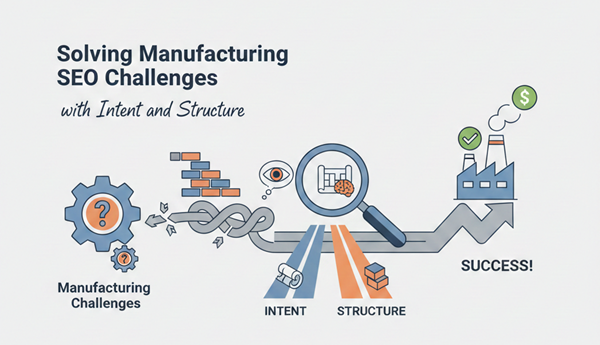
    Solving Manufacturing SEO Challenges with Intent and Structure

    Solving Manufacturing SEO Challenges with Intent and Structure

    Manufacturing SEO improves when it is treated less like a marketing task and more like an operational system. The companies that get results stop reacting to algorithms and start designing their SEO around how decisions are actually made, both internally and by buyers.

    Shift SEO From Visibility Goals To Decision Support

    Many SEO strategies fail because they chase exposure instead of helping buyers decide.

    • Manufacturing buyers use search to reduce risk. They are not looking for inspiration or brand stories. They want confirmation that a supplier understands their problem and can deliver without surprises. When SEO pages are designed to support that decision, rankings become secondary to usefulness.

    • This means prioritising pages that help buyers compare options, understand trade-offs, and assess fit. SEO works faster when pages answer “Should I choose you?” instead of “What do you do?”

    Decision support creates trust, and trust converts better than visibility alone.

    Treat SEO As Part Of Product And Process Communication

    Manufacturing SEO often breaks down because it is disconnected from operations.

    • The strongest SEO content comes from documenting real processes, constraints, and quality controls. When SEO reflects how work actually happens on the floor, it feels credible and hard to copy.

    • Involving operations or engineering in content creation improves accuracy and reduces generic messaging. This also ensures SEO stays aligned as capabilities change.

    SEO becomes more durable when it mirrors internal reality instead of marketing assumptions.

    Use Search Data To Sharpen Positioning

    Search behavior reveals how the market sees you, even when sales conversations lag behind.

    • Patterns in search terms can show which capabilities attract interest and which ones confuse buyers. This insight can guide not just SEO, but broader positioning decisions.

    • Pages that attract the wrong audience are signals, not failures. They highlight mismatches between messaging and market demand.

    Using SEO as feedback helps refine focus instead of spreading effort thin.

    Design For Comparison, Not Just Discovery

    Manufacturing buyers compare suppliers before contacting them. SEO pages should reflect that reality.

    • Instead of isolated service descriptions, content should acknowledge alternatives, limitations, and common decision criteria. This helps buyers feel informed rather than sold to.

    • Pages that address why one approach fits certain projects and not others tend to keep buyers engaged longer and improve contact rates.

    Comparison-friendly content stands out because most competitors avoid it.

    Build Consistency Across Touchpoints

    SEO rarely fails on its own. It fails when it contradicts other signals.

    • Messaging on SEO pages should match sales conversations, proposal language, and how teams talk about capabilities internally. Inconsistency creates doubt.

    • Consistent language and framing across the site, sales materials, and outreach reinforce credibility and reduce friction.

    Consistency turns SEO from a channel into part of the brand experience.

    Conclusion

    Manufacturing SEO does not fail because the industry is difficult. It fails when complexity is ignored. Buyers search with intent, evaluate with skepticism, and decide based on clarity and trust. When SEO reflects that reality, it stops being a slow burn and starts becoming a strategic asset.

    Overcoming common SEO challenges requires discipline, honesty, and patience. The reward is visibility that competitors struggle to replicate and leads that arrive better informed and easier to close.